Rare Vintage, Antiques and Art Collector / Curator / Personal Shopper From Japan
The Real McCoy’s A-2 Little Bitch Custom Flight Jacket One-Off Hand Painted Horsehide Pin Up Art Size 36
The Real McCoy’s A-2 Little Bitch Custom Flight Jacket One-Off Hand Painted Horsehide Pin Up Art Size 36
Couldn't load pickup availability
Have a reasonable price in mind? Submit your best offer and our concierge will review it personally.
THE REAL McCOY’S
A ONE-OFF CUSTOM A-2 FLIGHT JACKET, ‘LITTLE BITCH’
HORSEHIDE, HAND-PAINTED PIN-UP BACK PANEL, BOMB TALLY MOTIF, WITH WHISTLE ACCESSORY
The present jacket is a compelling example of how the iconic A-2 flight jacket continues to function as a site of reinterpretation, desire, and mythmaking long after its original military context. Constructed on a Real McCoy’s horsehide base and transformed through a one-off custom program, it draws on the enduring visual language of wartime nose art, combining a boldly painted pin-up figure, bomb tally motifs, and avian symbolism in a composition of notable theatrical force.
What distinguishes the piece is the harmony between base garment and embellishment. The dark horsehide shell provides sufficient gravitas and depth for the artwork to read as integral rather than applied, while the rear composition retains the swagger and emotional voltage associated with vintage aviation graphics. The result is a jacket that operates simultaneously as a premium reproduction garment and as a singular collector’s object.
Such works occupy a particularly desirable niche within the wider market for military-inspired leatherwear, appealing not only to enthusiasts of Japanese reproduction culture but also to collectors of bespoke outerwear, archive fashion, and visually distinctive crossover pieces. In this instance, the jacket’s rarity lies not simply in limited availability, but in the irreproducible nature of its custom identity, which grants it a presence beyond that of ordinary production examples.
Object Type: Custom A-2 flight jacket
Base Maker: The Real McCoy’s
Customization: One-off / one-of-one full custom presentation
Theme Name: “Little Bitch”
Material: Horsehide leather shell
Color: Deep seal-to-blackened brown leather with brown knit waist and cuffs
Artwork Type: Hand-painted / custom-applied pin-up and bomb tally composition across back panel
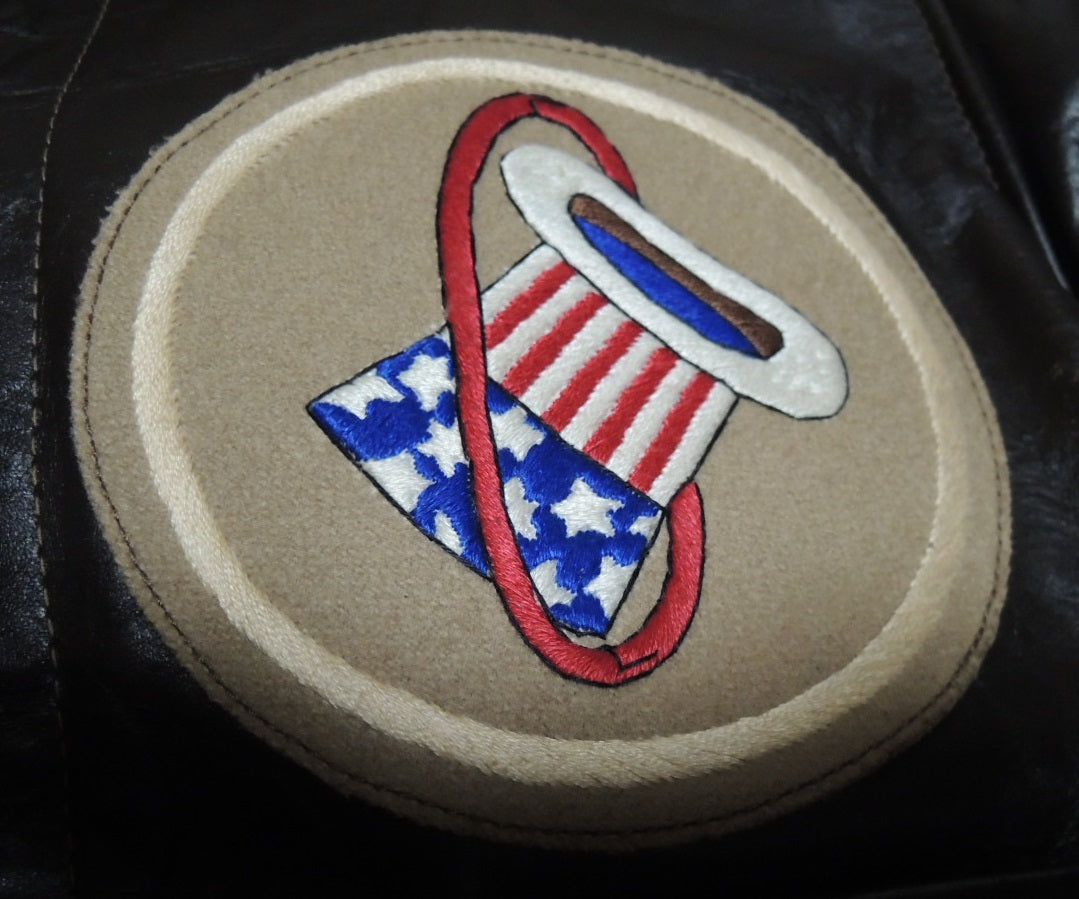
Front Graphics: Chest patch, military-inspired insignia, custom presentation details
Interior Detail: American flag panel at lining
Hardware: Talon zipper, whistle accessory included
Size Marked: 36
Approx. Measurements Provided: Shoulder 42 cm / Body width 48 cm / Sleeve 61 cm / Length 59 cm
Condition Notes: Tag partially cut, described as second-quality example; knit fraying and stitch loosening noted; general handling and age-present surface character
Collector Classification: One-off Japanese custom A-2 with pin-up nose art language and boutique repro foundation
Era of Inspiration: WWII American flight-jacket art tradition reinterpreted through high-end Japanese reproduction culture
One-off custom example with theatrical display value
Pin-up nose-art composition with unusually coherent visual balance
Collector-grade Japanese reproduction base elevated into art-object territory
Strong crossover appeal for military, leather, and archive-fashion collectors
Overview
This jacket lives in the charged territory where military reproduction stops being mere historical reenactment and becomes something far more seductive: a deliberate act of myth-building. At its core, it is an A-2, the most recognizable leather flight jacket silhouette ever canonized into menswear memory. Yet this example refuses to stay in the safe museum lane of contract labels and pattern minutiae alone. It steps into a hotter zone, one shaped by pin-up fantasy, bomb tally symbolism, nose-art language, and the enduring appetite collectors have for objects that feel less like garments and more like portable relics of cinematic wartime imagination.
Built on a Real McCoy’s foundation, the jacket already begins from serious ground. That matters. A weak base would make the customization feel theatrical in a disposable way. A McCoy’s base gives the object weight, authority, and credibility before the eye even reaches the painted composition. The leather carries the sheen, density, and visual body necessary for a custom narrative to feel embedded rather than applied. That structural seriousness is what allows the entire piece to work.
And work it does. The back presentation is not timid. It is declarative. The “Little Bitch” title, the seated red-haired pin-up, the bomb tally marks, and the striking swallow motif give the jacket the exact kind of electricity that made wartime aircrew-decorated garments so mythic in the first place. The difference is that this is not an exhausted copy of a known original. It is a new archive object created in conversation with that tradition, then elevated by Japanese reproduction culture into something both collectible and performative.
This is what makes the piece compelling. It is not simply a jacket with art on it. It is an interpretive artifact, built to satisfy the collector who wants the silhouette of history and the drama of legend in the same frame.
Iconography
The iconography is the heart of the object, and here it is unusually well balanced between sensuality, aggression, humor, and formal restraint.
The pin-up figure dominates the back without overwhelming it. She is seated, languid, bright against the deep leather field, and framed in a way that recalls classic WWII-era nose-art composition without descending into clutter. Her pale body and vivid hair create a dramatic contrast against the dark shell, while the painted title above gives the scene its name and attitude. The title “Little Bitch” is deliberately provocative, but in the context of vintage aviation art language it reads as period-coded swagger rather than random vulgarity. It is part of the grammar of wartime bravado, where superstition, flirtation, and gallows humor often collapsed into a single painted surface.
Below her, the bomb tally marks add rhythm and menace. They break the composition into a military scorecard, hinting at mission count, impact, repetition, survival. They are small, but psychologically powerful. They transform the pin-up from decorative figure into participant in a martial narrative.
Then there is the swallow. This is one of the most effective details in the entire composition. The bird introduces motion, a flash of color, and a contrasting symbolic register. Where the bombs speak of destruction and count, the swallow suggests speed, return, instinct, omen, and flight itself. It creates a miniature emotional chord within the scene: seduction above, violence beside, velocity below.
The front continues the language more quietly, which is the correct choice. Rather than crowd the chest with competing graphics, the jacket uses a more controlled military-custom vocabulary: insignia, patching, selected visual anchors, and the deeply satisfying sense that the back remains the revelation panel. That theatrical asymmetry is exactly right for a piece like this.
Material
Custom jackets live or die by whether the base material has enough charisma to support the narrative laid onto it. This one does more than support it. It amplifies it.
The horsehide shell appears dense, lustrous, and visually rich, with the kind of dark brown surface that can read almost black in certain light. That tonal depth is a gift for custom artwork because it allows painted elements to emerge dramatically without making the leather itself feel secondary. The shell remains the stage. The painting performs on top of it. Neither cancels the other.
This is important because many custom jackets end up feeling split in half: there is the jacket, and then there is the art. Here the two feel integrated. The leather’s natural reflectivity, creasing, and tonal variation become part of the composition. Light drifts across the back panel, making the pin-up and script feel alive rather than static.
The knit elements, while showing wear and fray, also contribute to the atmosphere. On a sterile luxury object, pristine knits might be ideal. On a piece like this, a degree of texture and lived-in edge actually strengthens the illusion that the jacket belongs to a deeper visual world. The knits ground the object. They remind the eye that this remains a flight-jacket form first and an art surface second.
The interior flag detail is another strong collector flourish. It is not necessary for the jacket to function. Which is precisely why it matters. It signals that the maker or commissioner thought not only about exterior display, but about the hidden theater of ownership. That is the kind of detail collectors remember.
Maker Significance
The Real McCoy’s carries weight because it occupies one of the upper tiers of Japanese reproduction culture, where military garments are approached not as costumes but as devotional objects. Construction, material selection, pattern fidelity, finish behavior, and historical language all receive unusually serious treatment. That reputation creates the foundation for trust.
But the jacket’s importance does not stop with the maker label. In fact, the maker is only half the story.
The other half is transformation.
A one-off or one-of-one custom built on a McCoy’s base enters a different category from standard release product. It moves from collectible garment into authored object. Once that threshold is crossed, strict comparables become less useful. No two examples have equal narrative heat. Some customs feel forced. Some feel cheap. Some feel conceptually loud but materially weak. This one avoids those traps because the base is serious and the visual composition is coherent.
That coherence is what gives the piece collectible authority. Not simply brand. Not simply artwork. But the fit between the two.
There is also something particularly Japanese about this sort of object. American wartime leather jackets were once personalized as expressions of mission, fear, ego, memory, and esprit de corps. Japanese reproduction culture, decades later, learned how to preserve the material language of those jackets with almost forensic care, and then, in selected cases like this, learned how to push them beyond preservation into curation and reinvention. That second move is where pieces like this become irresistible.
Historical Context
The A-2 occupies a strange and extraordinary place in cultural memory. It began as military issue, but it did not stay there. It became cinema, mythology, costume, aspiration, fetish object, archive material, and eventually a kind of secular relic. Every generation that rediscovers the A-2 also rewrites it slightly. Pilots personalized them. Hollywood glamourized them. Japanese makers purified them. Collectors elevated them into talismans.
This example belongs to that later chapter: the chapter where the A-2 is no longer simply reproduced, but actively authored.
Its pin-up language is central to that. The pin-up is not random nostalgia. It is one of the key emotional devices of wartime graphic culture. It condensed longing, irreverence, morale, sexuality, superstition, and luck into a single symbolic figure. On jackets, nose cones, and aircraft, these women were never merely decorative. They were mascots of survival and attitude, soft power painted onto hard machinery.
The bomb tally marks also matter in this historical grammar. They are both literal and theatrical. They create narrative count. They imply repetition and action. They turn the jacket from “beautiful image” into “evidence of legend.”
Yet this is not a period original. It is something arguably more nuanced: a modern object that understands the semiotics of the original and rebuilds them in premium leather form. That makes it a valuable object not just within military repro culture, but within the wider history of how wartime symbolism gets remembered, stylized, and desired.
Collector Relevance
This piece is unusually strong because it speaks fluently to multiple collector tribes at once.
For Real McCoy’s collectors, it offers a premium base plus a singular custom identity that cannot be duplicated by off-the-rack contract reissues.
For A-2 enthusiasts, it preserves the essential silhouette, pocketing, and military gravitas while adding a dramatic visual field that deepens rather than trivializes the jacket.
For pin-up and nose-art collectors, it delivers exactly what so many modern customs fail to deliver: not just image, but proper emotional register. The back feels period-aware, not cartoonish.
For Japanese archive-fashion buyers, the appeal lies in crossover tension. This is military clothing, art object, display piece, and luxury reproduction at once.
For one-off hunters, the argument is obvious. There is no true substitute. Once this exact jacket is gone, only echoes remain.
That last point matters most. In the high end of collectible outerwear, true scarcity is not merely low production. It is non-repeatability. A limited-edition jacket can be found again. A one-off with strong graphic identity has a much narrower orbit. That scarcity tends to intensify over time because collectors do not simply buy such pieces to wear them out. They buy them to hold them, remember them, and benchmark other jackets against them.
Condition Positioning
The condition profile should be framed with confidence and honesty. This is not a sterile deadstock object. Nor should it be sold as though it were. The real story is better than that.
The jacket presents with visible wear at the knits, some stitch loosening, and a partially cut tag consistent with second-quality designation. These details matter for transparency, but they do not collapse the object. The leather still presents with rich depth and strong visual command. The back artwork remains the gravitational center. The front remains handsome and well balanced. The overall silhouette still holds its authority.
That means the correct language is not “perfect” or “mint.” The correct language is:
strong-display, collector-owned, materially substantial, visually resolved, and atmospherically seasoned.
That is the honest and desirable frame. It acknowledges imperfection while preserving the object’s magnetism.
Summary
This is a Real McCoy’s A-2 transformed into a one-off nose-art leather object with real collector voltage. The horsehide base gives it credibility. The pin-up composition gives it drama. The bomb tally and swallow details give it rhythm. The interior flag detail and whistle accessory add the sort of eccentric finishing notes that serious collectors tend to love.
It is not merely a reproduction.
It is not merely an art jacket.
It is not merely a military-style leather piece.
It is all three, locked into one object with enough coherence to feel complete.
This is the type of jacket that does not just sit in a wardrobe. It anchors a rack. It is the piece that changes the temperature of everything around it.
Authenticity & Stewardship
Evaluated under the Japonista Aviation & Military Garment Authentication Framework™
Each work is examined through a structured, multi-layered assessment:
• Model classification and military typology verification (A-2, B-3, MA-1, G-1, L-2, etc.)
• Material evaluation across leather, shearling, nylon, wool, and mixed components
• Hardware inspection including zippers, snaps, and period-correct fastenings
• Graphic and nose art analysis, including paint method, iconography, and historical alignment
• Condition and structural integrity review, including wear patterns consistent with age and use
Where applicable, contract labels, manufacturer markings, and period construction details are reviewed to confirm authenticity and era alignment.
Guaranteed 100% Authentic.
All garments are curated and backed by the Japonista Lifetime Authenticity Warranty™, with emphasis on both material truth and historical accuracy.
A Note on Flight Jackets, Service & Visual Identity
Military flight jackets were engineered as functional equipment—designed for temperature regulation, durability, and survival in demanding conditions. Over time, they evolved into carriers of identity, memory, and personal expression.
Nose art and painted jackets—originally applied to aircraft and later to garments—represent a distinct form of visual folklore. Pin-up figures, squadron insignia, mascots, and symbolic imagery transformed standard-issue equipment into individualized statements of presence and morale.
At Japonista, these jackets are approached as wearable military artifacts. Surface wear, leather creasing, paint aging, and textile fatigue are evaluated as evidence of lived history rather than imperfection.
We preserve these works with restraint—allowing their material narrative to remain visible and intact.
Our role is to connect these garments with collectors who recognize their dual nature as both functional objects and historical documents.
Inquiries, Availability, and Private Consideration
Many flight jackets are singular in character due to condition, paintwork, contract variation, or production era. Certain pieces are held firmly due to rarity, historical resonance, or preservation status.
All inquiries are handled discreetly, and we welcome thoughtful discussion regarding provenance, contract details, nose art interpretation, and long-term wear or display considerations.
Collectors building focused archives—by model type, era, or graphic style—may consult with us for deeper guidance.
Concierge Support & Collector Guidance
Japonista Concierge™ provides tailored assistance for collectors seeking deeper engagement with aviation garments:
• Model and contract identification (A-2 variants, G-1 lineage, MA-1 evolution)
• Leather and textile preservation guidance
• Paint conservation and display considerations
• Wearability versus archival preservation assessment
• Strategic acquisition planning for aviation-focused collections
For select rare or historically significant works, private reservation or structured acquisition arrangements may be available on a case-by-case basis.
Before Proceeding
We encourage collectors to review our shop policies and house guidelines, available through the links in our website footer. These outline shipping protocols, handling considerations, and condition standards specific to vintage leather, painted garments, and military-issued clothing.
Understanding these guidelines supports responsible stewardship of each piece.
A Closing Note
Flight jackets occupy a distinct place within material history. They are objects of function shaped by environment, and over time, transformed into records of identity, service, and expression.
Nose art—whether applied to aircraft or garments—extends this narrative, capturing moments of humor, defiance, and individuality within structured military life.
At Japonista, we steward these works as aviation artifacts in wearable form—ensuring they continue their journey with collectors who understand both their construction and their story.
If you have questions or wish to explore related items, please feel free to contact Japonista Concierge™ at any time.