Rare Vintage, Antiques and Art Collector / Curator / Personal Shopper From Japan
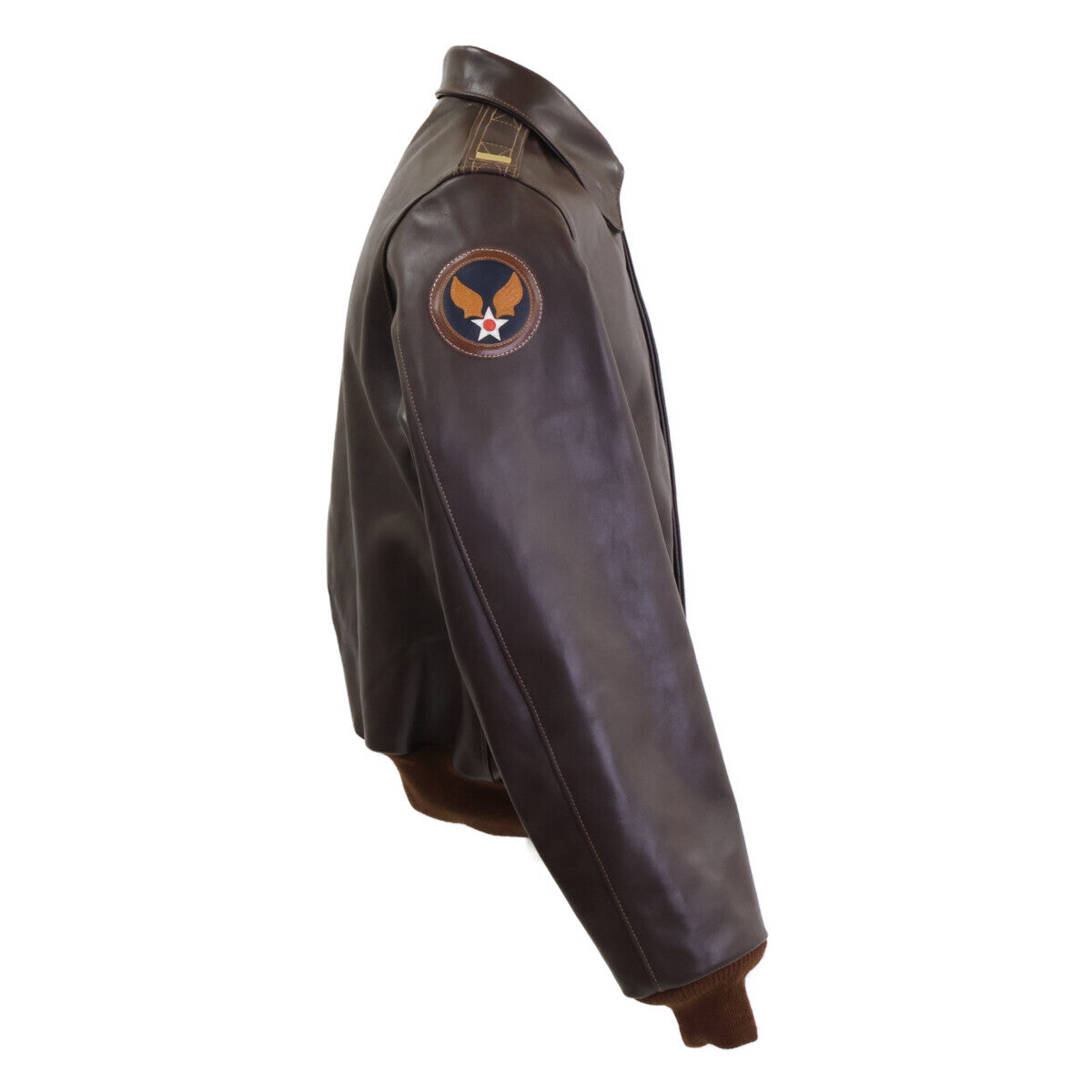
The Few J.A. Dubow A-2 Flight Jacket Horsehide Size 40 30-1415 Custom Patch Japan
Couldn't load pickup availability
Have a reasonable price in mind? Submit your best offer and our concierge will review it personally.
A THE FEW HORSEHIDE TYPE A-2 FLIGHT JACKET AFTER J.A. DUBOW, SIZE 40
Japanese contract-minded reproduction with restrained custom chest decoration and localized waistband knit damage
A horsehide A-2 flight jacket by The Few, produced in homage to the J.A. Dubow contract lineage and cut in the classic short-waist military aviation silhouette with snap-down collar, front patch pockets, and wool knit trim. The jacket is decorated with a restrained leather name strip and circular chest patch, adding a measured service-inspired character without overwhelming the formal clarity of the A-2 pattern. The shell remains visually strong and disciplined, while the principal condition issue is localized moth damage to the rear waistband knit. The present example is best understood as a serious Japanese contract reproduction whose appeal lies in fidelity of form, quality of material, and the controlled intelligence of its customization.
Object
The Few J.A. Dubow A-2 Flight Jacket 30-1415 / W33-038 custom king flight jacket
Brand / Maker
The Few
Contract / Pattern Reference
J.A. Dubow Mfg. Co.
Type A-2
Drawing No. 30-1415
W33-038 contract reproduction language
Production Era
Modern Japanese heritage / contract-obsessed reproduction period
Category
High-grade Japanese A-2 contract reproduction with restrained custom service-style decoration
Material
Horsehide shell
Wool rib knit cuffs and waistband
Cotton lining in rust-brown / brick-toned field
A-2 spec silhouette with reproduction contract labeling
Style Basis
WWII U.S. Army Air Forces A-2 flight jacket pattern:
- snap-down collar
- front patch pockets with scalloped flaps
- zip front
- short-waist military aviation silhouette
- knit cuffs and waistband
Color
Dark brown
Custom / Surface Context
Front:
- leather name strip at upper chest
- round custom squadron / cartoon-style chest patch at left chest
Back:
- plain back, allowing the jacket to remain closer to contract silhouette discipline than full theatrical art pieces
Size
40
Measured Fit
Shoulder: 43 cm
Length: 60 cm
Chest: 53 cm
Sleeve: 68 cm
Condition Summary
Outer: B rank
Inner: B rank
General light use-consistent handling
No notable heavy wear from actual use stated
Most important flaw is moth damage / insect bite trace at rear waistband knit
Interior material label absent
Overall shell reads clean, controlled, and structurally strong
Object Classification
Not original wartime issue
Not a loud art-jacket reconstruction
A serious contract-minded Japanese A-2 repro with controlled custom character
COLLECTOR RELEVANCE
Tier: Upper-Tier Japanese Contract Reproduction / Smart Buy Category
This piece is for:
- The Few collectors
- A-2 reproduction purists who still welcome restrained personalization
- horsehide-jacket buyers
- collectors seeking contract seriousness without full tribute theatrics
- wearer-collectors who value silhouette discipline
This piece is not for:
- buyers who want untouched mint condition
- collectors who cannot tolerate knit damage
- those looking for full back-art drama or overt tribute spectacle
This is for the buyer who understands that a good repro does not need to shout if the pattern and shell already know what they are doing.
CURATORIAL ANALYSIS
A Contract Reproduction First, a Custom Piece Second
This is the key to reading the jacket correctly.
Many modern A-2 custom pieces begin with graphics and only secondarily care about contract discipline. This one works the other way around. The silhouette, hide choice, and Dubow reference are doing the foundational work first. Only after that does the jacket introduce a restrained layer of personalization through the chest patch and name strip.
That order matters.
Because of it, the jacket does not drift into costume. It remains anchored in the serious Japanese contract-reproduction tradition, where the point is not just to imitate wartime jackets, but to reconstruct their body language convincingly enough that even small custom additions still feel plausible.
Why The Few Matters
The Few sits in a respected niche for a reason. It is one of the makers that understands that reproduction quality is not only about copying dimensions. It is about:
- hide character
- stance
- seam discipline
- correct emotional proportion
- how a jacket occupies air when worn
The best A-2 reproductions do not merely look “similar” to originals. They capture the pressure of the original shape. That is where better Japanese makers separate themselves from ordinary repro brands, and that is where The Few earns its reputation.
J.A. Dubow Reference and What It Signals
The Dubow reference is not incidental. Collectors know that contractor identity carries different silhouette implications, and even where modern makers blend fidelity with their own production realities, invoking Dubow means the jacket is entering a more serious historical conversation. It signals that the piece is not generic “A-2 style.” It is contract-conscious.
That alone improves the collector floor.
It tells the buyer:
this garment expects to be judged by higher standards.
Horsehide and the Weight of the Shell
Horsehide still matters in this category, not because it magically makes every jacket better, but because on a contract-minded A-2 it often contributes the right sort of tensile crispness and depth. Here, the dark-brown shell reads controlled, even, and relatively clean. It does not look over-distressed or theatrically “aged.” That is good. The jacket is strongest when it behaves as a disciplined A-2 with just enough surface life to feel substantial.
This is not a shell screaming for attention.
It is a shell holding rank.
That is usually a better place to be.
The Value of Restraint in the Custom Work
The patch and name strip are well judged because they do not overwhelm the garment. This is important. Once custom work dominates a reproduction too strongly, the jacket risks becoming locked into one narrow fantasy. Here, the front remains balanced:
- one circular patch
- one name strip
- no excessive body clutter
- no back illustration forcing the piece into theatrical display mode
That gives the buyer more ways to wear and appreciate it. It stays closer to military-language subtlety than many tribute jackets do.
In commercial terms, restraint improves liquidity.
Why the Plain Back Helps
The plain back is not absence. It is discipline.
It keeps the jacket within the proper A-2 tradition and allows the shell to do its work. On many custom jackets the back becomes the billboard. Here, by refusing that move, the piece stays more contract-oriented and more elegant. That will appeal to the buyer who wants just enough service flavor without losing the seriousness of the pattern.
It also means the jacket can function more convincingly in daily wear rather than becoming occasion-only outerwear.
The Rear Waistband Moth Damage: A Real Deduction, but a Contained One
This is the biggest issue, and it should be handled directly. Moth or insect damage to the rear waistband knit is a genuine condition deduction because knits are not trivial on an A-2. The waistband is one of the lines that gives the jacket its authority. Damage there interrupts purity, preservation, and future confidence.
But the good news is that the damage appears localized rather than identity-destroying. It does not erase the value of the shell, the maker, the pattern, or the overall visual strength. It simply keeps the jacket from rising into a cleaner premium band.
That is an important distinction:
it reduces the ceiling,
but does not collapse the floor.
MATERIAL FORENSICS
Shell
The horsehide shell is one of the jacket’s major strengths. It presents with good tonal consistency and enough depth to feel substantial without relying on fake drama. The body line remains strong and the pockets hold their shape correctly.
Points that matter:
- shell appears structurally stable
- collar and pocket lines remain crisp
- no obvious heavy collapse or over-softening
- leather still carries the dignity of a serious contract repro
Knits
The cuffs appear generally sound, while the rear waistband knit is the major flaw due to moth damage. This is the central condition point and the main reason the jacket remains in a lower-value band than a cleaner example.
Lining
The rust-toned lining presents attractively and helps reinforce the traditional A-2 visual language. The absence of an interior material label matters slightly, but much less than the overall structural integrity of the interior.
Patch and Name Strip
The patch and strip are well integrated and do not look visually disruptive. Their placement respects the jacket rather than fighting it, which is exactly what stronger custom repros should do.
Authenticity & Stewardship
Evaluated under the Japonista Aviation & Military Garment Authentication Framework™
Each work is examined through a structured, multi-layered assessment:
• Model classification and military typology verification (A-2, B-3, MA-1, G-1, L-2, etc.)
• Material evaluation across leather, shearling, nylon, wool, and mixed components
• Hardware inspection including zippers, snaps, and period-correct fastenings
• Graphic and nose art analysis, including paint method, iconography, and historical alignment
• Condition and structural integrity review, including wear patterns consistent with age and use
Where applicable, contract labels, manufacturer markings, and period construction details are reviewed to confirm authenticity and era alignment.
Guaranteed 100% Authentic.
All garments are curated and backed by the Japonista Lifetime Authenticity Warranty™, with emphasis on both material truth and historical accuracy.
A Note on Flight Jackets, Service & Visual Identity
Military flight jackets were engineered as functional equipment—designed for temperature regulation, durability, and survival in demanding conditions. Over time, they evolved into carriers of identity, memory, and personal expression.
Nose art and painted jackets—originally applied to aircraft and later to garments—represent a distinct form of visual folklore. Pin-up figures, squadron insignia, mascots, and symbolic imagery transformed standard-issue equipment into individualized statements of presence and morale.
At Japonista, these jackets are approached as wearable military artifacts. Surface wear, leather creasing, paint aging, and textile fatigue are evaluated as evidence of lived history rather than imperfection.
We preserve these works with restraint—allowing their material narrative to remain visible and intact.
Our role is to connect these garments with collectors who recognize their dual nature as both functional objects and historical documents.
Inquiries, Availability, and Private Consideration
Many flight jackets are singular in character due to condition, paintwork, contract variation, or production era. Certain pieces are held firmly due to rarity, historical resonance, or preservation status.
All inquiries are handled discreetly, and we welcome thoughtful discussion regarding provenance, contract details, nose art interpretation, and long-term wear or display considerations.
Collectors building focused archives—by model type, era, or graphic style—may consult with us for deeper guidance.
Concierge Support & Collector Guidance
Japonista Concierge™ provides tailored assistance for collectors seeking deeper engagement with aviation garments:
• Model and contract identification (A-2 variants, G-1 lineage, MA-1 evolution)
• Leather and textile preservation guidance
• Paint conservation and display considerations
• Wearability versus archival preservation assessment
• Strategic acquisition planning for aviation-focused collections
For select rare or historically significant works, private reservation or structured acquisition arrangements may be available on a case-by-case basis.
Before Proceeding
We encourage collectors to review our shop policies and house guidelines, available through the links in our website footer. These outline shipping protocols, handling considerations, and condition standards specific to vintage leather, painted garments, and military-issued clothing.
Understanding these guidelines supports responsible stewardship of each piece.
A Closing Note
Flight jackets occupy a distinct place within material history. They are objects of function shaped by environment, and over time, transformed into records of identity, service, and expression.
Nose art—whether applied to aircraft or garments—extends this narrative, capturing moments of humor, defiance, and individuality within structured military life.
At Japonista, we steward these works as aviation artifacts in wearable form—ensuring they continue their journey with collectors who understand both their construction and their story.
If you have questions or wish to explore related items, please feel free to contact Japonista Concierge™ at any time.