Rare Vintage, Antiques and Art Collector / Curator / Personal Shopper From Japan
Tetsujin 28 No.3 Battery Operated Tin Robot with Box – Nomura Japan Showa Era Classic
Tetsujin 28 No.3 Battery Operated Tin Robot with Box – Nomura Japan Showa Era Classic
Couldn't load pickup availability
Have a reasonable price in mind? Submit your best offer and our concierge will review it personally.
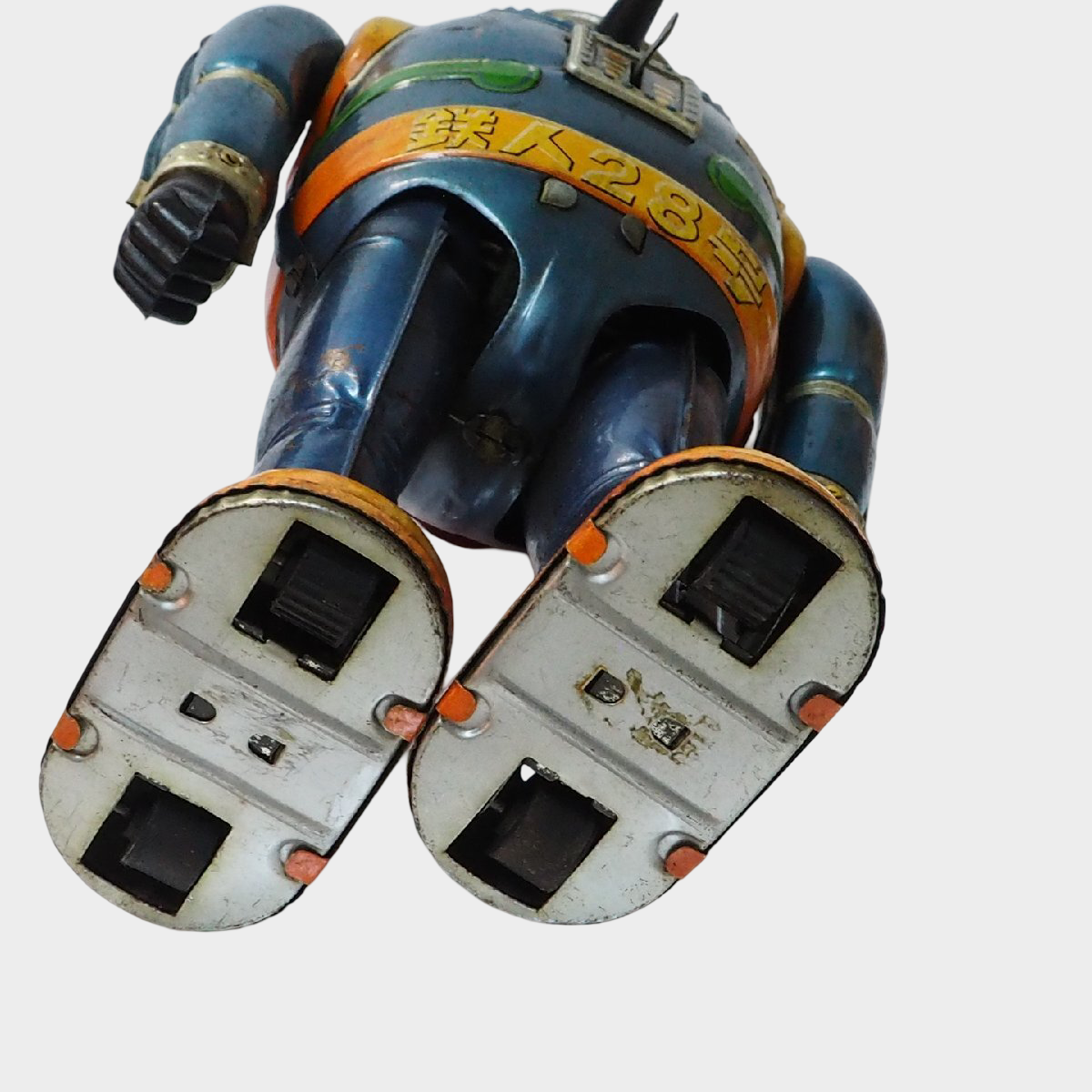
This is a Tetsujin 28 No.3 battery-operated tin robot, manufactured by Nomura during the peak Showa robot production years. The form is immediately recognizable: rounded helmet head, broad cylindrical torso, simplified mechanical chest panel, and thick articulated limbs designed for forward walking motion.
The presence of the original illustrated box elevates this piece into a higher archival tier. Even with age wear, the box preserves the visual language that defined early Japanese robot culture: urban nightscapes, looming scale, and the sense that technology itself had become a character.
Paint application remains consistent with mid-period Nomura output: matte blue body, contrasting yellow accents, and bold chest insignia. Surface wear is present and honest, aligning with age and use, but the robot retains strong visual integrity and shelf authority.
WHO IS TETSUJIN 28 — AND WHY THIS ROBOT MATTERS
Tetsujin 28 is not merely a character. He is the origin point of Japanese giant robot culture.
Created by Mitsuteru Yokoyama in 1956, Tetsujin 28 predates piloted robots, super robots, and mecha teams. He is a remote-controlled giant machine, originally built as a wartime weapon and later operated by a child controller. This concept shaped the emotional core of robot storytelling: power without maturity, responsibility without consent.
In anime history, Tetsujin 28 stands as:
-
the first giant robot protagonist
-
the foundation for later works such as Mazinger Z, Getter Robo, and Gundam
-
the symbolic bridge between postwar trauma and technological optimism
Unlike later heroic robots, Tetsujin is morally neutral. He does not choose. He obeys. That ambiguity is why early collectors and historians treat Tetsujin artifacts with exceptional seriousness.
PLACEMENT IN ANIME & TOY HISTORY
This robot belongs to the pre-super-robot era, when tin toys were not merchandise extensions but parallel cultural objects. The toy and the manga evolved together.
Compared to later robots:
-
Mazinger Z = piloted, heroic, adult power fantasy
-
Tetsujin 28 = remote, dangerous, child-controlled, morally complex
That difference is crucial. It explains why early Tetsujin toys often feel heavier, simpler, and more imposing. They were not playful mascots. They were machines.
Nomura’s No.3 configuration reflects this philosophy: thick proportions, minimal decoration, emphasis on mass and movement rather than expression.
MANUFACTURER CONTEXT — NOMURA
Nomura was one of the core pillars of Japanese tin toy production. Their robots are known for:
-
bold silhouettes
-
reliable battery or wind-up engineering
-
conservative but durable paint schemes
Nomura robots consistently command higher long-term stability compared to novelty makers, especially when paired with original packaging.
Within Nomura’s robot lineup, Tetsujin variants outperform generic space robots and animal mecha due to direct media lineage and historical first-mover status.
CONDITION & TECHNICAL NOTES
-
Battery-operated walking mechanism
-
Period-correct construction and scale
-
Box present with visible age wear consistent with Showa paper stock
-
Paint wear, scuffs, and patina aligned with authentic age
-
Structural form remains intact and display-worthy
This is not a restored or modernized piece. It reads as an honest survivor.
COLLECTOR POSITIONING
This piece sits in the same conversation as:
-
early box-included Tetsujin variants
-
first-generation robot icons
-
museum-referenced Showa mechanical artifacts
It appeals to:
-
serious robot collectors
-
anime historians
-
postwar Japanese design collectors
-
buyers exiting soft vinyl into tin robotics
TETSUJIN 28-GO: NO.1 vs NO.2 vs NO.3
Early Showa Tin Robot Lineage Explained
(Foundational context: Tetsujin 28-go)
Tetsujin 28-go is not just another robot character — it is the origin point of Japanese giant robot culture. The early Nomura tin series captures this moment before the genre split into super robot and real robot, when robots were still framed as autonomous weapons controlled remotely.
Within that lineage, No.1, No.2, and No.3 are not revisions — they are philosophical and industrial stages.
NO.1 — THE PROTOTYPE ICON
Identity
-
Earliest mass-market physical interpretation
-
Closest to manga-era conception
-
Most primitive mechanically and visually
Design Language
-
Simplest body geometry
-
Heavy, rounded torso
-
Minimal surface decoration
-
Often darker or muted finishes
-
Feels closer to a “weapon” than a character
Cultural Meaning
No.1 represents postwar anxiety made metal.
This is Tetsujin before nostalgia, before merchandising logic — a blunt embodiment of power without personality.
Collector Read
-
Rarest and most historically charged
-
Appeals to advanced, museum-grade collectors
-
Less visually playful, more austere
-
Often prized even in rough condition
Positioning Summary
Archaeological artifact of Japanese mecha history.
NO.2 — THE INDUSTRIAL STANDARD (SILVER ERA)
Identity
-
Transitional form
-
Most “machine-forward” version
-
Peak industrial aesthetic
Design Language
-
Cleaner symmetry
-
Refined proportions
-
Expanded chest panel detailing
-
Silver or muted metallic finishes dominate
-
Walking mechanism more emphasized
Why Silver Matters
Silver No.2 examples read as prototype machinery, not toys.
They visually align with early Showa visions of automation, factories, and remote warfare.
Cultural Meaning
No.2 is where Tetsujin becomes recognizable, but not yet friendly.
This is the robot as infrastructure — controlled, powerful, emotionally distant.
Collector Read
-
Strong demand from serious collectors
-
Silver variants command a premium
-
Ideal centerpiece for a focused robot display
-
Highly respected even without box
Positioning Summary
The purest expression of Tetsujin as a machine.
NO.3 — THE ICONIC HERO FORM
Identity
-
Most widely recognized version
-
Peak popularity model
-
Bridge between weapon and hero
Design Language
-
More expressive silhouette
-
Brighter accents
-
Bolder chest graphics
-
Slightly more animated posture
-
Strong shelf presence
Cultural Meaning
No.3 marks the moment when Tetsujin enters collective memory.
This is the version most people picture when they hear the name.
It represents the softening of postwar fear into adventure and nostalgia.
Collector Read
-
Broadest market appeal
-
Strong crossover between casual and advanced collectors
-
Boxed examples reach top-tier pricing
-
Ideal anchor piece for mixed collections
Positioning Summary
The canonical image of Tetsujin in popular culture.
SIDE-BY-SIDE COLLECTOR COMPARISON
| Variant | Core Identity | Visual Tone | Rarity | Market Strength |
|---|---|---|---|---|
| No.1 | Prototype weapon | Austere, raw | Very high | Institutional |
| No.2 | Industrial machine | Silver, mechanical | High | Strong, serious |
| No.3 | Cultural hero | Expressive, iconic | Moderate | Broad, liquid |
HOW THIS AFFECTS PRICING & NARRATIVE
-
No.1: priced for rarity and historical weight
-
No.2 (silver): priced for design purity and collector respect
-
No.3: priced for recognition and nostalgia liquidity
Silver No.2 pieces sit in a sweet spot:
-
Less common
-
More serious
-
More visually timeless
-
Less dependent on box condition for legitimacy
FINAL CURATOR NOTE
If No.1 is the birth, and No.3 is the memory,
then No.2 is the moment of truth — when Tetsujin fully becomes a machine worth fearing, studying, and preserving.
This is why silver No.2 examples consistently outperform expectations when presented with the correct narrative.
Authenticity & Stewardship
Evaluated under the Japonista Authentication Framework™:
- Material, carving, and surface-study comparison
- Iconographic and stylistic verification
- Condition and stability review (surface integrity)
- Construction assessment and handling-risk evaluation
Guaranteed 100% Authentic. Covered by the Japonista Lifetime Authenticity Warranty™.
A Note on Stewardship and Collecting
At Japonista, we approach Buddhist statues, sacred images, and ritual objects not merely as collectibles, but as cultural and spiritual artifacts deserving of respect, understanding, and careful presentation. Every piece we offer is thoughtfully examined, researched, and curated with sensitivity to its origin, meaning, and historical role.
Our role is not only to offer access to rare and meaningful objects, but to serve as responsible custodians—connecting the right works with collectors who value depth, intention, and authenticity.
Inquiries, Availability, and Private Consideration
Some of the cultural and heritage works may allow room for discussion, while others are held firmly due to rarity, condition, or cultural importance. All inquiries are reviewed personally and discreetly, and we welcome thoughtful questions or expressions of interest.
If you are exploring a particular theme, deity, lineage, or period—or seeking guidance in building a focused collection—our concierge team is always available to assist with quiet expertise and care.
Concierge Support & Collector Guidance
Japonista Concierge™ provides personalized assistance for collectors seeking deeper understanding, thoughtful acquisition, or long-term curation strategies. Whether your interest is devotional, scholarly, or aesthetic, we are here to help guide your journey with clarity and respect.
For select high-value or historically significant works, private reservation or structured payment arrangements may be available on a case-by-case basis. Please reach out to discuss eligibility and discreet options.
Before Proceeding
We kindly encourage collectors to review our shop policies and house guidelines, available through the links in our website footer, which outline shipping, handling, and conditions specific to vintage, sacred, and collectible works.
A Closing Note
Thank you for exploring Japonista’s collection of Oriental Cultural Heritage and arts. We are honored to share these meaningful works and to help place them where they may continue to be appreciated, studied, and respected.
If you have questions or wish to explore related works, please feel free to contact Japonista Concierge™ at any time.