Rare Vintage, Antiques and Art Collector / Curator / Personal Shopper From Japan
TET Japan / Naito-Shoten-Associated “South Pole Explorer B-17” · Clockwork Skiing Tin Explorer · Original Box, Skis, Poles & Accessories · Japan, circa 1955
TET Japan / Naito-Shoten-Associated “South Pole Explorer B-17” · Clockwork Skiing Tin Explorer · Original Box, Skis, Poles & Accessories · Japan, circa 1955
Couldn't load pickup availability
Have a reasonable price in mind? Submit your best offer and our concierge will review it personally.
Object: South Pole Explorer B-17
Maker / Mark: TET Japan attribution
Production Association: Naito-Shoten-associated explorer / robot pressing family
Origin: Japan
Date: circa 1955
Object Type: Clockwork tinplate skiing explorer / robot figure
Construction: Lithographed and painted tinplate with metal clockwork mechanism
Theme: Antarctic / polar exploration
Power: Removable-key wind-up mechanism
Movement: Forward skiing / walking motion using wheels concealed beneath the skis, with linked pole / arm movement
Uniform: Orange and cream polar suit with green-blue helmet and gloves, black boots and utility graphics
Chest Graphics: “South Pole Explorer B-17,” camera and equipment imagery
Accessories: Metal skis, ski poles, wind-up key and accessory storage bag represented with the ensemble
Packaging: Period illustrated South Pole Explorer B-17 box
Approximate Height: circa 21–22 cm / 8.3–8.7 in class
Mechanism: Working / operating according to the current presentation
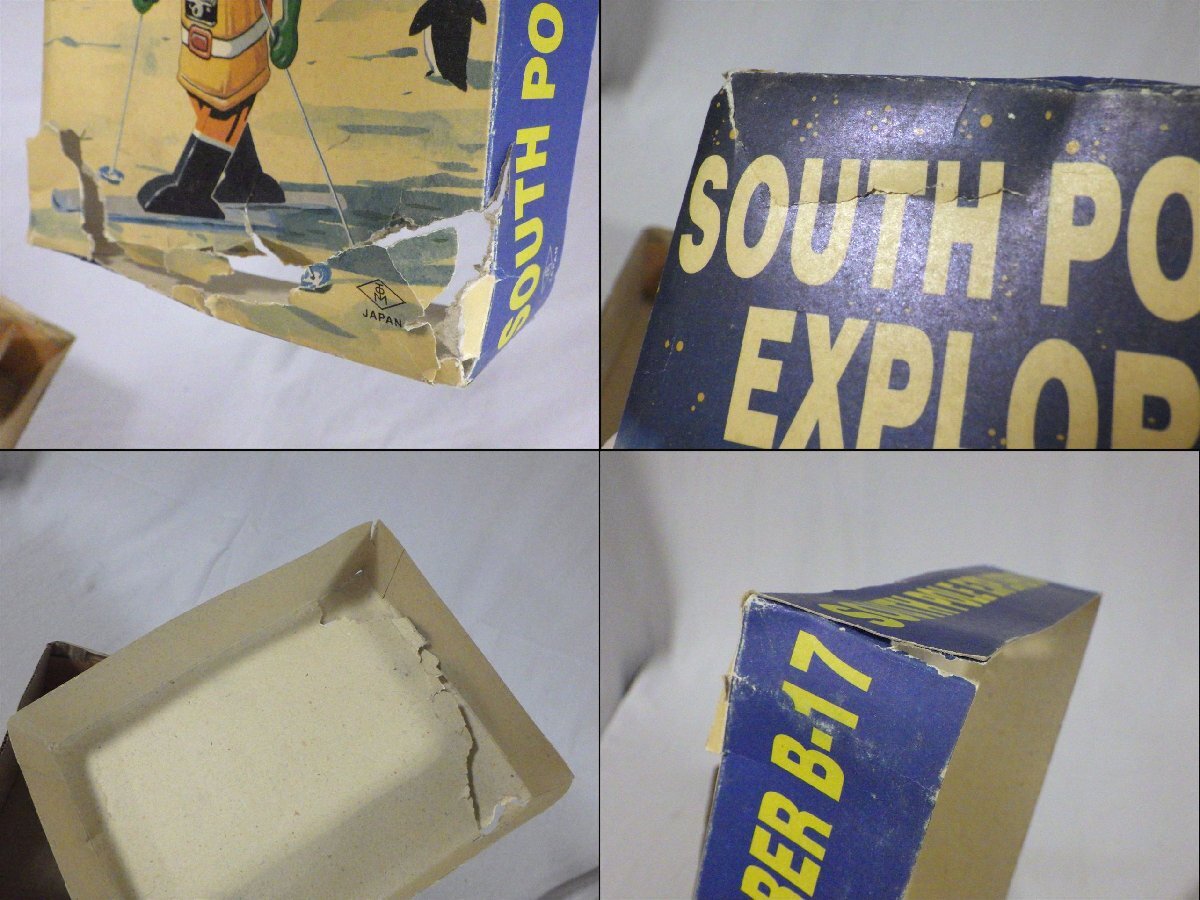
Condition: Authentic vintage presentation with age-related scratches, rubbing, paint loss, oxidation and packaging wear
Collector Category: Japanese tin toys / early robot toys / explorer figures / clockwork toys / polar toys / 1950s space-age collectibles / TET Japan
A major 2024 specialist auction catalogued the original B-17 as a rare TET Japan South Pole Explorer, circa 1955, and documented its skiing figure format, green helmet, yellow-orange polar clothing, black boots, skis, poles, penguin patch and chest-mounted camera decoration.
Milestone Auctions has also linked Naito Shoten to a family of closely related explorer and space-figure pressings that included the Interplanetary Explorer, Inter Planet Space Captain and South Pole Explorer, explaining why the model sometimes appears under different maker descriptions in collector literature.
A TET JAPAN SOUTH POLE EXPLORER B-17
Japan, circa 1955
Lithographed tinplate, clockwork mechanism, skis and poles
With illustrated box and period accessories
In the middle years of the 1950s, exploration itself became a kind of science fiction.
The poles remained among the last places on Earth where distance, machinery, weather and human endurance could still generate genuine mystery.
Japanese toy manufacturers responded with characteristic imagination.
They turned the explorer into a machine.
The South Pole Explorer B-17 belongs to this wonderfully peculiar moment.
He is not a robot in the strict narrative sense.
Nor is he simply a doll.
He is a mechanical human figure whose body has been reorganized around movement.
A wind-up motor sits inside the torso.
Metal skis conceal small wheels.
Pole movements accompany the advance.
The body glides forward under its own stored mechanical energy.
The effect transforms a polar expedition figure into something closer to an automaton.
Its design is wonderfully specific.
A deep green-blue helmet encloses the head.
The face looks outward through a narrow opening.
The body wears a heavily graphic polar suit decorated with equipment, straps, insignia and the words SOUTH POLE EXPLORER B-17.
A camera hangs at the chest.
A penguin emblem reinforces the Antarctic narrative.
Tall black boots disappear into metal skis.
The long poles complete the illusion.
The figure seems ready not merely to stand in the snow, but to cross it.
This is what makes the B-17 so memorable among Japanese tinplate toys.
It carries the visual grammar of the robot age without actually abandoning the human form.
The explorer is treated almost as technology.
Helmet, camera, straps, boots, skis and equipment turn the body itself into a system.
The clockwork mechanism then completes that transformation.
Wind the key.
Release the figure.
The explorer moves.
At approximately twenty-one centimeters high, the object is not large, but its silhouette is extraordinary.
The skis extend the stance.
The poles widen the composition.
The illustrated box behind it expands the toy into a complete polar scene, showing the explorer moving across an icy landscape beneath the dramatic title SOUTH POLE EXPLORER B-17.
That result reflects more than rarity.
It recognizes an object positioned at the crossroads of:
Japanese tinplate manufacture,
the early robot-toy tradition,
postwar fascination with scientific exploration,
clockwork engineering,
and the visual culture of the International Geophysical era.
The South Pole Explorer does not travel to another planet.
It does something almost stranger.
It turns the most remote region of Earth into a mechanical adventure.
Before Space Became the Final Frontier
The South Pole Explorer belongs to a moment when the future had not yet completely left Earth.
The Moon was still distant.
Human spaceflight had not begun.
Yet technological adventure was already everywhere.
Aircraft crossed continents.
Submarines descended deeper.
Scientific teams pushed into polar landscapes.
Antarctica became a stage for modern machinery.
The B-17 turns that atmosphere into a toy.
Its explorer looks less like an ordinary person than an operator sealed inside equipment.
The helmet hides much of the head.
The camera becomes part of the chest.
The skis become running gear.
The clockwork motor becomes invisible muscle.
The human figure and the machine begin to merge.
That is precisely where the object touches the history of the Japanese robot toy.
THE ORIGINAL JAPANESE B-17
An original example was catalogued by Landry Pop Auctions as:
Rare TET Japan B-17 South Pole Explorer Tin Wind-Up Robot
dated circa 1955.
That auction result is exceptionally important because it provides a modern high-quality market reference from a specialist toy sale rather than a generic marketplace listing.
TET JAPAN AND THE NAITO-SHOTEN CONNECTION
Collector attribution surrounding this pressing family is more complicated than the name on a single catalogue line.
The original South Pole Explorer has been sold under the TET Japan attribution, while specialist auction commentary on related explorer figures connects the pressing family to Naito Shoten.
Milestone Auctions described Naito Shoten as using the same pressing for several rare 1950s figures, including:
Interplanetary Explorer,
Inter Planet Space Captain,
and South Pole Explorer.
This shared-body strategy was common in Japanese toy manufacture.
A basic mechanical architecture could be transformed through lithography, colors and accessories into several different characters.
The B-17 therefore belongs to a wider family of explorers rather than standing entirely alone.
WHY THE TET MARK MATTERS
A Japanese tin-toy trademark reference identifies TET Japan as a distinct trade mark consisting of the letters TET within a circular device.
For serious authentication, this kind of manufacturer mark matters enormously.
It helps separate:
original Japanese production
from
later collector reproductions.
That distinction is especially important for this exact model because the B-17 was copied unusually faithfully decades later.
POLAR EXPLORATION AS FUTURISM
Today we often separate polar exploration from science fiction.
The 1950s did not always make such a clean distinction.
The South Pole involved:
special clothing,
radio communications,
aircraft,
tracked vehicles,
scientific instruments,
photography,
weather technology,
and survival equipment.
An expedition could therefore appear almost extraterrestrial.
The B-17 figure captures precisely that mood.
He resembles an astronaut whose spacecraft happens to be Antarctica.
THE HELMET
The rounded green-blue helmet dominates the upper silhouette.
It is not a casual winter hat.
It reads as equipment.
The narrow face opening makes the explorer look enclosed and protected, while the contrasting ear pieces give the head a technical character.
That visual treatment is one reason the figure so easily crosses into robot collecting.
The face remains human.
Everything surrounding it feels mechanical.
THE POLAR SUIT
The body is among the most richly decorated areas of the toy.
Orange, cream, black and green-blue divide the figure into bold blocks.
Printed straps and equipment imply expedition hardware.
The chest carries the B-17 designation.
A camera hangs prominently in front.
The resulting costume is part uniform, part machine.
Tinplate lithography allows all of this information to occupy a relatively small surface without requiring separate molded pieces.
THE CAMERA
The camera is a wonderfully specific detail.
It shifts the character away from soldier or generic adventurer and toward scientific documentation.
The explorer is there to observe.
Record.
Survey.
Bring evidence back.
That single piece of imagery changes the narrative of the object.
He is not merely conquering a landscape.
He is studying it.
THE PENGUIN EMBLEM
The penguin insignia gives the toy a playful visual anchor while reinforcing the polar theme immediately.
It is a tiny graphic, but it serves almost as a mission patch.
Long before space-program patches became familiar visual culture, expedition insignia already carried the idea of belonging to a technological mission.
The B-17 borrows that visual logic.
CLOCKWORK ENGINEERING
The toy is powered by a spring-driven wind-up mechanism.
Turning the removable key tensions the internal spring.
When released, stored energy travels through a compact gear train.
That movement drives the concealed wheels beneath the skis and coordinates the figure’s upper-body motion.
No battery is required.
No electronic component is needed.
The entire performance emerges from steel, gears and stored spring energy.
This mechanical simplicity is part of the object’s long-term charm.
THE SKIING MOTION
The movement distinguishes the B-17 from ordinary walking robots.
The figure does not merely alternate mechanical feet.
It advances on skis.
Small wheels concealed beneath them provide propulsion while the poles and arms reinforce the skiing illusion.
The mechanical trick is simple.
The theatrical result is excellent.
A rigid tin figure suddenly seems to cross snow.
POLE MOVEMENT
Later reproduction documentation preserves useful information about the mechanism because those replicas copied the original action closely.
When wound, the figure moves forward on hidden wheels beneath the skis while its poles move with the advance.
This is useful for understanding the original design, although reproduction documentation should never be confused with proof of an individual toy’s age.
LITHOGRAPHED TINPLATE
The B-17 comes from the high period of lithographed Japanese tin toys.
Tinplate made it possible to combine:
structural form,
surface color,
costume,
equipment,
lettering,
badges,
and mechanical housings
within one lightweight material system.
The printed body therefore performs several jobs simultaneously.
It is chassis.
Costume.
Narrative.
Decoration.
THE BOX
The illustrated carton is almost as charismatic as the figure itself.
The large words SOUTH POLE EXPLORER B-17 establish the mission immediately.
The explorer is shown against an icy polar landscape.
Small expedition and aviation imagery creates the sense of a larger operation beyond the figure itself.
The package therefore transforms a single mechanical toy into the central actor of an entire imagined expedition.
Original box survival is especially important in this category.
Large, oddly shaped accessories such as skis and poles were easily separated.
Packaging helped keep the ensemble together.
ACCESSORIES AND COMPLETENESS
The B-17 is particularly dependent upon its accessories.
Without skis, the action loses its visual logic.
Without poles, the skiing gesture disappears.
Without the winding key, the mechanism cannot be demonstrated conveniently.
The present ensemble is represented with:
figure
pair of skis
ski poles
wind-up key
accessory bag
and
illustrated box
making completeness a major part of its collector appeal.
CONDITION
This South Pole Explorer B-17 survives in strong vintage display condition with its principal mechanical and presentation components present.
The tinplate figure retains the striking orange, cream, black and green-blue polar color scheme together with chest graphics, equipment imagery and character details.
Age-related wear may include:
small scratches,
rubbing,
contact marks,
minor paint loss,
oxidation,
and other evidence of long-term storage and mechanical use.
Particular attention should be paid to the areas where the ski poles move near the body and feet, as abrasion in these locations is characteristic of genuine mechanical use and is also documented on a specialist-auction original example.
The metal skis and poles remain with the figure.
The clockwork mechanism is represented as operational.
The illustrated box survives with age-related edge wear, creasing, rubbing, tears and handling marks consistent with long-term preservation.
As with all mechanical toys of this age, current operation does not constitute a guarantee of indefinite future performance. The mechanism should be wound conservatively and demonstrated only as necessary.
Please review all photographs carefully for the complete visual condition record.
DIMENSIONS
Original and related examples are generally documented at approximately:
Height: circa 21–22 cm / approximately 8.3–8.7 in
A European auction listing for an original Japanese TOM-attributed example records approximately 21 cm height.
HUMAN OR ROBOT?
This is one of the most enjoyable classification questions surrounding the B-17.
The face is human.
The costume is human.
The camera is human.
But the object behaves mechanically and is collected within the robot-toy world.
Major specialist auctions themselves describe it as a tin wind-up robot.
That ambiguity is part of its appeal.
The South Pole Explorer occupies a borderland:
human explorer in subject,
mechanical automaton in form,
robot collectible in market culture.
MID-CENTURY JAPANESE TECHNOLOGY IMAGINATION
The B-17 emerged during the same broad period that produced:
space men,
atomic robots,
mechanical astronauts,
rocket ships,
flying saucers,
polar explorers,
and futuristic vehicles.
All of these objects share a fascination with technology expanding the boundaries of human movement.
The South Pole Explorer simply points that fascination downward toward the ice rather than upward toward space.
ROBOT COLLECTOR SIGNIFICANCE
Serious Japanese robot collectors value objects like the B-17 because they sit near the beginning of the recognizable postwar tin-robot tradition.
The figure contains many of the elements that would later become standard:
helmeted head,
technological torso,
mechanical locomotion,
mission graphics,
specialized equipment,
bright lithography,
and strong box art.
Yet it remains sufficiently unusual to stand apart from more conventional humanoid robots.
MUSEUM WALL LABEL
South Pole Explorer B-17
TET Japan / Naito-Shoten-associated pressing family
Japan, circa 1955
Lithographed tinplate, steel clockwork mechanism
With skis, poles and illustrated carton
Approx. 21–22 cm high
Produced during the extraordinary expansion of Japanese mechanical toys in the mid-1950s, the South Pole Explorer B-17 transforms a scientific polar traveler into a clockwork automaton.
The figure’s helmet, camera, equipment graphics and mission-style markings reflect contemporary fascination with technological exploration. When wound, hidden wheels beneath the skis propel the explorer forward while the poles participate in the mechanical action.
COLLECTOR’S NOTE
The B-17 is wonderfully strange.
He is too human to be a robot.
Too mechanical to be merely human.
Too heavily equipped to be an ordinary skier.
Wind the spring and he quietly glides toward the end of the world.
The Moon could wait.
Antarctica was alien enough. ❄️🤖⛷️
Authenticity & Collectible Stewardship
Evaluated under the Japonista Collectibles Authentication Framework™:
-
Period, manufacturer, and production-era assessment
-
Material, paint, lithography, and surface-wear analysis
-
Mechanical, structural, and component integrity review (where applicable)
-
Design, iconography, and cultural-context verification
Guaranteed 100% Authentic.
Every piece is backed by the Japonista Lifetime Authenticity Warranty™ and curated with collector-grade scrutiny.
A Note on Collecting & Preservation
At Japonista, we approach vintage and modern toys not merely as nostalgic objects, but as design artifacts, cultural touchstones, and expressions of their era—from postwar ingenuity and Showa imagination to contemporary pop and designer movements.
Each work is carefully examined, researched, and presented with respect for its original intent, historical context, and collector relevance, balancing preservation with the honest character earned through time and play.
Our role is not only to offer access to meaningful collectibles, but to act as thoughtful custodians—connecting the right pieces with collectors who value history, originality, and lasting significance.
Inquiries, Availability, and Private Consideration
Some collectible works may allow room for discussion, while others are held firmly due to rarity, condition, provenance, or cultural importance. All inquiries are reviewed personally and discreetly, and we welcome thoughtful questions or expressions of interest.
If you are exploring a specific theme, franchise, maker, era, or mechanical category—or seeking guidance in building a focused collection—our team is always available to assist with informed, quiet expertise.
Concierge Support & Collector Guidance
Japonista Concierge™ offers personalized assistance for collectors seeking deeper understanding, strategic acquisitions, or long-term curation across vintage and modern collectibles.
Whether your interest lies in nostalgia, design history, mechanical fascination, or pop-culture legacy, we are here to support your collecting journey with clarity, care, and discretion.
For select high-value or historically significant pieces, private reservation or structured payment arrangements may be available on a case-by-case basis. Please contact us to discuss eligibility and options.
Before Proceeding
We kindly encourage collectors to review our shop policies and house guidelines, available through the links in our website footer, which outline shipping, handling, and condition standards specific to vintage, mechanical, and collectible works.
A Closing Note
Thank you for exploring Japonista’s collection of vintage and modern toys, robots, and cultural collectibles. We are honored to share these enduring objects of imagination and design—and to help place them where they may continue to be appreciated, studied, and enjoyed.
If you have questions or wish to explore related works, please feel free to contact Japonista Concierge™ at any time.