Rare Vintage, Antiques and Art Collector / Curator / Personal Shopper From Japan
TEDMAN Ted Company Reversible Sukajan Jacket Black Velvet Gold Satin Little Devil Phoenix Mount Fuji Japanese Y2K Bomber
TEDMAN Ted Company Reversible Sukajan Jacket Black Velvet Gold Satin Little Devil Phoenix Mount Fuji Japanese Y2K Bomber
Couldn't load pickup availability
Have a reasonable price in mind? Submit your best offer and our concierge will review it personally.
Vintage TEDMAN “Lucky Devil” Yokosuka Jumper with Embroidered Little Devil, Mythical Bird, Sakura, Fuji, Waves, Bamboo, and Two Distinct Wearable Faces
COLLECTOR’S OVERVIEW
A richly embroidered reversible sukajan by TED COMPANY, featuring the unmistakable TEDMAN little-devil mascot across a deep midnight-black velvet face and an elaborate Japanese landscape composition across the contrasting copper-gold satin face.
This is not simply a souvenir bomber with two color options. Each side has been conceived as a separate visual identity.
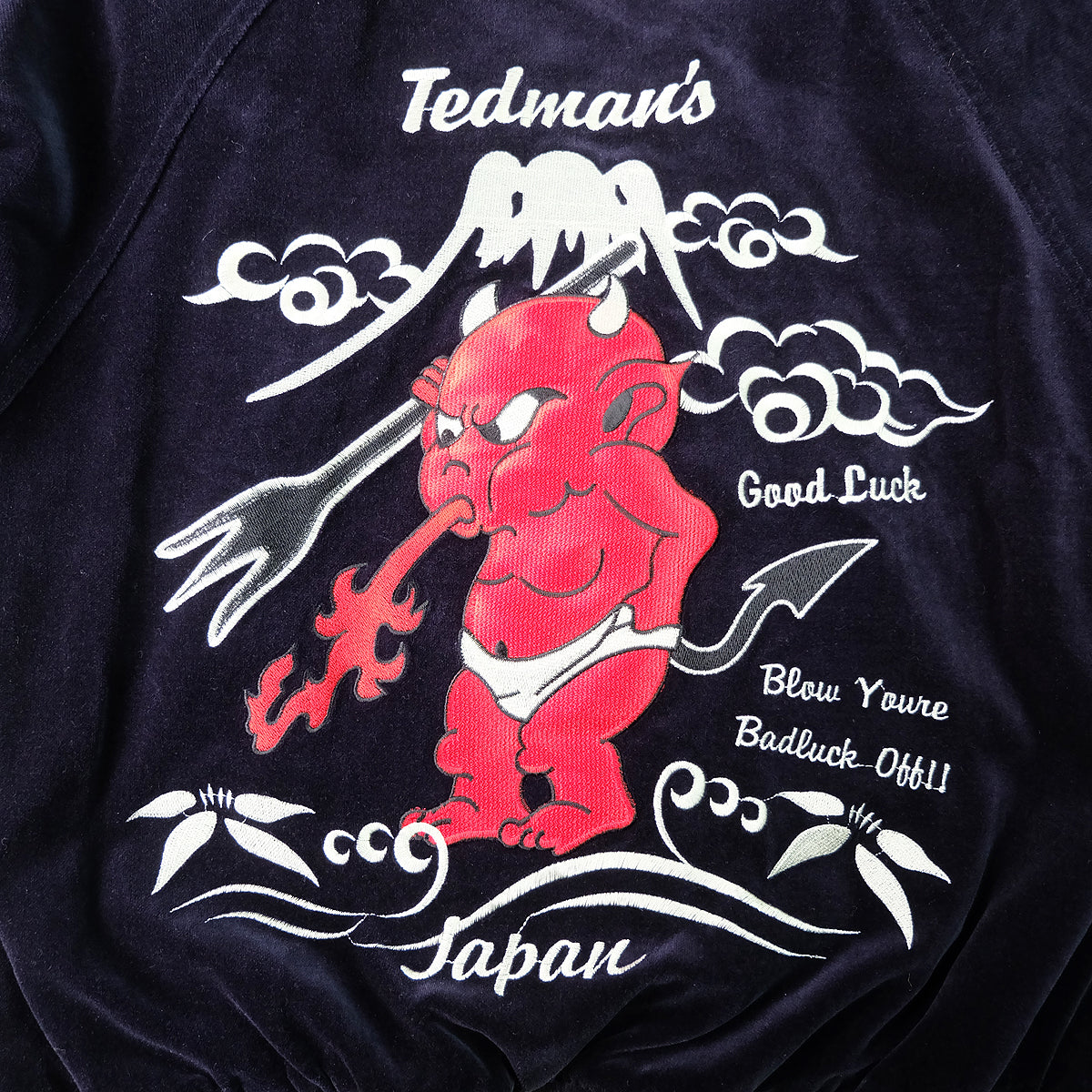
The velvet face is dark, graphic, playful, and unmistakably TEDMAN. A large red devil stands beneath Mount Fuji, blowing flame from his mouth while stylized clouds, bamboo leaves, and rhythmic scrollwork move around him. Embroidered lettering reads “Tedman’s,” “Good Luck,” “Japan,” and the characteristically eccentric English slogan “Blow You’re Badluck-Off!!” Full-length sleeve embroidery extends the design beyond the back panel and gives the jacket a strongly animated appearance from every angle.
The reverse transforms the garment into a luminous copper, cream, and silver sukajan. Its back is dominated by a large mythical bird, likely inspired by the Japanese hō-ō or phoenix tradition, surrounded by Mount Fuji, flowering cherry branches, clouds, waves, and bamboo. The smaller TEDMAN figure stands beside the bird beneath the words “Lucky Devil. Tedman’s,” creating a playful meeting between Japanese auspicious imagery and the label’s irreverent mascot.
The combination of velvet, satin, extensive sleeve embroidery, full reversibility, Japanese landscape symbolism, and TEDMAN branding makes this a particularly charismatic piece of Japanese streetwear and sukajan material culture.
IDENTIFICATION
Object Type
Vintage reversible Japanese sukajan, also known as a Yokosuka jumper, embroidered souvenir jacket, or Japanese souvenir bomber.
Brand
TEDMAN.
Maker
TED COMPANY.
Label Family
Japanese Americana, motorcycle, tattoo, military-inspired, rockabilly, and souvenir-jacket streetwear associated with the TEDMAN little-devil mascot.
Origin
Japan.
Primary Style
Reversible embroidered sukajan with one velvet-finish face and one satin-finish face.
Exterior Face One
Midnight black or extremely deep navy velvet with red, ivory, silver, black, and muted gold embroidery.
Exterior Face Two
Copper-gold satin body with pearl-white side and sleeve panels, dark piping, and multicolored pictorial embroidery.
Principal Motifs
TEDMAN little devil, Mount Fuji, stylized clouds, bamboo, flowering cherry branches, waves, fire, a large mythical bird, and embroidered Japan lettering.
Wearability
Unisex collectible outerwear with a traditional short bomber silhouette.
TEDMAN AND THE JAPANESE AMERICANA TRADITION
The TEDMAN Character
TEDMAN is represented by the red little-devil figure appearing throughout the jacket.
The mascot is immediately recognizable through his compact body, pointed horns, long tail, mischievous expression, white briefs, and exaggerated cartoon energy. Rather than embodying literal religious evil, the figure functions as a humorous emblem of rebellious luck, bravado, endurance, and outsider character.
Across TEDMAN garments, the devil often appears within military, motorcycle, tattoo, collegiate, workwear, and Japanese traditional compositions. This allows the mascot to move between American pop imagery and Japanese decorative storytelling without losing his distinctive identity.
On this jacket, TEDMAN appears in several forms. He dominates the black velvet back, appears as a smaller chest emblem, repeats near the lower sleeves, and returns on the copper satin reverse beside the large mythical bird.
TED COMPANY Identity
The satin face includes embroidered wording reading:
“Lucky Devil. Tedman’s”
“Ted Company Since 1991”
“Good Luck”
“Japan”
These inscriptions connect the garment directly with TED COMPANY and frame the mascot as a “Lucky Devil” rather than a threatening figure.
The repeated emphasis on luck is central to the design. The devil is transformed from a symbol of danger into a talismanic character who confronts bad fortune with fire, confidence, and humor.
Japanese Americana
TEDMAN belongs to the wider Japanese Americana tradition in which Japanese designers reinterpret American military clothing, motorcycle culture, denim, varsity garments, tattoo graphics, and mid-century workwear with exceptional attention to construction and surface detail.
This jacket expresses that exchange particularly clearly. Its bomber shape and striped ribbing recall American athletic and military outerwear, while its Fuji, cherry blossom, cloud, wave, bamboo, and mythical-bird embroidery remain distinctly Japanese.
The garment is therefore not a replica of a traditional postwar souvenir jacket. It is a later Japanese streetwear interpretation of the sukajan, enriched through mascot branding and a highly theatrical reversible format.
THE SUKAJAN AND YOKOSUKA JUMPER LINEAGE
Origins of the Garment Form
The sukajan emerged from embroidered souvenir jackets associated with Yokosuka and other postwar military-port communities in Japan.
The name is commonly understood as an abbreviated form of “Yokosuka jumper.” Early examples combined American bomber-jacket construction with Japanese embroidery, often featuring dragons, tigers, eagles, maps, Mount Fuji, cherry blossoms, military insignia, and place names.
Over subsequent decades, the sukajan moved through Japanese youth culture, rockabilly style, motorcycle fashion, punk, luxury design, visual-kei wardrobes, and international streetwear.
From Souvenir to Collectible Streetwear
Later makers expanded the sukajan beyond its original souvenir role.
Brands such as TEDMAN used the garment as a storytelling surface, combining Japanese auspicious motifs with cartoon mascots, custom lettering, biker graphics, and playful references to luck, courage, and rebellion.
This jacket belongs to that evolved tradition. It retains the essential architecture of the Yokosuka jumper while presenting two fully developed compositions linked by the TEDMAN identity.
Why Reversible Sukajan Matter
Reversibility is one of the most compelling features found in select sukajan designs.
A successful reversible jacket must function visually and structurally from both sides. Pockets, seams, zipper construction, ribbing, embroidery placement, and fabric behavior must all be considered for two wearable presentations.
Here, reversibility is not treated as a novelty. The velvet and satin faces differ in texture, palette, symbolism, and mood, giving the wearer two genuinely distinct jackets.
BLACK VELVET FACE
Velvet Ground
The first face is constructed from a dark velvet or velour-finish textile with a soft, light-responsive pile.
Depending on illumination and the direction of the nap, the surface may appear black, midnight navy, or deep blue-black. This tonal movement gives the jacket unusual depth and separates it from the smoother shine of conventional satin sukajan.
Velvet absorbs light rather than reflecting it evenly. As a result, the embroidered white clouds, silver Fuji, red devil, and pale lettering emerge with exceptional clarity.
Central TEDMAN Composition
The rear composition centers on a large red TEDMAN figure.
He stands in profile with narrowed eyes and a determined expression, directing a stream of flame from his mouth. His pointed horns, rounded belly, arrow-tipped tail, white briefs, and compact cartoon proportions identify him immediately as the label mascot.
The figure is humorous, but the pose carries genuine visual force. His forward-leaning stance and flame-breathing action create movement across the otherwise dark field.
Mount Fuji
A silver-white Mount Fuji rises behind the devil.
The mountain is rendered with a broad triangular silhouette and a snow-covered summit. Its position above TEDMAN gives the composition vertical structure and locates the mascot within an unmistakably Japanese symbolic landscape.
Mount Fuji represents permanence, aspiration, spiritual elevation, national identity, and the beauty of disciplined form. Within a sukajan composition, it also acts as one of the most recognizable emblems of Japan.
Stylized Clouds
White and silver cloud forms surround the mountain and devil.
These are not naturalistic meteorological clouds. They are decorative cloud scrolls derived from East Asian pictorial traditions, simplified into rhythmic curls and elongated horizontal shapes.
The clouds create movement around the central figure and prevent the dark velvet ground from becoming visually static. Their white outlines also echo the pale embroidery used on the sleeves.
Flame Imagery
The red flame leaving TEDMAN’s mouth is one of the composition’s most animated features.
It reinforces the mascot’s devil identity while also suggesting the expulsion of bad fortune. This idea is supported by the nearby embroidered slogan:
“Blow You’re Badluck-Off!!”
The phrase preserves the unconventional English characteristic of Japanese graphic streetwear. Its meaning is clear despite the playful grammar: blow away your bad luck.
“Good Luck” Inscription
The words “Good Luck.” appear near the central figure.
This transforms the devil from a creature of misfortune into an active guardian against it. The image becomes almost talismanic: a fiery little devil deployed to chase away undesirable luck before it reaches the wearer.
“Japan” Lettering
The lower back is anchored by a large embroidered “Japan” inscription.
The flowing script sits above a sweeping horizontal band that recalls a wave, banner, or stylized ground line. It gives the composition the destination identity associated with classic souvenir jackets.
Bamboo Motifs
Bamboo leaves appear near the lower back and throughout the sleeves.
Bamboo is admired in Japanese visual culture for its combination of strength and flexibility. It bends beneath pressure without losing its structure, making it a symbol of resilience, adaptability, integrity, and disciplined growth.
Its inclusion deepens the good-luck vocabulary of the jacket. The design combines the steadfastness of Fuji, the resilience of bamboo, and the disruptive energy of the TEDMAN mascot.
VELVET-FACE SLEEVE EMBROIDERY
Full-Length Decoration
Both sleeves are extensively embroidered from the upper arm toward the cuffs.
This is an important collector feature. Many souvenir jackets reserve their primary decoration for the back and leave the sleeves largely plain. Here, the sleeves act as active extensions of the central design.
Repeating TEDMAN Figures
Smaller red devils appear near the lower sleeves.
Their placement close to the cuffs creates movement as the arms shift and ensures that the mascot remains visible even when the back is not facing the viewer.
Cloud Scrolls
The sleeves repeat the white cloud-scroll vocabulary seen on the back.
These forms move vertically and diagonally along the arms, visually lengthening the sleeves and linking the separate embroidered motifs.
Bamboo and Leaf Forms
Muted gold and pale green leaves weave between the clouds and devil figures.
The restrained accent colors prevent the sleeves from becoming overly bright while introducing enough tonal variation to distinguish the botanical details from the white linework.
Pale Pictorial Forms
White embroidered shapes resembling mountain peaks, birds, or stylized landscape elements appear along the sleeves.
They create a continuous Japanese landscape vocabulary rather than functioning as isolated decorative patches.
Embroidery Rhythm
The sleeve designs alternate dense pictorial sections with dark stretches of velvet.
This use of negative space is important. It allows each devil, cloud, leaf, and pale landscape form to remain legible while preserving the luxurious darkness of the velvet.
VELVET-FACE FRONT
Left Chest Embroidery
One chest carries the TEDMAN name above a small red Mount Fuji-like emblem and scrolling clouds.
The placement functions like a brand crest, identifying the jacket immediately without repeating the entire back composition.
Right Chest Embroidery
The opposite chest features a compact red TEDMAN figure breathing flame.
A pale diagonal form passes behind him, accompanied by small leaf or floral details. The figure mirrors the action of the larger devil on the back and gives the front a strong visual focal point.
Balanced Asymmetry
The two chest motifs are not identical.
One side emphasizes brand lettering and landscape imagery, while the other emphasizes the character. This asymmetry is carefully balanced through comparable scale, red-white contrast, and shared cloud forms.
Front Pockets
Dark welt pockets are integrated into the velvet face.
Their restrained construction allows them to remain functional without interrupting the embroidered chest and sleeve compositions.
Central Zipper
A reversible metal zipper closes the jacket at the center front.
The dark zipper tape blends into the velvet face, preserving the uninterrupted depth of the body color.
COPPER-GOLD SATIN FACE
Satin Color Architecture
The reverse is built around a warm copper, bronze, or muted gold satin body.
Large pearl-white side panels and sleeves create a luminous contrast, while narrow dark piping outlines the panel divisions. Burnt-orange ribbing with cream and navy stripes completes the composition.
This face is brighter, more decorative, and more traditionally aligned with the ornamental vocabulary of a classic Japanese souvenir jacket.
Reflective Surface
The satin catches light across folds, seams, and embroidered areas.
Its color may shift between copper, champagne, salmon-gold, and warm bronze depending on the viewing angle and lighting conditions.
This fluid sheen creates a dramatic contrast with the light-absorbing velvet face. The two materials do not merely differ in color. They behave differently under light, creating separate tactile and visual experiences.
Large Central Bird
The satin back is dominated by a large fantastical bird with spread wings and layered plumage.
The creature appears consistent with a hō-ō or phoenix-inspired motif rather than a strictly naturalistic bird species. Its exaggerated feather structure, decorative crest, expressive face, and auspicious setting place it within the ornamental tradition of Japanese mythical-bird imagery.
The bird is shown in an energetic forward movement, wings lifted and body angled diagonally. This creates a sense of confrontation or encounter with the smaller TEDMAN figure standing nearby.
Hō-ō and Phoenix Associations
The hō-ō is an auspicious mythical bird associated with peace, virtue, renewal, harmonious rule, and rare appearances during favorable eras.
In Japanese decorative art, it is often represented with elaborate plumage and surrounded by flowers, clouds, or other auspicious motifs.
On this jacket, the mythical bird introduces dignity and grandeur, while the TEDMAN mascot adds humor and subcultural irreverence. The meeting of the two figures is central to the jacket’s charm.
TEDMAN and the Mythical Bird
The smaller red devil stands at the lower right of the bird.
Rather than fleeing, he appears to confront, address, or interact with the much larger creature. His fiery breath and compact stance create a comic contrast with the bird’s sweeping feathers.
This difference in scale gives the composition a narrative quality. The tiny “Lucky Devil” faces an immense symbolic bird with confidence disproportionate to his size.
JAPANESE LANDSCAPE MOTIFS ON THE SATIN FACE
Mount Fuji
A pale Mount Fuji appears above the bird.
The mountain functions as both geographic identity and symbolic anchor. It places the action within an idealized Japanese landscape and reinforces the Japan inscription below.
Cherry Blossoms
Flowering branches surround the mythical bird.
The blossoms appear consistent with sakura, rendered in pink, ivory, red, and muted green embroidery. Their clustered placement softens the bird’s strong wing lines and introduces seasonal delicacy.
Cherry blossoms symbolize beauty, renewal, seasonal transition, and the fleeting nature of life. Their brief bloom has long made them an emblem of impermanence and the preciousness of the present moment.
Waves
Stylized waves rise near the lower left of the composition.
The pale curling water is built from layered embroidered lines that recall the graphic vocabulary of traditional Japanese painting and woodblock design.
Water represents movement, continuity, adaptation, purification, and the ability to persist through changing conditions.
Bamboo
Small bamboo shoots rise near the lower section.
Their narrow pointed leaves and upright structure contribute another auspicious motif associated with resilience and flexible strength.
Clouds
Clouds appear near Fuji, around the bird, and within the broader landscape.
Their curled forms unify mountain, sky, bird, blossom, and water into a continuous decorative environment.
Seasonal and Elemental Balance
The satin composition combines mountain, sky, bird, flowers, water, bamboo, cloud, and fire.
These elements create a richly layered symbolic world:
Mount Fuji supplies permanence.
Cherry blossoms express transience.
Waves represent movement.
Bamboo suggests resilience.
The mythical bird evokes renewal and virtue.
TEDMAN contributes luck, defiance, and comic energy.
EMBROIDERED WORDING AND BRAND DETAILS
“Lucky Devil. Tedman’s”
The upper back reads:
“Lucky Devil. Tedman’s”
This phrase defines the mascot’s role and frames the entire jacket as a wearable good-luck statement.
“Ted Company Since 1991”
The inscription on the right side of the satin composition reads:
“Ted Company Since 1991”
This wording is embroidered as part of the garment’s original design and connects the piece with the maker’s established identity.
“Good Luck”
The phrase “Good Luck” appears beneath the TED COMPANY wording.
Its repetition across both faces reinforces the talismanic nature of the jacket.
“Japan”
A large “Japan” inscription anchors the lower back.
Its dark outlined script remains clearly legible against the copper satin and visually balances the upper “Lucky Devil” lettering.
Stylized English
TEDMAN garments often use English as a graphic and cultural element.
The language may be unconventional, humorous, or intentionally exaggerated. These phrases are part of the label’s Japanese Americana character and should be appreciated as original design features rather than corrected or modernized.
REVERSIBLE CONSTRUCTION
Two Complete Visual Programs
The garment presents two substantially different wearable faces.
The velvet side is dark, plush, graphic, and mascot-driven.
The satin side is luminous, pictorial, multicolored, and rooted more deeply in traditional Japanese auspicious imagery.
This level of contrast greatly increases the jacket’s styling range and collecting interest.
Reversible Zipper
The central zipper is configured for use from either side.
The zipper pull and tape sit between the velvet and satin constructions without requiring a separate removable lining.
Shared Ribbing
The collar, cuffs, and waistband serve both faces.
On the velvet side, the ribbing appears predominantly dark with cream stripes. From the satin face, the burnt-orange reverse of the knit becomes more visible, coordinating with the copper body.
This dual appearance demonstrates how even the trim contributes to the two-sided design.
Panel Construction
The satin face uses contrasting white panels and dark piping, while the velvet face appears visually more continuous.
The different panel systems allow each side to maintain its own character despite sharing the same garment structure.
Pockets
Welt pockets are incorporated into the reversible construction.
The photographed velvet face clearly shows dark pocket openings. The garment’s reversible architecture allows the opposite face to function as outerwear rather than merely as a decorative lining.
TEXTILE AND SURFACE CHARACTER
Velvet or Velour Face
The black face has a soft pile surface consistent with velvet or velour.
The nap creates natural tonal variation. Areas may appear lighter or darker depending on the direction of brushing, folding, pressure, and photography.
This is an inherent quality of pile textiles and not necessarily evidence of staining or color loss.
Satin Face
The copper and white face has a smooth satin weave with strong directional sheen.
Satin naturally shows creases, fold lines, pressure marks, and embroidery-related puckering more readily than matte fabrics.
Embroidery Density
The jacket carries extensive machine embroidery across both backs, both sleeves, and the velvet chest.
Dense embroidery adds weight and visual depth but can also create localized rippling where the thread tension interacts with the softer shell fabric.
Thread Palette
The embroidery includes red, white, ivory, silver, pale blue, navy, black, pink, gold, green, brown, and copper-toned threads.
This broad palette is especially concentrated on the satin face, where individual feather groups, blossoms, waves, clouds, lettering, and character details are separately articulated.
Ribbed Knit
The collar, cuffs, and waistband are finished in striped ribbed knit.
The elastic ribbing draws the body inward at the wrists and hem, creating the compact shape associated with sukajan and bomber jackets.
Hardware
A metal zipper forms the central closure.
Its visible pull, slider, and lower insertion area contribute to the vintage utilitarian character of the garment.
EMBROIDERY QUALITY AND ARTISTIC EXECUTION
Mythical Bird Feathering
The bird’s wings are built from layered rows of feathers in pale blue, silver, dark blue, pink, green, and muted red.
Directional stitching distinguishes the long flight feathers from the shorter body plumage. The contrast between cool blues and warm pinks gives the bird volume against the copper ground.
Head and Facial Detail
The bird’s eye, beak, crest, and facial contours are defined with darker embroidery.
These details create an intense expression and prevent the complex head from disappearing within the surrounding feathers and blossoms.
Sakura Clusters
The cherry blossoms are formed from multiple small embroidered flowers rather than a single printed field.
Their petals, centers, leaves, and branch sections are differentiated through compact areas of thread color.
TEDMAN Figure Work
The devil is rendered in saturated red thread with black outlines, white briefs, pale horns, and a narrow tail.
His compact design remains legible at both large and small scales, demonstrating the strength of the original mascot artwork.
Velvet-Side Linework
The velvet face relies heavily on bold white outlines and saturated red figures.
This high-contrast method is effective against the dark pile textile, where subtle tonal embroidery would be more easily absorbed.
Sleeve Integration
The sleeves are not treated as secondary surfaces.
Their repeated clouds, bamboo, pale landscape forms, and small TEDMAN figures continue the story from shoulder to cuff and make the jacket visually active during wear.
COLOR ARCHITECTURE
Velvet Face Palette
The velvet face is dominated by midnight black or deep navy.
White and silver define clouds, Fuji, and lettering.
Red identifies the TEDMAN figures and flame.
Muted gold and green add botanical accents.
The overall result is graphic, controlled, and nocturnal.
Satin Face Palette
The satin face is warmer and more complex.
Copper-gold forms the central body.
Pearl white brightens the sleeves and side panels.
Blue, silver, rose, green, ivory, and red articulate the bird and surrounding landscape.
Burnt-orange ribbing draws the composition together.
Visual Transformation
Turning the jacket inside out produces an immediate transformation.
The dark side feels closer to Japanese biker, rockabilly, and tattoo-inspired streetwear.
The copper side feels closer to a traditional decorative souvenir jacket with auspicious Japanese imagery.
This duality is one of the garment’s strongest qualities.
PERIOD AND ERA ASSESSMENT
Likely Era
The jacket appears consistent with late 1990s to 2000s Japanese streetwear and the Y2K-era expansion of highly embroidered reversible sukajan.
Its combination of branded mascot artwork, ornate Japanese motifs, velvet construction, contrasting satin reverse, and full sleeve embroidery reflects the more elaborate collector-oriented souvenir jackets produced during this period.
Dating Language
The embroidered wording “Ted Company Since 1991” identifies the company heritage presented by the design.
It does not necessarily indicate that this individual garment was manufactured in 1991.
The precise production year is not shown in the supplied photographs.
Vintage Streetwear Context
The jacket belongs to a period when Japanese labels elevated military and souvenir silhouettes through dense embroidery, premium-feeling fabrics, mascot identity, and nostalgic American styling.
Today, pieces of this type sit at the intersection of vintage fashion, archive streetwear, Japanese Americana, sukajan collecting, motorcycle culture, and wearable textile art.
CONDITION
Overall Condition
Vintage pre-owned condition with visible age-related wear, textile variation, creasing, and storage character.
The jacket remains visually strong, with both embroidered faces retaining substantial color, definition, and impact.
Velvet Nap
The black velvet or velour surface shows natural nap movement and tonal variation.
Areas may appear lighter, darker, brushed, or slightly flattened according to the direction of the pile. This is especially visible across the back, sleeves, and areas near seams or embroidery.
Gentle surface wear and localized pile variation are consistent with prior use.
Velvet Embroidery
The principal TEDMAN figure, Mount Fuji, clouds, lettering, bamboo, sleeve motifs, and chest embroidery remain clearly legible.
No major section of the principal velvet-side composition appears absent in the supplied photographs.
Minor thread irregularities, small raised fibers, and light embroidery-edge wear may be present.
Copper Satin Surface
The copper-gold satin shows visible creasing, rippling, and localized discoloration or darker surface variation.
More noticeable age-related marking appears around the upper left shoulder and left side of the satin back, with additional tonal variation near panel seams and embroidered areas.
These visible marks should be considered part of the jacket’s vintage condition.
White Satin Panels
The pearl-white sleeve and side panels retain their contrast against the copper body.
Light creasing, surface variation, and subtle age-related discoloration may be present. Pale satin naturally reveals handling and storage marks more readily than dark textiles.
Embroidery Puckering
Localized puckering is visible around the dense bird, blossom, lettering, and landscape embroidery.
This is common where substantial threadwork has been applied to lightweight satin and forms part of the garment’s authentic construction and age.
Ribbing
The striped collar, cuffs, and waistband remain present and visually cohesive.
The cream sections show natural age toning, and the ribbing displays gentle waviness, stretching, or relaxation consistent with use and storage.
No major missing ribbed section is visible in the supplied images.
Zipper
The central metal zipper, pull, and lower fastening components are present.
The photographed zipper area shows normal vintage handling character. Vintage hardware may operate with a different degree of smoothness or resistance than modern factory-new components.
Seams and Structure
The principal body panels, sleeve seams, neckline, cuffs, waistband, and embroidery fields appear structurally present.
No extensive tear, major open seam, widespread embroidery loss, or catastrophic structural damage is visible in the supplied photographs.
Vintage Expectations
This jacket is not presented as deadstock or factory-new.
Its creasing, satin variation, velvet nap movement, ribbing relaxation, small thread irregularities, and visible age marks form part of its history as a genuine pre-owned garment.
Please examine every photograph carefully, particularly the copper satin shoulder areas, pale panels, ribbing, zipper, embroidery edges, and velvet pile.
DIMENSIONS AND SIZING
Manufacturer’s Tag Size
The manufacturer’s size label is not visible in the supplied photographs.
Exact Measurements
Exact flat measurements are not shown in the available images.
No numerical chest width, length, sleeve span, hem width, or shoulder measurement is stated without direct ruler evidence.
Recommended Comparison Method
Compare the jacket with a similar bomber or sukajan that already fits comfortably.
Measure both garments flat without stretching the ribbing.
Useful points include:
A: Pit-to-pit chest width
B: Back length from the base of the collar to the hem
C: Sleeve length measured from the collar seam along the upper sleeve to the cuff
D: Hem width measured across the relaxed waistband
E: Cuff width or another relevant fit point
Raglan-Style Measurement
The jacket uses angled shoulder construction rather than a conventional sharply defined shoulder seam.
For this reason, sleeve length is most accurately assessed from the base of the collar to the end of the cuff rather than from a modern shoulder point.
Japanese Vintage Sizing
Japanese vintage sizes should not be treated as direct equivalents of modern Western sizing.
Fit varies according to production era, intended silhouette, lining construction, ribbing tension, body length, sleeve volume, and the wearer’s layering preference.
A compact body and relatively full sleeves are characteristic of many sukajan jackets.
Unisex Fit
The jacket is suitable for masculine, feminine, and gender-neutral styling.
The correct fit should be determined through actual flat measurements rather than gendered size assumptions.
COLLECTOR DESIRABILITY
Full TEDMAN Identity
The garment presents the TEDMAN mascot across the back, chest, sleeves, and reverse.
This repeated branding makes the jacket immediately recognizable and gives it stronger collector identity than a sukajan carrying only a small logo.
Two Distinct Textile Faces
The combination of velvet and satin is particularly attractive.
Many reversible sukajan use satin on both sides. The use of a dark pile textile on one face gives this piece richer tactile contrast and a more unusual wardrobe presence.
Extensive Sleeve Embroidery
The full-length sleeve designs add significant visual and collector value.
They make the jacket feel complete from every direction and demonstrate a higher decorative commitment than examples limited to a single back motif.
Auspicious Symbol System
The jacket combines several favorable Japanese motifs:
Mount Fuji for endurance and aspiration.
Cherry blossoms for beauty and impermanence.
Bamboo for resilience and flexibility.
Waves for continuity and adaptation.
Clouds for movement and celestial atmosphere.
The phoenix-like bird for renewal and harmonious fortune.
TEDMAN as the “Lucky Devil” who drives away bad luck.
Narrative Reversibility
The two sides feel connected rather than unrelated.
The velvet side shows TEDMAN confronting bad luck through flame.
The satin side shows the smaller mascot standing beside a grand mythical creature within an auspicious Japanese landscape.
Together they build a continuous story of courage, luck, humor, and resilience.
Display Value
Both backs function as embroidered pictorial panels.
The jacket can be displayed from either side on a broad padded hanger, rotated seasonally, or presented within a Japanese streetwear, sukajan, or textile-art collection.
Archive Streetwear Appeal
The mascot branding, elaborate embroidery, reversible construction, velvet surface, and Y2K character make the jacket especially suitable for archive-fashion and Japanese streetwear collections.
STYLING
Japanese Americana
Wear the velvet face with selvedge denim, a plain white T-shirt, engineer boots, and a leather belt.
The dark pile surface and striped ribbing coordinate naturally with vintage workwear and motorcycle-inspired clothing.
Rockabilly Styling
Pair with cuffed denim, boots, a bowling shirt, or an open-collar rayon shirt.
The TEDMAN mascot and short bomber silhouette complement Japanese rockabilly and hot-rod aesthetics.
Contemporary Streetwear
Style with wide black trousers, washed jeans, sneakers, or minimal monochrome layers.
The velvet face works especially well when the rest of the outfit remains restrained.
Luminous Satin Styling
Wear the copper face with cream, brown, burgundy, navy, or faded blue.
Its warm metallic character makes it effective with neutral clothing and allows the multicolored mythical-bird embroidery to dominate.
Punk and Alternative Styling
The flame-breathing devil, unconventional English, dark velvet, and embroidered sleeves work naturally within punk, visual-kei, gothic, and alternative wardrobes.
Stage and Editorial Use
The two textiles behave dramatically under photography and stage lighting.
Velvet creates deep shadow and saturated color.
Satin reflects highlights and emphasizes movement.
The jacket therefore offers two distinct visual treatments for performance, fashion editorial, music photography, and costume styling.
Seasonal Wear
The ribbed bomber construction makes the jacket suitable for transitional weather.
It can be worn over a lightweight shirt, knit, or sweatshirt depending on fit and climate.
CULTURAL AND ARTISTIC VALUE
Wearable Narrative Art
The jacket uses the body as a moving picture surface.
The back carries the principal narrative, the chest provides character and brand emblems, the sleeves extend the landscape, and the reverse offers an alternate chapter.
Humor Within Tradition
TEDMAN’s strongest designs often rely on contrast.
A cartoon devil appears within a refined Japanese landscape.
Serious symbols of endurance and renewal coexist with a character in white briefs blowing fire at bad luck.
This collision of humor and tradition gives the garment personality without erasing the cultural meaning of its motifs.
Craft and Subculture
The sukajan has always occupied a space between craft and subculture.
Its embroidery can be technically sophisticated, while its social life remains connected to youth fashion, motorcycle culture, music, rebellion, souvenir identity, and streetwear.
This jacket embodies that tension beautifully. It is carefully made but never overly formal, symbolic but playful, collectible but still designed to be worn.
East-West Design Exchange
The bomber silhouette and striped ribbing reflect American military and varsity clothing.
The embroidery reflects Japanese landscape, floral, mythical, and auspicious design.
The English text is filtered through Japanese graphic culture.
The result is a genuine hybrid object rather than a simple imitation of either tradition.
WHY THIS PIECE STANDS OUT
Velvet and Satin Reversibility
The tactile difference between the two faces creates a more dramatic transformation than color reversal alone.
Large TEDMAN Back Graphic
The flame-breathing mascot is bold, humorous, and instantly recognizable.
Mythical Bird Reverse
The large phoenix-like bird gives the opposite face a richer, more traditional pictorial character.
Extensive Sleeve Embroidery
Both sleeves remain visually active from shoulder to cuff.
Strong Japanese Motif System
Fuji, sakura, waves, bamboo, clouds, and mythical-bird imagery provide cultural depth.
Warm and Cool Color Duality
The velvet face is cool, dark, and nocturnal.
The satin face is warm, luminous, and celebratory.
Collector-Friendly Brand Identity
The TEDMAN name, TED COMPANY wording, “Lucky Devil” inscription, and recurring mascot establish the jacket clearly within the label’s visual world.
Authentic Vintage Character
Visible satin variation, velvet nap movement, creasing, and gentle age wear give the piece an honest lived history rather than the uniformity of a modern reproduction.
CARE AND PRESERVATION
Professional Cleaning
Professional dry cleaning by a specialist experienced with embroidered vintage garments, pile textiles, satin, and reversible construction is recommended.
Do not machine wash, soak, bleach, wring, or tumble dry.
Velvet Care
Do not iron velvet directly.
Pressure and heat may crush the pile and create permanent shine or flattened areas.
A specialist may use gentle steaming from the reverse or controlled brushing appropriate to the fiber and nap.
Satin Care
Avoid pressing directly over satin embroidery or reflective panels.
Excess heat may alter the sheen, flatten threads, or create surface marks.
Embroidery Care
Do not pull loose fibers or trim thread ends without understanding how they connect to the embroidery structure.
Avoid bags, jewelry, hook-and-loop fasteners, rough walls, and abrasive surfaces that may catch the threadwork.
Ribbing Care
Handle the collar, cuffs, and waistband gently.
Do not hang or carry the jacket by the ribbing, as concentrated weight may stretch the knit.
Zipper Care
Align the lower zipper components carefully before fastening.
Do not force the slider if resistance is encountered. Vintage hardware benefits from patient handling.
Storage
Use a broad padded hanger capable of supporting the embroidered weight without creating sharp shoulder points.
Store in a cool, dry environment away from direct sunlight, humidity, smoke, perfume, and prolonged compression.
Breathable Cover
Use a breathable garment cover rather than sealed plastic.
Allow air circulation around the velvet and satin surfaces to reduce the risk of trapped moisture.
Long-Term Display
When displayed, alternate the visible face periodically to limit unequal light exposure.
Keep the jacket away from strong daylight, heat sources, and surfaces that may flatten the velvet pile or abrade the embroidery.
SHIPPING, OFFERS, AND FINAL-SALE POLICIES
Shipping
Worldwide tracked shipping is available from Japan, generally through Japan Post EMS or another suitable tracked international service.
The jacket will be carefully folded with protective material placed between the embroidered surfaces, velvet pile, satin panels, ribbing, zipper, and hardware.
Tracking information is normally provided approximately 3–5 business days after dispatch.
Delivery times vary according to destination, customs processing, postal conditions, and the international service available at the time of shipment.
Packaging
Special care will be taken to avoid placing unnecessary pressure on the central embroidery and velvet nap.
The garment may retain gentle transit folds upon arrival. These should be allowed to relax naturally rather than being subjected to direct high heat.
Additional Photographs
Additional images may be available upon request.
Please contact us before purchase should you wish to examine the satin discoloration, velvet nap, embroidery edges, lining areas, ribbing, cuffs, waistband, pockets, zipper, or other specific details more closely.
Offers
Reasonable offers may be considered on selected items.
Some firmly held collector pieces have limited flexibility, while others may allow greater room for negotiation. Serious proposals are welcome and considered individually.
Product Representation
Every effort has been made to represent the jacket accurately through the photographs and description.
Color may vary slightly according to screen calibration, lighting, camera exposure, and the reflective behavior of velvet and satin.
The velvet may appear black, navy-black, or deep midnight blue.
The satin may appear copper, bronze, rose-gold, champagne, or muted orange depending on illumination.
Vintage Condition and Expectations
This is a pre-owned vintage garment and is not presented as factory-new.
Visible creasing, satin variation, discoloration, pile movement, ribbing relaxation, minor thread irregularity, and age-related textile character are part of its condition.
These qualities should be accepted as part of the garment’s history and aesthetic identity.
Final Sale
The jacket is sold in its present condition as photographed and described.
All sales are final. No returns, claims, cancellations, or exchanges are accepted for accurately disclosed vintage wear, sizing, patina, textile variation, color variation, velvet nap movement, satin creasing, embroidery tension, or age-related characteristics, subject to applicable Etsy rules and consumer law.
Please review all photographs, condition details, sizing information, and policies carefully before completing your purchase.
#TEDMAN #TEDCompany #LuckyDevil #VintageSukajan #ReversibleSukajan #VelvetSukajan #JapaneseSouvenirJacket #LittleDevilJacket #PhoenixJacket #MountFujiJacket #JapaneseStreetwear #JapaneseAmericana #Y2KFashion #EmbroideredBomber #YokosukaJumper #SukajanCollector #JapanVintage #WearableArt #ArchiveStreetwear #RockabillyFashion #BikerStyle #JapaneseEmbroidery #SakuraEmbroidery #HooPhoenix #VelvetBomber #SatinJacket #UnisexVintage #CollectorJacket #StatementOuterwear #Japonista
MATERIAL TAGS
rayon satin, velvet textile, cotton ribbing, embroidery thread, metal zipper