Rare Vintage, Antiques and Art Collector / Curator / Personal Shopper From Japan
Takashi Murakami 108 Flowers Asa Borake-chan PSA 9 Japanese Holo Card Rare High-Tier Character Slab Collector Piece
Takashi Murakami 108 Flowers Asa Borake-chan PSA 9 Japanese Holo Card Rare High-Tier Character Slab Collector Piece
Couldn't load pickup availability
Have a reasonable price in mind? Submit your best offer and our concierge will review it personally.
TAKASHI MURAKAMI
“ASA BORAKE-CHAN” (#114)
FROM THE 108 FLOWERS SERIES
HOLOGRAPHIC TRADING CARD, JAPANESE TEXT VARIANT
PSA GRADED MINT 9
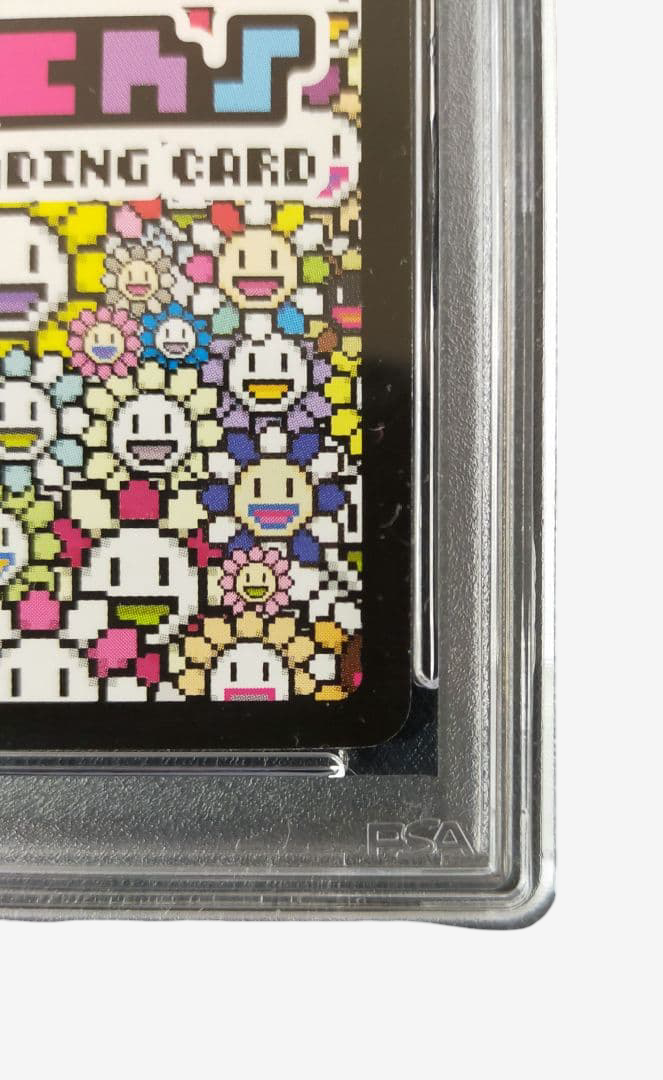
A highly luminous example from Takashi Murakami’s 108 Flowers series, the present “Asa Borake-chan” card is distinguished by its holographic surface, which disperses light into a shifting constellation of circular reflections across the composition. The character, rendered in Murakami’s signature flattened aesthetic, is set within an optically active field that resists static viewing.
Encapsulated within a PSA Mint 9 slab, the card is preserved within an institutional framework of evaluation and permanence, situating it at the intersection of collectible culture and contemporary art practice. The Japanese-language variant further enhances its desirability, reflecting a more limited circulation relative to its global counterparts.
Collector’s example of a high-recognition character within the series; notable for its dynamic surface behavior and its position within Murakami’s serialized visual system.
Work: 108 Flowers Trading Card — (Asa Borake-chan)
Artist: Takashi Murakami
Series: 108 Flowers (Murakami Flowers TCG)
Language Variant: Japanese
Grade: PSA 9 (Mint)
Card Type: High-rarity holo / foil character card
Encapsulation: PSA slab (archival-grade preservation)
Key Rarity Note:
Sub-100 print perception within circulation tier (market-recognized scarcity band)
OVERVIEW
At first encounter, the object appears disarmingly small—contained, even modest within its slab. Yet scale here is misleading. What is held within this format is not merely a card, but a compression of Murakami’s larger visual universe into a surface no larger than a hand.
“Asa Borake-chan” does not function as an isolated character. She emerges instead as a fragment of a wider system—a moment within the expanding field of Murakami’s 108 Flowers project, where image, narrative, and collectible logic converge.
The slab, often mistaken as protective casing alone, becomes in this context a secondary frame—an institutional boundary that quietly signals permanence.
IMAGE & LIGHT
The surface is constructed as a field of interruption.
Light does not rest on the card—it fractures across it. The holographic layer disperses illumination into shifting points, creating a condition in which the image is never entirely fixed. Each movement of the viewer produces a new arrangement of reflections, as though the figure resists being fully seen in a single moment.
The character herself—rendered in Murakami’s distinctly softened anime vocabulary—exists within this instability. Her outline remains consistent, but her environment flickers, dissolves, reforms.
The effect is not decorative. It is temporal.
The card becomes less an image and more an event—something that occurs between light, surface, and gaze.
SCALE & CONTAINMENT
There is a tension inherent to the format.
Murakami’s practice has often operated at monumental scale—canvases, installations, environments that engulf the viewer. Here, that expansive logic is condensed into a strictly bounded plane.
Nothing spills beyond the edges. Nothing escapes.
And yet, the density of information—the layering of color, reflection, and line—suggests something larger pressing against containment. The borders do not feel like limits, but like constraints actively holding something in.
This is where the object gains its quiet intensity.
MATERIAL & PRESERVATION
The PSA slab introduces a second order of meaning.
It does not merely preserve condition; it formalizes the object. It situates the card within a system of evaluation, hierarchy, and archival intent. The grade—Mint 9—signals proximity to perfection without claiming it, leaving a trace of human contingency within an otherwise controlled structure.
The plastic casing reflects light differently from the card beneath, creating a layered optical experience:
- surface glare (outer shell)
- refracted shimmer (inner foil)
Two distinct skins, each interacting with light on separate terms.
CONTEXT — SYSTEMS OF VALUE
The 108 Flowers project occupies a unique position within Murakami’s output. It is neither purely fine art nor purely collectible commodity. It exists between systems, drawing equally from:
- trading card culture
- contemporary art distribution
- digital-era scarcity models
Within this framework, rarity is not only about quantity. It is about circulation, visibility, and narrative attachment.
“Asa Borake-chan,” as a top-tier character within the set, accumulates these factors. Its desirability is not imposed externally—it emerges from within the system itself.
COLLECTOR POSITION
For the collector, the distinction lies not in ownership of a Murakami object, but in participation within a specific layer of his practice.
This is not the monumental Murakami of museum walls.
Nor is it the purely commercial Murakami of mass production.
It is something more precise:
a controlled, serialized, and graded fragment of a larger visual language.
The PSA slab transforms it further—from circulation object to fixed artifact.
CONCLUSION
“Asa Borake-chan” resists simplification.
It is at once:
- an image
- a collectible
- a unit within a system
- an artifact sealed against time
Its significance lies in this multiplicity. It does not resolve into a single category, nor does it need to.
Instead, it remains suspended between them—contained, luminous, and perpetually shifting in the light.
Authenticity & Stewardship
Evaluated under the Japonista Contemporary Art Authentication Framework™:
• Artist attribution, studio verification, and edition confirmation
• Print process, material composition, and production context review
• Condition assessment across surface, framing, and structural integrity
• Release provenance and documentation evaluation
Guaranteed 100% Authentic.
All works are curated and backed by the Japonista Lifetime Authenticity Warranty™.
A Note on Superflat, Commercial Layering & Art Market Context
Murakami’s practice and the Kaikai Kiki studio operate within the intersection of fine art, commercial production, and mass-media aesthetics. Superflat dissolves hierarchy between gallery and marketplace, elevating pop iconography to conceptual discourse.
At Japonista, we treat Murakami and Kaikai Kiki works as contemporary canon. Surface integrity, print clarity, and edition accuracy are examined with institutional discipline, preserving artistic intent rather than speculative hype.
Our role is to steward these works within their proper art-historical and market context, connecting them with collectors who understand both conceptual lineage and edition structure.
Inquiries, Availability, and Private Consideration
Certain works are held firmly due to edition limitation, release context, or condition tier. All inquiries are handled discreetly, and we welcome thoughtful discussion regarding provenance, authentication documentation, or collection strategy.
If you are building a focused contemporary art archive—by series, era, or studio collaboration—our team is available to provide informed guidance.
Concierge Support & Collector Guidance
Japonista Concierge™ provides personalized assistance for collectors seeking deeper insight into edition hierarchies, release cycles, and long-term preservation strategies for contemporary works.
Whether your interest is exhibition display, investment alignment, or art-historical study, we guide each acquisition with clarity and market literacy.
For select high-value works, private reservation or structured arrangements may be available on a case-by-case basis.
Before Proceeding
We kindly encourage collectors to review our shop policies and documentation guidelines, which outline condition transparency, edition verification standards, and shipping precautions specific to contemporary art works.
A Closing Note
Thank you for exploring Japonista’s curated Takashi Murakami & Kaikai Kiki archive. These works exist at the intersection of art theory, commercial production, and global cultural dialogue—and we are honored to steward them with institutional seriousness.
If you have questions or wish to explore related items, please feel free to contact Japonista Concierge™ at any time.