Rare Vintage, Antiques and Art Collector / Curator / Personal Shopper From Japan
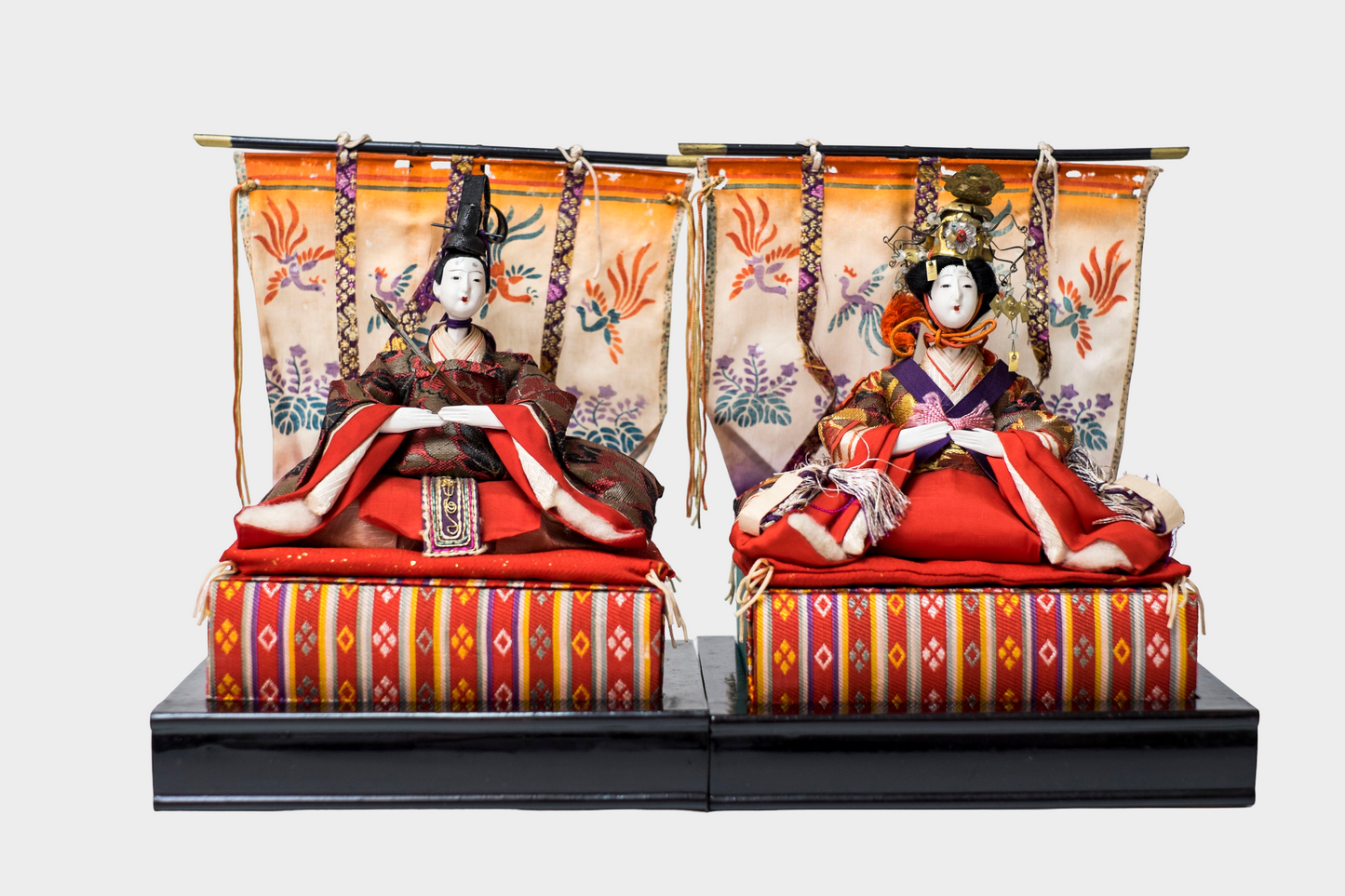
Taishō–Early Shōwa Hina Ningyō Imperial Pair (Dairi-bina) Silk Brocade with Phoenix Screens
Taishō–Early Shōwa Hina Ningyō Imperial Pair (Dairi-bina) Silk Brocade with Phoenix Screens
Couldn't load pickup availability
Have a reasonable price in mind? Submit your best offer and our concierge will review it personally.
🏛 OVERVIEW
A dignified Dairi-bina imperial pair representing the Heian court ideal, executed in early 20th century workshop production.
The Emperor holds a ritual baton (shaku). The Empress wears elaborate kanmuri-style head ornamentation with dangling metal fittings. Both figures are seated formally atop red brocade platforms mounted on lacquered bases.
Behind them, textile byōbu screens display stylized hō-ō phoenix motifs in repeating dyed pattern.
This is a complete upper-tier two-figure display — not a fragment.
Object: Dairi-bina (Imperial Pair) Hina Ningyō Set
Type: Emperor (Odairi-sama) and Empress (Ohina-sama)
Material: Gofun-finished heads (likely composition base), silk brocade garments, lacquered wood platforms, textile byōbu screens
Mounting: Separate black lacquered bases with integrated brocade risers
Screens: Fabric-covered panels with phoenix (hō-ō) motif
Estimated Period: Late Taishō to Early Shōwa (circa 1920s–1940s)
🎨 ICONOGRAPHY
Hina Matsuri (Girls’ Day, March 3) originates in Heian court purification rites.
The Dairi-bina represent:
• The Emperor (Odairi-sama)
• The Empress (Ohina-sama)
Phoenix motifs on the screen signify:
-
Imperial authority
-
Renewal
-
Feminine grace
-
Auspicious power
Layered kimono reflect Heian juunihitoe stylization simplified for doll format.
🧵 MATERIAL & TECHNICAL ANALYSIS
Heads
Likely gofun over molded composition core.
Surface appears intact with minimal cracking from images.
Hair
Black silk fiber arranged in traditional shimada style.
Empress headpiece includes metal floral and pendulum ornaments.
Garments
Silk brocade with metallic thread accents.
Multi-layer textile construction.
Early machine-woven brocade, not handwoven Nishijin masterwork.
Platforms
Brocade risers mounted over wooden cavity frames.
Lacquered bases likely black urushi or synthetic lacquer (period consistent).
Screens
Fabric-draped wooden frame.
Purple gradient lower section.
Signs of staining visible (age consistent).
📚 HISTORICAL CONTEXT
Taishō (1912–1926) and early Shōwa saw expanded middle-class access to Hina displays.
Mass workshop production increased but quality remained respectable.
These sets were:
• Displayed annually
• Carefully stored
• Often passed generationally
They are culturally significant, even when not elite atelier pieces.
🏛 COMPARATIVE POSITIONING
Not:
✖ Edo period hina
✖ Meiji imperial commission quality
✖ Signed master doll studio
✖ Museum-tier carved head specimen
But,
✔ Authentic early 20th century ceremonial dolls
✔ Complete imperial pair
✔ Strong textile presence
✔ Decorative and culturally meaningful
🎯 COLLECTOR RELEVANCE
Target buyer segments:
• Japanese seasonal collectors
• Cultural heritage decorators
• Hina Matsuri traditionalists
• Textile-focused collectors
• Early 20th century Japanese decorative arts buyers
Works well for:
-
Tokonoma display
-
Cultural photography staging
-
Gallery seasonal exhibition
📌 CONFIDENCE & VERIFICATION NOTES
• Period assessed visually; no internal inspection performed
• Faces appear gofun over molded core
• Textile shows age-related wear
• Screens display staining
• No signature observed in provided images
• Classified as Taishō–early Shōwa production
• Not represented as Meiji period without further evidence
Authenticity & Stewardship
Evaluated under the Japonista Traditional Figurative Arts Authentication Framework™:
• Doll type, regional lineage, and craft-school verification
• Material assessment across gofun, silk, wood, lacquer, and mixed media
• Structural integrity of limbs, heads, joints, and mounting components
• Costume preservation, textile condition, and accessory completeness review
Guaranteed 100% Authentic.
All works are curated and backed by the Japonista Lifetime Authenticity Warranty™, with disciplined attention to craft tradition and material stability.
A Note on Ritual, Persona & Cultural Memory
Japanese dolls occupy a unique position within cultural life. They are seasonal guardians, theatrical representations, domestic symbols of growth and protection, and embodiments of aesthetic refinement. Whether Hina dolls marking spring rites, Musha figures reflecting martial valor, or Ichimatsu dolls embodying lifelike presence, each form carries defined symbolic weight.
At Japonista, we approach Japanese dolls as figurative craft traditions rather than decorative curiosities. Gofun surface aging, silk fading, minor textile fray, and patina are evaluated within historical and seasonal context, preserving authenticity while disclosing condition with transparency.
Our role is to steward these works as vessels of cultural memory, ensuring they are placed where their presence may be appreciated with contextual understanding and care.
Inquiries, Availability, and Private Consideration
Certain dolls and seasonal sets are held firmly due to completeness, rarity, or craft significance. All inquiries are handled discreetly, and we welcome thoughtful discussion regarding restoration history, display context, or lineage distinctions.
If you are building a focused archive—by festival type, regional style, theatrical representation, or historical period—our team is available to provide informed, collector-level guidance.
Concierge Support & Collector Guidance
Japonista Concierge™ provides personalized assistance regarding safe display practices, textile preservation, humidity control, and structural stabilization for delicate figurative works.
Whether your intention is seasonal installation, archival storage, or curated exhibition, we guide each acquisition with clarity and respect for the doll’s cultural and material sensitivity.
For select complete Hina or Gogatsu sets, private reservation or structured arrangements may be available on a case-by-case basis.
Before Proceeding
We kindly encourage collectors to review our shop policies and preservation guidelines, available through the links in our website footer, outlining handling precautions, environmental considerations, and condition disclosure standards specific to fragile figurative and textile works.
A Closing Note
Thank you for exploring Japonista’s curated archive of Japanese dolls. These figures embody ritual, craftsmanship, and seasonal continuity across generations. We are honored to steward them where their presence may continue with dignity and cultural understanding.
If you have questions or wish to explore related items, please feel free to contact Japonista Concierge™ at any time.