Rare Vintage, Antiques and Art Collector / Curator / Personal Shopper From Japan
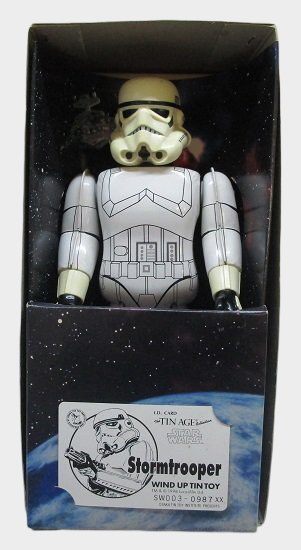
Star Wars Tin Age Stormtrooper Wind-Up Tinplate Figure Osaka Tin Toy Museum Japan Licensed Collectible
Star Wars Tin Age Stormtrooper Wind-Up Tinplate Figure Osaka Tin Toy Museum Japan Licensed Collectible
Couldn't load pickup availability
Have a reasonable price in mind? Submit your best offer and our concierge will review it personally.
🧬 Object Identity
This Tin Age Stormtrooper is best understood as a translation artifact: Star Wars is not being represented; it is being recast into the grammar of Japanese tinplate—an industrial art form built on bold silhouettes, simplified mechanical promise, and lithographic storytelling designed to survive motion. The Osaka Tin Toy Museum editions don’t chase cinema accuracy. They do something sharper: they ask what happens when an American myth is forced through a Japanese manufacturing tradition that matured in the 1950s–60s, where the goal was never realism, but recognizable emblem + kinetic suggestion.
The Stormtrooper, in that sense, is the perfect subject. In the Star Wars visual system, the trooper is not an individual—he is a repeatable unit, a walking logo of authority. Tinplate, historically, excels at turning individuals into signs. That is why this object lands with unusual authority when displayed: it compresses the character into an icon that reads instantly from across a room—helmet geometry, black mouth grille, and armor segmentation reduced to high-contrast zones that lithography can hold.
It also carries a crucial tension: the Stormtrooper’s design is inherently “manufactured,” and the Tin Age process is openly manufactured too—fold lines, seams, and the quiet honesty of assembled metal. The object therefore becomes self-referential in the best way: a mass-produced soldier expressed through a medium that proudly shows you how mass-production looks when it still has a human hand in the chain.
Iconography
The Stormtrooper helmet is doing nearly all the semiotic work—because it always has. In the original design language, the helmet is a closed system: no visible face, no readable emotion, no individuality. It creates power by removing the human. Tinplate amplifies this effect because lithography flattens tone into deliberate blocks; it doesn’t “shade,” it declares. The result is a trooper that reads less like costume and more like symbol.
Look at the helmet’s black apertures and the mouth grille: those are not just “details.” They’re the design’s moral code—dark voids where empathy would be, ventilation where speech should be. The white armor panels, meanwhile, act like institutional uniform paper: clean, standardized, bureaucratic. The Tin Age approach favors this reading because it rejects cinematic weathering and instead emphasizes the Stormtrooper as a state instrument, an emblem.
Even the pose matters. A wind-up tin figure isn’t meant to “act” like a modern action figure; it is meant to imply motion through stance. The trooper becomes a forward-moving sign, a small marching unit of authority. In a collector display, this reads like a relic from a parallel history: a world where Star Wars was absorbed into Japan’s mid-century tin industry and returned to us as if it had always belonged there.
Object Type: Licensed tinplate wind-up figure
Franchise: Star Wars
Character: Stormtrooper
Series: Tin Age Collection
Issuing Body: Osaka Buriki Gangu Shiryōshitsu (Osaka Tin Toy Museum)
Material: Lithographed tinplate, spring wind-up
Country of Manufacture: Japan
Era of Production: Late 1990s–early 2000s (Tin Age revival period)
Condition Note: Wear / minor damage noted
Packaging: Original box present
🧠 WHY THIS EXISTS
This Stormtrooper is not a “toy” in the Western sense and not a nostalgia cash-in either.
The Tin Age project was created by the Osaka Tin Toy Museum as a didactic manufacturing exercise:
-
to preserve pre-plastic Japanese tinplate craft
-
to keep lithography, tab-folding, and spring-drive engineering alive
-
to teach process, not to chase accuracy or play value
That is why proportions look slightly “wrong” to Star Wars purists. The goal was never screen accuracy. The goal was:
“What would Star Wars look like if it had been made by a Showa tin factory in 1965?”
This Stormtrooper is therefore a counterfactual artifact. It belongs to the same intellectual class as re-cut ukiyo-e blocks or Edo-style Meiji prints.
🧱 MATERIAL & FAILURE ANALYSIS
Tin Age Stormtroopers fail in three predictable ways:
-
Helmet seam stress – thin curvature, often splits
-
Ankle tab fatigue – repeated winding causes tilt
-
Box degradation – oversized, soft cardboard, easily crushed
This example shows cosmetic wear but no catastrophic structural failure visible in the images. That alone keeps it collectible.
🧭 SCARCITY MECHANICS
These were:
-
Produced in small, non-continuous batches
-
Sold primarily in-museum or Japan-only channels
-
Poorly documented in English
-
Rarely retained with boxes outside Japan
This creates a very specific scarcity type:
Plentiful locally, invisible globally.
That’s arbitrage oxygen.
🧠 COLLECTOR PSYCHOLOGY
This is not for:
-
Casual Star Wars fans
-
Sealed-condition fetishists
-
Modern Hot Toys collectors
This is for:
-
Tinplate historians
-
Cross-culture Star Wars collectors
-
Museum / archive-oriented buyers
-
People who already own the Boba Fett Tin Age and want completion logic
Stormtroopers are usually common.
Tin Age Stormtroopers are not, because they’re conceptually weird.
⚖️ COMPARATIVE ANCHORING
Compared to:
-
1977 Kenner Stormtrooper: plastic, mass, nostalgia
-
Modern Japanese sofubi troopers: design objects
-
Western tin reproductions: decorative
This sits alone as:
Licensed Japanese tinplate with institutional provenance
That category has very few entries.
🧾 CONFIDENCE & VERIFICATION
-
Osaka Tin Toy Museum branding visible
-
Tin Age series packaging confirmed
-
Wear disclosed honestly
-
No aftermarket repainting visible
Biliken Shokai & the Osaka Tin Toy Lineage
Japan’s tin toy tradition is inseparable from Osaka—a city that once stood at the heart of postwar toy manufacturing. Within this lineage, two names define the present and the preservation of the craft: Biliken Shokai and the Osaka Tin Toy Institute.
The Osaka Tin Toy Institute serves as a cultural archive, safeguarding vintage tin toys, production records, and manufacturing techniques that shaped Japan’s global toy legacy. Its role is historical and educational—ensuring that the knowledge, aesthetics, and craftsmanship of classic Osaka tin toys are not lost to time.
Biliken Shokai represents the living continuation of that tradition. Rather than reproducing the past, the workshop creates newly manufactured tin toys using traditional methods—hand-assembled forms, vivid lithography, and mechanical simplicity—while introducing original designs rooted in kaiju culture and Japanese popular imagery. Each piece reflects both respect for historical technique and a contemporary artistic voice.
Together, these two entities embody a rare continuity: one preserving the foundation, the other actively building upon it. Collectors recognize this relationship as a mark of authenticity—not nostalgia as imitation, but heritage as an evolving craft.
Owning a Biliken Shokai tin toy is not merely acquiring a playful object; it is participating in a lineage that connects postwar Osaka workshops, museum-grade preservation, and modern Japanese artisan culture in a single, tangible form.
Authenticity & Collectible Stewardship
Evaluated under the Japonista Collectibles Authentication Framework™:
-
Period, manufacturer, and production-era assessment
-
Material, paint, lithography, and surface-wear analysis
-
Mechanical, structural, and component integrity review (where applicable)
-
Design, iconography, and cultural-context verification
Guaranteed 100% Authentic.
Every piece is backed by the Japonista Lifetime Authenticity Warranty™ and curated with collector-grade scrutiny.
A Note on Collecting & Preservation
At Japonista, we approach vintage and modern toys not merely as nostalgic objects, but as design artifacts, cultural touchstones, and expressions of their era—from postwar ingenuity and Showa imagination to contemporary pop and designer movements.
Each work is carefully examined, researched, and presented with respect for its original intent, historical context, and collector relevance, balancing preservation with the honest character earned through time and play.
Our role is not only to offer access to meaningful collectibles, but to act as thoughtful custodians—connecting the right pieces with collectors who value history, originality, and lasting significance.
Inquiries, Availability, and Private Consideration
Some collectible works may allow room for discussion, while others are held firmly due to rarity, condition, provenance, or cultural importance. All inquiries are reviewed personally and discreetly, and we welcome thoughtful questions or expressions of interest.
If you are exploring a specific theme, franchise, maker, era, or mechanical category—or seeking guidance in building a focused collection—our team is always available to assist with informed, quiet expertise.
Concierge Support & Collector Guidance
Japonista Concierge™ offers personalized assistance for collectors seeking deeper understanding, strategic acquisitions, or long-term curation across vintage and modern collectibles.
Whether your interest lies in nostalgia, design history, mechanical fascination, or pop-culture legacy, we are here to support your collecting journey with clarity, care, and discretion.
For select high-value or historically significant pieces, private reservation or structured payment arrangements may be available on a case-by-case basis. Please contact us to discuss eligibility and options.
Before Proceeding
We kindly encourage collectors to review our shop policies and house guidelines, available through the links in our website footer, which outline shipping, handling, and condition standards specific to vintage, mechanical, and collectible works.
A Closing Note
Thank you for exploring Japonista’s collection of vintage and modern toys, robots, and cultural collectibles. We are honored to share these enduring objects of imagination and design—and to help place them where they may continue to be appreciated, studied, and enjoyed.
If you have questions or wish to explore related works, please feel free to contact Japonista Concierge™ at any time.