Rare Vintage, Antiques and Art Collector / Curator / Personal Shopper From Japan
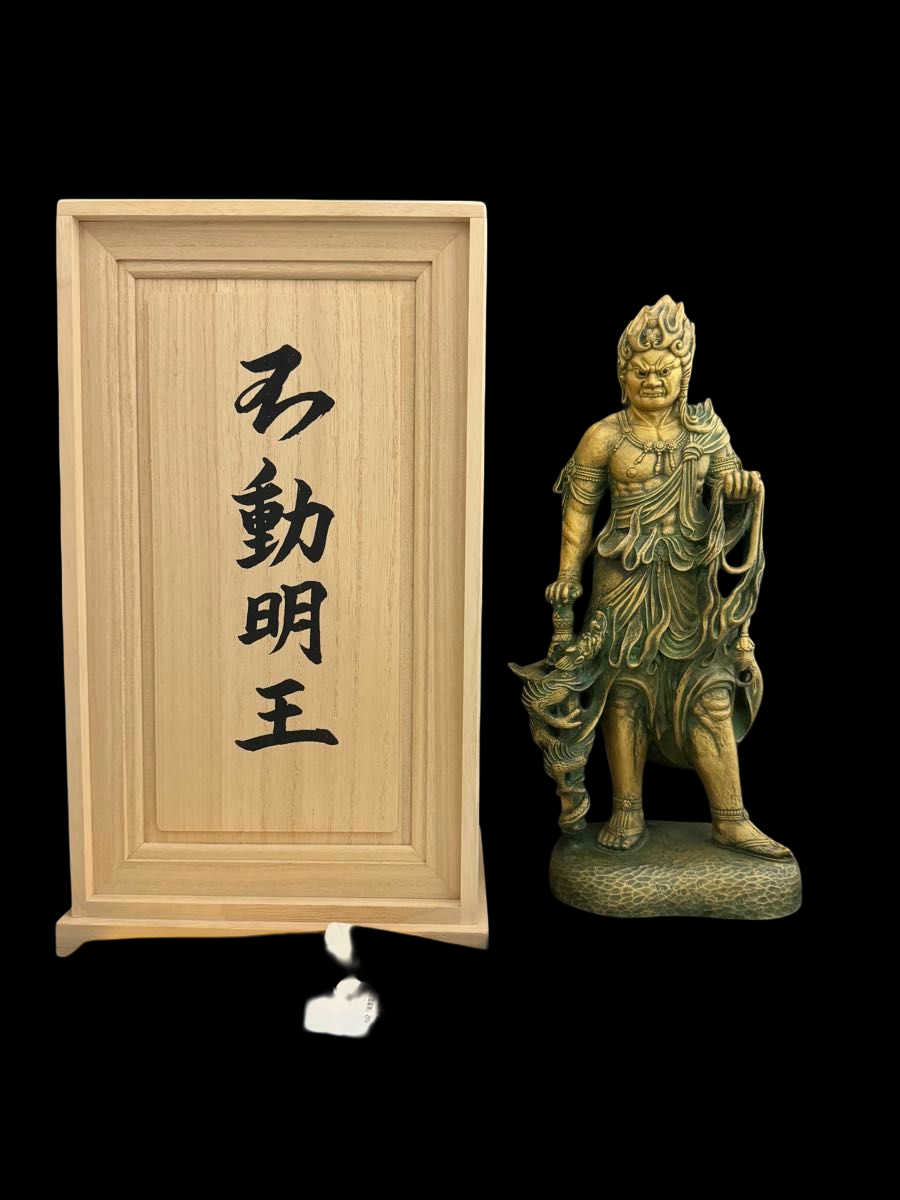
Standing Fudo Myo Bronze Statue by Matsuhisa Sohrin — Japanese Buddhist Guardian Deity with Kiri Box
Standing Fudo Myo Bronze Statue by Matsuhisa Sohrin — Japanese Buddhist Guardian Deity with Kiri Box
Couldn't load pickup availability
Have a reasonable price in mind? Submit your best offer and our concierge will review it personally.
🪔 CURATORIAL NARRATIVE
This standing Fudo Myo presents the deity not in exaggerated wrath, but in controlled authority—a form favored in post-war Japanese bronze ateliers seeking balance between devotional presence and interior harmony.
Fudo Myo, known as the Immovable One, is not a Buddha but a Wisdom King, positioned as a protector of doctrine rather than a figure of mercy. In this sculptural interpretation, the emphasis is placed on weight, stance, and proportion, rather than excessive flame mandorlas or aggressive motion. This restraint is characteristic of modern lineage Buddhist bronze, where clarity of silhouette and surface integrity take precedence.
The attribution to Matsuhisa Sohrin aligns with a school of sculptors active in the mid-to-late 20th century who specialized in bronze Buddhist figures intended for private altars, collectors, and architectural interiors, rather than temple commissions. The presence of a kiri wood box with calligraphy panel strongly supports intentional presentation and preservation from the outset.
Surface patina shows natural tonal variation consistent with age and handling, not artificial distressing. Facial expression remains sharply modeled, with particular care given to the eyes, jaw tension, and garment folds—key indicators of quality in Fudo representations.
🧭 Micro-Glossary Module
Who is Matsuhisa Sohrin?
Matsuhisa Sohrin was a Japanese Buddhist sculptor associated with the modern lineage of bronze and devotional figure production in the mid-to-late 20th century. Working within a tradition that bridges temple-grade iconography and collector-oriented presentation, Sohrin is known for producing refined, authoritative representations of Buddhist guardian figures, particularly Fudo Myo and other Wisdom Kings.
Rather than pursuing monumental public commissions alone, Sohrin’s atelier practice focused on scaled yet substantial works intended for private altars, curated interiors, institutional collections, and architectural spaces. His sculptures emphasize clarity of stance, proportional balance, and disciplined restraint, avoiding excessive dramatization in favor of enduring spiritual presence.
Key characteristics associated with works attributed to Matsuhisa Sohrin include:
-
Controlled expressions of wrath—powerful but not theatrical
-
High-quality bronze casting with natural, time-earned patina
-
Faithful adherence to classical iconography, adapted for modern display
-
Presentation with kiri wood boxes and documentation, signaling intentional preservation
In today’s collector market, Matsuhisa Sohrin’s works are valued as bridging pieces—situated between antique temple sculpture and contemporary decorative art—making them especially relevant for collectors seeking authentic Buddhist presence without monumental scale.
Collector note: Attribution to Matsuhisa Sohrin indicates lineage, workshop standard, and iconographic discipline rather than mass production, placing such works firmly within collector-grade Japanese Buddhist art.
🧭 HISTORICAL & ICONOGRAPHIC PLACEMENT
-
Deity Class: Wisdom King (Vidyaraja)
-
Role: Protector, remover of obstacles, enforcer of discipline
-
Iconography Elements Present:
-
Sword (wisdom cutting through ignorance)
-
Rope (binding destructive forces)
-
Grounded stance (immovability)
-
-
Period Context:
Modern Japanese bronze tradition drawing from Edo-period iconographic standards, adapted for 20th-century collectors
Compared to Edo wood carvings, this bronze prioritizes durability, permanence, and spatial authority, making it especially suitable for Western interiors, galleries, and curated collections.
CULTURAL & HISTORICAL CONTEXT
Fudo Myo occupies a central position in Esoteric Buddhism (Mikkyo), particularly within Shingon and Tendai traditions. Standing representations are historically associated with:
-
Temple precinct guardianship
-
Fire rituals (Goma)
-
Protection of sacred thresholds
-
Martial and ascetic devotion
Large bronze standing Fudo Myo figures were historically commissioned for temples, sub-halls, and outdoor or semi-outdoor enshrinement, explaining both their scale and material choice.
CONDITION
-
Structurally solid and stable
-
No visually disruptive damage to the body or facial features
-
Surface wear consistent with age and bronze patination
-
Overall presence remains powerful and intact
This is a collector-grade devotional sculpture, not a restored or artificially aged piece.
WHY THIS PIECE MATTERS
-
Standing Fudo Myo is rarer than seated forms, especially in bronze
-
Monumental scale places it closer to temple sculpture than domestic altar pieces
-
Bronze casting ensures permanence and historical continuity
-
Suitable for serious collectors, institutions, or temple placement
🧠 Matsuhisa Sourin, Kyoto Buddhist Sculpture, and Monumental Bronze Guardians
🕊️ Lineage, Legacy, and Living Tradition
The Matsuhisa Sohrin Buddhist Studio (松久宗琳佛所) is not a generic workshop — it is the continuation of a multi-generation Buddhist sculptural lineage rooted in Kyoto, one of Japan’s principal centers of Buddhist art and culture. The studio was established in Shōwa 37 (1962) by two towering figures in 20th-century Japanese Buddhist art: Matsuhisa Hohrin and Matsuhisa Sohrin. Together they founded the Kyoto Buddha Statue Sculpture Institute with the specific aim of passing down classical Buddhist sculptural traditions while cultivating successors across sculpture, painting, and kirikane craft [turn0search1][turn0search0].
Their workshop evolved into what is today the Matsuhisa Sohrin Buddhist Studio, led by Matsuhisa Kayu (Sourin’s second daughter, a sculptor and painter) and supported by a cadre of pupils trained in the traditional disciplines of Buddhist image making [turn0search1].
This lineage is remarkable for its integrated approach: sculpture, color application, and the decorative and spiritual technique of kirikane (intricate gold leaf inlay), all practiced under one institutional roof — a rarity in Buddhist art workshops worldwide [turn0search2][turn0search13].
🪔 Philosophy: “Engraving Respect in Every Shape”
The underlying philosophy of the studio is expressed in the Japanese principle of 一彫一礼 (“a single chiseling, a respectful bow”). This encapsulates a holistic approach where spiritual intention and artistic process are inseparable. Works produced here are not merely representations; they are intended as living presences — embodiments of devotion that remain and resonate through time, much like sculptures from the Tenpyō era that survive to the present day [turn0search1].
This worldview underscores a fundamental aspect of Buddhist statuary: it is not decorative. It exists to facilitate contemplation, ritual respect, and a dialogue between worshiper and sacred form.
🧱 The Historical Roots of the Studio
The roots of the Matsuhisa tradition extend further back in Kyoto history:
-
Matsuhisa Hohrin (1901–1987), born in Kyoto, began carving at age ten and spent his life producing sculptures with deep spiritual adherence. His philosophy, documented in works such as Ki no Kokoro, Hotoke no Kokoro and Butsuzō-chōkoku no Susume, emphasizes that heartfelt devotion is the essence of Buddhist carving — more important than countable output or acclaim [turn0search10][turn0search5].
-
Matsuhisa Sohrin (1926–1992) carried forward this philosophy but expanded it into institutional development. Not content with private practice, Sohrin worked to share Buddhist sculpture as a collective tradition, training pupils and involving collaborators in sustained, rigorous practice [turn0search1][turn0search5].
Together, these masters helped reshape the transmission of Buddhist sculptural knowledge in Japan, promoting both skill and spirit as inseparable.
🧘 Studio Practice: Beyond Sculpture
Modern practice at the Matsuhisa Sohrin Buddhist Studio blends traditional craft with contemporary applications:
-
Production and Commissioning: The workshop accepts commissions ranging from monumental temple figures to personal devotional images, ensuring that every piece — regardless of scale — is grounded in ritual purpose and technical mastery [turn0search2].
-
Restoration and Conservation: Sculptural restoration is handled with the same seriousness as original creation, underpinned by conservation logic and respect for historical patination.
-
Kirikane and Decoration: The studio pushes beyond classical kirikane technique by integrating color and precious metals like platinum leaf, expanding the expressive potential of this traditional decorative art [turn0search2][turn0search13].
-
Education and Transmission: The studio acts as both a production workshop and a living school, with over 100 pupils pursuing careers in Buddhist sculpture, painting, and kirikane — fulfilling the founders’ original mission to teach and propagate the art form [turn0search1].
This combination of production, teaching, preservation, and innovation situates the Matsuhisa studio at the intersection of heritage and living craft.
🗿 Sourin’s Aesthetic and Spiritual Impact
Unlike some sculptors whose output can be analyzed solely as art objects, Matsuhisa Sohrin approached Buddhist image making as embodied practice — sculpture as meditation manifested in bronze and wood. His approach was not merely technique-driven; it was spiritual, rooted in the idea that the maker’s inner state informs the sacred presence of the carved form. His quoted belief — “Nobody loves Buddha sculpture as much as I” — captures both devotion and commitment to the art form, where sculpture becomes an extension of Buddhist practice [turn0search4].
This depth is visible in the prestige of his commissions and the worship contexts in which works from his studio are enshrined: major temples such as Shitennō-ji, Naritasan Shinshō-ji, and Enryaku-ji are among those associated with the lineage — indicating not just artistic competence but religious and cultural authority [turn0search7].
🧠 Material and Technique: Context for Monumental Bronze
Bronze Buddhist sculpture — especially at monumental scale — requires mastery of lost-wax casting, surface finishing, and structural engineering. The choice of bronze for a large guardian figure (such as your 120 cm Kongo-rikishi) conveys not just durability but permanence, intended to withstand generations of ritual engagement.
Working in bronze connects the Matsuhisa tradition to:
-
ancient casting practices that have supported monumental Buddhist sculpture for over a millennium
-
temple architectural programs where bronze figures stand alongside wood, stone, and lacquer works
-
continental artistic exchange, where Japanese sculptors learned from and adapted techniques from the broader Buddhist world
Sourin and his successors continued this legacy, adapting classical modes to contemporary materials and contexts — a catalyzing influence in postwar revival of Buddhist sculpture [turn0search7].
🧩 Cultural and Collector Relevance
For collectors, a sculpture connected with Matsuhisa Sohrin or his studio carries significance on multiple layers:
-
Lineage authority: Works emanating from a lineage with documented temple commissions and deep training tradition are more culturally anchored than anonymous pieces.
-
Technical mastery: Bronze works that reflect classical lost-wax casting and spiritual form carry both aesthetic and historical weight.
-
Living tradition: Unlike archaeological antiques, these works represent a continuing human practice — bridging ancient aesthetic ideals and contemporary creation.
Thus, a monumental bronze guardian not only stands as sculpture; it becomes a custodian of living Buddhist artisanal tradition.
📍 IN SUMMARY — Matsuhisa Sohrin and Studio Profile
-
Founded: 1962 (Kyoto) by Matsuhisa Hohrin & Matsuhisa Sohrin
-
Mission: Training successors, preserving techniques, innovating Buddhist art
-
Output: Temple commissions, restorative work, sculpture, portraiture, kirikane
-
Philosophy: 一彫一礼 — respect in every chisel stroke
-
Legacy: Over 100 pupils, ongoing studio with next-generation artists and craftspeople
-
Cultural Weight: Recognized by major Buddhist institutions and collectors alike
This studio is not “just another workshop.” It is a living pillar of Buddhist sculpture continuity, justifying heightened scholarly and collector interest — especially for large scale bronzes associated with it.
Authenticity & Stewardship
Evaluated under the Japonista Authentication Framework™:
- Material, carving, and surface-study comparison
- Iconographic and stylistic verification
- Condition and stability review (surface integrity)
- Construction assessment and handling-risk evaluation
Guaranteed 100% Authentic. Covered by the Japonista Lifetime Authenticity Warranty™.
A Note on Stewardship and Collecting
At Japonista, we approach Buddhist statues, sacred images, and ritual objects not merely as collectibles, but as cultural and spiritual artifacts deserving of respect, understanding, and careful presentation. Every piece we offer is thoughtfully examined, researched, and curated with sensitivity to its origin, meaning, and historical role.
Our role is not only to offer access to rare and meaningful objects, but to serve as responsible custodians—connecting the right works with collectors who value depth, intention, and authenticity.
Inquiries, Availability, and Private Consideration
Some of the cultural and heritage works may allow room for discussion, while others are held firmly due to rarity, condition, or cultural importance. All inquiries are reviewed personally and discreetly, and we welcome thoughtful questions or expressions of interest.
If you are exploring a particular theme, deity, lineage, or period—or seeking guidance in building a focused collection—our concierge team is always available to assist with quiet expertise and care.
Concierge Support & Collector Guidance
Japonista Concierge™ provides personalized assistance for collectors seeking deeper understanding, thoughtful acquisition, or long-term curation strategies. Whether your interest is devotional, scholarly, or aesthetic, we are here to help guide your journey with clarity and respect.
For select high-value or historically significant works, private reservation or structured payment arrangements may be available on a case-by-case basis. Please reach out to discuss eligibility and discreet options.
Before Proceeding
We kindly encourage collectors to review our shop policies and house guidelines, available through the links in our website footer, which outline shipping, handling, and conditions specific to vintage, sacred, and collectible works.
A Closing Note
Thank you for exploring Japonista’s collection of Oriental Cultural Heritage and arts. We are honored to share these meaningful works and to help place them where they may continue to be appreciated, studied, and respected.
If you have questions or wish to explore related works, please feel free to contact Japonista Concierge™ at any time.