Rare Vintage, Antiques and Art Collector / Curator / Personal Shopper From Japan
Rare Signed Ryubundo Tetsubin Iron Kettle — Iwamoto Maker — Japanese Antique Tea Ceremony Art
Rare Signed Ryubundo Tetsubin Iron Kettle — Iwamoto Maker — Japanese Antique Tea Ceremony Art
Couldn't load pickup availability
Have a reasonable price in mind? Submit your best offer and our concierge will review it personally.
Overview & Cultural Context
A great tetsubin is not merely a vessel; it is a small architecture of heat, time, and surface memory. In the Japanese tea world, iron kettles occupy a quiet authority: they are functional first, yet they carry an unmistakable dignity that turns daily boiling into a ritual. What you are looking at here is an older-style tetsubin presented as a tea utensil with a mature, grounded presence—heavy enough to feel serious, refined enough to live as a display-grade object.
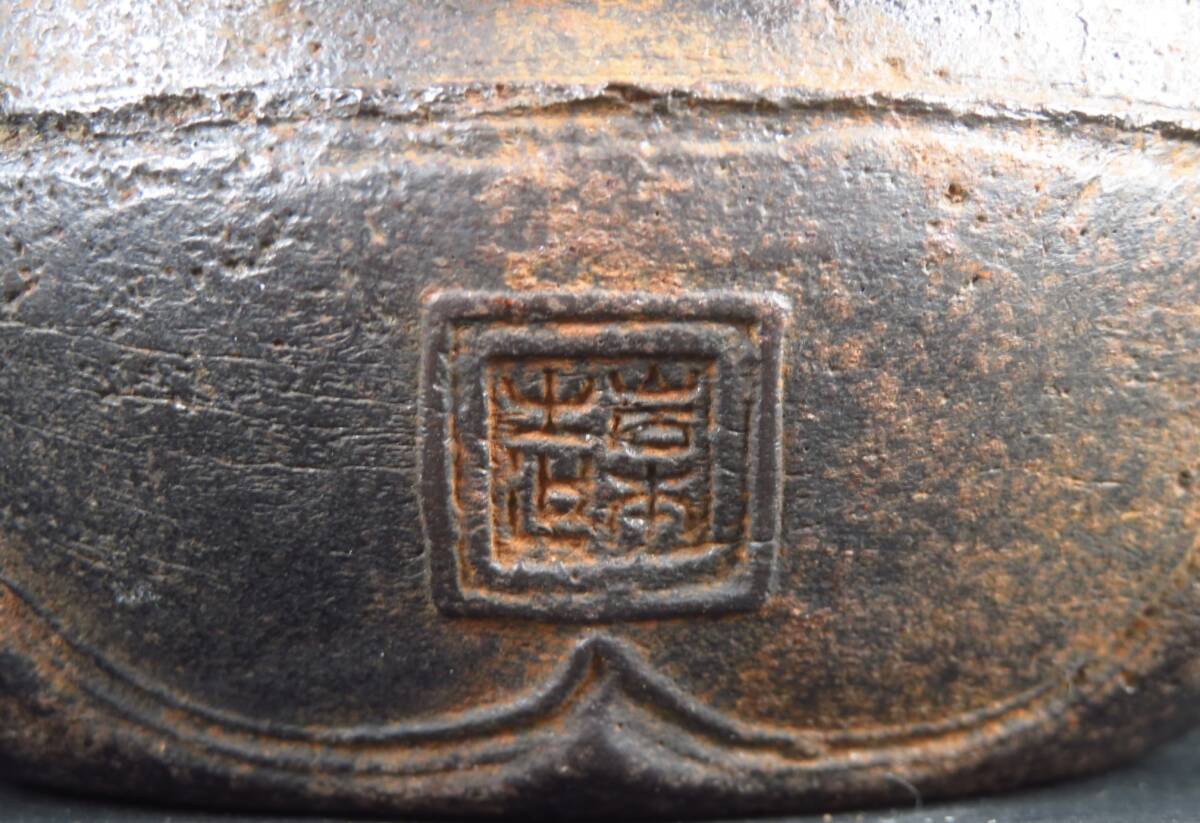
This piece is presented with Ryubundo / Iwamoto-related markings (seal / stamp visible in the photos). In Japanese collecting, maker marks and workshop seals often function like a handshake across time: sometimes fully documented, sometimes known through comparative surfaces, stamp styles, and construction habits. Even when documentation is not included, a well-cut seal and a coherent build language can strongly suggest a school or workshop lineage. This is why a stamped kettle, especially one with a legible seal panel, tends to sit in a higher attention bracket than anonymous cast work.
A tetsubin becomes “good” through decisions you cannot unsee once you notice them: the arc of the handle, the disciplined lip, the spout geometry, the hinge-like join of lid to rim, and the way relief sits on the body as if it belongs there rather than being pasted on. When those elements harmonize, the kettle reads as calm power. This one presents exactly that kind of cohesion—an object that feels engineered for use, but composed for aesthetic permanence.
Collectors also value tetsubin because the medium rewards patience. Iron develops honest patina, not fragile shine. The object can age with a home rather than being afraid of it. In a market saturated with decorative imitations, an older, well-formed kettle with credible stamps and a balanced silhouette stands out as a long-horizon acquisition—something you keep, not something you rotate.
Material, Technique & Object Character
Tetsubin are typically cast iron, built to withstand repeated thermal cycles. The best examples show a confident casting surface: neither overly soft nor overly crude, with edges that resolve cleanly (especially around the rim, lid seat, and relief boundaries). The handle should feel structurally “correct”—a stable arc that reads as load-bearing rather than ornamental.
This kettle’s form suggests a deliberate, older profile: compact but tall (approx. 22 cm height), with a silhouette that prioritizes presence. The spout is proportioned to the body (not needle-thin, not blunt), which matters for both pour control and visual balance. The lid appears appropriately seated and scaled—important because lid fit is where many lesser kettles reveal themselves.
The visible seal panel is particularly meaningful. For serious tea-object buyers, seals and stamps are not decoration; they are a language of workshop identity. Even when the exact artist biography is not supplied, a coherent seal placement and confident carving can support a “workshop/school attribution” that is materially stronger than an unmarked piece.
Design Language & Collector Psychology
Why do people pay for iron? Because iron is the opposite of disposable culture. A tetsubin is a “slow object”: it asks for care, gives back stability, and becomes more itself over time. In interiors, it reads as deliberate restraint—black, brown, and deep metal tones that anchor a room without demanding attention. In tea culture, it reads as discipline: the kettle is where heat becomes readiness.
This is also why the best buyers are not only tea practitioners. Interior collectors, design-oriented buyers, and Japan-culture collectors often choose a kettle precisely because it bridges sacred and practical—an object you can use, but also an object you can honor visually. A stamped kettle adds one more layer: it offers the collector the satisfaction of “named tradition,” not only anonymous utility.
Why This Piece
- Credible workshop/school identity indicated by seal / stamp (stronger than anonymous cast iron).
- Scale that reads as “serious object,” not small decorative ironware (22 cm height; substantial weight).
- Aesthetic permanence: an iron object that integrates into modern interiors while remaining authentically Japanese.
- Collectible logic: stamped kettles tend to hold attention and value better than unmarked counterparts.
- A long-horizon acquisition: iron improves with stewardship; it is built to stay.
Key Facts
- Object type: Japanese tetsubin (cast iron tea kettle)
- Attribution: Ryubundo school / Iwamoto seal (stylistic + stamp-based; documentation not provided)
- Material: Cast iron
- Approx. size (provided): Overall length approx. 17.5 cm; height approx. 22.0 cm
- Weight (provided): Approx. 2.05 kg
- Condition note: Presented as well-kept; age patina expected (please review photos for surface nuance)
Condition & Care
Ironware can show natural patina shifts, fine surface variation, and tone changes from storage and age. We recommend reviewing close-up photos of the rim, lid seat, and base. For use, standard tetsubin care applies (avoid detergents; fully dry after use; prevent long-term standing moisture). If you intend display-only, the piece reads exceptionally well in a shelf or tea-room setting.
Collector’s Resonance
This is for the buyer who wants quiet authority—someone building an interior with Japanese gravity, or someone who collects tea objects that feel intentional rather than decorative. If your taste leans toward durable, honest materials—iron, wood, stone—this kettle will speak your language immediately. It is less about flash and more about presence.
Shipping & Logistics
Estimated object weight (provided): ~2.05 kg
Recommended packed weight (double-box, padding, moisture barrier): ~3.8–4.6 kg
Estimated packed dimensions (safe): ~30 x 26 x 24 cm (subject to final packing)
Confidence & Verification Notes
Attribution is based on the visible seal/stamp, construction language, and stylistic coherence consistent with Japanese tetsubin traditions. No separate documentation confirming an exact artist biography is included here. Treat specific master-level claims as probable rather than certain unless independent paperwork is provided.
Customs (HS Code & Country of Origin)
Country of origin: Japan
HS Code (recommended): 7323.91 (cast iron household/kitchen articles) — classification can vary by customs authority.
Explore the Collection
To browse related Japanese tea objects and culturally significant works curated under the same standards, explore our Buddhist Statues & Sacred Art collection.
Authenticity & Stewardship
- Material and surface-study comparison
- Construction and stamp/seal review
- Condition stability review (rim, lid seat, base)
AUTHENTICITY & GUARANTEE
Evaluated under the Japonista Authentication Framework™:
-
Casting analysis and surface-study comparison
-
Motif verification
-
Patina and oxidation aging review
-
Mold-mark consistency checks
-
Handle and lid metallurgy inspection
-
Interior firing and mineral pattern confirmation
Guaranteed 100% Authentic. Covered by the Japonista Lifetime Authenticity Warranty™.
Looking to secure this piece today?
At Japonista, we take pride in offering only carefully curated, original, and authentic pieces. Every item we list is examined, researched, and backed by our full authenticity guarantee—so you may buy with complete confidence.
Some of our pieces may allow a little room for negotiation, while others hold firm due to rarity, condition, or collector value. On a case-by-case basis, we do entertain best offers, and we welcome you to submit one if you have a particular figure in mind. We review all offers seriously and personally.
Should you have any questions, require tailored recommendations, or need assistance with budgeting or shipping arrangements, our concierge team is always here to help. Simply message us anytime—we are warm, responsive, and ready to assist.
Before checking out, we kindly encourage you to review our shop policies and house rules, available through the links in our website footer, as they offer clarity regarding shipping, handling, returns, and conditions for vintage and collectible goods.
For clients who wish to reserve a high-value item, Japonista provides layaway plans on a case-by-case basis. This allows you to lock in rare pieces while spacing out payments flexibly and discreetly. Simply reach out to request eligibility and tailored arrangements.
Have questions or want to place this item on hold?
Contact our Japonista Concierge™ anytime for priority assistance and private offers.
Thank you for choosing Japonista. We are honored to share these extraordinary treasures of Japan with you, from our heart to your doorstep.
Curatorial Footer: Tetsubin occupy the boundary between daily use and ritual culture in Japanese tea practice.