Skip to product information
1 of 7

Rare Vintage, Antiques and Art Collector / Curator / Personal Shopper From Japan

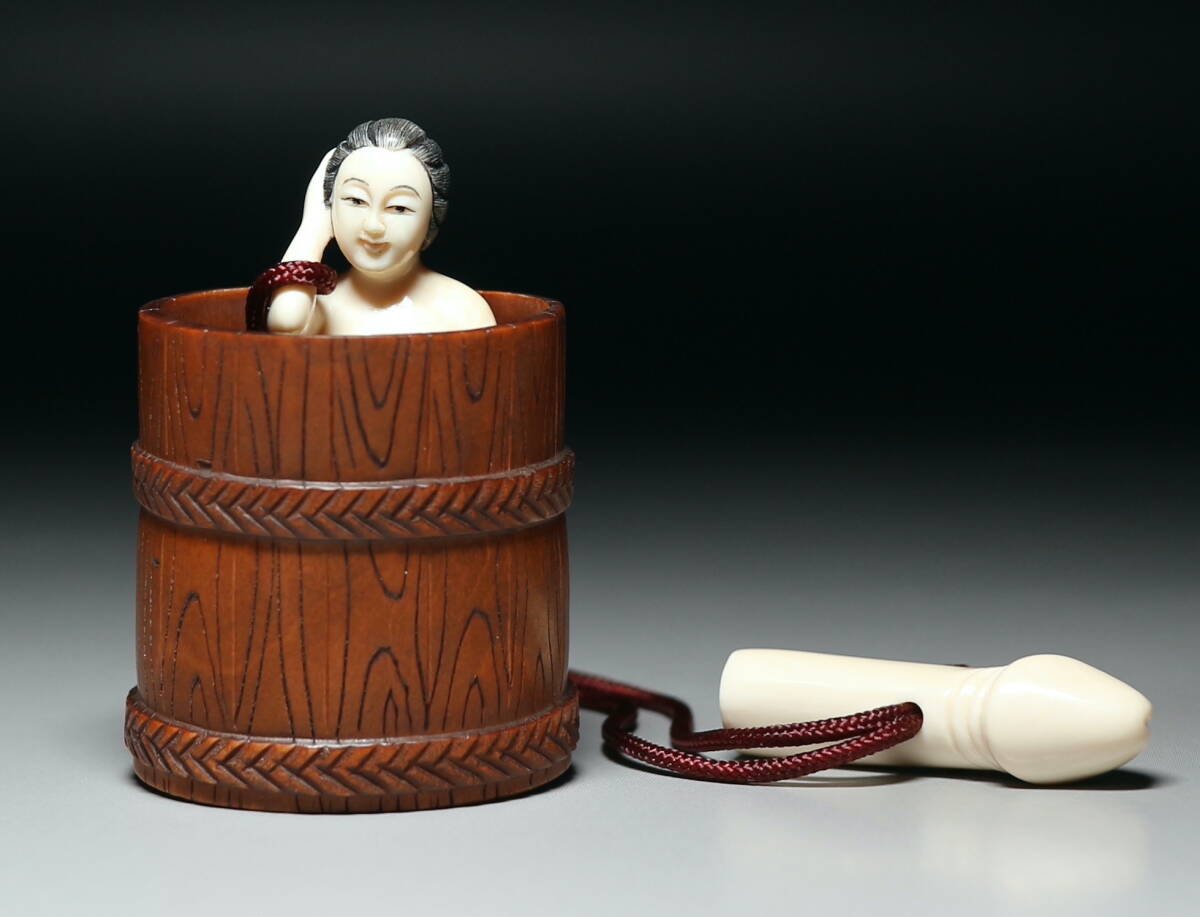
Japanese Erotic Netsuke Figure with Bath Tub — Concealed Shunga Ivory Ensemble, Mammoth Tusk, Showa Period

Japanese Erotic Netsuke Figure with Bath Tub — Concealed Shunga Ivory Ensemble, Mammoth Tusk, Showa Period

Regular price $1,350.00 USD
Regular price Sale price $1,350.00 USD
Sale Sold out
Shipping calculated at checkout.
Quantity
SEND AN OFFER

Have a reasonable price in mind? Submit your best offer and our concierge will review it personally.

Share

CURATORIAL OVERVIEW — WHAT THIS OBJECT ACTUALLY IS

This object is a multi-component erotic netsuke ensemble, combining a kneeling female figure with a carved wooden bathing tub and a concealed ivory element. Rather than overt erotic display, it operates through implication, humor, and concealment, aligning closely with Edo-derived shunga logic where sexuality is embedded within everyday domestic scenes.

Bathing women (yuyoku-bi, yuagari-onna) are a long-standing subject in Japanese visual culture, representing vulnerability, sensuality, and the threshold between public and private. Here, the figure’s modest pose contrasts deliberately with the hidden erotic component, reinforcing the tradition of ura-shunga—art that reveals itself only to the informed or curious handler.

Object Type
Erotic netsuke-scale figural ensemble with accessory vessel (concealed shunga / bathing motif)

Era
Likely late Showa period (circa 1960s–1980s), informed by Edo-period shunga and bathing-woman iconography

Origin
Japan

Materials
Keratinized mammoth ivory (ke-naga mammoth tusk) figure and detachable element; carved and stained wood vessel; cord binding

Dimensions
Approx. 38 mm (H) × 33 mm (W) × 65 mm (D) overall (assembled)

Condition (Truth State)
Excellent condition. Smooth ivory polish with even patina; no visible cracks or restorations. Wooden vessel clean and intact; cord original and functional.


ICONOGRAPHY & THEMATIC ANALYSIS

The tub functions as both narrative prop and concealment device. In Japanese erotic folk art, containers—boxes, barrels, tubs—often symbolize the boundary between restraint and release. The figure’s posture, with lowered gaze and bent knees, evokes modesty rather than invitation, heightening the contrast once the concealed element is discovered.

This interplay of innocence and erotic knowledge is central to shunga philosophy: pleasure is not crude, but clever, situational, and human.


MATERIAL & CRAFT ASSESSMENT

The mammoth ivory carving demonstrates confident handling of small-scale anatomy: smooth limb transitions, balanced proportions, and a warm, translucent surface polish consistent with hand-finished work. The detachable ivory component is carved to the same material standard, indicating intentional ensemble production rather than later pairing.

The wooden tub shows careful grain orientation and carved banding, suggesting workshop familiarity with traditional netsuke accessories rather than novelty manufacture.


HISTORICAL CONTEXT — WHY THESE SURVIVE AT ALL

During the Showa period, especially post-war decades, skilled artisans revisited Edo motifs in private production runs. Erotic netsuke survived precisely because they were portable, discreet, and collectible, unlike prints or large sculptures that faced censorship or destruction.

Multi-part erotic netsuke ensembles are less common than single-figure carvings, as they required greater labor and were more easily separated over time—making intact examples increasingly scarce.


COLLECTOR RELEVANCE

This piece is particularly relevant to collectors of:

  • Erotic netsuke and ivory miniatures

  • Shunga-inspired folk sculpture

  • Concealed or interactive Japanese art objects

  • Mammoth ivory carving traditions

The inclusion of the original wooden vessel significantly enhances collector value.


SUMMARY — WHY THIS PIECE MATTERS

This ensemble encapsulates the Japanese art of suggestion—where eroticism is intellectual, concealed, and playful rather than explicit. It represents continuity between Edo visual culture and Showa-era artisan revival, preserved in tactile, intimate scale.


🔗 SUB-COLLECTION

This object is best positioned within the Shunga & Hidden Arts parent collection, specifically under the sub-collection Erotic Netsuke & Concealed Ivory Ensembles. Such works form the backbone of the category, illustrating how Japanese erotic art persisted through private, collectible objects rather than public display.


PRIVATE CULTURE ARCHIVE

Shunga & Hidden Arts

Japanese erotic art objects, concealed craft traditions, and quiet connoisseur pieces — presented with museum-grade context and restraint.


CURATORIAL OVERVIEW — WHAT THIS COLLECTION ACTUALLY IS

Shunga & Hidden Arts is a private-culture archive: objects made for discreet viewing, intimate humor, and coded storytelling—where craft carries what polite society refuses to say out loud.

Shunga is most often reduced to Edo-period woodblock prints, but the lived tradition is far broader. Alongside prints existed sculptural works, concealed objects, narrative figurines, and intimate curios whose meaning revealed itself only to those who handled them closely. These were not made for display rooms or formal halls. They were made for drawers, boxes, trusted friends, and moments of private curiosity.

This collection focuses on three-dimensional and material culture. Here, the hand of the maker matters as much as the theme. Carving discipline, surface aging, textile bases, micro-scale detailing, and the physics of concealment all become part of the story. The goal is not shock. It is clarity: how intimacy was expressed, preserved, and quietly enjoyed as lived culture.

Every object is presented with context-first writing—what it is, why it exists, how it fits Japanese visual language, and what collector lane it belongs to. Where attribution or dating is uncertain, that uncertainty is stated openly. In this category, credibility is the real luxury.


SCOPE OF THE COLLECTION

This archive includes:

  • Sculptural shunga objects beyond prints

  • Concealed or “hidden-image” works (ura-kakushi)

  • Erotic folk figures and vernacular carvings

  • Studio-grade artisan pieces referencing classical erotic iconography

  • High-material works (ceramic, textile, mammoth ivory) produced in limited numbers

These objects are framed as cultural artifacts, not novelty items.


HISTORICAL CONTEXT — WHY THESE OBJECTS EXIST

Erotic imagery has always existed in Japanese culture, but its physical forms were shaped by censorship, social codes, and private circulation. While prints could be produced in quantity, three-dimensional erotic objects were far riskier to make, own, and preserve. As a result, sculptural and concealed erotic works were typically produced in small numbers, circulated discreetly, and rarely documented.

Many were destroyed. Others were hidden, passed down quietly, or absorbed into private collections without records. What survives today does so not by accident, but because someone chose to preserve it despite social pressure.

This collection exists to document that survival.


COLLECTOR POSITIONING

Shunga & Hidden Arts is intended for collectors who value:

  • Context over provocation

  • Craft over gimmick

  • Rarity over mass appeal

  • Cultural literacy over shock value

These pieces sit comfortably alongside netsuke, vernacular folk sculpture, contemporary erotic bronzes, and archival shunga albums. They are connoisseur objects, meant to be understood slowly and cataloged thoughtfully.


ETHICAL & PRESENTATION NOTE

Adult themes appear throughout this archive. They are presented in a museum and academic tone, prioritizing cultural history, craftsmanship, and visual language rather than explicit instruction or sensationalism.

Viewer discretion is advised, but the intent is educational and curatorial.


CONCIERGE NOTE

If you are searching for a specific motif, material, era, or scale—or wish to build a coherent sub-collection within this archive—we can curate discreetly and professionally within your collector lane.


SUMMARY — WHY THIS COLLECTION MATTERS

Shunga & Hidden Arts preserves what official histories often omit: intimacy as lived experience, humor as social release, and eroticism as cultural language rather than spectacle.

These objects matter because they show how people actually lived, laughed, desired, and created—quietly, privately, and with remarkable craft.


Authenticity & Stewardship

Evaluated under the Japonista Authentication Framework™:

  • Material, carving, and surface-study comparison
  • Iconographic and stylistic verification
  • Condition and stability review (surface integrity)
  • Construction assessment and handling-risk evaluation

Guaranteed 100% Authentic. Covered by the Japonista Lifetime Authenticity Warranty™.


A Note on Stewardship and Collecting

At Japonista, we approach Buddhist statues, sacred images, and ritual objects not merely as collectibles, but as cultural and spiritual artifacts deserving of respect, understanding, and careful presentation. Every piece we offer is thoughtfully examined, researched, and curated with sensitivity to its origin, meaning, and historical role.

Our role is not only to offer access to rare and meaningful objects, but to serve as responsible custodians—connecting the right works with collectors who value depth, intention, and authenticity.


Inquiries, Availability, and Private Consideration

Some of the cultural and heritage works may allow room for discussion, while others are held firmly due to rarity, condition, or cultural importance. All inquiries are reviewed personally and discreetly, and we welcome thoughtful questions or expressions of interest.

If you are exploring a particular theme, deity, lineage, or period—or seeking guidance in building a focused collection—our concierge team is always available to assist with quiet expertise and care.


Concierge Support & Collector Guidance

Japonista Concierge™ provides personalized assistance for collectors seeking deeper understanding, thoughtful acquisition, or long-term curation strategies. Whether your interest is devotional, scholarly, or aesthetic, we are here to help guide your journey with clarity and respect.

For select high-value or historically significant works, private reservation or structured payment arrangements may be available on a case-by-case basis. Please reach out to discuss eligibility and discreet options.


Before Proceeding

We kindly encourage collectors to review our shop policies and house guidelines, available through the links in our website footer, which outline shipping, handling, and conditions specific to vintage, sacred, and collectible works.


A Closing Note

Thank you for exploring Japonista’s collection of Oriental Cultural Heritage and arts. We are honored to share these meaningful works and to help place them where they may continue to be appreciated, studied, and respected.

If you have questions or wish to explore related works, please feel free to contact Japonista Concierge™ at any time.

View full details