Rare Vintage, Antiques and Art Collector / Curator / Personal Shopper From Japan
Showa-Era Japanese Tin “Mighty Atom Boat” with Astro Boy, Large Mechanical Wind-Up Character Vehicle (ATD)
Showa-Era Japanese Tin “Mighty Atom Boat” with Astro Boy, Large Mechanical Wind-Up Character Vehicle (ATD)
Couldn't load pickup availability
Have a reasonable price in mind? Submit your best offer and our concierge will review it personally.
Showa Japanese Tin “Mighty Atom Boat” (ATD)
Object Spine
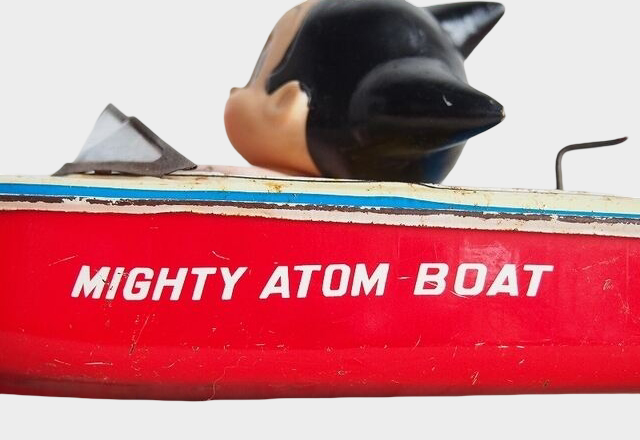
Oversized Japanese tinplate “Mighty Atom Boat” featuring Astro Boy (Atom) rendered as a three-dimensional seated pilot. Produced in Japan during the Showa period, this large-format mechanical tin toy combines character iconography, marine speed aesthetics, and wind-up propulsion into a visually commanding display object emblematic of postwar Japanese toy engineering and export-era optimism.
This is not a novelty miniature but a display-scale mechanical object, designed to read from a distance and command presence within a collection.
Astro Boy Cultural Essay
Astro Boy is not merely a character but a postwar philosophical symbol. Created during Japan’s recovery years, he embodies a radical idea: that advanced technology can coexist with compassion, restraint, and moral responsibility. Unlike Western robotic archetypes rooted in domination or fear, Astro Boy represents ethical futurism—power guided by empathy.
The choice to place Astro Boy in a speedboat is culturally revealing. Boats in Showa Japan symbolized leisure modernity, freedom, and technological progress divorced from militarism. This pairing reframes Atom not as a weapon or machine, but as a joyful participant in a peaceful, forward-looking society. As such, this object functions as a three-dimensional cultural thesis, not merely a toy.
Manufacturer Study — ATD
Confirmed marking: ATD
Manufacture: Japan
Era: Mid–late Showa (approx. 1960s–early 1970s)
ATD occupies an important secondary-tier position in Japanese tin toy history:
-
Smaller production runs than Bandai or Yonezawa
-
Willingness to experiment with hybrid novelty forms (boats, unusual vehicles)
-
Strong focus on character prominence over pure realism
ATD Astro Boy items are not mass-saturated and are materially scarcer than Bandai equivalents, particularly in large formats.
Formal Design Analysis
Hull & Form
-
Elongated speedboat hull exaggerates forward motion
-
Raised deck plane emphasizes Atom as focal point
-
Wide beam relative to length enhances stability and visual heft
Graphic Language
-
High-saturation lithography with simplified iconography
-
English text (“MIGHTY ATOM BOAT”) confirms export orientation
-
Playful yet confident color blocking reflects mid-century toy modernism
Figure Integration
-
Atom’s head and expression act as an emotional anchor
-
Scale intentionally oversized relative to hull for charm and visibility
-
Blurs boundary between vehicle and character sculpture
Materials & Fabrication
-
Tinplate steel hull with rolled edges
-
Lithographed surfaces using period-correct ink saturation
-
Molded plastic Atom head and upper body
-
Internal steel zenmai (spring) motor
-
Rear metal screw / propeller assembly
No composite plastics, no post-1970s materials. Construction fully consistent with pre-oil-shock Japanese tin manufacturing.
Mechanical System
-
Traditional zenmai wind-up motor, confirmed operational
-
Rear propeller spins when wound, simulating powered marine travel
-
Mechanical noise and vibration typical of Showa wind-up toys
Functionality is a major value multiplier, particularly for boat-format tins where mechanisms often fail due to moisture exposure.
Scale & Physical Presence
Measured dimensions:
-
Height: ~10.0 cm
-
Width: ~11.4 cm
-
Length: ~37.0 cm
This places the object firmly in the large-format category, closer to architectural toy objects than shelf miniatures. Comparable in footprint to large tin fire engines and tanks, but rarer due to boat configuration.
Condition Analysis
Condition Tier: B (Original, Unrestored)
Observed / disclosed:
-
General surface scuffing and scratches
-
Minor paint wear and edge chips
-
No repaint, no modern restoration
-
No structural deformation
-
Mechanism remains functional
From a serious collector perspective, this is preferable to over-restored examples, retaining original surfaces and honest patina.
Cultural & Iconographic Weight
Astro Boy is not merely a character but a cultural thesis:
-
Embodies ethical technology, pacifism, and futurism
-
Central to Japan’s postwar identity formation
-
Hugely influential on robotics, animation, and toy culture
Boat imagery adds a leisure-modernism layer—speed, freedom, and technological play—distinct from more common land vehicles.
Rarity & Survivability
-
Boats were produced in lower numbers than cars or robots
-
Exposure to water led to higher attrition rates
-
Large tin boats are disproportionately scarce in working condition
Survival with intact lithography and functioning zenmai significantly elevates this example into upper-collector territory.
Comparative Market Positioning
Compared to:
-
Astro Boy walkers: more common
-
Astro Boy cars: moderately common
-
Astro Boy boats: rare
-
Large-format boats: very rare
This places the piece in a niche-within-a-niche—ideal for flagship positioning rather than volume turnover.
Authenticity & Stewardship
Evaluated under the Japonista Authentication Framework™:
- Material, carving, and surface-study comparison
- Iconographic and stylistic verification
- Condition and stability review (surface integrity)
- Construction assessment and handling-risk evaluation
Guaranteed 100% Authentic. Covered by the Japonista Lifetime Authenticity Warranty™.
A Note on Stewardship and Collecting
At Japonista, we approach Buddhist statues, sacred images, and ritual objects not merely as collectibles, but as cultural and spiritual artifacts deserving of respect, understanding, and careful presentation. Every piece we offer is thoughtfully examined, researched, and curated with sensitivity to its origin, meaning, and historical role.
Our role is not only to offer access to rare and meaningful objects, but to serve as responsible custodians—connecting the right works with collectors who value depth, intention, and authenticity.
Inquiries, Availability, and Private Consideration
Some of the cultural and heritage works may allow room for discussion, while others are held firmly due to rarity, condition, or cultural importance. All inquiries are reviewed personally and discreetly, and we welcome thoughtful questions or expressions of interest.
If you are exploring a particular theme, deity, lineage, or period—or seeking guidance in building a focused collection—our concierge team is always available to assist with quiet expertise and care.
Concierge Support & Collector Guidance
Japonista Concierge™ provides personalized assistance for collectors seeking deeper understanding, thoughtful acquisition, or long-term curation strategies. Whether your interest is devotional, scholarly, or aesthetic, we are here to help guide your journey with clarity and respect.
For select high-value or historically significant works, private reservation or structured payment arrangements may be available on a case-by-case basis. Please reach out to discuss eligibility and discreet options.
Before Proceeding
We kindly encourage collectors to review our shop policies and house guidelines, available through the links in our website footer, which outline shipping, handling, and conditions specific to vintage, sacred, and collectible works.
A Closing Note
Thank you for exploring Japonista’s collection of Oriental Cultural Heritage and arts. We are honored to share these meaningful works and to help place them where they may continue to be appreciated, studied, and respected.
If you have questions or wish to explore related works, please feel free to contact Japonista Concierge™ at any time.