Rare Vintage, Antiques and Art Collector / Curator / Personal Shopper From Japan
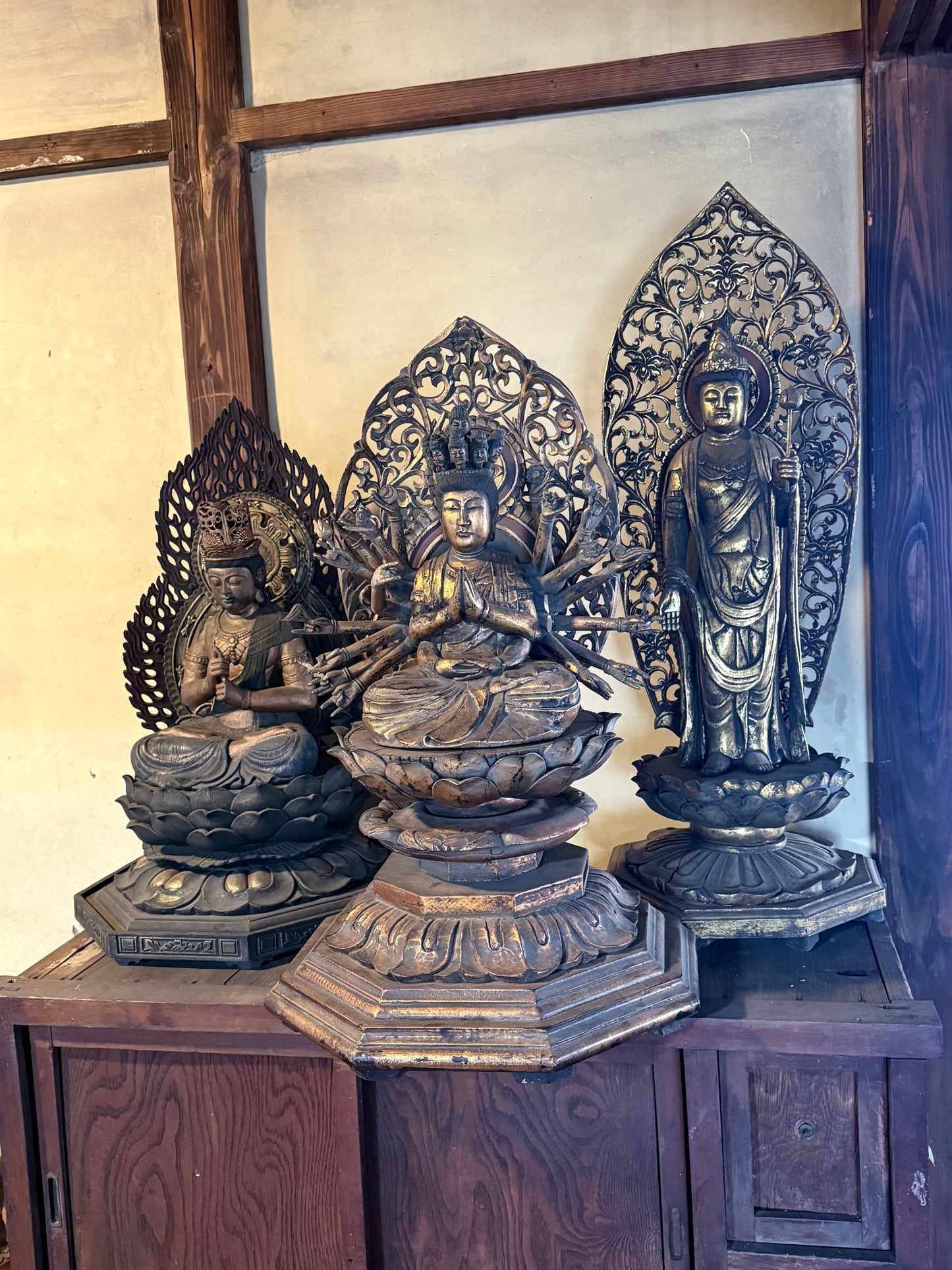
Mid–Late Showa Esoteric Buddhist Triad | Dainichi Nyorai, Shō Kannon & Senju Kannon Monumental Temple Ensemble
Mid–Late Showa Esoteric Buddhist Triad | Dainichi Nyorai, Shō Kannon & Senju Kannon Monumental Temple Ensemble
Couldn't load pickup availability
Have a reasonable price in mind? Submit your best offer and our concierge will review it personally.
A Monumental Shōwa-Period Esoteric Buddhist Ensemble
Dainichi Nyorai, Shō Kannon, and Senju Kannon
Mid–Late Shōwa Era (c. 1950s–1980s)
Japan
Overview
This commanding ensemble presents three of the most doctrinally significant figures within Japanese Esoteric and devotional Buddhism:
-
Dainichi Nyorai
-
Shō Kannon
-
Senju Kannon
Executed in the mid to late Shōwa period, the group embodies a distinctly modern yet reverential continuation of classical temple carving traditions. The works demonstrate a conscious revival of Kamakura and Edo sculptural vocabularies while integrating the technical refinements and production realities of postwar Japan.
The ensemble’s scale, architectural backplates, and lotus pedestals firmly situate it within temple-display conventions rather than domestic devotional miniatures. Each figure retains iconographic clarity and theological hierarchy, forming a spiritually coherent triad rooted in Esoteric cosmology and the cult of Avalokiteśvara.
I. Dainichi Nyorai
Display Dimensions: 65 × 39 × 41 cm
Statue Dimensions: 33 × 24 × 19 cm
At left stands Dainichi Nyorai, the Cosmic Buddha of Japanese Esoteric Buddhism. Unlike historical Shakyamuni, Dainichi represents the metaphysical source of all phenomena and enlightenment. In Shingon doctrine, he is not merely a teacher but the very body of reality itself.
The figure is seated in meditative composure, hands forming the Chiken-in mudra, the “wisdom-fist” gesture central to the Kongōkai (Diamond Realm) mandala. The crowned head and jeweled ornaments distinguish him from the simpler iconography of exoteric Buddhas. His attire affirms his role as transcendent sovereign rather than earthly ascetic.
The elaborate pierced aureole rises in a pointed mandorla form, intricately carved with scrolling vegetal motifs. This openwork halo reflects late Edo stylistic precedents while demonstrating the disciplined carving traditions maintained into the Shōwa period by regional atelier workshops. The flame-shaped silhouette evokes cosmic radiance, positioning Dainichi as the luminous axis of the group.
The lotus pedestal is broad and architecturally tiered, symbolizing spiritual emergence from the impurities of the phenomenal world. Its multi-level base enhances vertical authority and anchors the figure with doctrinal gravitas.
II. Shō Kannon (Standing Kannon)
Display Dimensions: 83 × 32 × 30 cm
Statue Dimensions: 51 × 17 × 12 cm
The central figure represents Shō Kannon, the “Sacred” or primary form of Avalokiteśvara in Japan. This is the archetypal embodiment of compassion before its multiplication into esoteric forms.
The bodhisattva stands in serene contrapposto upon a lotus, crowned and adorned with princely ornaments, signifying enlightened compassion active within the world rather than withdrawn from it. The vase (kundika) held in one hand is emblematic of purifying nectar or healing elixir. In some doctrinal interpretations, it signifies the dispensing of salvific grace to sentient beings.
The slender verticality of the figure contrasts with the seated Dainichi and Senju Kannon, creating compositional rhythm within the ensemble. The aureole, pierced and leaf-shaped, echoes classical Muromachi and Edo prototypes, while the smooth facial modeling and measured proportions reflect mid-20th-century workshop refinement.
The placement of Shō Kannon at center is theologically elegant: compassion stands between cosmic principle and its thousandfold extension.
III. Senju Kannon
Display Dimensions: 68 × 41 × 40 cm
Statue Dimensions: 31 × 26 × 21 cm
At right sits Senju Kannon, the Thousand-Armed manifestation of Avalokiteśvara. In Japanese sculptural tradition, the figure rarely displays a literal thousand arms; rather, a symbolic number—often forty-two—radiates behind the principal pair. Each arm signifies a method of salvific intervention.
The hands folded in gasshō at the core emphasize inward compassion, while the radiating arms articulate outward engagement with suffering. The crown frequently incorporates miniature heads, representing the bodhisattva’s manifold awareness.
The lotus pedestal here is particularly robust, tiered and architectural, lending stability to the otherwise dynamic radial composition. The pierced mandorla, dense with scrolling ornament, amplifies the sense of divine emanation.
Within the ensemble, Senju Kannon represents compassion multiplied to cosmic scale, complementing the singular standing form of Shō Kannon.
Provenance and Shōwa Context
The mid to late Shōwa era (1926–1989), particularly the postwar decades, saw renewed temple restoration and religious object commissioning. Economic recovery enabled both urban temples and regional workshops to produce large-format devotional sculpture drawing consciously from Kamakura and Edo precedents.
Unlike purely industrial reproductions, sculptures of this scale with complex pierced halos required skilled atelier production. Workshops in regions such as Kyoto, Nara, and parts of Nagano continued lineage-based carving traditions, often blending traditional joinery methods with stabilized wood substrates suited to modern environments.
The stylistic synthesis observed here—classical iconographic fidelity with slightly streamlined modeling—aligns closely with post-1950 temple commissions rather than prewar Taishō mass devotional carving.
The ensemble’s consistent aesthetic language suggests coordinated production, likely commissioned as a set rather than assembled piecemeal. Such triadic groupings reflect doctrinal coherence rather than decorative accumulation.
Iconographic and Theological Significance
The grouping forms a profound metaphysical progression:
-
Dainichi Nyorai: Cosmic principle and ultimate reality.
-
Shō Kannon: Compassion in its singular, archetypal form.
-
Senju Kannon: Compassion expanded infinitely into action.
This is not a random assembly but a carefully balanced doctrinal constellation. It reflects the fusion of Esoteric Buddhism with the deeply rooted Japanese devotion to Kannon.
In spatial terms, the ensemble creates a narrative arc:
Cosmic origin → compassionate mediation → universal salvation.
For the connoisseur, this coherence elevates the set beyond decorative religious sculpture. It becomes a condensed mandalic statement in three dimensions.
Sculptural Character and Craft
The pierced aureoles demonstrate technical assurance: thin yet structurally stable scrollwork with controlled negative space. The lotus bases are layered and architectonic, recalling Edo-period altar statuary.
The faces exhibit the gentle, symmetrical serenity characteristic of Shōwa devotional carving—less sharply defined than Kamakura realism yet retaining spiritual poise.
Surface treatment suggests polychrome or gilt application once more pronounced, now mellowed into dignified patination.
Conclusion
This mid-to-late Shōwa ensemble represents a disciplined continuation of Japan’s sacred sculptural lineage. Its scale, iconographic coherence, and architectural presence position it within temple-display tradition rather than domestic ornamentation.
For the discerning collector, the appeal lies not in antiquity alone but in theological completeness, workshop integrity, and compositional authority. The ensemble stands as a 20th-century reaffirmation of centuries-old devotional art, bridging postwar modernity and classical Buddhist cosmology with measured reverence.
It is, in essence, a mandala rendered in carved wood.
Cargo Shipping & Handling Notice
Due to the final packaged weight and/or dimensional requirements of this piece, standard parcel services such as Japan Post EMS, DHL, FedEx, or UPS are not applicable. This item will be shipped via cargo or freight-based shipping methods.
Cargo shipments require additional preparation time to ensure proper handling, which may include custom crating, reinforced packing, coordination with domestic logistics providers, and scheduling with international freight consolidators and export brokers. As a result, estimated delivery timelines typically range from 6 to 10 weeks, depending on routing, carrier availability, and customs clearance procedures in the destination country.
Please note that actual shipping costs may differ from automated shipping calculator estimates. By default, a portion of the expected shipping cost may be reflected in the listing price. Any difference or discrepancy will be quoted separately once destination, delivery method, and handling requirements are confirmed.
We kindly ask that collectors contact us prior to purchase to request an exact, customized shipping quotation for their destination. This ensures full transparency and allows us to arrange the most appropriate, secure, and efficient shipping solution for this piece.
Thank you for your understanding and patience as we take the necessary care to deliver this work safely.
Authenticity & Stewardship
Evaluated under the Japonista Authentication Framework™:
- Material, carving, and surface-study comparison
- Iconographic and stylistic verification
- Condition and stability review (surface integrity)
- Construction assessment and handling-risk evaluation
Guaranteed 100% Authentic. Covered by the Japonista Lifetime Authenticity Warranty™.
A Note on Stewardship and Collecting
At Japonista, we approach Buddhist statues, sacred images, and ritual objects not merely as collectibles, but as cultural and spiritual artifacts deserving of respect, understanding, and careful presentation. Every piece we offer is thoughtfully examined, researched, and curated with sensitivity to its origin, meaning, and historical role.
Our role is not only to offer access to rare and meaningful objects, but to serve as responsible custodians—connecting the right works with collectors who value depth, intention, and authenticity.
Inquiries, Availability, and Private Consideration
Some of the cultural and heritage works may allow room for discussion, while others are held firmly due to rarity, condition, or cultural importance. All inquiries are reviewed personally and discreetly, and we welcome thoughtful questions or expressions of interest.
If you are exploring a particular theme, deity, lineage, or period—or seeking guidance in building a focused collection—our concierge team is always available to assist with quiet expertise and care.
Concierge Support & Collector Guidance
Japonista Concierge™ provides personalized assistance for collectors seeking deeper understanding, thoughtful acquisition, or long-term curation strategies. Whether your interest is devotional, scholarly, or aesthetic, we are here to help guide your journey with clarity and respect.
For select high-value or historically significant works, private reservation or structured payment arrangements may be available on a case-by-case basis. Please reach out to discuss eligibility and discreet options.
Before Proceeding
We kindly encourage collectors to review our shop policies and house guidelines, available through the links in our website footer, which outline shipping, handling, and conditions specific to vintage, sacred, and collectible works.
A Closing Note
Thank you for exploring Japonista’s collection of Oriental Cultural Heritage and arts. We are honored to share these meaningful works and to help place them where they may continue to be appreciated, studied, and respected.
If you have questions or wish to explore related works, please feel free to contact Japonista Concierge™ at any time.