Rare Vintage, Antiques and Art Collector / Curator / Personal Shopper From Japan
Showa Japanese Tin Flying-Action Astro Boy (Tetsuwan Atom) Toy — Wind-Up Display Artifact
Showa Japanese Tin Flying-Action Astro Boy (Tetsuwan Atom) Toy — Wind-Up Display Artifact
Couldn't load pickup availability
Have a reasonable price in mind? Submit your best offer and our concierge will review it personally.
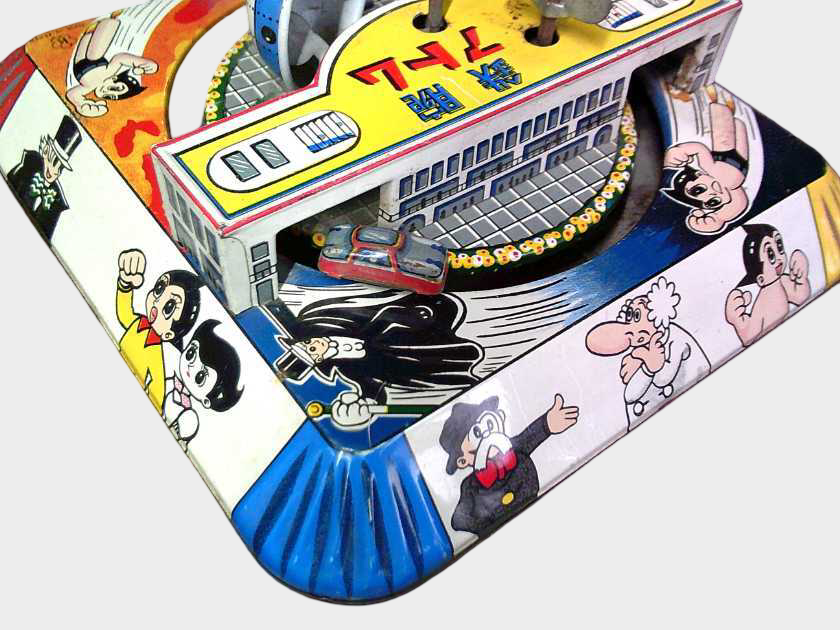
Showa-era Japanese tinplate Tetsuwan Atom (Astro Boy) flying-action toy, featuring a tethered airborne Atom figure linked to a colorful lithographed base, originally wind-up powered (now non-working), offered as a complete period junk example with strong visual impact.
Showa Japanese Tinplate Flying-Action Toy featuring Astro Boy (Tetsuwan Atom)
Narrative
Showa-era Japanese tinplate flying-action Astro Boy toy, composed of a vividly lithographed square base with central rotating mechanism and a tethered airborne Atom figure, originally wind-up powered (currently non-functional), preserved as a complete visual set and offered intentionally as a junk/mechanical-as-found example with strong display presence and cultural weight.
🌟 Who is Astro Boy (Tetsuwan Atom)?
Astro Boy, known in Japan as Tetsuwan Atom (“Mighty Atom”), is a robot child with a human heart—and one of the most important fictional characters Japan has ever created. He was created by Osamu Tezuka in 1952 as a manga, and later became the star of the world’s first successful TV anime series in 1963.
At a glance, Astro Boy looks simple: a small boy with spiky hair, big eyes, and rocket boots. But beneath that design is a character born from loss, grief, and hope, reflecting Japan’s postwar struggle to imagine a better future.
🤖 Astro Boy’s origin story (and why it matters)
Astro Boy was built by Dr. Tenma, a brilliant scientist mourning the death of his young son. Unable to accept his loss, Tenma creates a robot replica—Atom—hoping technology can replace what was taken from him. But Atom grows, learns, and feels, while Tenma cannot move on. Eventually, Atom is rejected, abandoned, and forced to discover who he is on his own.
This origin is unusually tragic for a children’s character. Astro Boy is not created to save the world—he is created to fill a human absence. That emotional wound defines him.
🧠 What kind of character Astro Boy is
Astro Boy is immensely powerful—he can fly, lift enormous weights, fire energy beams, and process information faster than any human. Yet his defining traits are not strength or intelligence, but:
-
Empathy – He cares deeply for humans, robots, and animals alike
-
Moral clarity – He instinctively knows when something is wrong
-
Gentleness – He avoids violence whenever possible
-
Loneliness – He knows he is different and can never truly grow up
Astro Boy constantly questions what it means to be “human,” even though he often behaves more humanely than the people around him.
⚖️ Astro Boy’s role in his world
In Astro Boy’s future society, humans and robots coexist—but uneasily. Robots are often discriminated against, exploited, or feared. Astro Boy becomes a bridge between the two, acting as mediator, protector, and moral example. He fights injustice not because he is programmed to, but because he chooses to.
This idea—that a machine could possess ethical judgment—was revolutionary in the early 1950s and remains relevant today.
🎨 Why Astro Boy looks the way he does
Tezuka deliberately designed Astro Boy to look:
-
Childlike, to evoke protection and empathy
-
Non-threatening, despite his power
-
Timeless, avoiding realistic machinery
His large eyes—now a defining trait of anime—were inspired by Western animation but repurposed to convey deep emotion. Astro Boy’s appearance invites viewers to care about him before they ever admire him.
🚀 Astro Boy (Tetsuwan Atom) — the moral blueprint of modern Japanese pop culture
If Tetsujin 28-go is Japan’s trauma and Big X is its inherited guilt, Astro Boy (Tetsuwan Atom) is Japan’s moral reset button. Created by Osamu Tezuka, Astro Boy is not merely the first successful TV anime—he is the ethical foundation upon which nearly all later Japanese science fiction, children’s media, and even toy culture was built.
Astro Boy is where Japan decided that the future did not have to repeat the past.
🧠 What Astro Boy really represents (beyond the cute design)
Astro Boy is a robot child created to replace a dead son—already a premise steeped in grief. But instead of becoming a weapon or a tool, Atom develops empathy, conscience, and self-doubt. His strength is immense, yet his defining trait is mercy.
This was radical in postwar Japan. The most powerful character in the room is also the most emotionally sensitive.
Tezuka’s message is unambiguous:
Power without compassion is failure.
Progress without ethics is hollow.
⚖️ Astro Boy vs same-era giants (where the philosophies split)
🤖 Tetsujin 28-go
-
Power source: military weapon
-
Control: external (remote)
-
Ethics: dependent on the operator
Astro Boy is the rebuttal.
No remote. No orders. His morality is internal. Tezuka places responsibility inside the machine, not in the human hand.
This single decision changes the entire future of anime.
🕊️ Big X
-
Theme: inherited war guilt
-
Power source: chemical enhancement
-
Tone: burdened, tragic
Big X asks whether inherited power can be redeemed.
Astro Boy answers: yes—but only through empathy.
Where Big X is weighed down by the past, Astro Boy chooses a future.
👽 Ultraman
-
Power source: alien savior
-
Scale: national / planetary
-
Violence: necessary defense
Astro Boy operates at a human scale. He saves individuals, robots, animals, outcasts. His conflicts are not about invasion—they are about coexistence.
This is why Astro Boy feels timeless while many spectacle-based heroes feel dated.
🎨 Design & symbolism (why Atom looks the way he does)
Astro Boy’s design is deceptively simple:
-
childlike proportions
-
large eyes
-
minimal mechanical detail
This was intentional. Tezuka wanted Atom to be relatable before impressive. Unlike Tetsujin’s industrial terror or Ultraman’s monumental authority, Atom’s body invites empathy.
Visually and philosophically, Astro Boy says:
“The future should look like someone you can love.”
🧭 Cultural position: why Astro Boy changed everything
Astro Boy did something unprecedented in 1960s Japan:
-
Made robots morally superior to humans
Adults lie, exploit, discriminate. Atom does not. -
Reframed science as hope, not punishment
After Hiroshima and Nagasaki, this was essential. -
Treated children as ethical agents
Atom is a child—not a trainee, not a mascot.
This is why Astro Boy became:
-
Japan’s first anime hit
-
A symbol of postwar rebirth
-
A cultural export that shaped global animation
🏛️ Astro Boy’s place in retro anime history
| Axis | Representative |
|---|---|
| Weaponized past | Tetsujin 28-go |
| Inherited guilt | Big X |
| Ethical future | Astro Boy |
| Organized defense | Ultraman |
| Compassion | Anpanman |
Astro Boy sits at the moral center. Everything else either reacts to him or argues with him.
🧠 Impact beyond anime (often overlooked)
Astro Boy influenced:
-
robotics ethics in Japan
-
children’s education media
-
toy design philosophy (friendly tech)
-
Japan’s global image as a tech-humanist culture
When Japanese engineers say they wanted to “build Atom,” they aren’t joking. They mean:
technology that protects, listens, and empathizes.
🕯️ Why Astro Boy still matters
Astro Boy asks a question that never stops being relevant:
If something is powerful enough to destroy the world, should it also be gentle enough to love it?
That question is why Astro Boy isn’t just retro anime.
He is Japan’s conscience, drawn with ink and hope.
🌍 Why Astro Boy became so important
Astro Boy arrived at a critical moment in Japanese history. Postwar Japan was rebuilding, grappling with trauma, and redefining its relationship with science and technology. Astro Boy offered a radical message:
Technology does not have to destroy.
Power does not have to dominate.
The future can be guided by compassion.
Because of this, Astro Boy became:
-
Japan’s first anime superstar
-
A symbol of peaceful technological progress
-
A moral role model for children
-
A cultural icon recognized worldwide
🕊️ In one sentence
Astro Boy is a being created from human grief, endowed with immense power, who chooses kindness—and in doing so, teaches humanity how to be better.
Details
-
Character: Astro Boy (Tetsuwan Atom)
-
Format: Tin base + tethered flying figure
-
Power: Wind-up (spring is tight / cannot be wound; non-working)
-
Action (original): Rotational motion causing suspended Atom to “fly”
-
Material: Lithographed tinplate (base), metal tether, molded figure
-
Era: Showa period
-
Condition declaration: Junk / non-operational
-
Notes: Atom figure is fixed and will ship attached as-is
Cultural Anchor — Why Astro Boy Matters
Created by Osamu Tezuka, Astro Boy is not merely a character—he is the symbolic beginning of modern Japanese manga, anime, and sci-fi optimism. Toys like this translate Tezuka’s themes (technology, flight, innocence, and hope) into kinetic objects. The flying-action format is especially resonant: flight = progress, a core post-war aspiration.
Design & Visual Engineering
-
Base: Square tin base with dense lithography—comic-panel energy, concentric motion cues, and high-contrast colors designed to amplify perceived movement.
-
Mechanism: Central rotor assembly engineered to convert spring torque into rotational spectacle.
-
Tethered figure: Atom is suspended in perpetual “flight,” creating verticality uncommon in tin toys dominated by horizontal motion.
-
Graphic language: Late-Showa pop-science aesthetic—meters, arcs, motion lines—bridging manga and mechanical fantasy.
Mechanical Status
-
Wind-up spring does not wind (tight / seized)
-
No attempt at restoration performed
-
Sold as junk for preservation, parts study, or static display
-
Importantly, visual completeness is intact—a critical value driver for this category
Condition Tier
Overall Tier: C (Display-Grade Junk)
-
Surface wear, scuffs, dirt, oxidation consistent with age
-
No deep cleaning performed (patina retained)
-
Structural composition intact; no loose major elements observed
For kinetic tin toys, complete composition > mechanical function when curated as artifacts.
Rarity & Format Analysis
Flying-action Astro Boy toys are far scarcer than standard wheeled tins. The vertical, tethered design increased failure rates and loss over time. Survivors—especially complete sets—are now disproportionately uncommon, even in non-working condition.
Collector Positioning
This piece appeals to:
-
Astro Boy / Tezuka collectors
-
Tin toy specialists seeking uncommon action formats
-
Museum or gallery displays focused on motion, imagination, and post-war futurism
-
Collectors comfortable with conservation-grade “as found” artifacts
Market Intelligence
Junk-status mechanicals typically trade below restored examples, but complete flying-action formats hold strong floor values due to rarity. As restoration ethics shift toward preservation, untouched examples gain legitimacy.
Authenticity & Stewardship
Evaluated under the Japonista Authentication Framework™:
- Material, carving, and surface-study comparison
- Iconographic and stylistic verification
- Condition and stability review (surface integrity)
- Construction assessment and handling-risk evaluation
Guaranteed 100% Authentic. Covered by the Japonista Lifetime Authenticity Warranty™.
A Note on Stewardship and Collecting
At Japonista, we approach Buddhist statues, sacred images, and ritual objects not merely as collectibles, but as cultural and spiritual artifacts deserving of respect, understanding, and careful presentation. Every piece we offer is thoughtfully examined, researched, and curated with sensitivity to its origin, meaning, and historical role.
Our role is not only to offer access to rare and meaningful objects, but to serve as responsible custodians—connecting the right works with collectors who value depth, intention, and authenticity.
Inquiries, Availability, and Private Consideration
Some of the cultural and heritage works may allow room for discussion, while others are held firmly due to rarity, condition, or cultural importance. All inquiries are reviewed personally and discreetly, and we welcome thoughtful questions or expressions of interest.
If you are exploring a particular theme, deity, lineage, or period—or seeking guidance in building a focused collection—our concierge team is always available to assist with quiet expertise and care.
Concierge Support & Collector Guidance
Japonista Concierge™ provides personalized assistance for collectors seeking deeper understanding, thoughtful acquisition, or long-term curation strategies. Whether your interest is devotional, scholarly, or aesthetic, we are here to help guide your journey with clarity and respect.
For select high-value or historically significant works, private reservation or structured payment arrangements may be available on a case-by-case basis. Please reach out to discuss eligibility and discreet options.
Before Proceeding
We kindly encourage collectors to review our shop policies and house guidelines, available through the links in our website footer, which outline shipping, handling, and conditions specific to vintage, sacred, and collectible works.
A Closing Note
Thank you for exploring Japonista’s collection of Oriental Cultural Heritage and arts. We are honored to share these meaningful works and to help place them where they may continue to be appreciated, studied, and respected.
If you have questions or wish to explore related works, please feel free to contact Japonista Concierge™ at any time.