Rare Vintage, Antiques and Art Collector / Curator / Personal Shopper From Japan
Setagaya Base Sukajan SEAF 97 Dragon Fuji Reversible Jacket Rare Japanese Embroidered Bomber
Setagaya Base Sukajan SEAF 97 Dragon Fuji Reversible Jacket Rare Japanese Embroidered Bomber
Couldn't load pickup availability
Have a reasonable price in mind? Submit your best offer and our concierge will review it personally.
Setagaya Base / SEAF Series Sukajan Jacket
“97 Made in SEAF / Dragon & Fuji” Reversible Embroidered Jacket
Japan, circa late 2000s–2010s
Cult subculture example bridging Setagaya Base design language with traditional sukajan structure; notable for its dual iconographic program combining cartoon mechanical satire with classical dragon-Fuji composition.
A visually arresting and conceptually layered sukajan, this example emerges from the creative orbit of Setagaya Base, where Japanese craftsmanship intersects with Americana-inflected humor and mechanical fascination.
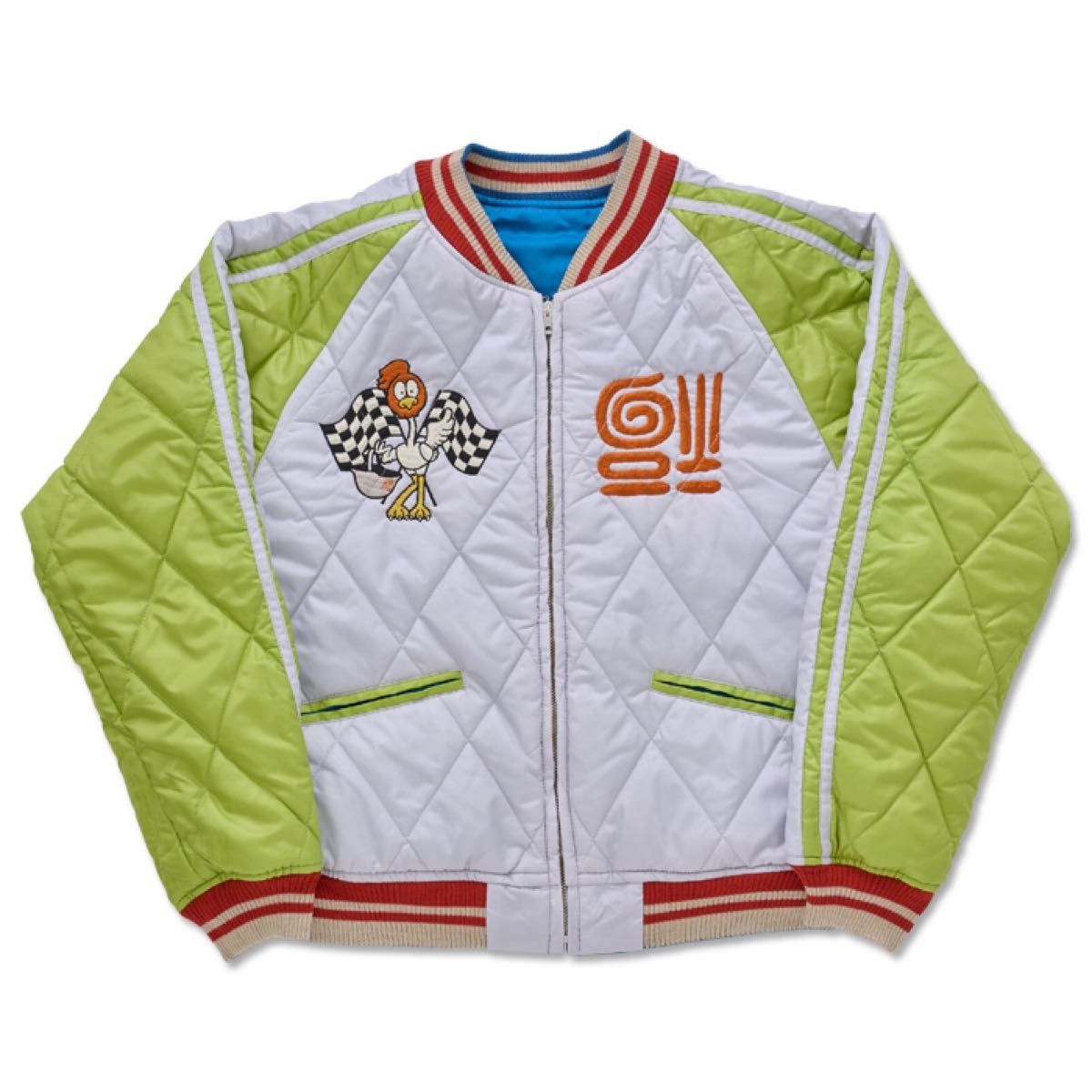
The quilted face presents a striking departure from orthodox souvenir jacket aesthetics. Executed in a crisp white ground with lime-toned sleeves, the surface frames a highly animated central motif: a skeletal figure fused with an exposed hot rod engine, emblazoned with the phrase “97 Made in SEAF.” The composition reads as both parody and homage—military insignia reinterpreted through the lens of garage culture, where pistons, flames, and mechanical exaggeration become expressive rather than functional.
In contrast, the reverse side restores a more classical visual grammar. A sinuous dragon encircles Mount Fuji, rendered in dense embroidery against a saturated blue field, accompanied by stylized avian elements that echo traditional Japanese motifs. Here, the jacket aligns itself with the lineage of postwar souvenir jackets, where mythic creatures and national symbols served as emblems of place and identity.
The duality between these two faces—one irreverent, one reverent—defines the garment’s significance. It resists singular categorization, instead operating as a dialogue between cultural registers: American and Japanese, industrial and mythological, comedic and ceremonial.
Materially, the use of quilted construction enhances the object’s tactile presence, lending it a utilitarian weight uncommon in standard sukajan forms. This structural choice reinforces its hybrid identity, situating it between outerwear and collectible artifact.
Within the broader field of sukajan collecting, pieces associated with Setagaya Base remain comparatively niche, appealing to those attuned to Japan’s more idiosyncratic creative subcultures. As such, examples of this nature carry a distinct appeal for collectors seeking garments that extend beyond conventional aesthetic boundaries.
Overview
This piece operates in a rare hybrid zone where American hot rod culture, Japanese souvenir jacket tradition, and irreverent cartoon aesthetics collide. Attributed to the Setagaya Base universe—associated with Tokoro George—it channels a deliberately chaotic visual language that resists conventional sukajan refinement.
Item: Setagaya Base “SEAF #7” Sukajan Jacket
Origin: Japan (Setagaya Base / Tokoro George lineage)
Era: Late 2000s–2010s production (retro WWII souvenir reference)
Size: L (Other sizes available upon request, contact us for availability)
Material: Quilted nylon / polyester shell
Construction: Reversible sukajan format
Motif (Side A): “97 Made in SEAF” cartoon hot rod skeleton engine
Motif (Side B): Dragon encircling Mt. Fuji with rooster motif
Colorway: White × lime × red (quilted side) / blue × yellow (embroidered side)
Condition: Appears clean, strong color retention
Acquisition Signal: Niche Japanese subculture brand + hybrid embroidery/cartoon execution
Iconography
Side A presents a cartoonish mechanical skeleton fused with a roaring engine—marked “97 Made in SEAF”—a parody of military insignia filtered through garage culture humor. Flames, exposed pistons, and exaggerated proportions transform industrial machinery into character.
Side B pivots sharply into classical Japanese symbolism: a coiling dragon encircles Mt. Fuji, accompanied by stylized avian figures. This duality between irreverence and tradition defines the jacket’s identity.
Material
Unlike traditional satin sukajan, this example employs a quilted nylon/polyester body on one side, giving it a padded, utilitarian feel. The reverse side adopts the smoother sukajan finish, allowing embroidery to take center stage.
Historical Context
Setagaya Base represents a subcultural node within Japanese creative culture—bridging television, design, Americana nostalgia, and mechanical obsession. Pieces emerging from this orbit often remix military motifs with humor, creating objects that feel both referential and rebellious.
Collector Relevance
This is for:
- sukajan collectors seeking non-traditional pieces
- Japanese subculture collectors
- Americana crossover enthusiasts
It sits outside mainstream sukajan taxonomy—making it harder to find, and harder to categorize.
Summary
A reversible Setagaya Base sukajan merging cartoon engine iconography with classical dragon-Fuji symbolism—an eccentric, culturally layered collector piece.
Authenticity & Stewardship
Evaluated under the Japonista Embroidered Garment Authentication Framework™
Each work is examined through a disciplined, multi-layered review process:
• Era attribution and construction typology assessment (postwar, Showa, Heisei, modern reinterpretation)
• Textile, lining, and hardware evaluation across satin, rayon, wool, and mixed materials
• Embroidery technique analysis including stitch density, thread composition, and execution method
• Iconographic verification of motifs, regional symbolism, and cultural context
• Condition and structural integrity review, including wear, repair, and aging consistency
Guaranteed 100% Authentic.
All garments are curated and backed by the Japonista Lifetime Authenticity Warranty™, with emphasis on both material truth and cultural accuracy.
A Note on Embroidery, Subculture & Wearable History
Japanese embroidered jackets—whether sukajan, souvenir jackets, or sutajan—are not simply garments. They are textile narratives shaped by movement, memory, and identity.
Emerging in the aftermath of postwar exchange, sukajan jackets carried imagery of dragons, eagles, maps, and mythic landscapes—stitched as portable souvenirs of place and encounter. Sutajan (stadium jumpers), while structurally different, evolved within parallel youth cultures—embedding identity, affiliation, and aspiration into wearable form.
At Japonista, these works are approached as wearable historical documents. Embroidery is not decoration; it is authorship. Stitch variation, thread aging, minor fray, and surface wear are read as evidence of lived passage rather than imperfection.
We preserve these garments with restraint—allowing their histories to remain visible, legible, and intact.
Our role is to connect these pieces with collectors who understand both their visual impact and the layered cultural narratives carried within every thread.
Inquiries, Availability, and Private Consideration
Many embroidered jackets are singular in character—defined by unique embroidery execution, condition, or period-specific construction. Certain works are held firmly due to rarity, historical resonance, or preservation status.
All inquiries are handled with discretion. We welcome thoughtful discussion regarding provenance, embroidery technique, cultural context, and long-term wear or display considerations.
Collectors building focused archives—by motif (dragon, tiger, eagle), era, or regional influence—may consult with us for deeper guidance and acquisition support.
Concierge Support & Collector Guidance
Japonista Concierge™ provides tailored assistance for collectors seeking deeper engagement with embroidered garment culture:
• Era differentiation and subculture mapping (postwar, sukajan evolution, stadium lineage)
• Embroidery technique interpretation and motif symbolism
• Textile preservation and long-term storage guidance
• Wearability assessment versus archival conservation
• Strategic acquisition planning for building cohesive collections
Whether worn, displayed, or archived, each garment is guided toward its next chapter with respect for both material and meaning.
For select rare or historically significant pieces, private reservation or structured acquisition arrangements may be available on a case-by-case basis.
Before Proceeding
We encourage collectors to review our shop policies and house guidelines, available through the links in our website footer. These outline shipping protocols, handling considerations, and condition standards specific to vintage, textile-based, and culturally significant garments.
Understanding these guidelines supports responsible stewardship of each piece.
A Closing Note
Thank you for exploring Japonista’s curated selection of Japanese embroidered jackets. These garments stand at the intersection of history, identity, and design—and we are honored to help place them where they will continue to be valued and remembered. They are records of movement—across borders, across subcultures, across generations.
Each piece carries not only craftsmanship, but memory—stitched in silk, worn into fabric, and preserved through time.
At Japonista, we steward these works with clarity and discipline, ensuring they continue their journey with collectors who recognize their weight beyond fashion.
If you have questions or wish to explore related items, please feel free to contact Japonista Concierge™ at any time.