Rare Vintage, Antiques and Art Collector / Curator / Personal Shopper From Japan
SATORI Reversible Sukajan Size L – Double Dragon × Koi Carp Sakura Japanese Embroidered Souvenir Jacket
SATORI Reversible Sukajan Size L – Double Dragon × Koi Carp Sakura Japanese Embroidered Souvenir Jacket
Couldn't load pickup availability
Have a reasonable price in mind? Submit your best offer and our concierge will review it personally.
Rare Satori Japan Reversible Sukajan – Bronze Ryū Dragon & Waves / Black Koi Carp Sakura Blossom Embroidery – Size L Japanese Tattoo Art Jacket
A spectacular SATORI reversible Japanese sukajan built around two of the most enduring visual traditions in Japanese decorative art: the dragon and the koi carp.
One face erupts with enormous intertwined Japanese ryū dragons, embroidered across a rich bronze-brown satin ground with ivory sleeves, clouds and stylized waves. Reverse the jacket and the entire personality changes into a deep black and cream composition of koi carp swimming through water beneath drifting sakura blossoms.
Brand: SATORI
Size: L
Style: Reversible Japanese Sukajan / Souvenir Jacket
Primary Motifs: Ryū Dragon, Koi Carp, Sakura, Waves, Clouds
Colorways: Black / Ivory and Bronze-Brown / Ivory
This is not simply a jacket with a decorative back patch. The embroidery is architecturally integrated across the garment, with motifs extending from chest to back and across both reversible faces. It is essentially two elaborate Japanese embroidered jackets occupying the same garment. 🐉🌸🎏
Description
SATORI is known among Japanese embroidered streetwear enthusiasts for pushing traditional wagara, tattoo and folklore motifs far beyond the small souvenir graphics found on ordinary fashion jackets.
This Size L reversible sukajan is an excellent example.
The first side uses an elegant black-and-ivory palette dominated by sakura blossoms and two monumental koi carp. The second side transforms the jacket into a bronze-toned dragon composition in which huge serpentine ryū twist through clouds and breaking water.
Although dramatically different in visual energy, both sides share a restrained palette of:
- black
- ivory
- champagne
- bronze
- taupe
- silver-gray
- muted brown
Rather than relying on bright primary colors, the jacket allows embroidery density, movement and texture to create the drama.
The result is sophisticated, almost monochromatic Japanese wearable art.
Opening Visual Presence
At first glance, the black side feels serene.
Clusters of pale cherry blossoms sweep diagonally across the front while a koi emerges from the lower opposite corner.
Turn the jacket around and the composition expands into an aquatic landscape.
Two massive koi circle through stylized streams of water. Sakura petals appear to drift across the current, linking the symbols of perseverance and impermanence within one design.
Then the jacket reverses.
The calm water garden disappears.
In its place are enormous dragons.
Across the bronze-brown reverse, heavily embroidered Japanese ryū twist through waves and clouds, their bodies filling almost the entire garment.
One jacket therefore moves between two visual worlds:
Koi and cherry blossom: contemplation, perseverance, seasonal beauty.
Dragon and waves: supernatural power, protection, energy and transformation.
Identification
Brand
SATORI
Garment
Reversible Japanese sukajan
Souvenir jacket
Embroidered bomber jacket
Wagara jacket
Japanese tattoo-art jacket
Amekaji streetwear outerwear
Size
L
Japanese sizing can differ from contemporary Western sizing. Please compare actual garment measurements when available rather than relying solely on the label size.
Construction
Reversible zip-front sukajan construction with raglan-style sleeves, rib-knit collar, cuffs and hem.
Main Themes
- Japanese ryū dragons
- koi carp
- sakura / cherry blossoms
- waves
- clouds
- traditional Japanese water patterns
Side A – Black Koi Carp & Sakura Sukajan
Black & Ivory Color Story
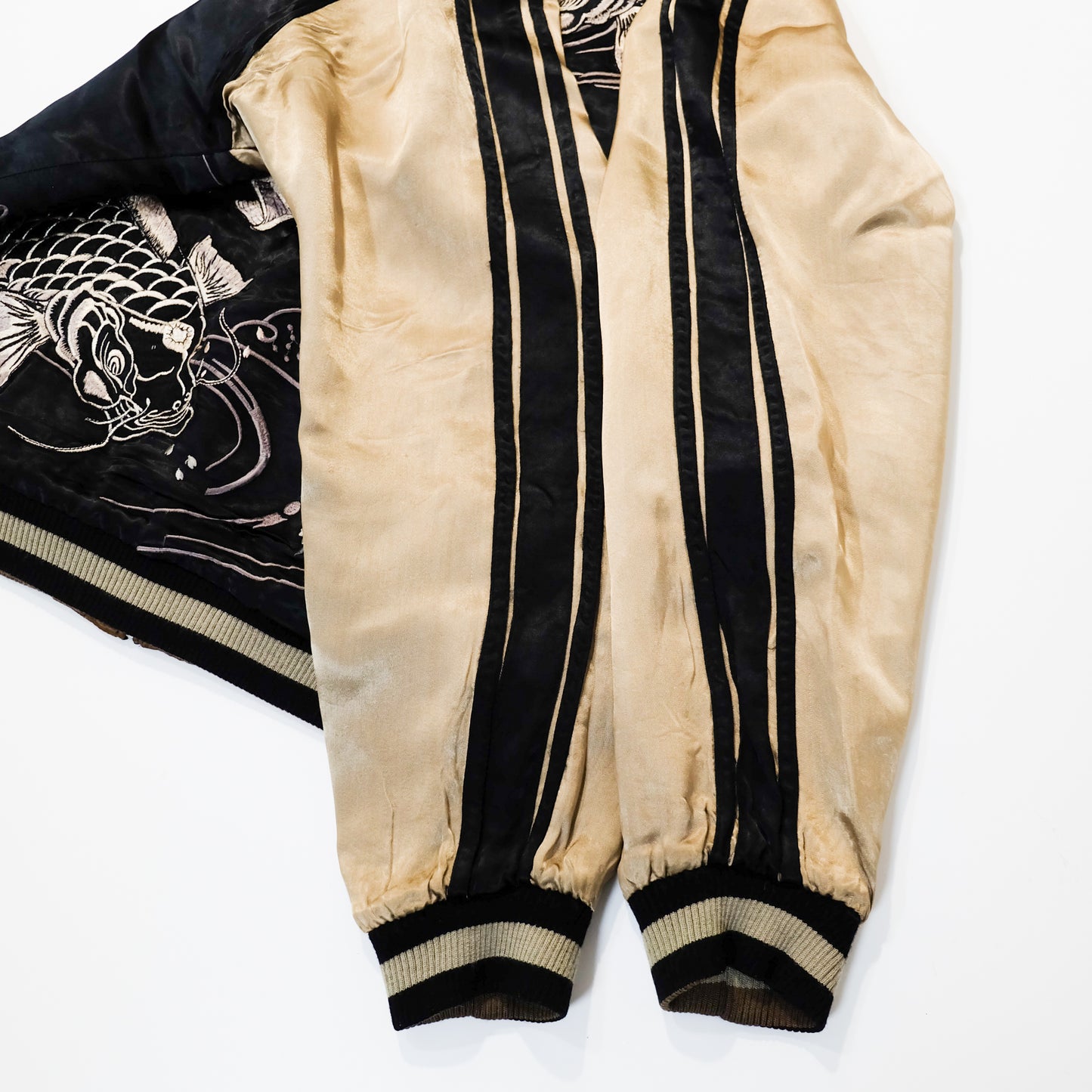
The darker face uses a classic black satin-style body contrasted against champagne-ivory sleeves.
Black striping runs along the sleeves, while coordinated black, cream and muted gray ribbing frames the neckline, cuffs and waistband.
The palette gives the jacket a distinctly mature quality.
Rather than overwhelming the eye with color, Satori allows the embroidery itself to dominate.
Sakura Blossom Front
The viewer's left chest is covered by a cascading field of embroidered blossoms.
The sakura appear in several pale shades:
- ivory
- pale gray
- dusty blue-gray
- soft blush
- muted pink
Some flowers are fully opened while others appear as smaller blossoms or scattered petals.
The embroidery spreads naturally rather than forming a rigid geometric patch, making the composition feel closer to a Japanese painted textile.
Koi Carp Front Motif
At the lower opposite front sits a large embroidered koi.
Its body emerges into the composition rather than being isolated as a simple chest emblem.
The fish is rendered primarily in ivory, charcoal and silver-gray thread, with carefully repeated scale patterns defining its body.
Curved water lines reinforce the sense that the koi is actively swimming through the garment.
This asymmetric placement is especially effective because the floral mass on the other side balances the fish without creating artificial mirror symmetry.
Monumental Koi Back
The reverse view of the black face is where the design fully unfolds.
Two giant koi dominate nearly the entire back panel.
One swims through the upper portion of the jacket.
The second occupies the lower field.
Their bodies follow opposing curved paths through streams of embroidered water.
This creates a circular visual rhythm across the entire back.
The koi are rendered in predominantly pale neutral thread so that their scales become almost graphic linework against the black satin ground.
Around them drift:
- cherry blossoms
- falling petals
- water ripples
- curling current lines
- stylized splashes
The result has the character of a Japanese tattoo back piece translated into embroidery.
Koi Symbolism
Few animals possess stronger associations with perseverance in East Asian visual culture than the carp.
Koi are commonly associated with:
- endurance
- determination
- courage
- transformation
- prosperity
- advancement
- resilience
The famous carp-and-water narrative reflects the creature's ability to move against strong currents.
This makes koi particularly appropriate for tattoo-inspired fashion, where visual beauty is often paired with ideas of personal strength.
Koi and Dragon Connection
The combination of koi on one face and dragon on the other is especially meaningful.
In East Asian legend, a carp capable of overcoming great currents and ascending the Dragon Gate could transform into a dragon.
Thus the two sides can be understood almost sequentially:
Koi = perseverance and striving
Dragon = transformation and attained power
Whether intentional or simply a brilliant design pairing, the reversible construction gives that traditional symbolic relationship unusual visual force.
Sakura Meaning
Cherry blossoms carry a very different emotional character.
They are celebrated for extraordinary beauty precisely because their flowering season is brief.
Sakura therefore became associated with concepts including:
- beauty
- renewal
- transience
- seasonality
- awareness of passing time
- mono no aware
Placed beside the enduring koi, the blossoms create a striking contrast between persistent movement and fleeting beauty.
Side B – Bronze Double Dragon Sukajan
Turn the jacket inside out and the calm aquatic world becomes dramatically more aggressive.
The second face uses a bronze, antique-gold and taupe color palette.
The satin ground has a rich mottled sheen that shifts between:
- bronze
- tobacco brown
- antique gold
- copper
- muted olive-brown
depending on the direction of light.
Against this ground, enormous gray, ivory and charcoal dragons dominate the garment.
Double Dragon Front
The front composition is unusually ambitious.
Instead of small matching dragon heads, large dragon bodies extend across both chest panels.
Their elongated forms twist from the shoulders toward the lower body.
The creatures possess the characteristic elements associated with Japanese and East Asian dragon imagery:
- long serpentine bodies
- scaled torsos
- clawed feet
- elongated whiskers
- prominent horns
- expressive eyes
- open mouths
- flowing facial hair
Cloud formations and water motifs weave between the bodies.
Because the design is divided by the front zipper, the two dragons appear to converge toward one another when the jacket is closed.
Monumental Dragon Back
The back becomes a complete Japanese tattoo-style composition.
A huge dragon descends from the upper portion of the jacket, its body curling downward through the image.
A second dragon rises from below.
The two appear surrounded by turbulent:
- waves
- foam
- clouds
- flowing lines
- atmospheric scroll forms
Their heads are especially expressive, featuring exaggerated eyes, whiskers, horns and snarling mouths.
The scale embroidery gives the bodies extensive surface texture while darker outlining creates dramatic separation from the bronze background.
Ryū – The Japanese Dragon
The Japanese dragon, ryū / tatsu, is among the most important supernatural creatures in Japanese decorative culture.
Unlike the destructive fire-breathing dragon familiar from much Western mythology, East Asian dragons are frequently connected with:
- water
- rain
- rivers
- seas
- storms
- protection
- wisdom
- authority
- transformation
- supernatural energy
This relationship with water explains why dragons appear so naturally alongside the embroidered waves on this jacket.
The animal is not simply placed over the water.
It belongs to it.
Dragon & Water Imagery
The curling waves beneath the dragons reinforce their traditional connection with aquatic forces.
Japanese decorative artists have long used highly stylized water rather than literal realism.
Here the embroidered currents are built from:
- parallel contour lines
- curling crests
- foam shapes
- sweeping directional curves
These same visual devices can be seen throughout Japanese painting, woodblock prints, tattooing and textile decoration.
Two Sides, Two Philosophies
The reversible construction creates a fascinating visual narrative.
Black Side
🎏 Koi carp
🌸 Sakura blossoms
🌊 Flowing water
⚫ Black and champagne palette
🧘 More refined and contemplative atmosphere
Bronze Side
🐉 Double dragons
🌊 Breaking waves
☁️ Clouds
🤎 Bronze and ivory palette
⚡ More powerful and supernatural atmosphere
This makes the jacket considerably more versatile than an ordinary reversible sukajan.
Neither face feels like a secondary lining.
Both are complete compositions.
Embroidery Character
A major strength of this Satori piece is the quantity of embroidery.
The artwork extends across:
- chest
- lower front
- full back
- upper torso
- multiple large motif areas
Rather than relying solely on dense fill stitch, the design uses combinations of:
- outlined forms
- solid fills
- repeated scales
- contour stitching
- narrow linear water embroidery
- layered floral clusters
- directional threadwork
This variation keeps the large compositions readable.
Wagara & Japanese Tattoo Influence
Wagara refers broadly to traditional Japanese patterns and decorative motifs.
In contemporary Japanese fashion, these subjects frequently overlap with imagery associated with irezumi / horimono tattoo art.
Typical motifs include:
- dragon
- tiger
- koi
- phoenix
- peony
- chrysanthemum
- sakura
- waves
- clouds
- oni
- Buddhist guardians
Satori's design language belongs firmly within this modern revival of traditional Japanese visual culture.
The wearer is effectively carrying a textile interpretation of a full tattoo composition.
Sukajan Tradition
The sukajan traces its identity to postwar Japan, when souvenir jackets embroidered with Japanese imagery became popular among American servicemen stationed in the country.
Western bomber-style silhouettes were combined with Japanese embroidery depicting subjects such as:
- dragons
- tigers
- eagles
- geisha
- maps
- Mount Fuji
- military insignia
- Japanese place names
Over the following decades, the souvenir jacket was absorbed back into Japanese youth fashion.
It moved through:
- biker culture
- rockabilly
- delinquent fashion
- punk
- Amekaji
- vintage reproduction
- luxury streetwear
Modern Japanese brands such as Satori transformed the sukajan into increasingly elaborate examples of wearable embroidery art.
Amekaji Context
The jacket also belongs to the broader tradition of Amekaji, or Japanese interpretation of American casual clothing.
What began as fascination with American garments eventually produced an entirely Japanese fashion culture based around obsessive reconstruction and reinterpretation of:
- denim
- military jackets
- varsity jackets
- leather
- workwear
- Hawaiian shirts
- souvenir jackets
The sukajan is perhaps the ultimate Amekaji paradox.
It began as a Japanese interpretation of a Western jacket made for American customers, then became one of the most internationally recognized symbols of Japanese street fashion.
Materials & Construction
The photographs indicate a smooth satin-style shell typical of sukajan construction.
Visible features include:
- reversible construction
- metal front zipper
- raglan sleeves
- striped sleeve piping
- rib-knit collar
- rib-knit cuffs
- rib-knit waistband
- welt-style pockets
- extensive machine embroidery
- contrasting reversible colorways
Exact fiber composition should be referenced from the garment's care label if available.
Condition
This is a pre-owned Japanese embroidered garment and should be considered in its existing vintage / collectible condition.
The photographs show the expected natural character of satin-style sukajan fabric, including:
- creasing
- surface reflection
- tonal variation
- light rubbing
- possible minor discoloration
- age-related textile variation
- minor embroidery irregularities
- possible loose or projecting threads
- normal rib-knit wear
The light champagne sleeves may show age and tonal variation more visibly than the darker body panels.
Because satin changes dramatically under directional photography, darker or lighter areas visible in the photographs may partially result from reflected light rather than permanent discoloration.
Please inspect all supplied photographs carefully as they form an integral part of the condition description.
Size & Fit
Marked Size: L
Japanese Size L frequently fits somewhat differently from contemporary Western L sizing.
For the most reliable fit, compare the jacket's flat measurements to a well-fitting garment already in your wardrobe.
Useful measurements include:
- pit to pit
- body length
- sleeve length from collar / center back
- hem width
Because sukajan commonly use raglan sleeves, traditional shoulder-seam measurements may not be directly applicable.
Styling
The restrained black, ivory and bronze palette makes this unusually easy to style despite the extraordinary embroidery.
The koi side pairs beautifully with:
- black denim
- raw indigo jeans
- white T-shirt
- engineer boots
- loafers
- minimalist sneakers
The bronze dragon side works particularly well with:
- faded selvedge denim
- black trousers
- military chinos
- leather boots
- monochrome streetwear
It can move from Japanese heritage fashion to contemporary luxury street styling without losing its identity.
Display & Collecting Appeal
For a dedicated sukajan enthusiast, this is exactly the sort of garment that rewards display as much as wear.
Hung from the black side, the two koi form a sweeping Japanese water composition.
Hung from the bronze side, the dragons transform the same jacket into something resembling an embroidered folding-screen or tattoo back piece.
Collectors interested in:
- Satori
- Japanese sukajan
- koi embroidery
- dragon jackets
- Japanese tattoo art
- wagara
- Amekaji
- souvenir jackets
- Japanese streetwear
- reversible jackets
should find significant visual appeal here.
Distinctive Details
The defining quality of this Satori jacket is its dual full-scale narrative.
It does not merely provide two colors.
It provides two symbolic worlds.
Koi + water + sakura represent movement, resilience and ephemeral beauty.
Dragons + waves + clouds represent transformation, supernatural force and authority.
And because traditional mythology connects the persevering carp with transformation into the dragon, the reversible construction gives the jacket an unusually coherent symbolic character.
For a garment designed to be physically turned from one identity into another, the symbolism could hardly be more fitting.
Purchase, Shipping and Vintage Policy
This is a genuine pre-owned collectible garment offered in its present as-is condition.
Natural signs of previous ownership, including minor textile creasing, rubbing, subtle discoloration, embroidery irregularities, loose threads, age-related marks, rib-knit wear and hardware wear may be present.
Please examine all photographs carefully. The photographs constitute an important part of the item's condition description.
Color may vary slightly depending on lighting, display calibration and the reflective characteristics of satin fabric.
Please compare provided measurements with a garment you already own before purchasing. Japanese sizing conventions can differ considerably from contemporary Western sizing.
Due to the collectible, pre-owned and internationally shipped nature of the item, returns, claims or exchanges based upon fit, previously disclosed condition, ordinary age-related characteristics or minor color differences cannot generally be accepted, subject to applicable Etsy rules and consumer law.
Reasonable and respectful offers may be considered.
The garment will be packed carefully for international shipment.
Preparation, shipping and handling normally takes 5–10 business days or earlier.
Worldwide shipping is normally provided through Japan Post EMS or another appropriate tracked international service.
Tracking information will be provided following dispatch.
Any import duties, destination-country taxes, VAT, customs charges or associated fees remain the buyer's responsibility where applicable.
If you are looking for this design or model in another size, please feel free to message us. Although availability cannot be guaranteed, we may be able to locate the same or a closely matching piece in a different size through our sourcing network.
#Satori #SatoriJapan #Sukajan #JapaneseSukajan #DragonJacket #KoiJacket #KoiCarp #JapaneseDragon #RyuDragon #Sakura #CherryBlossom #Wagara #JapaneseEmbroidery #SouvenirJacket #ReversibleJacket #Amekaji #JapaneseStreetwear #TattooArt #JapaneseTattoo #IrezumiStyle #Horimono #JapanFashion #EmbroideredJacket #VintageJapan #WearableArt #DragonEmbroidery #KoiEmbroidery #JapanJacket #JapaneseFashion #CollectorJacket
satori sukajan, dragon sukajan, koi carp jacket, japanese jacket, reversible jacket, sukajan jacket, dragon jacket, koi embroidery, wagara jacket, japan streetwear, tattoo art jacket, souvenir jacket, amekaji jacket
Material Tags
satin style textile, embroidery thread, rib knit, metal zipper, woven textile, reversible construction, embroidered fabric