Rare Vintage, Antiques and Art Collector / Curator / Personal Shopper From Japan
Samurai Yoroi Armor Kusari Bugu Kacchu Gusoku with Chainmail Hood | Edo Period Iron Defense Armor | Antique Japanese Martial Art
Samurai Yoroi Armor Kusari Bugu Kacchu Gusoku with Chainmail Hood | Edo Period Iron Defense Armor | Antique Japanese Martial Art
Couldn't load pickup availability
Have a reasonable price in mind? Submit your best offer and our concierge will review it personally.
Samurai Yoroi Armor Kusari Gusoku with Iron Chainmail Hood — Edo Period Bugu Defensive Art
A chainmail-dominant samurai armor ensemble where iron rings complete the protection that plates alone cannot.
Curator’s Overview
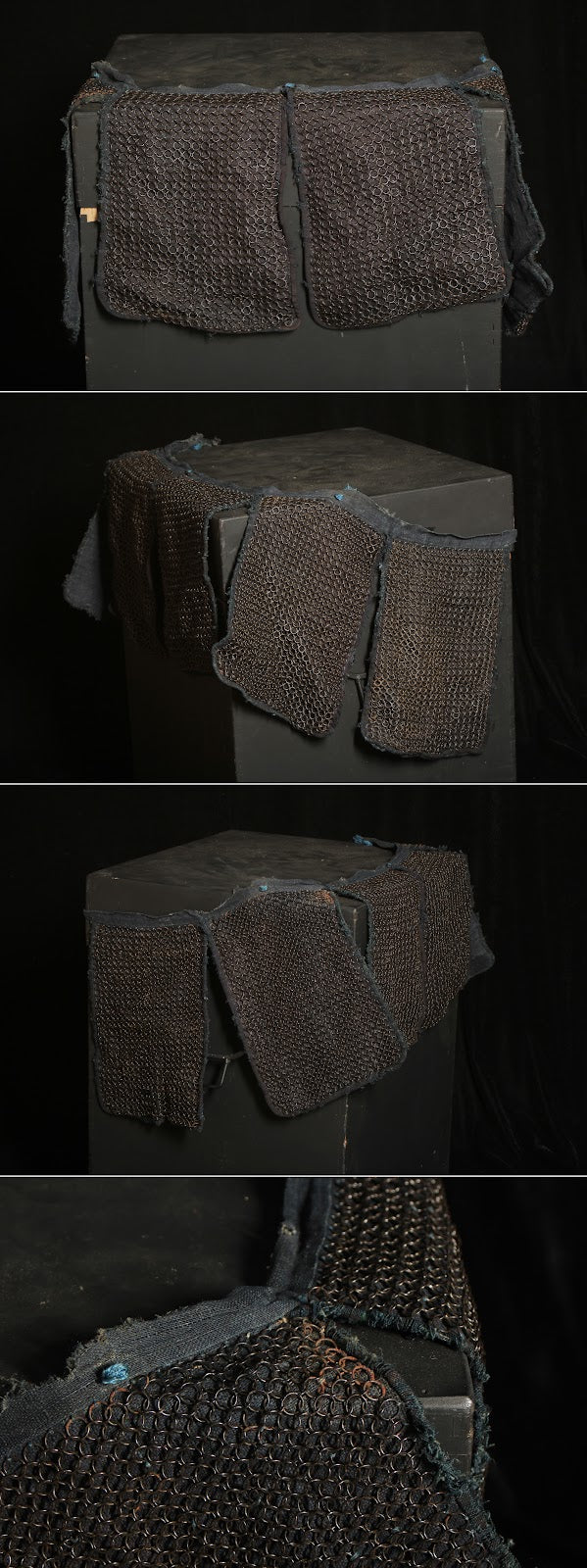
This piece presents as a coherent kusari gusoku: a full-body samurai armor ensemble built around kusari—iron chainmail—paired with plate elements in the classic logic of Japanese bugu (martial equipment). In Japanese armor practice, chainmail does not replace plate; it completes it, forming a flexible defense over the body’s articulation zones—where movement demands gaps and vulnerability follows.
The overall silhouette, material aging, and system-like integration support an Edo-period reading (late Edo most plausible), rather than a postwar decorative build. Final confirmation benefits from hands-on inspection of ring construction, textiles, and internal lacing.
What Is Iron Kusari (Japanese Chainmail)?
- Structure: thousands of interlinked iron rings forming a flexible defensive “skin.”
- Purpose: protects joints and gaps—under-sleeve, throat line, waist zones—where rigid plates cannot articulate.
- Why it endured: as warfare and security needs changed, the problem of “gaps” never disappeared; kusari stayed relevant because continuity of defense matters.
- Collector value: the hooded chainmail interface is especially desirable—head/neck transitions are historically high-risk zones.
Iconology & Bushido Context
Kusari carries a quiet symbolism in warrior culture: discipline expressed as repetition. A single ring is small; thousands linked together become structure. This is the visual metaphor of bushido practice—resilience assembled from innumerable small acts of attention.
Aesthetically, chainmail-forward armor reads as restrained and duty-bound: iron, patina, textile ties, and functional severity. For collectors, it is a direct window into the engineering mind of the samurai world—how protection was actually solved.
Core Attributes
- Category: Samurai armor / bugu
- Type: Kusari gusoku (chainmail-dominant defensive ensemble)
- Notable element: iron chainmail hood (zukin-style silhouette)
- Materials: iron chainmail, iron plate components, natural-fiber ties
- Display: photographed on a standing mount; confirm included items via photos
Condition
As a long-held historical object, expect age-appropriate patina, surface oxidation, textile fatigue, and minor losses to lacing. Chainmail may show uneven oxidation, small separations, or areas of reinforcement—normal realities for antique kusari.
Please rely on photographs for exact completeness and included accessories.
Collector’s Resonance
Best suited for collectors who prioritize functional authenticity, iron-forward restraint, and “systems of wear” over purely decorative parade spectacle. If your collection is moving toward the engineering vocabulary of samurai culture, kusari gusoku is a cornerstone category.
HS‑Code Decision
Decision: Antique (credibly over 100 years; presented as historical art object).
Recommended HS Code: 9706.00 — Antiques of an age exceeding 100 years.
Final customs classification can vary by country and broker interpretation. Keep listing screenshots, invoice, and description for documentation.
Confidence & Verification Notes
- Period attribution is a best-faith assessment based on visible construction logic and presentation.
- Confirm by inspecting ring construction (riveted vs butted), backing textiles, internal lacing, and plate hardware.
- If mixed-period parts are identified, disclose as “assembled from period components.”
Authenticity & Stewardship
Evaluated under the Japonista Authentication Framework™:
- Material, carving, and surface-study comparison
- Iconographic and stylistic verification
- Condition and stability review (surface integrity)
- Construction assessment and handling-risk evaluation
Guaranteed 100% Authentic. Covered by the Japonista Lifetime Authenticity Warranty™.
A Note on Stewardship and Collecting
At Japonista, we approach Buddhist statues, sacred images, and ritual objects not merely as collectibles, but as cultural and spiritual artifacts deserving of respect, understanding, and careful presentation. Every piece we offer is thoughtfully examined, researched, and curated with sensitivity to its origin, meaning, and historical role.
Our role is not only to offer access to rare and meaningful objects, but to serve as responsible custodians—connecting the right works with collectors who value depth, intention, and authenticity.
Inquiries, Availability, and Private Consideration
Some of the cultural and heritage works may allow room for discussion, while others are held firmly due to rarity, condition, or cultural importance. All inquiries are reviewed personally and discreetly, and we welcome thoughtful questions or expressions of interest.
If you are exploring a particular theme, deity, lineage, or period—or seeking guidance in building a focused collection—our concierge team is always available to assist with quiet expertise and care.
Concierge Support & Collector Guidance
Japonista Concierge™ provides personalized assistance for collectors seeking deeper understanding, thoughtful acquisition, or long-term curation strategies. Whether your interest is devotional, scholarly, or aesthetic, we are here to help guide your journey with clarity and respect.
For select high-value or historically significant works, private reservation or structured payment arrangements may be available on a case-by-case basis. Please reach out to discuss eligibility and discreet options.
Before Proceeding
We kindly encourage collectors to review our shop policies and house guidelines, available through the links in our website footer, which outline shipping, handling, and conditions specific to vintage, sacred, and collectible works.
A Closing Note
Thank you for exploring Japonista’s collection of Oriental Cultural Heritage and arts. We are honored to share these meaningful works and to help place them where they may continue to be appreciated, studied, and respected.
If you have questions or wish to explore related works, please feel free to contact Japonista Concierge™ at any time.