Japonista
Reversible Sukajan, Black Velveteen Tiger & Sleeve Dragons, Royal-Blue Satin Reverse, Mount Fuji, 1980s–1990s
Reversible Sukajan, Black Velveteen Tiger & Sleeve Dragons, Royal-Blue Satin Reverse, Mount Fuji, 1980s–1990s
Couldn't load pickup availability
Have a reasonable price in mind? Submit your best offer and our concierge will review it personally.
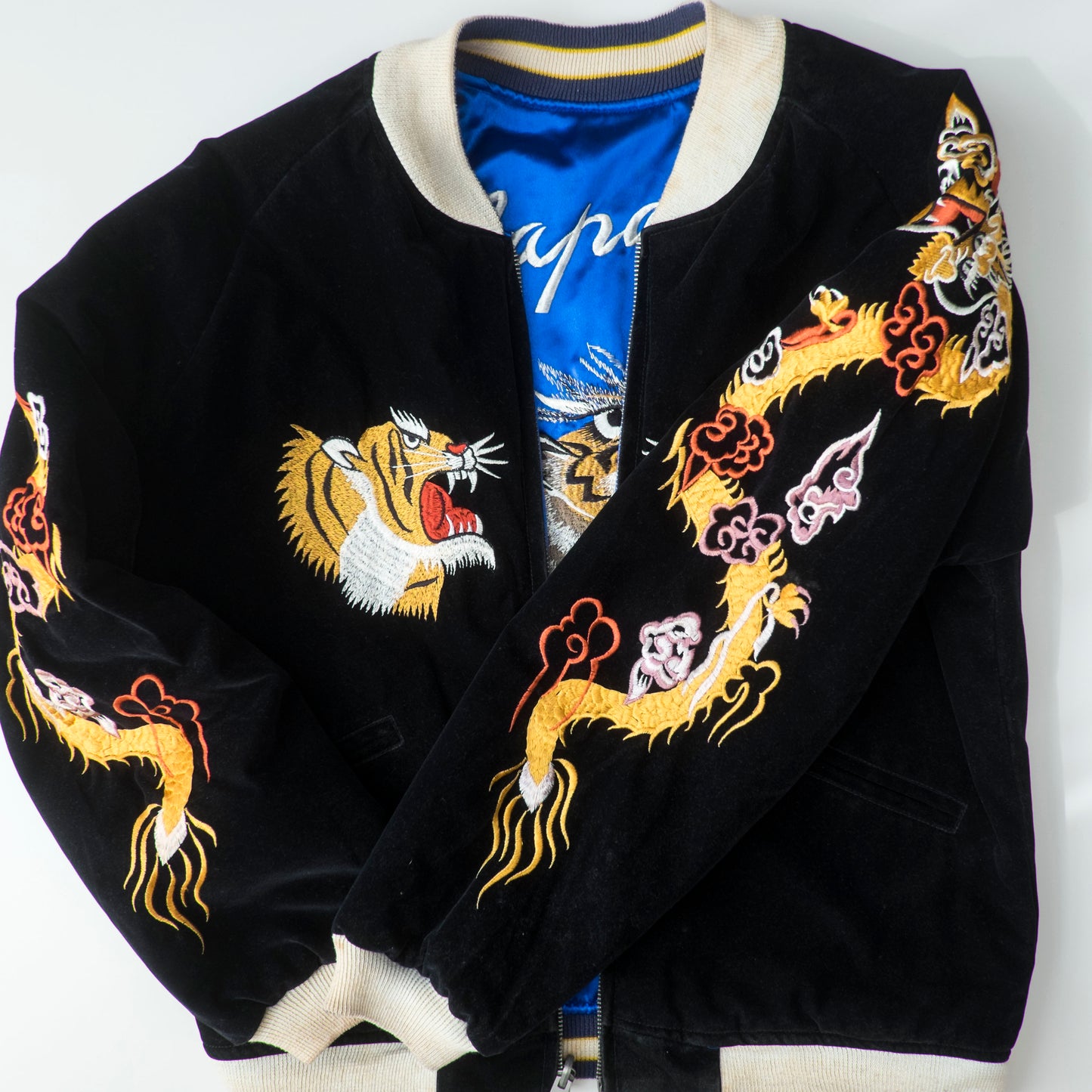
A reversible Yokosuka jacket built on the two great forces of souvenir embroidery, tiger and dragon. The black velveteen face carries mirrored tiger heads, golden dragons the full length of both sleeves and a roaring tiger beneath Mount Fuji; reversed, it turns royal-blue satin with ivory sleeves and a second tiger rising from the mountains.
The Piece
This is not a jacket with a decorative lining but two fully realized faces, one dark, luxuriant and dramatic, the other bright, athletic and rooted in the golden age of Japanese souvenir fashion. On the black velveteen back a large tiger rises vertically from stylized rockwork and bamboo in an elevated, frontal pose, shoulders lifted, claws extended and mouth open, as if climbing toward the viewer. It is worked in golden yellow, burnt orange, black and ivory, with white thread at the throat, muzzle and whiskers and a red mouth with pale fangs. Behind it a snow-covered peak evokes Mount Fuji, bamboo leaves rise around the animal, and flowing white lines near the hem suggest water, cloud or shifting terrain. Above the scene the word “Japan” is embroidered in fluid white script against the dense black pile.
Two mirrored roaring tiger heads guard the chest, each in golden-orange fur with black facial striping, white cheek and throat details, a red open mouth, pale fangs, extended white whiskers and strong black outlines. Closed, they confront one another across the zipper; worn open, they frame the reverse beneath. The sleeves are among the strongest features: a long dragon runs down each arm from upper sleeve almost to the cuff, in golden yellow and orange with ivory facial accents and crimson details, moving through curling clouds of pink, white, black and red. Against velveteen, which absorbs light while the thread reflects it, the imagery seems to rise from a dark field. Cream ribbing frames this face in an aged monochrome border.
The reverse flashes into luminous royal-blue satin with ivory sleeves. Its back again carries “Japan” in white script above a large seated or rising tiger in golden yellow, black, ivory, gray and warm brown, head tilted upward and mouth open, above angular brown and gray forms that read as mountain peaks, rocks or waves in compact souvenir-jacket graphic language. The front holds another mirrored pair of tiger heads, slightly more compact than those on the black side, each rising from a small embroidered mountain base above white-trimmed welt pockets. Narrow red-and-white twisted piping traces the raglan seams, and blue, gray, yellow and cream ribbing completes the athletic silhouette.
The tiger stands for courage, instinct, authority and endurance in hostile terrain, and every tiger here is roaring, climbing, guarding or asserting its presence, which gives both faces unusual thematic unity. The dragon brings the complementary energy, fluid, airborne and supernatural, so that the pairing balances sky and earth, movement and stillness, held in tension rather than shown as a literal battle. Bamboo, which bends and survives harsh weather, adds endurance and adaptability, and the embroidered place name with mountain imagery recalls the earliest souvenir jackets, where “Japan” was part of the artwork rather than a label.
Sukajan developed in postwar Yokosuka as souvenir garments for American service members, local embroidery workshops adapting tigers, dragons, eagles, maps and mountains to Western bomber and varsity forms; Yokosuka City still identifies the sukajan as a local product of the souvenir trade around Dobuita Street, and the name is generally read as a contraction of Yokosuka jumper. Reversibility became a defining trait. This example belongs to the later vintage tradition, presenting the historic vocabulary of place name, tiger, dragon and mountain through dense machine embroidery and strong late-twentieth-century color blocking.
Details
- Maker: Unattributed (no maker label)
- Era: Later vintage Showa to early Heisei, likely circa 1980s–1990s (stylistic assessment)
- Origin: Japanese-market sukajan design
- Material: Black cotton-like velveteen or velvet-pile face; lustrous synthetic satin reverse; ivory satin sleeves; multicolor machine embroidery; rib-knit trim; reversible metal zipper
- Color: Black face with cream ribbing; royal-blue reverse with ivory sleeves and blue, gray, yellow and cream ribbing
- Construction: Fully reversible raglan-sleeve bomber; lightweight, apparently unpadded; two welt pockets on each face; striped rib-knit collar, cuffs and waistband; red-and-white piping along the blue-side raglan seams
- Black face: Tiger with bamboo and Mount Fuji beneath “Japan” script on the back; mirrored tiger heads on the chest; full-length dragons on both sleeves
- Blue face: Tiger above mountain forms beneath “Japan” script on the back; mirrored tiger heads on mountain bases at the chest
Condition
- Pre-owned vintage condition with visible age-related wear, discoloration and textile patina; the embroidery remains visually powerful in strong gold, orange, blue, ivory and red, and the principal tiger and dragon compositions remain clear and legible.
- General wrinkling and storage creasing; natural rippling across the satin; surface variation in the velveteen pile; scattered lint or light surface particles on the dark fabric.
- The cream ribbing on the black face shows particularly noticeable age toning, most visible at the collar, cuffs and lower waistband: yellowish or brownish discoloration around portions of the collar, discoloration and wear around the cuffs and darkened areas along the waistband.
- The ivory sleeves of the blue face may show subtle marks and uneven coloration, with minor marks on the pale satin; collectors seeking a uniformly bright white textile should weigh this patina carefully.
- Possible faint spotting or handling marks; light rubbing around edges and pocket openings; embroidery puckering around dense stitched areas and minor thread irregularities consistent with age.
- No major tears, large holes or extensive embroidery loss are apparent in the photographs. The zipper is present; all hardware and seams should be handled with care given the garment's age.
- Not represented as professionally restored or newly cleaned. Velveteen may shift between deep black and charcoal with the direction of the pile, and the blue may read cobalt, royal or electric blue on screen.
Dating Evidence
The period assessment rests on the black velveteen and synthetic satin pairing, extensive modern machine embroidery, compact reversible construction, the rib-knit pattern and coloration, revival-era tiger imagery, traditional motifs combined with a brighter athletic reverse, apparent age toning to the cream knit trim, and the absence of features proving an occupation-era origin.
Fit and Sizing
Vintage Japanese sukajan often have a shorter body, compact chest and narrower proportions than contemporary Western bombers, so letter sizing alone is not a reliable guide; the reversible layers and embroidery may also influence how it feels when worn. Before purchase, compare flat measurements (chest armpit to armpit, back length from collar base to hem, sleeve from center back neck to cuff along the raglan, underarm sleeve, and hem width across the waistband) with a raglan jacket that already fits.
Authenticity & Care
With no maker or care label in evidence, maker and date are described conservatively; the 1980s–1990s dating is an informed stylistic assessment, and the jacket is not represented as a 1940s or 1950s occupation-era souvenir without period labels, hardware evidence or documentation. Every piece is examined and documented in Japan before dispatch and is offered with the Japonista authenticity guarantee.
Delivery from Japan
Packed by hand in Japan and shipped insured and tracked by EMS or an equivalent express service. Import duties and taxes, where applicable, are payable on arrival. Returns follow our published policy.
Considered offers are welcome through Send an Offer, and each one is reviewed personally.
Continue browsing: Sukajan Souvenir Jackets · Amekaji & Wagara Fashion
Related pieces: Reminiscence padded tiger and Fuji sukajan · Satori reversible koi and dragon sukajan · Satori reversible velvet Soga-style dragon sukajan
Yokosuka Archive
A particular size, motif or decade in mind? Postwar souvenir jackets and heritage amekaji surface in Japan one at a time. Name the maker, the embroidery and the chest measurement, and the Hunting Salon™ watches for it on your behalf. Request a jacket search →
Collectors also search: black velvet tiger sukajan · reversible tiger dragon jacket · blue satin tiger sukajan · mount fuji souvenir jacket · dragon sleeve sukajan · 1980s japanese souvenir jacket · velveteen yokosuka jacket · vintage reversible sukajan