Rare Vintage, Antiques and Art Collector / Curator / Personal Shopper From Japan
Rare Tailor Toyo U.S. Marines Iwo Jima Sukajan Reversible Japan 54-55 CHUCK Red Velvet Dragon Souvenir Jacket
Rare Tailor Toyo U.S. Marines Iwo Jima Sukajan Reversible Japan 54-55 CHUCK Red Velvet Dragon Souvenir Jacket
Couldn't load pickup availability
Have a reasonable price in mind? Submit your best offer and our concierge will review it personally.
Extraordinary Two-Faced Military Tour Jacket with USMC Iwo Jima Flag-Raising, Semper Fidelis, Golden Dragons, Mount Fuji, Temples and Personalized “CHUCK / チャック” Embroidery
An extraordinary Tailor Toyo reversible Japanese souvenir jacket built around one of the most historically evocative themes in the entire sukajan tradition: the meeting of postwar American military memory and the visual culture of Japan.
One face is rendered in magnificent deep crimson-red velveteen, almost completely transformed through embroidery. Across the back appears a monumental U.S. Marines composition centered on the iconic Iwo Jima flag-raising, surrounded by a dense roll call of Pacific and military campaign locations. Above it rises an eagle, globe and anchor-inspired Marine emblem beneath a SEMPER FIDELIS banner; below, enormous block lettering declares U.S. MARINES. Golden Japanese dragons descend along both sleeves from shoulder to cuff.
Reverse the jacket and its personality changes completely.
A vivid royal-blue face presents a nostalgic vision of Japan beneath snow-capped Mount Fuji, with temple and pagoda architecture, an arched bridge, pine-like trees and the embroidered tour dates 54-55. Across the shoulders appears simply JAPAN.
And then there is the detail that gives the entire jacket its human heartbeat:
CHUCK is embroidered across one chest.
Across the opposite chest, the same name appears phonetically in Japanese:
チャック
This is precisely the kind of personalized East-meets-West storytelling from which the sukajan tradition was born.
Tailor Toyo itself traces the souvenir jacket to the early postwar period, when American servicemen stationed in the Pacific commissioned jackets embroidered with unit names, base names, locations and Japanese motifs as tangible records of their time overseas. Toyo Enterprise’s predecessor, KOSHO & CO., was deeply involved in supplying such jackets to U.S. military PX markets during the 1950s.
This jacket does not merely reproduce the look of that tradition.
Its two-sided artwork reproduces its entire narrative logic.
Description
This is a jacket about memory.
The crimson face looks outward toward military service, battle history and the Marine Corps.
The blue face looks inward toward the place remembered: Japan.
Between them travel dragons.
Across both fronts remains a name.
Chuck. チャック.
That structure is what makes the jacket so compelling.
Rather than combining two unrelated decorative backs, the garment behaves like a reversible illustrated diary. One side records the identity and military world of the imagined original wearer. The other records the country and period he wished to remember.
The embroidered 54-55 should be understood as part of the reproduced tour-jacket narrative and source artwork, not automatically as the manufacturing date of this Tailor Toyo garment.
That distinction is important.
This is a Japanese heritage reproduction or archive-style souvenir jacket rooted in the visual language of a 1954-1955 Japan tour garment, rather than a claim that the physical jacket itself was manufactured in those years.
Identification
Brand
Tailor Toyo / テーラー東洋
Manufacturer
Toyo Enterprise Co., Ltd. / 東洋エンタープライズ
Garment Type
Reversible Japanese souvenir jacket
Sukajan / スカジャン
Military tour jacket
USMC-inspired embroidered jacket
Velveteen souvenir jacket
Japanese dragon jacket
Amekaji heritage outerwear
Collector-grade Japanese reproduction fashion
Unisex wearable textile art
Principal Artwork
Side A: U.S. Marines / Iwo Jima / Semper Fidelis / campaign roll / golden dragons
Side B: Japan / Mount Fuji / temples / bridge / landscape / 54-55 / golden dragons
Personalization
CHUCK
チャック
The katakana チャック is the natural phonetic rendering of “Chuck” in Japanese.
Exact Tailor Toyo Lot Number
The original lot or model number is not visible in the supplied photographs and is therefore not asserted here.
That is preferable to assigning the jacket a different Tailor Toyo Iwo Jima model number simply because the subject matter is related. Tailor Toyo has produced multiple historically inspired Marine and Iwo Jima designs over the years.
The Jacket as a Two-Sided Story
The most successful historic souvenir jackets did not separate Japanese motifs from American military identity.
They collided them.
Eagles appeared beside dragons.
Unit names sat beneath Mount Fuji.
Japanese temples shared garments with aircraft, ships and campaign maps.
A serviceman’s name might appear in English on one chest and be transliterated into Japanese on the other.
Tailor Toyo’s own historical account explains that early souvenir jackets developed when U.S. servicemen stationed in the Pacific had jackets embroidered with Japanese imagery, their units, bases and other personal memories before the style became commercialized through PX stores.
This particular design embraces that cultural hybridity more completely than most.
Its military side and Japan side are not opposites.
They are two halves of the same remembered journey.
Crimson Velveteen U.S. Marines Face
Monumental Iwo Jima Composition
The back is dominated by a large pale-thread representation of Marines raising the American flag.
The composition unmistakably references the flag-raising on Mount Suribachi during the Battle of Iwo Jima, one of the defining visual images of the Pacific War.
The famous second flag-raising photographed by Associated Press photographer Joe Rosenthal took place on February 23, 1945. The Naval History and Heritage Command also records an earlier flag raising on Mount Suribachi that morning.
On this jacket, the scene is recreated not photographically but through the stylized language of mid-century souvenir embroidery.
The Marines are rendered largely in ivory and pale gray thread, allowing their intertwined figures to emerge dramatically from the crimson velveteen.
Above them, the Stars and Stripes billow diagonally upward.
The embroidery intentionally preserves the slightly naive, almost hand-drawn character associated with vintage souvenir jackets rather than reducing the image to a polished modern vector graphic.
That imperfection is part of its power.
Semper Fidelis and Marine Corps Imagery
At the top of the back appears an eagle above globe-and-anchor imagery beneath a ribbon reading:
SEMPER FIDELIS
“Semper Fidelis” is Latin for “Always Faithful” and is the motto of the United States Marine Corps.
The official Marine Corps emblem is built around the Eagle, Globe and Anchor, a combination that has represented the Corps in evolving forms for more than a century.
Here, those visual references create an unmistakable Marine Corps identity above the flag-raising composition.
The jacket is not represented as U.S. government-issued, Marine-issued, battlefield worn or an officially commissioned military artifact. Rather, the imagery reproduces the personalized military souvenir tradition from which jackets of this genre historically developed.
Campaign and Place-Name Roll
One of the most fascinating elements is the large field of embroidered place names surrounding the flag raisers.
The white lettering forms two dense vertical banks, creating almost a wall of geographic memory around the central figures.
Visible names and campaign references include locations associated with the Pacific and wider U.S. military experience, among them references to places such as:
New Guinea
Bougainville
Guadalcanal
Solomons
Tarawa
Tinian
Saipan
Guam
Iwo Jima
Okinawa
Korea
Bataan
Wake
Shanghai
Samar
Nicaragua
Veracruz
Peking
and others
The lettering should be appreciated within the visual language of historic souvenir embroidery.
Period-style tour jackets often preserved idiosyncratic spelling, compacted names and imperfect lettering derived from hand-drawn source artwork. Rather than “correcting” every embroidered word, the listing preserves the jacket as it physically appears.
The effect is extraordinary.
The central Iwo Jima scene becomes surrounded by a textual geography of Marine memory.
U.S. MARINES Lettering
Across the lower back, enormous gold-and-cream block embroidery reads:
U.S. MARINES
The letters form a strong visual foundation beneath the pale flag-raising group.
Their warm color links the central back scene to the golden sleeve dragons, making what could otherwise have been two separate visual traditions feel intentionally connected.
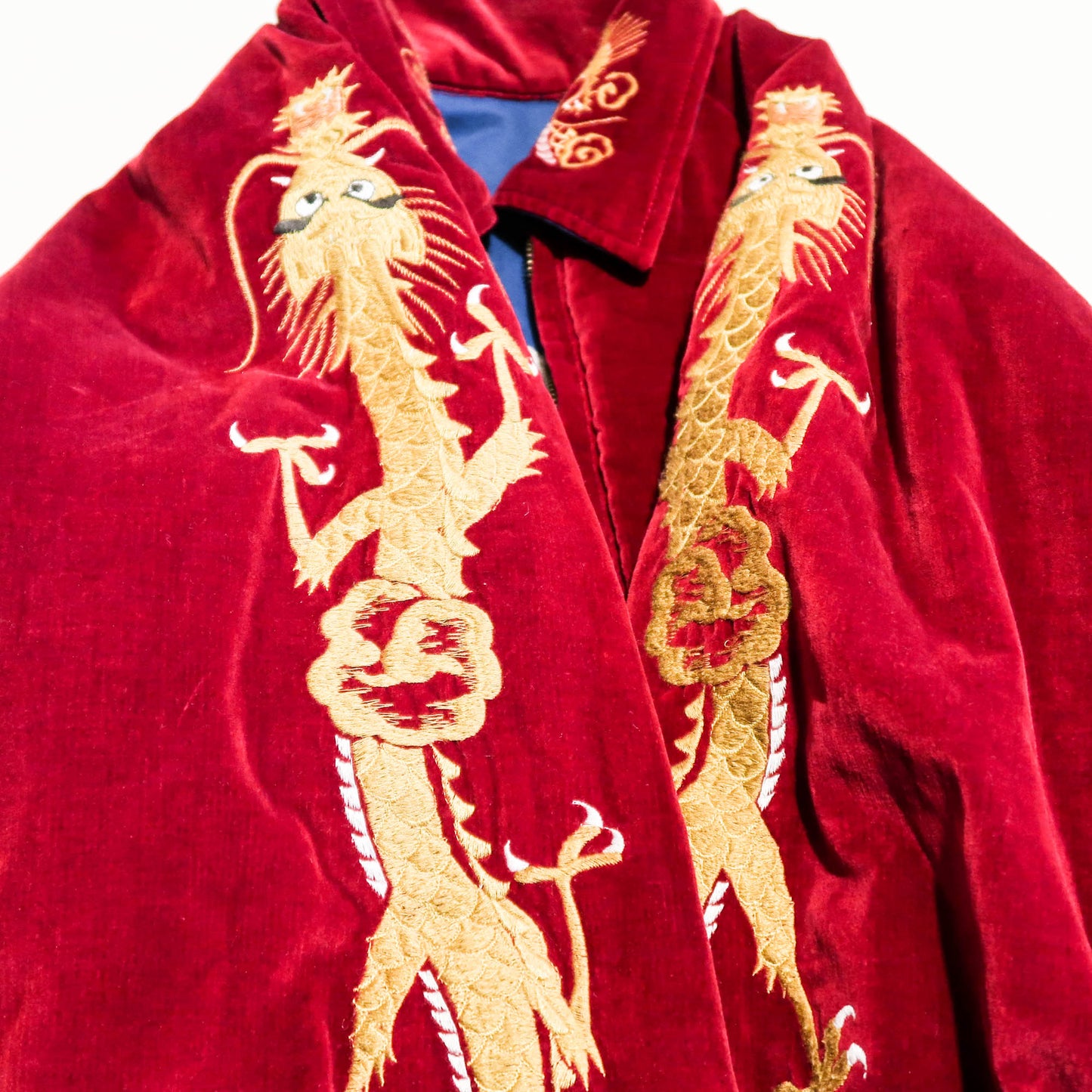
Golden Dragons Down Both Sleeves
Perhaps the jacket’s most spectacular Japanese element is not on the central back at all.
It runs down the arms.
A huge golden dragon descends along each sleeve, beginning near the shoulder and continuing almost to the cuff.
Each dragon is articulated through:
Overlapping gold scales
Long whiskers
Clawed legs
Antler-like horns
White belly accents
Curving tail sections
Cloud-like spiral forms
Fine facial embroidery
Extended serpentine bodies
The scale of this sleeve embroidery is extraordinary.
Rather than adding a small token dragon to a military jacket, the design allows the traditional Japanese motif to claim almost as much visual territory as the Marine imagery.
When worn, the dragons become particularly dramatic because their bodies bend and move with the arms.
From the back they frame the Iwo Jima scene.
From the front they become the most dominant decorative element.
From the side, they essentially take over the jacket.
Dragon-Embroidered Cuffs and Collar
The embroidery continues even after the main sleeve dragons end.
Smaller ornamental dragon forms appear near the cuffs, executed in gold with soft pink, white and lavender details.
The point collar also carries compact dragon embroidery.
These small details matter because they make the jacket feel fully conceived rather than merely decorated on its most visible panels.
Even when the sleeves are folded or the collar is turned upward, another piece of the design is revealed.
Crimson Velveteen Surface
The Marine side is constructed in a rich wine-red to crimson velveteen or velvet-pile textile.
Depending upon the direction of the pile and lighting, the surface moves between:
Deep burgundy
Ruby red
Crimson
Wine
Dark garnet
Near-black shadow
That shifting surface gives the jacket depth even where there is no embroidery.
Velveteen is especially appropriate for souvenir jackets because it creates a luxurious, almost theatrical background while allowing metallic-looking embroidery to shine with exceptional contrast.
“CHUCK / チャック” Front Personalization
The front is remarkably restrained compared with the back.
Across one chest appears:
CHUCK
Across the opposite chest:
チャック
Both are embroidered in warm gold.
This bilingual personalization may be the jacket’s most charming feature.
It reproduces an important feature of historical tour jackets: they were personal mementos, not anonymous fashion products.
Names, nicknames, dates, locations and units turned otherwise similar jackets into records of individual experience.
Here, “CHUCK” ties the entire design together.
The back may tell a grand story about military history.
The chest reminds us that the source garment’s story belonged to one person.
Royal-Blue Japan 54-55 Face
Turn the jacket around and the militaristic crimson landscape disappears completely.
The reverse opens into blue.
This face is quieter and, in many ways, more nostalgic.
Large gold letters across the upper back read:
JAPAN
Beneath them is an embroidered landscape dominated by snow-capped Mount Fuji.
Below the scenery appear the dates:
54-55
If the Marine face resembles a service record, the blue face resembles a souvenir postcard.
Mount Fuji
Mount Fuji rises in white across the upper center of the composition.
Its broad snow-covered silhouette is deliberately simplified and idealized.
Rather than depicting Fuji with photographic realism, the embroidery captures the instantly recognizable visual shorthand used throughout Japanese tourism art and souvenir design.
Fuji performs an essential function here.
The word JAPAN identifies the country linguistically.
Fuji identifies it visually.
Together they make the destination impossible to mistake.
Temple and Pagoda Landscape
Below Fuji lies an idyllic Japanese architectural scene.
The embroidery includes:
A multi-tiered pagoda
Traditional rooflines
Temple or palace structures
Layered green trees
Pines and ornamental foliage
A large curved bridge
Water beneath the bridge
Warm gold, cream and orange architectural accents
The imagery is not intended to document one exact site.
It belongs to the romantic vocabulary of mid-century souvenir Japan: the country distilled into recognizable icons of mountains, temples, gardens, bridges and traditional architecture.
That quality is important.
This is memory rather than cartography.
The Arched Bridge
A large warm-brown bridge stretches across the lower-left landscape.
Its curved silhouette creates one of the strongest lines in the entire composition, leading the eye from the forest toward the architecture beyond.
White embroidery beneath it suggests water or reflected light.
The bridge also has a metaphorical resonance within the jacket’s wider design.
One face is America and the Marines.
The other is Japan.
Between them lies a garment born from cultural exchange.
Few motifs could be more fitting than a bridge.
The Meaning of “54-55”
Large gold embroidery at the bottom reads:
54-55
Within the visual narrative, this represents 1954-1955, the tour or commemorative chronology reproduced by the source artwork.
It should not be confused with the manufacturing date of the present Tailor Toyo jacket.
This distinction protects the integrity of the listing while preserving the historical flavor that makes the design so compelling.
The jacket is better understood as a Japanese reproduction or archive piece that recreates the identity of a 1954-55 personalized souvenir jacket.
Blue-Face Golden Dragons
The same spectacular dragons continue along both arms when the blue face is worn outward.
Against royal blue, however, their effect changes dramatically.
The gold becomes brighter.
The white belly details become more visible.
The crimson shadows disappear.
The dragons now feel less ceremonial and more graphic, almost like gold embroidery across a military dress jacket.
Because the sleeve artwork belongs visually to both sides, the dragons form the literal connective tissue between the jacket’s two narratives.
Construction
This piece has a more tailored tour-jacket architecture than the most familiar rib-collar sukajan.
Visible construction details include:
Fully reversible construction
Pointed turn-down collar
Crimson velveteen face
Royal-blue woven reverse
Dense direct embroidery
Extensive full-length sleeve embroidery
Embroidered collar details
Embroidered cuff details
Central metal zipper
Two lower hand pockets
Snap-fastened lower front tabs
Rib-knit waistband
Long sleeves
Traditional short souvenir-jacket body
Contrasting interior surfaces
Personalized chest embroidery
The point collar gives the piece a wonderfully 1950s sports-jacket character and distinguishes it from the standard baseball-collar souvenir bomber.
Materials
Red Face
Velveteen / velvet-pile textile
Blue Face
Smooth woven or satin-finish textile
Decoration
Dense multicolor embroidery thread
Trim
Rib-knit waistband
Hardware
Metal center zipper
Metal snap closures
The exact fiber percentages are not visible in the photographs supplied here and therefore are not invented.
Please refer to any surviving interior or care label for definitive fiber composition.
Tailor Toyo and the Souvenir Jacket Tradition
Tailor Toyo occupies a uniquely credible position within modern sukajan production because its history is directly connected with the original postwar industry.
Toyo Enterprise explains that its predecessor, KOSHO & CO., supplied souvenir jackets to military PX stores during the genre’s original rise and at one point held an overwhelming share of the 1950s market. Tailor Toyo continues to reproduce historic jackets using surviving vintage examples and archival techniques.
That history matters particularly with a design like this.
The jacket is not simply borrowing a generic tiger or dragon motif.
It reconstructs the very kind of personalized military-and-Japan narrative around which souvenir jackets originally developed.
East Meets West in a Single Garment
Few jackets illustrate the cultural DNA of sukajan as clearly as this one.
American imagery includes:
U.S. Marines
Iwo Jima flag raising
Semper Fidelis
Military campaign names
American flag
Marine-style insignia
Personalized English name
Japanese imagery includes:
Golden dragons
Mount Fuji
Pagoda architecture
Traditional temples
Garden landscape
Arched bridge
Japanese katakana
Ornamental dragon decoration
Neither vocabulary overwhelms the other.
Instead, they coexist.
That coexistence is the point.
Period Assessment
The embroidered 54-55 reflects the chronology represented by the reproduced source jacket.
The physical Tailor Toyo garment itself should be described as a later Japanese heritage reproduction / archive souvenir jacket, not as an original 1954-55 U.S. serviceman-issued garment unless documentary provenance independently establishes otherwise.
The exact Tailor Toyo release year and lot number are not visible in the current photographs.
No claim is therefore made that this specific garment:
Was physically manufactured in 1954 or 1955
Was issued by the U.S. Marine Corps
Belonged to an actual Marine named Chuck
Was worn at Iwo Jima
Was military government property
Was produced as an official USMC uniform item
Its collectible importance lies in its extraordinary reproduction of the personalized postwar souvenir-jacket tradition.
Condition
This is a genuine pre-owned collector garment with natural surface character.
Based upon the supplied photographs, the jacket appears to remain in very good overall visual condition, particularly considering the extensive embroidery and pile textile.
Crimson Velveteen Face
Visible characteristics include:
Natural directional variation in the velvet pile
Soft creasing through the body and sleeves
Minor impressions from folding and storage
Light tonal changes according to the nap
Gentle wear consistent with handling
Possible fine lint or fibers naturally attracted to velveteen
The deep red color remains rich and visually dramatic.
Blue Face
The blue textile shows:
Natural fabric wrinkling
Light handling creases
Minor tonal variation
Soft shaping through the sleeves and body
Normal pre-owned surface character
The royal-blue color remains strong and provides excellent contrast with the embroidery.
Embroidery
The embroidery is the jacket’s great strength.
The following remain visually bold and highly legible:
U.S. Marines back artwork
Iwo Jima figures
Semper Fidelis banner
Campaign lettering
American flag
Golden sleeve dragons
CHUCK lettering
チャック lettering
Mount Fuji
Japan landscape
JAPAN lettering
54-55 dates
Collar and cuff embroidery
No obvious large sections of missing embroidery, catastrophic unraveling or major distortion are visible in the supplied full-garment photographs.
Overall Structure
No obvious major holes, severe tears or catastrophic seam failures are visible.
As with any densely embroidered pre-owned jacket, smaller thread pulls, tiny marks, minor abrasions, localized stains, zipper wear or imperfections may be present and should be evaluated through all available close-up photographs.
Please review every photograph carefully, as the images form an essential part of the condition description.
Size and Measurements
The tagged size is not visible in the photographs supplied here.
Please contact us for the current flat-lay measurements before purchase.
For this particular point-collar souvenir-jacket construction, the most useful measurements are:
Chest: armpit to armpit
Shoulders: seam to seam where applicable
Back length: base of collar to lower hem
Sleeve length: shoulder or center-back collar to cuff depending upon construction
Hem width: waistband measured flat
Vintage-inspired Japanese sizing can differ substantially from contemporary Western sizing.
Actual garment measurements should therefore take priority over a nominal letter or number size.
Styling Possibilities
Crimson U.S. Marines Face
Pair with:
Raw indigo selvedge denim
Black straight-leg jeans
Military chinos
Engineer boots
Service boots
Plain white T-shirt
Black knitwear
Vintage workwear
Heritage Americana
Rockabilly outfits
Motorcycle-inspired styling
Japanese Amekaji
The wine-red velveteen and gold dragons already provide extraordinary visual richness, so restrained supporting pieces work especially well.
Royal-Blue Japan Face
Pair with:
Cream chinos
Dark denim
Faded jeans
Brown leather boots
White sneakers
Vintage sweatshirts
Military trousers
1950s-inspired casualwear
Japanese workwear
Ivy-influenced styling
The blue side is especially effective when the goal is to emphasize the Japanese tour-jacket character rather than the Marine imagery.
Display and Collecting Appeal
This is the kind of jacket that can be collected even by someone who never intends to wear it.
The crimson side functions almost like an embroidered military memorial panel.
The blue side resembles a mid-century Japan travel poster rendered in thread.
Displayed on a wall or mannequin, it offers powerful crossover appeal for collections centered on:
Tailor Toyo
Japanese souvenir jackets
Sukajan
Postwar Japanese fashion
USMC memorabilia-inspired fashion
Iwo Jima iconography
1950s military-tour aesthetics
Japanese dragons
Mount Fuji
Amekaji
Velveteen jackets
Military embroidery
American-Japanese cultural history
Vintage reproduction clothing
Wearable textile art
Because both faces are significant, the jacket can be periodically reversed for an entirely different display.
Why This Piece Stands Apart
Many sukajan rely upon one strong back embroidery.
This jacket offers considerably more.
Its distinguishing qualities include:
Tailor Toyo heritage
Fully reversible construction
Deep crimson velveteen
Royal-blue alternate face
Massive Iwo Jima composition
Semper Fidelis banner
U.S. Marines lettering
Campaign-place roll call
Golden dragons down both sleeves
Embroidered dragons at the cuffs
Embroidered collar details
Mount Fuji landscape
Temple and pagoda embroidery
Japanese garden bridge
JAPAN lettering
54-55 tour chronology
Personalized CHUCK embroidery
Matching チャック katakana
Point-collar tour-jacket architecture
Rare East-meets-West narrative cohesion
Most importantly, the reversible design tells a coherent story.
The Marine side answers:
Who was the source jacket remembering?
The blue side answers:
Where was he remembering?
And the chest supplies the name:
Chuck.
Collecting Perspective
The attraction of Tailor Toyo is not merely embroidery quality.
It is historical literacy.
The company has spent decades interpreting actual souvenir-jacket traditions rather than reducing the genre to generic Japanese ornament. Tailor Toyo’s official history describes the original jackets as personalized mementos commissioned by American servicemen stationed in the Pacific, exactly the cultural structure this CHUCK / Japan 54-55 design recreates.
The unusual combination of Marine Corps imagery, personalized bilingual embroidery, Japanese landscape art, velvet construction and enormous sleeve dragons makes this especially attractive for a collector who already owns more conventional tiger, eagle or map jackets and wants something with deeper narrative character.
Purchase, Shipping and Vintage Policy
This is a genuine pre-owned collectible garment offered in its present as-is condition.
Natural velveteen nap movement, fabric creasing, embroidery variation, rib relaxation, minor surface marks, thread movement, storage impressions, hardware patina and other signs of previous use are inherent characteristics of collectible clothing.
Please examine all photographs and written details carefully before purchasing. The photographs form an essential part of the description and provide the clearest representation of the materials, embroidery, colors and current condition.
Colors may appear slightly different depending upon lighting, display calibration and the direction of the velvet pile.
Vintage-inspired and Japanese-market sizing can differ significantly from contemporary Western sizing. Please compare the actual flat-lay measurements with a similar jacket that already fits comfortably.
Due to the collectible, pre-owned and internationally shipped nature of this item, returns, exchanges and claims based upon fit, previously disclosed condition, natural material characteristics or minor color differences cannot be accepted, subject to applicable Etsy policies and consumer law.
Reasonable and respectful offers may be considered.
The jacket will be carefully protected and packed for international transit with attention given to minimizing unnecessary compression of the embroidery and velveteen.
Worldwide shipping is normally provided through Japan Post EMS or another suitable tracked international service where required.
Preparation, shipping and handling normally takes 5–10 business days or earlier.
Tracking information will be supplied after dispatch.
Any customs duties, import taxes, brokerage charges, local handling fees or destination-country charges remain the responsibility of the buyer.
If you are looking for this design or model in another size, please feel free to message us. Although availability cannot be guaranteed, we may be able to locate the same or a closely matching piece in a different size through our sourcing network.
#TailorToyo #ToyoEnterprise #USMarinesJacket #IwoJimaJacket #IwoJima #USMCStyle #SemperFidelis #Sukajan #VintageSukajan #SouvenirJacket #TourJacket #JapaneseSukajan #ReversibleJacket #RedVelvetJacket #VelvetSukajan #DragonJacket #DragonEmbroidery #Japan5455 #MountFujiJacket #JapanSouvenir #Amekaji #JapaneseStreetwear #MilitaryJacket #MilitaryEmbroidery #ChuckJacket #JapaneseVintage #WearableArt #YokosukaJacket #CollectorJacket #JapanFashion
tailor toyo, iwo jima jacket, us marines jacket, vintage sukajan, dragon sukajan, japan 54 55, reversible jacket, red velvet jacket, military souvenir, mount fuji jacket, tour jacket, japanese bomber, amekaji jacket
Material Tags
velveteen, velvet-pile textile, woven reverse fabric, embroidery thread, rib-knit trim, metal zipper, metal snaps, woven pocketing, reversible construction