Rare Vintage, Antiques and Art Collector / Curator / Personal Shopper From Japan
Rare Tailor Toyo M18333 Okushiri-Shima 613th AC&W Black Tiger Reversible Sukajan Souvenir Jacket
Rare Tailor Toyo M18333 Okushiri-Shima 613th AC&W Black Tiger Reversible Sukajan Souvenir Jacket
Couldn't load pickup availability
Have a reasonable price in mind? Submit your best offer and our concierge will review it personally.
Early M-Number Japanese Embroidered Bomber with Midnight Tiger, 5th Air Force Detachment 29 Insignia, Dragons and Eagle Motifs
A scarce early-production Tailor Toyo reversible sukajan combining two dramatically different chapters of postwar Japanese souvenir-jacket culture.
One face presents a roaring midnight-blue tiger against an ivory satin body, framed by electric-blue sleeves, bamboo, waves and a distant mountain. The opposite face transforms into an elaborate military commemorative jacket dedicated to the 613th Aircraft Control & Warning Squadron, Detachment 29, Okushiri-Shima, Japan, with a large central “5” emblem surrounded by dragons, clouds and heraldic ornament.
Identified with the collectible Tailor Toyo M18333 model family, this design belongs to the brand’s earlier “M-number” generation and is now increasingly difficult to locate, particularly with both embroidered faces remaining visually complete. Documented examples of this same pattern identify it as the Okushiri-Shima / blue-tiger reversible model.
This is more than a tiger jacket and more than a military reproduction. It is a textile collision between Japanese animal symbolism, American radar-unit history, postwar souvenir culture and the gloriously eccentric imagination that made sukajan one of Japan’s most original contributions to global streetwear.
Opening Impression
The first face is cool, controlled and almost monochromatic.
A dark navy tiger rises from the pale satin back, its body rendered through dense curved stitching rather than conventional orange-and-black striping. The restrained blue-and-ivory palette gives the animal the appearance of an old ink painting awakened inside a bomber jacket.
Turn the garment inside out and the mood changes completely.
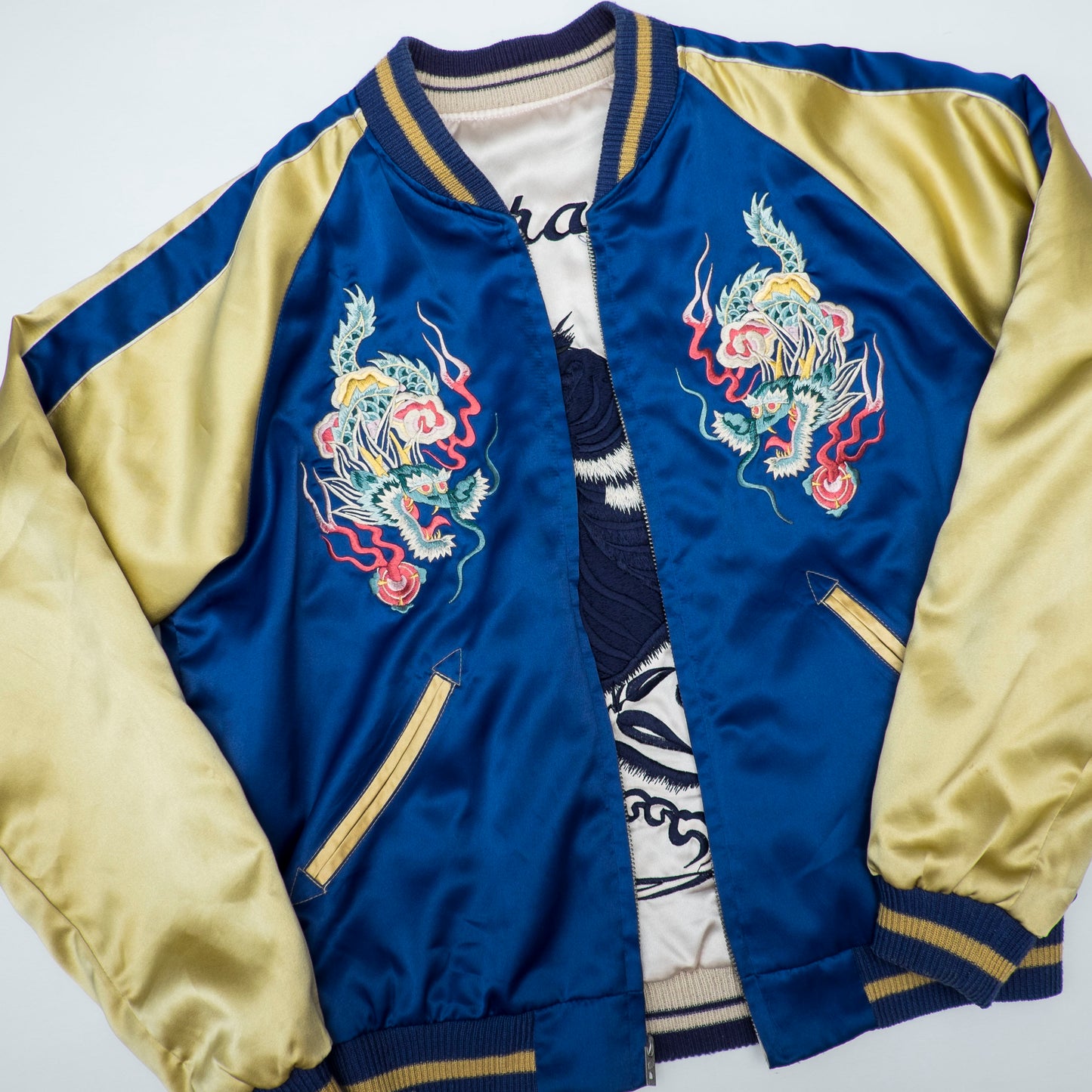
Royal blue and antique-gold satin become the foundation for a large military unit composition reading:
613th AC&W SQDN
DET 29
OKUSHIRI-SHIMA
JAPAN
At the center sits a bold numeral “5” insignia, encircled by dragons, stylized clouds, stars and radiant lines. The reverse is not a secondary lining. It is a completely different collectible jacket with its own embroidered narrative.
Two faces, two histories, one unforgettable piece.
Identification and Subject
Brand: Tailor Toyo / Toyo Enterprise
Model association: M18333
Garment type: Reversible sukajan / Japanese souvenir bomber jacket
Primary face: Midnight-blue roaring tiger with bamboo and mountain landscape
Reverse face: 613th Aircraft Control & Warning Squadron, Detachment 29, Okushiri-Shima military commemorative design
Primary colors: Ivory, electric blue and navy
Reverse colors: Royal blue, antique gold and navy
Front imagery, tiger face: Paired stylized eagle or hawk motifs
Front imagery, military face: Paired Japanese dragons with clouds and flaming jewels
Construction: Fully reversible raglan-sleeve bomber
Closure: Reversible metal zipper
Pockets: Angled welt pockets on both wearable faces
Trim: Striped rib-knit collar, cuffs and waistband
Material: Satin-finish polyester construction consistent with documented M18333 examples
Size: Not visible in the supplied photographs
Production category: Earlier Tailor Toyo M-number reproduction
Original inspiration: Mid-1950s American military souvenir-jacket culture in Japan
The Midnight Tiger Face
Ivory Satin and Electric-Blue Sleeves
The tiger face is built around a striking three-color arrangement:
- Warm ivory or champagne-colored satin body
- Saturated electric-blue raglan sleeves
- Deep navy embroidery and trim
- Fine red piping dividing the sleeve panels
- Cream-and-navy striped ribbing
The ivory center allows the dark embroidery to read with unusual clarity, while the blue sleeves give the jacket a distinctly mid-century athletic character.
Narrow ivory sleeve stripes create a visual connection between the pale body and blue arms. Their fine red piping adds a subtle flash of warmth without disturbing the largely cool palette.
The result is bold from a distance but surprisingly elegant up close.
Roaring Blue Tiger
The back is dominated by a large tiger seated upright upon rocky terrain.
Unlike conventional sukajan tigers embroidered in gold, orange, brown and white, this animal is interpreted almost entirely in navy and ivory. The reduced color palette brings attention to the actual stitchwork:
- Curved lines define the tiger’s body and musculature
- Layered navy stitching creates the stripes
- White sections articulate the chest, jaw and face
- Dark claws extend over the rocky foreground
- The open mouth reveals individually embroidered teeth
- Long whiskers project outward from the muzzle
- A sharply raised eye gives the animal an alert, confrontational expression
The tiger appears caught between stillness and movement. Its seated posture is grounded, but its open mouth, raised head and extended claws suggest immediate defensive power.
Bamboo, Mountain and Water
The tiger is surrounded by a simplified Japanese landscape.
Bamboo leaves rise around its paws and lower body. A dark mountain silhouette, likely intended to evoke Mount Fuji, appears in the distance. Curving lines below the tiger suggest water, mist or rolling terrain.
These secondary details keep the animal from floating against an empty satin panel. They place it inside an idealized Japanese environment, closer to an ink painting or textile hanging than a modern logo composition.
The dark blue embroidery also creates an almost aizome-inspired visual effect, recalling indigo-dyed textiles and monochrome Japanese printmaking.
Meaning of the Tiger
Within East Asian visual traditions, the tiger is associated with:
- Courage
- Command
- Protective power
- Physical strength
- Fearlessness
- The ability to repel harmful forces
- Authority over the earthly realm
In sukajan design, the tiger became one of the defining images through which Japanese embroidery workshops translated regional symbolism into garments desired by American servicemen.
This example is particularly memorable because it strips away the tiger’s expected natural colors. The animal becomes a shadow, guardian and emblem rather than a literal zoological portrait.
Eagle and Hawk Chest Embroidery
The tiger face features two mirrored bird motifs across the chest.
Each bird is depicted in flight with:
- Hooked beak
- Extended wings
- Layered tail feathers
- Dark navy body
- Gray-blue feather accents
- Pale cloud formations behind the figure
The birds may be interpreted as stylized eagles or hawks. Their symmetrical arrangement creates a ceremonial entrance to the jacket and balances the massive tiger composition on the back.
The birds also establish an East-meets-West visual dialogue. Eagles are strongly associated with American military heraldry, while hawks have long appeared in Japanese warrior culture and decorative art.
That ambiguity works beautifully here. The motifs can belong equally to the skies of military insignia and the world of Japanese animal symbolism.
The Okushiri-Shima Military Face
Royal Blue and Antique Gold
The reverse face changes from cool ivory to vivid military pageantry.
The body is rendered in lustrous royal blue, while the raglan sleeves are antique gold. Navy sleeve stripes and matching ribbing keep the palette visually disciplined.
The colors carry a natural heraldic quality:
- Blue suggests sky, radar coverage and military aviation
- Gold suggests insignia, rank and ceremonial identity
- White and silver embroidery provide graphic definition
- Red accents energize the surrounding dragons and emblems
Unlike many reversible jackets where the secondary face is comparatively plain, this side carries the garment’s most specific historical narrative.
613th Aircraft Control & Warning Squadron
The large embroidered inscription refers to the:
613th Aircraft Control & Warning Squadron
Detachment 29
Okushiri-Shima, Japan
Aircraft Control and Warning units formed part of the radar and air-defense network responsible for identifying, tracking and communicating information about aircraft moving through strategically important airspace.
Historical unit records place Detachment JR29 on Okushiri Island, southwest of Hokkaido, in 1955, where equipment included AN/FPS-3 and AN/FPS-4 radar systems together with AN/UPX-6 identification equipment. The broader squadron’s mission included continuous radar surveillance, aircraft identification, interception control and navigational assistance within the northern defense of Japan.
The wording on this jacket is therefore not invented decorative military language. It refers to an actual Cold War-era radar detachment positioned on a remote Japanese island.
Okushiri-Shima
Okushiri is an island lying off the southwestern coast of Hokkaido.
Its isolated maritime location made it strategically useful for radar surveillance during the early Cold War. Personnel stationed there would have been far removed from the major urban centers of occupied and post-occupation Japan.
Souvenir jackets provided servicemen with a way to preserve these highly specific postings in wearable form. Rather than simply saying “Japan,” personalized military jackets could record:
- Squadron
- Detachment number
- Air base or island
- Years of service
- Personal name
- Unit emblem
- Local imagery
Tailor Toyo’s vintage archive documents an original mid-1950s jacket commissioned for a member of the 613th AC&W Squadron on Okushiri Island. The archival example demonstrates how unit names, remote locations and custom embroidery became symbols of status and personal history among servicemen.
The Central “5” Emblem
The reverse back is anchored by an oversized numeral 5 positioned inside a circular field.
The emblem includes:
- A large gold “5”
- White diagonal rays
- Small stars
- A winged or radiating lower star
- Dark navy circular framing
- A surrounding wreath of dragons and cloud forms
The composition visually references the Fifth Air Force context under which the 613th operated in Japan.
Rather than reproducing a sterile modern military badge, the emblem has been translated through the expressive language of souvenir-jacket embroidery. The number becomes part unit insignia, part celestial symbol and part pop-art medallion.
Its scale makes the back immediately recognizable even before the surrounding wording is read.
Dragons, Clouds and Celestial Movement
The central emblem is surrounded by a circular procession of Japanese dragons.
Several dragon figures appear in alternating colors:
- White and red
- Lavender and pink
- Blue and gold
- Red-brown
- Pale green and silver
They weave among stylized clouds, radiating feathers and smaller floating forms.
The design effectively fuses two symbolic systems:
American Military Identity
Represented through:
- Squadron lettering
- Detachment number
- Stars
- Central numeral insignia
- Geographic posting
- Bold collegiate-style typography
Japanese Decorative Tradition
Represented through:
- Dragons
- Clouds
- Flame shapes
- Jewels
- Circular movement
- Embroidered mythological ornament
This combination is at the core of authentic sukajan culture. Western military narratives were not merely printed onto Japanese clothing. They were reimagined through the materials, imagery and embroidery practices of local workshops.
Dragon Chest Embroidery
The military face features two mirrored dragons across the chest.
Each dragon curls vertically within a field of:
- Pale clouds
- Red flame-like tendrils
- Green and blue scales
- White whiskers
- Gold highlights
- Small red jewels or pearls
The dragons are animated, expressive and tightly composed. Their mirrored placement gives the front visual symmetry while leaving the center zipper clean.
In Japanese and East Asian art, dragons commonly symbolize:
- Command over water and weather
- Wisdom
- Transformation
- Spiritual authority
- Protection
- Dynamic energy
- Imperial and celestial power
Here the dragons also reinforce the aviation and radar theme. They appear to move through the same sky that the squadron was tasked with observing.
A Rare Historical Combination
Many Tailor Toyo jackets recreate broadly familiar motifs such as Japan maps, eagles, dragons or tigers.
This model is more particular.
Its military face names a remote island, a squadron and a numbered detachment. Its opposite face presents an unusually monochromatic dark tiger rather than a standard multicolor animal design.
That specificity gives the jacket several overlapping collector identities:
- Early Tailor Toyo M-number model
- Okushiri Island souvenir design
- 613th AC&W Squadron memorabilia
- Fifth Air Force-related fashion
- Black or blue tiger sukajan
- Reversible Japanese military bomber
- Postwar cultural-history reproduction
- Rare colorway collector jacket
Tailor Toyo and the Sukajan Tradition
Tailor Toyo is the souvenir-jacket division of Toyo Enterprise, a company deeply associated with the preservation and revival of postwar Japanese-American clothing traditions.
The sukajan originated through the encounter between American servicemen and Japanese embroidery workshops in the years following the Second World War. Bomber-style jackets were decorated with dragons, tigers, maps, eagles, military units and place names, allowing personnel to return home with wearable records of their postings.
Tailor Toyo developed its reputation by studying surviving historical garments and reproducing their unusual proportions, reversible construction, embroidery styles, color combinations and period irregularities.
This model is especially representative of the brand’s archival spirit because it does not settle for a generic “Japan” composition. It revives a highly specific radar-unit narrative from northern Japan.
M-Number Production
The M18333 association places this design within the earlier Tailor Toyo “M-number” family.
Collectors generally use “M-number” to describe older Tailor Toyo models whose product codes begin with “M,” in contrast to the later and current “TT” numbering system. Exact production-year documentation for every M-number model is incomplete, but these pieces are commonly associated with the brand’s earlier reproduction period around the late 1990s and turn of the millennium.
This means the jacket is itself now a vintage or near-vintage Japanese reproduction of a mid-1950s historical souvenir-jacket tradition.
It carries two layers of age:
- The original 1950s military culture that inspired the design
- The earlier Tailor Toyo revival era in which this particular jacket was produced
Materials and Construction
Visible construction features include:
- Smooth satin-finish polyester shell
- Full reversible construction
- Embroidery on both wearable faces
- Raglan sleeves
- Reversible metal zipper
- Angled welt pockets on both faces
- Rib-knit collar
- Rib-knit cuffs
- Rib-knit waistband
- Contrasting sleeve insets
- Fine piping along sleeve panels
- Dense back embroidery
- Mirrored chest embroidery
- Chain-style script “Japan” lettering
- Multicolor rayon-like embroidery thread
Documented resale examples of this exact M18333 pattern identify the garment as polyester.
The smooth synthetic satin produces the liquid sheen associated with classic sukajan, while also allowing both embroidered faces to remain relatively light and wearable.
Color and Visual Character
Tiger Face
Body: Ivory, cream or pale champagne
Sleeves: Electric blue
Embroidery: Midnight navy, white and gray-blue
Piping: Fine red accent
Mood: Graphic, cool, restrained and animalistic
Squadron Face
Body: Royal blue
Sleeves: Antique gold
Embroidery: Gold, navy, white, red, lavender, pink and green
Mood: Military, heraldic, energetic and historically specific
The two faces are linked by blue, but they use it differently.
On the tiger side, blue is shadow and ink.
On the squadron side, blue becomes sky, insignia and ceremony.
Period Assessment
Earlier Tailor Toyo M-Number Production, Likely Circa Late 1990s to Early 2000s
This is not represented as an original 1950s serviceman-owned souvenir jacket.
It is a later Tailor Toyo reproduction inspired by genuine mid-century military souvenir designs. Its M-number association, polyester satin construction and documented model references are consistent with the brand’s earlier production era, before current TT-numbered releases became standard.
A cautious public dating would be:
Likely late 1990s to early 2000s, with exact production year unconfirmed.
The design itself directly references a mid-1950s Okushiri-Shima military jacket tradition documented within Toyo Enterprise’s vintage archive.
Condition
Pre-Owned Vintage Condition with Visible Age, Wear and Satin Character
The jacket presents with clear signs of previous wear and age but retains strong visual impact across both embroidered faces.
Visible characteristics include:
- General satin wrinkling and creasing
- Mild surface marks and scattered spotting
- Age-related toning to the ivory satin panels
- Areas of discoloration around the pale front body
- Light staining near the lower front and pocket areas
- Some darkening and wear to the cream rib-knit trim
- Minor pilling or fuzzing on the ribbing
- Possible light discoloration along cuffs and waistband
- Natural puckering around dense embroidery
- Minor thread irregularities consistent with age and wear
- Subtle rubbing or dulling to high-contact satin areas
- Mild fading or color variation
- Storage creasing across both faces
The main embroidered compositions remain visually complete and readable:
- The midnight tiger retains its face, claws, stripes and landscape details
- The paired chest birds remain distinct
- The 613th AC&W lettering remains legible
- The central “5” emblem remains bold
- The surrounding dragons retain their individual colors
- The military-side chest dragons remain well defined
No major structural tear is immediately apparent from the available photographs. As with all vintage satin garments, close inspection of the zipper, cuffs, collar, pocket edges, underarms and embroidery should be made before purchase.
The visible aging contributes to the jacket’s authentic earlier-production character, but buyers seeking an unused or flawless garment should carefully review all photographs.
Colors may shift depending on lighting, display calibration and the reflective direction of the satin.
Size and Measurements
The tagged size is not visible in the current photographs.
Exact flat measurements will follow shortly, or please message for priority confirmation.
Recommended measurements include:
Chest width: To follow
Back length: To follow
Raglan sleeve length: To follow
Hem width: To follow
Tagged size: To be confirmed
Japanese sukajan often fit shorter and more compactly than contemporary Western bomber jackets. Please compare the actual measurements with a well-fitting jacket rather than relying solely on a general letter size.
The intended silhouette is traditionally waist-length with rounded raglan shoulders and a relaxed upper body.
Styling and Wearability
Wear the Tiger Face With
- Black denim
- Raw indigo jeans
- Navy trousers
- Cream work pants
- White T-shirt
- Chambray shirt
- Black boots
- Minimal sneakers
- Japanese amekaji
- Vintage military clothing
- Monochrome streetwear
Wear the Squadron Face With
- Faded blue denim
- Olive military trousers
- Khaki chinos
- White denim
- Navy knitwear
- Work boots
- Retro sneakers
- American collegiate pieces
- Flight-jacket styling
- Heritage streetwear
The ivory tiger face feels artistic and graphic.
The royal-blue squadron face feels brighter, more athletic and immediately connected to military-souvenir history.
Display and Archival Appeal
This jacket has enough visual and historical substance to work as both clothing and display textile.
It would suit:
- Sukajan collections
- Japanese streetwear archives
- Military-fashion collections
- Postwar cultural displays
- Aviation memorabilia rooms
- Tattoo studios
- Vintage boutiques
- Creative offices
- Music studios
- Americana collections
- Hokkaido or Okushiri-related displays
- Textile and embroidery collections
For display, use a broad padded hanger and avoid prolonged direct sunlight.
Because the jacket contains pale satin panels, it should be stored away from dark garments that may transfer dye. Avoid crushing the embroidery beneath heavier coats.
Why Collect This Piece
A Documented Pattern
The exact Okushiri-Shima / blue-tiger design is documented under Tailor Toyo’s M18333 model association, giving the jacket a stronger identity than an anonymous embroidered bomber.
Historical Specificity
The 613th AC&W Detachment 29 inscription refers to an actual radar station and military unit rather than imaginary decorative lettering.
Early Tailor Toyo Appeal
M-number pieces represent an earlier stage in Tailor Toyo’s revival history and are becoming more difficult to replace.
Exceptional Two-Sided Design
Both faces offer major back embroidery, chest embroidery, contrasting sleeves and distinct narratives.
Unusual Tiger Palette
The dark monochrome tiger is far less common than traditional orange, gold or white tiger compositions.
International Collector Interest
The jacket crosses several collector communities at once:
- Japanese fashion
- Military history
- Aviation
- Vintage streetwear
- Sukajan
- Hokkaido history
- Embroidery
- Postwar cultural exchange
Purchase, Shipping and Vintage Policy
This is a unique pre-owned vintage garment offered in its present condition.
Vintage and pre-owned clothing may display fading, discoloration, stains, storage marks, wrinkles, fabric wear, embroidery irregularities, loose threads, pilling, weakened ribbing, zipper wear, repairs, odors and other evidence of age and previous ownership.
Please review all photographs carefully. The photographs form an integral part of the condition description. Additional photographs or measurements may be requested before purchase.
Because this is a unique vintage collectible, all sales are final. Returns, exchanges, cancellations, partial refunds and claims based on fit, personal color perception, expected vintage characteristics or condition details already shown or disclosed cannot be accepted, except where required by applicable law or marketplace buyer protection.
Preparation, shipping and handling normally takes 5–10 business days or earlier.
Worldwide shipping is normally arranged through Japan Post EMS or another appropriate tracked international service. Tracking information will be provided after dispatch.
International buyers are responsible for any customs duties, import taxes, handling charges or brokerage fees imposed by the destination country.
Respectful and realistic offers may be considered depending on rarity, condition, international demand and replacement availability.
If you are looking for this design or model in another size, please feel free to message us. Although availability cannot be guaranteed, we may be able to locate the same or a closely matching piece in a different size through our sourcing network.
#TailorToyo #M18333 #OkushiriShima #613thACW #Sukajan #JapaneseSukajan #SouvenirJacket #TigerJacket #BlackTiger #BlueTiger #MilitaryJacket #MilitarySouvenir #FifthAirForce #AircraftControlWarning #Detachment29 #JapaneseBomber #ReversibleJacket #EmbroideredJacket #VintageJapanese #JapaneseStreetwear #Amekaji #ToyoEnterprise #Hokkaido #OkushiriIsland #DragonJacket #AviationHistory #WearableHistory #VintageBomber #CollectorJacket #JapaneseEmbroidery
tailor toyo, m18333 sukajan, okushiri shima, 613th acw jacket, reversible jacket, japanese sukajan, black tiger jacket, military souvenir, vintage bomber, embroidered jacket, 5th air force, dragon sukajan, rare japanese coat
Material Tags
polyester satin, embroidery thread, rib-knit trim, metal zipper, reversible construction, satin bomber fabric, embroidered textile, synthetic satin, striped knit ribbing