Rare Vintage, Antiques and Art Collector / Curator / Personal Shopper From Japan
Rare Senju Kannon Reversible Sukajan Jacket – Blue Buddhist Embroidery & Black Gold Brocade Japanese Souvenir Bomber
Rare Senju Kannon Reversible Sukajan Jacket – Blue Buddhist Embroidery & Black Gold Brocade Japanese Souvenir Bomber
Couldn't load pickup availability
Have a reasonable price in mind? Submit your best offer and our concierge will review it personally.
Thousand-Armed Kannon Bodhisattva Satin Jacket with Lotus, Sacred Implements and Woven Garden Reverse
A visually extraordinary reversible sukajan centered on an elaborate depiction of Senju Kannon, the Thousand-Armed manifestation of Kannon Bosatsu, rendered across a richly mottled blue satin back in intricate silver-gray embroidery.
The principal face presents a serene Buddhist figure seated upon an immense lotus throne, surrounded by radiating arms, sacred implements, crowned heads, circular emblems and finely articulated devotional ornament. The restrained palette of cobalt blue, antique silver and charcoal gives the image the appearance of an old temple engraving translated into thread.
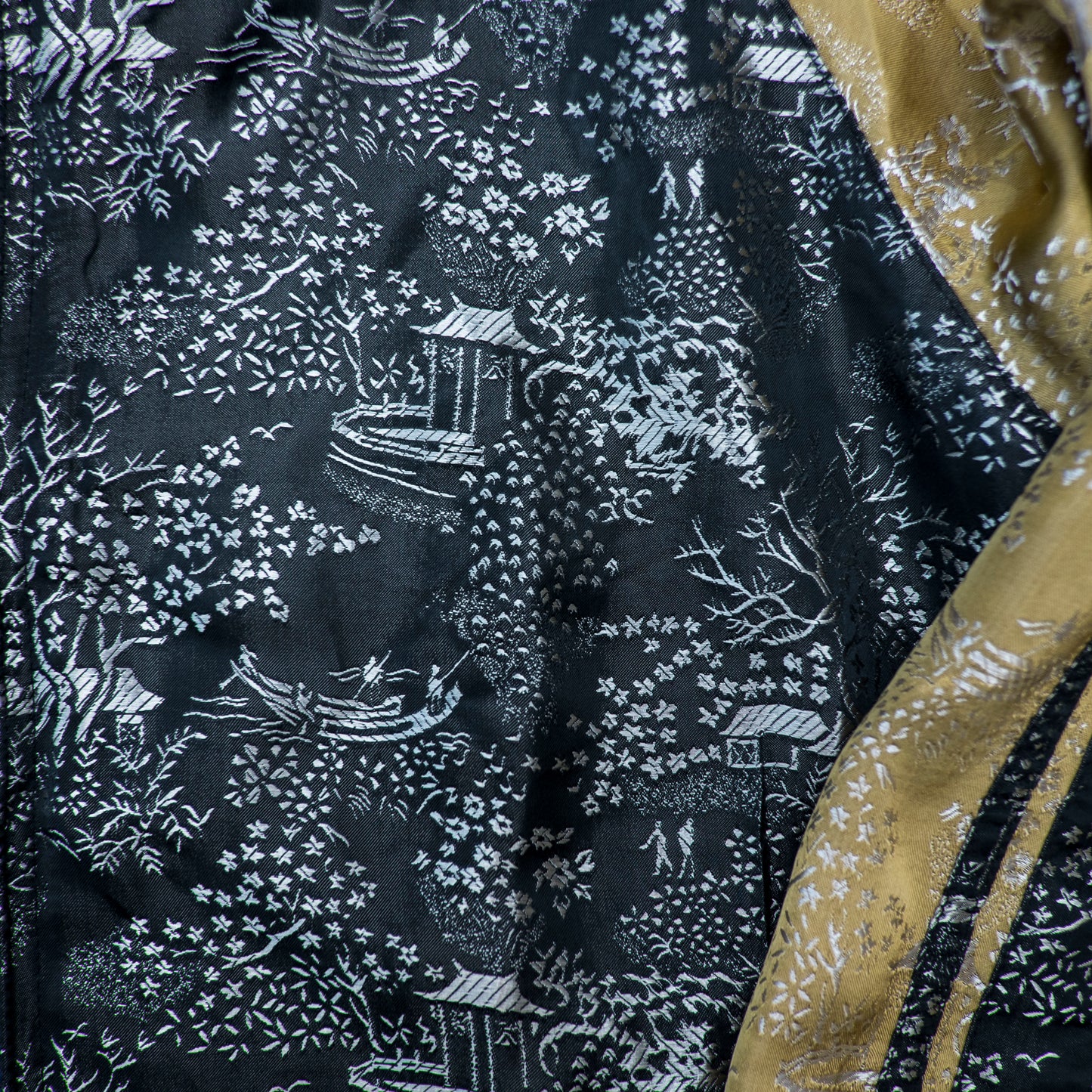
The second wearable face changes the jacket completely. Black and antique-gold jacquard-style satin is woven with an all-over East Asian garden landscape of pavilions, trees, bridges, waterways and distant scenery. Rather than serving as a plain lining, this reverse functions as a fully developed brocade bomber with its own pockets, striped ribbing and graphic identity.
One side carries monumental Buddhist iconography. The other becomes a midnight textile garden. Together they form an unusually sophisticated piece of Japanese wearable art.
Opening Impression
Most sukajan reveal their message immediately through roaring tigers, dragons or military eagles.
This jacket works differently.
Its blue face rewards close inspection. The Kannon figure does not leap from the satin in bright primary colors. Instead, pale embroidery traces the deity through layers of silver, gray, muted lavender and shadow. The image appears almost engraved into the fabric, while the mottled blue ground gives it an aged, atmospheric quality.
The reverse is equally unusual. Its woven black-and-gold landscape feels less like the lining of a bomber and more like an antique brocade robe transformed into streetwear.
This is a contemplative sukajan rather than a purely aggressive one, though its presence remains formidable.
Identification and Garment Details
Garment type: Reversible sukajan / Japanese souvenir-style bomber jacket
Primary subject: Senju Kannon / Thousand-Armed Kannon Bosatsu
Likely form represented: Crowned, multi-armed Kannon with elements associated with an eleven-faced manifestation
Primary color: Mottled cobalt, lapis and ocean blue
Primary sleeves: Aged ivory or pale champagne satin
Primary embroidery: Silver-gray, charcoal, lavender and blue Buddhist imagery
Reverse body: Black jacquard-style satin with silver landscape pattern
Reverse sleeves: Antique gold brocade-style satin
Construction: Fully reversible raglan-sleeve bomber
Closure: Reversible metal zipper
Pockets: Angled welt pockets on both wearable faces
Trim: Striped rib-knit collar, cuffs and waistband
Maker: Not confirmed from the supplied photographs
Fiber content: Not confirmed
Size: Not confirmed
Era: Later fashion-production sukajan, likely late 20th to early 21st century
Origin: Japanese-market or Japanese-inspired production; manufacturing country not confirmed
The maker label and composition tag have not been photographed, so this listing presents the jacket on the strength of its imagery, construction and visible craftsmanship rather than assigning an unsupported brand attribution.
The Blue Face
Mottled Cobalt Satin
The principal body is rendered in a blue satin finish that shifts between cobalt, indigo, turquoise and smoky gray depending on the light.
The color is not visually flat. It has an irregular, washed or naturally aged appearance that gives the surface depth and prevents the large back composition from feeling overly polished.
The ivory sleeves provide a calm architectural frame around the blue center panel. Narrow blue piping and inset stripes follow the raglan seams and sleeves, connecting the contrasting areas and lengthening the jacket’s silhouette.
Blue-and-cream striped ribbing completes the face.
Senju Kannon Back Embroidery
The back is dominated by a monumental seated Kannon figure.
The deity sits in meditative balance upon an expansive lotus pedestal. Two central hands meet in a prayer gesture at the chest, while additional arms radiate around the body and hold symbolic implements.
Visible details include:
- A calm, symmetrical central face
- Half-closed meditative eyes
- An elaborate crown
- Smaller crowned or divine faces above the principal head
- Multiple surrounding arms
- Staffs and ritual implements
- Circular emblems
- Lotus blossoms
- A wheel-like Buddhist symbol
- Globular objects held in outstretched hands
- Ornamental jewelry
- Flowing robes
- Layered lotus petals
- Fine linear halos and architectural framing
The composition is likely intended to represent Senju Kannon, the Thousand-Armed Kannon, in an elaborate crowned form associated with the ability to perceive suffering in every direction and respond through innumerable compassionate actions.
In established Japanese Buddhist imagery, the many arms of Senju Kannon symbolize compassion reaching outward through countless methods. Japanese museum and temple sources explain that the “thousand” is understood as immeasurable or limitless, with the hands and their implements representing the many ways in which Kannon responds to those in distress.
An Embroidered Temple Image
The embroidery deliberately avoids the brightly colored treatment often used for dragons, warriors and tigers.
Instead, the image resembles:
- A monochrome Buddhist print
- A silver temple relief
- A weathered devotional hanging
- A line drawing translated into satin stitch
- An illuminated figure emerging from blue stone
Different thread densities create the figure’s dimensionality. Thick satin-stitched contours define the lotus and major arms, while finer linear stitching articulates the jewelry, crown, hands and implements.
The face remains largely blue, allowing the deity to appear integrated into the body of the jacket rather than pasted over it.
Crown and Sacred Faces
The elaborate crown rises into several tiers.
A larger divine or crowned face appears above the central Kannon, accompanied by smaller heads or symbolic forms. This arrangement recalls the many-faced iconography associated with Kannon manifestations capable of observing the world from multiple directions.
Because the design is stylized rather than a direct reproduction of a documented temple statue, it is best understood as a fashion interpretation of Senju Kannon and eleven-faced Kannon imagery, rather than an exact copy of one specific sacred image.
The visual idea remains clear: perception expands upward while compassionate action radiates outward through the many arms.
Hands, Implements and Compassion
Each outstretched hand contributes to the visual rhythm of the composition.
The implements appear to include stylized representations of:
- Lotus flowers
- Staffs
- A wheel or circular emblem
- A dark orb
- A ritual vessel
- Possibly a mirror or jewel
- Bladed or trident-like forms
- Small seated Buddhist figures
- Esoteric Buddhist emblems
The center remains still while the outer arms create movement.
This contrast is one of the design’s strongest qualities. The figure’s expression is composed and inward-looking, but the surrounding hands are active, equipped and extending in every direction.
The Lotus Throne
The lower third is occupied by an enormous embroidered lotus.
The petals open outward in symmetrical layers, with heavy charcoal borders, pale silver interior stitching and smaller diamond-shaped details. The scale gives the Kannon figure a stable architectural base and anchors the dense field of arms above.
In Buddhist art, the lotus is widely associated with awakening and spiritual purity. Here it also performs a compositional role, transforming the jacket’s lower back into a broad ceremonial pedestal.
The pointed petals echo the shapes of the crown and ritual implements, bringing the entire image into a unified vertical structure.
Front Buddhist Motifs
The front carries two separate devotional emblems rather than reducing the artwork to ordinary logo-sized chest decoration.
Flaming Hand and Lotus
One chest features a raised hand positioned inside a circular flame-like halo.
The wrist rises from a lotus base, creating an image that can be read as a protective or compassionate gesture. The hand is delicately outlined, with individual fingers, palm lines and surrounding flame points carefully rendered.
Crowned Kannon Medallion
The opposite chest bears a crowned Kannon face enclosed within a petal-shaped mandala.
The face mirrors the serene expression of the larger back figure, while the surrounding lotus-like framework gives the motif the appearance of a devotional seal or temple emblem.
Together, the front images prepare the viewer for the full composition on the back.
Silver, Charcoal and Blue Embroidery
The subdued thread palette is crucial to the jacket’s character.
Rather than depending on vivid reds and yellows, the embroidery uses:
- Pale silver
- Soft dove gray
- Charcoal
- Muted lavender
- Faded blue
- Occasional darker accents
This restrained palette gives the artwork an almost moonlit appearance.
The stitching is highly visible from nearby, but it does not completely overpower the satin. As the jacket moves, reflected light alternately reveals and conceals portions of the figure.
Reverse Face
Black and Antique-Gold Brocade
The reverse abandons Buddhist figural embroidery and becomes an all-over woven landscape jacket.
The body is primarily black or deep charcoal with a silver-gray repeating scenic pattern. The raglan sleeves change to antique gold, patterned with the same family of miniature landscapes.
Black-and-tan striped ribbing frames the collar, cuffs and waistband.
The overall effect is ornate but restrained, resembling traditional robe fabric recut into an American-style bomber silhouette.
Woven Landscape Design
The reverse pattern appears to depict an idealized East Asian garden or mountain landscape.
Across the fabric are miniature scenes of:
- Pavilions
- Trees
- Flowering branches
- Bridges
- Small architectural structures
- Waterways
- Boats
- Fences
- Hills or rocks
- Garden pathways
- Repeated natural scenery
The pattern is created within the fabric rather than applied as a large separate embroidered panel.
This makes the reverse visually complex without becoming heavy. From a distance it reads as textured black and gold. Closer inspection reveals an entire repeating landscape.
Midnight Garden Character
The black center panels resemble a garden seen at night, where silver trees and structures emerge against a dark sky.
The gold sleeves act almost like illuminated borders.
This face has a distinctly different personality from the Kannon side:
- More formal
- More textile-focused
- Less figurative
- Easier to style
- Quieter from a distance
- Richly detailed at close range
It could be worn with no immediate indication that an enormous Buddhist composition is concealed inside.
Two Complete Visual Identities
This jacket offers more than a decorative lining.
Blue Kannon Face
- Monumental Buddhist imagery
- Cobalt and ivory palette
- Silver-gray embroidery
- Spiritual and contemplative atmosphere
- Strong collector display value
- Dramatic back composition
Black and Gold Brocade Face
- Woven landscape pattern
- Midnight black body
- Antique-gold sleeves
- Minimal external embroidery
- More understated styling
- Textile-focused elegance
The two faces move between sacred figure and sacred landscape, icon and environment, satin embroidery and woven brocade.
Design Character
This jacket occupies an unusual position between several worlds:
- Japanese souvenir-jacket culture
- Buddhist devotional imagery
- Esoteric ornament
- Streetwear
- Textile art
- Vintage-inspired fashion
- Brocade tailoring
- Embroidered illustration
- East-meets-West bomber construction
The bomber silhouette is direct and familiar, but the imagery is unusually meditative.
It is not merely a jacket with a Buddhist symbol added to it. The entire back has been organized as a devotional composition, with the deity, crown, implements and lotus functioning together as one image.
Sukajan Context
Sukajan emerged from the postwar Japanese souvenir-jacket tradition, combining American bomber construction with Japanese and East Asian imagery. Reversible construction, silky fabrics and large embroidered backs became defining features of the form. Modern Japanese labels have since expanded the visual language far beyond military souvenirs, incorporating mythology, Buddhism, folklore, tattoo imagery and fine-art references.
This example belongs to that later artistic evolution.
Rather than reproducing a conventional eagle-and-map souvenir, it uses the sukajan as a moving textile shrine.
Period Assessment
Likely Late 20th- or Early 21st-Century Fashion Sukajan
The garment does not appear to be an original 1940s or 1950s occupation-era souvenir jacket.
Its dense computer-guided embroidery, fully coordinated reverse face, modern zipper construction, extensive brocade fabric and intentionally elaborate Buddhist composition are more consistent with later Japanese fashion production.
A cautious dating would place it broadly within the late 1990s to 2010s, pending identification of the original brand label or product code.
This assessment is based on visible construction and design characteristics rather than a confirmed maker archive.
Materials and Construction
Visible features include:
- Satin-finish outer fabric
- Multicolor embroidery thread
- Jacquard or brocade-style reverse fabric
- Reversible construction
- Raglan sleeves
- Metal zipper with reversible slider
- Rib-knit collar
- Rib-knit cuffs
- Rib-knit waistband
- Angled welt pockets on both faces
- Contrasting sleeve panels
- Decorative sleeve piping
- Dense back embroidery
- Coordinated chest embroidery
- All-over woven scenic reverse
The exact fiber composition should be confirmed from the care label before describing the shell as rayon, acetate or polyester.
Condition
Pre-Owned Vintage Condition with Visible Age and Wear
The jacket displays substantial signs of previous wear, storage and age, especially on the pale sleeves and rib-knit areas.
Visible characteristics include:
- General satin wrinkling and creasing
- Mottled color variation throughout the blue body
- Uneven fading or washed appearance
- Noticeable discoloration and grayish marks on the ivory sleeves
- Areas of yellowing or age toning
- Surface soiling concentrated around the sleeves and cuffs
- Darkened areas near the lower sleeves
- Wear and discoloration to the striped ribbing
- Minor fuzzing or pilling on knit trim
- Natural rippling around dense embroidery
- Possible isolated thread pulls
- Minor loose or projecting embroidery fibers
- Creasing throughout the brocade reverse
- General evidence of handling and prolonged storage
The main Kannon composition remains remarkably complete and visually powerful. The central face, numerous arms, ritual implements, crown, chest emblems and lotus base are all clearly readable.
The reverse brocade pattern also remains visually extensive, with the black, gold and silver landscape continuing across the body and sleeves.
No large structural tear is immediately apparent in the supplied photographs, but the garment has not been represented as unused or pristine.
The visible aging is part of the jacket’s current appearance and should be carefully considered before purchase.
Because satin changes dramatically under light, some dark and pale areas may appear stronger or weaker depending on the angle of photography.
Size and Measurements
The tagged size is not visible in the supplied photographs.
Actual flat measurements should be added before purchase, including:
- Chest width, pit to pit
- Back length
- Raglan sleeve length
- Hem width
- Cuff width
Japanese sukajan commonly have a shorter body and more compact proportions than contemporary Western bomber jackets. Buyers should compare the actual measurements with a well-fitting jacket rather than relying on a general letter size.
Please message for priority measurement confirmation.
Styling
Blue Kannon Face
Pairs beautifully with:
- Black denim
- Wide charcoal trousers
- Raw indigo jeans
- Cream work pants
- Black leather boots
- Minimal white sneakers
- Silver jewelry
- Plain black T-shirts
- Japanese streetwear
- Avant-garde layering
- Monochrome outfits
- Vintage amekaji wardrobes
Brocade Face
Works particularly well with:
- Black tailored trousers
- Dark denim
- Neutral knitwear
- Cream shirts
- Gold-toned accessories
- Loafers
- Minimal sneakers
- Contemporary Japanese silhouettes
- Evening streetwear
- Textile-forward styling
Display Potential
The Kannon face is substantial enough to be displayed as embroidered textile art.
Suitable display environments include:
- Japanese fashion archives
- Meditation rooms
- Buddhist art collections
- Tattoo studios
- Streetwear boutiques
- Textile collections
- Creative studios
- Music rooms
- Sukajan displays
- Eclectic interiors
A wide padded hanger is recommended. Avoid prolonged direct sunlight, moisture and compression beneath heavier garments.
The pale sleeves should not be stored in contact with dark-dyed fabrics that may transfer color.
Collector Interest
This jacket may appeal to collectors of:
- Senju Kannon imagery
- Kannon Bosatsu art
- Buddhist fashion
- Reversible sukajan
- Japanese souvenir jackets
- Embroidered bomber jackets
- Brocade garments
- Japanese streetwear
- Esoteric Buddhist symbolism
- Lotus imagery
- Wearable textile art
- Vintage-inspired Japanese fashion
- Religious iconography in contemporary design
- Unusual blue sukajan
- Statement outerwear
The strongest collector feature is the combination of a monumental, subdued Kannon composition with a completely wearable black-and-gold scenic reverse.
Why This Piece Is Special
Many modern Buddhist jackets rely on a single printed image or simplified symbol.
This jacket commits the entire structure to the subject.
The deity is not merely placed on the back. It is constructed through an extensive hierarchy of:
- Crown
- Faces
- Hands
- Implements
- Jewelry
- Halos
- Lotus petals
- Meditative posture
- Symmetrical framing
The subdued embroidery prevents the image from becoming theatrical or costume-like. It feels closer to an engraved temple image than a conventional fashion graphic.
The reverse then adds another layer of value through true woven patterning rather than a plain synthetic lining.
Purchase, Shipping and Vintage Policy
This is a unique pre-owned vintage garment offered in its present condition.
Vintage clothing may display fading, discoloration, fabric wear, weakened fibers, loose threads, embroidery irregularities, stains, storage marks, wrinkles, odors, pilling, rib wear, repairs and other evidence of age and previous use.
This jacket shows visible discoloration and wear, particularly across the pale sleeves and rib-knit trim. Please review every photograph carefully and request any additional close-up images needed before purchase.
The photographs form an integral part of the condition description.
Because this is a unique pre-owned collectible, all sales are final. Returns, exchanges, cancellations, partial refunds and claims based on fit, personal color perception, expected vintage characteristics or condition details already visible or disclosed cannot be accepted, subject to applicable marketplace protections and consumer law.
Preparation, shipping and handling normally takes 5–10 business days or earlier.
Worldwide shipping is normally arranged through Japan Post EMS or another appropriate tracked international service. Tracking information will be provided after dispatch.
International buyers are responsible for customs duties, import taxes, brokerage charges and other destination-country fees where applicable.
Respectful and realistic offers may be considered. Flexibility depends on rarity, condition, collector interest and replacement availability.
If you are looking for this design or model in another size, please feel free to message us. Although availability cannot be guaranteed, we may be able to locate the same or a closely matching piece in a different size through our sourcing network.
#SenjuKannon #ThousandArmedKannon #KannonBosatsu #BuddhistJacket #BuddhistEmbroidery #ReversibleSukajan #JapaneseSukajan #SouvenirJacket #JapaneseBomber #BlueSukajan #BrocadeJacket #JapaneseStreetwear #WearableArt #TextileArt #LotusEmbroidery #BodhisattvaArt #VintageJapanese #EmbroideredBomber #WagaraFashion #JapaneseFashion #Amekaji #SpiritualArt #TempleArt #JapaneseTextile #StatementJacket #CollectorJacket #SatinBomber #BuddhistFashion #ReversibleJacket #RareSukajan
senju kannon, buddhist jacket, reversible sukajan, japanese bomber, souvenir jacket, kannon embroidery, bodhisattva art, blue satin jacket, brocade jacket, wearable buddhism, japanese streetwear, embroidered bomber, vintage sukajan
Material Tags
satin-finish fabric, jacquard brocade, embroidery thread, rib-knit trim, metal zipper, woven landscape fabric, reversible construction, synthetic lining, embroidered satin, patterned textile