Rare Vintage, Antiques and Art Collector / Curator / Personal Shopper From Japan
Rare 2009 SATORI Bato Kannon Benzaiten Reversible Sukajan Jacket M Japanese Buddhist Embroidered Wagara Bomber
Rare 2009 SATORI Bato Kannon Benzaiten Reversible Sukajan Jacket M Japanese Buddhist Embroidered Wagara Bomber
Couldn't load pickup availability
Have a reasonable price in mind? Submit your best offer and our concierge will review it personally.
Archived SATORI 馬頭観音 × 弁財天 Double-Sided Souvenir Jacket with Wrathful Horse-Head Kannon, Sacred Flames, Benzaiten, Biwa, Lotus and Waves
A genuinely unusual early SATORI / さとり reversible sukajan, tagged Size M, carrying one of the brand’s most ambitious Buddhist-art embroidery programs: 馬頭観音 / Batō Kannon on one face and 弁財天 / Benzaiten on the reverse.
This exact motif pairing is historically documented. A surviving Japanese retailer archive from December 2009 lists a SATORI “和柄総刺繍リバーシブルスカジャン『馬頭観音/弁財天』”, literally a fully embroidered Japanese-pattern reversible sukajan featuring Batō Kannon / Benzaiten.
That archival identification makes this far more interesting than an unidentified Buddhist-themed souvenir jacket.
One face is fierce, almost volcanic: a red-bodied, many-armed Batō Kannon rises from an elaborate throne surrounded by vermilion flames, with crimson sleeves and additional flame embroidery running dramatically along the arms.
Reverse the jacket and the atmosphere completely changes.
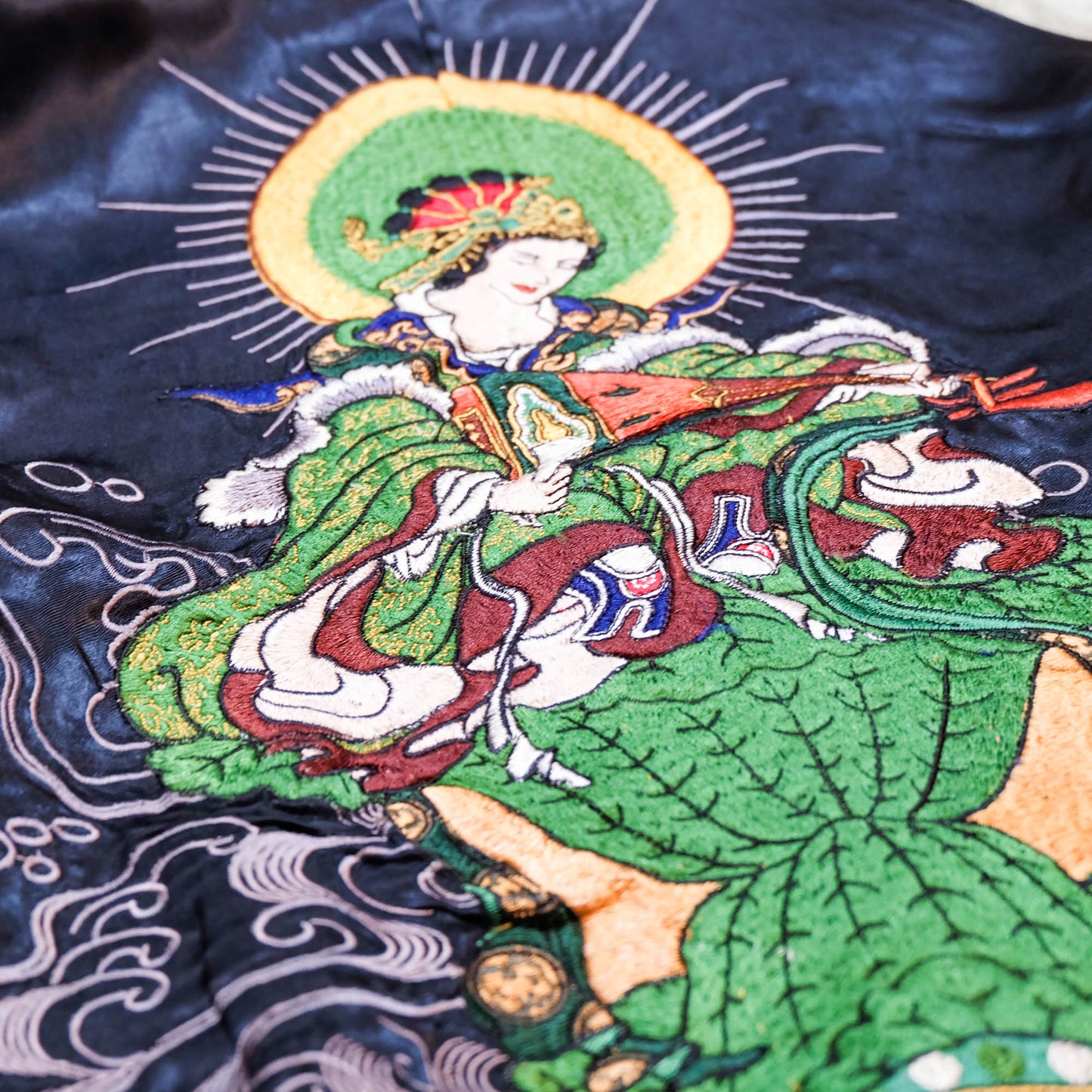
The alternate face presents an elegant Benzaiten, haloed in gold and green, holding her traditional biwa amid stylized waves and richly colored ornamental forms. Champagne-gold sleeves, lotus embroidery and restrained black-and-ivory ribbing transform the same garment into something serene and luminous.
Wrath and grace.
Protection and art.
Fire and water.
Two seemingly opposite spiritual worlds stitched into one remarkable piece of Japanese streetwear. 🔥🪷
Description
SATORI has long occupied a distinctive position within Japanese wagara fashion, using the silhouette of the postwar sukajan as a canvas for imagery taken from Buddhism, folklore, tattoo art, mythology and traditional Japanese visual culture.
This jacket represents that philosophy at its fullest.
Rather than placing a conventional tiger, eagle or dragon on one side and leaving the reverse comparatively plain, SATORI created two complete devotional compositions.
The dark-and-red face depicts Batō Kannon, one of the most visually dramatic forms of Kannon.
The pale-sleeved reverse depicts Benzaiten, patron of music, art, wisdom and fortune, surrounded by imagery of flowing water and lotus blossoms.
Even the fronts are extensively developed.
The Batō Kannon face incorporates a sacred-looking embroidered emblem surrounded by flames and long embroidered fire motifs running along both sleeves.
The Benzaiten face becomes quieter, with floating lotus blossoms and pale sleeve panels that allow the large back image to become the principal focus.
This is less a conventional bomber jacket than a reversible textile diptych.
Opening Story
Most sukajan tell a story across one back panel.
This one tells two.
The first begins with fire.
Against a blue-black satin ground sits an extraordinary red Buddhist figure, crowned, many-armed and wrathful. Multiple faces emerge from the composition, ritual implements rise from the hands, and a tiny horse-form appears above the crown.
This is Batō Kannon, the Horse-Head Kannon.
The figure is surrounded by embroidered flames that rise along the shoulders like a mandorla. SATORI extends those flames down the sleeves, so the imagery remains alive even when the wearer is viewed from the side.
Turn the jacket over.
The flames disappear.
Now there is water.
A graceful female deity sits beneath a radiant halo dressed in brilliant green, white, gold, orange and jewel-like accents. A stringed instrument rests across her body while waves curl beneath and around the composition.
This is Benzaiten.
The effect of reversing the jacket is almost theatrical.
One side confronts.
The other enchants.
And that contrast is exactly what makes the design so special.
Identification
Brand
SATORI / さとり
Garment
Fully Reversible Embroidered Sukajan / Japanese Souvenir Jacket
Documented Historic Design Name
馬頭観音 / 弁財天
Batō Kannon / Benzaiten
Tagged Size
M
Documented Period
Circa 2009
A Japanese retailer archive dated December 2009 records this exact SATORI motif pairing .
Style
Japanese wagara
Buddhist art fashion
Reversible sukajan
Souvenir bomber
Yokosuka jacket
Japanese tattoo-art influence
Archive streetwear
Amekaji crossover
Rock / biker fashion
Wearable textile art
Design Character
This jacket works because the two faces are not merely color inversions.
They represent opposing emotional states.
Batō Kannon Face
Dark
Wrathful
Protective
Flame-filled
Ritualistic
Visually aggressive
Benzaiten Face
Luminous
Graceful
Musical
Water-associated
Ornamental
Meditative
The relationship makes the reversible construction meaningful.
Instead of simply owning two colors of the same jacket, the wearer can choose between two completely different symbolic identities.
Batō Kannon / 馬頭観音 Face
Monumental Three-Faced, Many-Armed Kannon
The back is dominated by an extremely detailed embroidered Batō Kannon.
The deity is rendered with a brilliant red complexion and multiple arms arranged symmetrically around the torso.
This is consistent with established Japanese Batō Kannon iconography. Important surviving examples are represented as three-faced and eight-armed, and Japanese cultural-property documentation specifically records such 三面八臂 forms.
The embroidered figure appears with:
Multiple wrathful faces
Numerous arms
A crown or elaborate headdress
A horse-head element above the crown
Ritual implements
Wheel-like Buddhist attributes
Staff-like implements
Jewelry and ceremonial ornament
Lotus or throne architecture
An extensive flame mandorla
The complexity is astonishing for a garment.
At first glance, the viewer sees a bright red supernatural figure.
Only on closer inspection does the enormous quantity of individual linework become apparent.
The Horse Head Above the Crown
The tiny horse head is the crucial identifying element.
Batō Kannon is known precisely for the horse head appearing above the principal face or crown. Japanese cultural references describe Batō Kannon as a wrathful Kannon traditionally represented with a horse head and, in many examples, multiple faces and arms.
This is what distinguishes the figure from:
Fudō Myōō
Aizen Myōō
Ashura
Gundari Myōō
other multi-armed Buddhist deities
The jacket’s archival identification confirms the visual reading.
Meaning of Batō Kannon
Batō Kannon is one of the distinctive forms of Kannon, or Avalokiteśvara.
Unlike the serene expressions normally associated with Kannon, Batō Kannon frequently assumes a wrathful appearance.
The fierce expression should not be understood simply as evil or anger.
Within Buddhist imagery, wrathful forms can represent compassionate power capable of confronting obstacles that gentler imagery cannot.
Batō Kannon later became especially associated in Japan with horses and other animals, while roadside Batō Kannon monuments were also connected with prayers for safe travel. Sensō-ji identifies Batō Kannon with animal protection, good health, calamity prevention and travel safety, while Matsumoto’s cultural heritage documentation records a Batō Kannon monument erected specifically to pray for travelers’ safety.
That history gives the jacket an intriguing connection to the very idea of a souvenir jacket.
A garment born from travel carries the image of a deity historically invoked for safe journeys.
Flame Mandorla
Vermilion flames form the dominant background around Batō Kannon.
They extend upward from the throne and surround the deity’s shoulders and arms.
Rather than using a simple circular halo, SATORI builds a complete field of fire.
The flame embroidery uses multiple tonal values:
Crimson
Scarlet
Coral red
Rust
Black contouring
Pale highlights
This prevents the fire from becoming flat.
It feels layered and alive.
Ritual Objects and Sacred Attributes
The numerous hands carry objects inspired by the complex ritual iconography of esoteric Buddhism.
Visible forms include:
Wheel-like implements
Staff forms
Hooked or ringed ritual objects
Raised mudra-like hands
Weapons or vajra-inspired forms
The fine embroidery transforms each hand into a separate miniature composition.
This is especially impressive because the central figure occupies only part of the total back panel. The density of design within that restricted space is remarkable.
Throne and Lotus Architecture
The deity rests upon an elaborately embroidered ceremonial base.
Pale pink, turquoise, cream, gold and black thread construct layers resembling:
Lotus petals
Decorative pedestal sections
Architectural supports
Jewelled trim
Buddhist throne ornament
These cooler colors are important because they prevent the red deity and flames from visually merging.
The effect resembles a miniature Buddhist painting recreated entirely in embroidery.
Batō Kannon Front
Sacred Flame Emblem
The chest features a large stylized sacred emblem surrounded by embroidered flames.
Its form resembles the calligraphic visual language associated with bonji / Siddham Buddhist seed-syllable imagery, used widely in Japanese Buddhist art and contemporary wagara fashion.
The exact sacred character is less important visually than the way SATORI deploys it.
Gray embroidery forms the central glyph.
Red flames rise around it.
Against the black-blue body, the result feels like a spiritual crest.
Full-Length Sleeve Flames
One of the most dramatic features appears along the sleeves.
Long embroidered flames extend vertically through the contrasting black sections of the red sleeves.
This dramatically increases the jacket’s visual presence when worn.
Most sukajan concentrate embroidery on the front chest and back.
Here the sleeves become part of the narrative.
When the wearer moves their arms, the flames move with them.
Batō Kannon Colorway
This face combines:
Deep blue-black satin body
Crimson-red satin sleeves
Black sleeve inserts
Red and black ribbing
Scarlet flame embroidery
Silver-gray sacred chest emblem
The result is theatrical without becoming chaotic because the palette remains dominated by black, navy and red.
Benzaiten / 弁財天 Face
The reverse completely resets the visual language.
The body remains dark, but the sleeves become luminous champagne or pale gold.
The crimson fire disappears.
In its place appear:
Lotus flowers
Water
A radiant halo
Green robes
Musical imagery
Elegant flowing linework
The mood becomes contemplative rather than confrontational.
Monumental Benzaiten Back Embroidery
Benzaiten occupies the center of the back.
She is rendered as an elegant female deity with pale complexion, elaborate hair ornaments and richly patterned clothing.
A radiant circular halo rises behind her head.
The inner halo is green.
The surrounding ring is gold.
Fine pale rays extend outward across the black ground.
This produces one of the jacket’s strongest visual effects.
The dark satin behaves almost like a night sky while the halo shines from its center.
The Biwa
Benzaiten holds a traditional Japanese lute-like instrument across her body.
The biwa is one of her most recognizable attributes.
Ishiyama-dera explains that the two-armed form of Benzaiten is represented holding a biwa, and Japan’s tourism authorities describe her as a deity connected with music, poetry, wisdom, water and fortune.
This immediately distinguishes the peaceful reverse from the weapon-bearing Batō Kannon face.
One deity carries ritual power.
The other carries music.
Benzaiten Symbolism
Benzaiten developed in Japan from the Indian goddess Sarasvati and became deeply integrated into Japanese Buddhist and syncretic religious traditions.
She is associated with things that flow:
Water
Music
Poetry
Speech
Knowledge
Wisdom
Fortune
She also became one of Japan’s Seven Gods of Good Fortune.
This makes the jacket’s water imagery especially meaningful.
The waves are not merely decorative backgrounds.
They reinforce Benzaiten’s longstanding connection with water and flowing sound.
Waves and Flowing Water
A field of elaborate monochrome waves fills the lower background.
These are rendered predominantly in gray, white and lavender-gray thread.
Their appearance recalls Japanese woodblock-print linework more than conventional modern embroidery.
Curling wave crests repeat throughout the lower half of the composition.
Spirals create pools and eddies.
Fine parallel stitches describe water movement.
Against the dark satin, the waves appear almost engraved.
Green Robes and Jewel-Like Color
Benzaiten’s clothing provides the jacket’s brightest color contrast.
Rich emerald and jade-green sections are combined with:
Orange
Red
Gold
White
Turquoise
Blue
Cream
The embroidery is especially dense around the sleeves, collar, waist and instrument.
Unlike the Batō Kannon side, where color radiates outward through flames, the Benzaiten side concentrates its strongest colors around the deity herself.
This makes the figure appear illuminated.
Lotus Imagery
The front of the Benzaiten face incorporates several large pale lotus blossoms.
Lotus flowers appear in cream, blush pink and white embroidery with delicate linework suggesting ripples beneath them.
One chest design also incorporates a pale sacred or ornamental symbol emerging from a lotus.
The lotus is among the foundational symbols of Buddhist visual culture, commonly associated with purity and spiritual awakening.
Its use here provides the perfect counterpoint to the flames hidden on the reverse.
Pale Champagne Sleeves
The Benzaiten face is framed by champagne, pale gold or aged ivory satin sleeves.
Their color varies dramatically according to light.
At some angles they appear cream.
At others they become muted gold or warm silver.
This reflective behavior gives the jacket greater dimensionality and beautifully complements the golden halo.
Fire and Water: The Reversible Concept
The most compelling interpretation of this jacket is the dialogue between its two sides.
Batō Kannon
Fire
Wrathful compassion
Protection
Power
Movement
Confrontation
Benzaiten
Water
Music
Grace
Wisdom
Fortune
Flow
The jacket therefore becomes more than two unrelated religious images.
Its reversibility creates a visual balance.
Fire becomes water.
Wrath becomes serenity.
Red becomes green and gold.
The same dark central body becomes either a furnace or a night sky.
That is unusually sophisticated design for a streetwear garment.
SATORI and Japanese Wagara Fashion
SATORI belongs to the Japanese wagara fashion tradition that expanded the sukajan far beyond its original postwar souvenir-jacket vocabulary.
Instead of limiting itself to:
Eagles
Tigers
Dragons
Japan maps
the brand has repeatedly explored Buddhist and mythological subjects.
Current SATORI catalogues continue to feature themes including Fudō Myōō, Ashura, dragons, Kannon figures, oiran, tigers and koi, demonstrating the brand’s longstanding commitment to dense Japanese narrative embroidery.
This older Batō Kannon / Benzaiten jacket is particularly compelling because it belongs to an earlier generation of the brand’s work.
The exact design was already documented in 2009.
It is therefore now approximately a 17-year-old Japanese archive garment.
Materials and Construction
The jacket presents the high-luster satin construction strongly associated with SATORI sukajan.
Visible Construction
Lustrous satin body
Contrasting satin raglan sleeves
Dense multicolor machine embroidery
Fully embroidered back artwork on both faces
Chest embroidery on both faces
Sleeve embroidery on Batō Kannon face
Reversible center zipper
Angled hand pockets
Rib-knit collar
Rib-knit cuffs
Rib-knit waistband
Lightweight traditional sukajan structure
Modern SATORI reversible sukajan frequently use rayon satin construction, and the brand continues to position rayon as one of its characteristic materials.
Material Tags
Rayon satin
Embroidery thread
Rib-knit trim
Reversible zipper
Satin textile
Woven pocketing
Period Assessment
This design is not merely “vintage-inspired.”
It is itself now an older Japanese archive piece.
A surviving SATORI retail advertisement dated December 2, 2009 specifically lists:
SATORI / さとり
和柄総刺繍リバーシブルスカジャン
『馬頭観音/弁財天』
Accordingly, the jacket can be confidently positioned as an approximately 2009-era SATORI release, rather than generically described as a later modern sukajan.
This documented period materially strengthens its collector appeal.
Condition
This is a genuine pre-owned archive garment showing visible age, wear and material evolution consistent with an older satin sukajan.
The supplied photographs show a particularly attractive smoky, naturally aged surface character.
Dark Satin Body
The black/navy central panels display pronounced tonal movement including:
Blue-black areas
Charcoal shading
Cloud-like lighter patches
Warm brown-black undertones
Natural satin sheen variation
Creasing and storage impressions
Some of this appearance results from the reflective direction of the satin, while age, wear and previous storage may also contribute to the mottled tonal character.
The resulting patina gives the garment substantial visual depth.
Red Sleeves
The crimson sleeves display:
Natural satin wrinkling
Light tonal variation
Subtle fading or softening
Age-related surface movement
Handling wear around cuffs and seams
The flame embroidery remains strongly visible.
Pale Gold Sleeves
The champagne-colored reverse sleeves naturally reveal age more clearly.
Visible characteristics include:
Warm tonal variation
Localized darker shading
Light surface discoloration
Wrinkling
Storage impressions
Variation in reflected sheen
These characteristics reinforce the jacket’s genuine archive character rather than presenting as a newly manufactured garment.
Embroidery
The embroidery remains the strongest aspect of the piece.
The Batō Kannon figure retains impressive detail across:
Faces
Horse-head crown
Hands
Ritual objects
Flames
Jewelry
Throne
The Benzaiten image remains equally readable, including:
Face
Halo
Biwa
Green robes
Waves
Ornamental base
The lotus chest embroidery and flame sleeve embroidery also retain strong visual presence.
Isolated thread movement, pulls or small irregularities may naturally be present within such extensive embroidery.
Ribbing
The rib-knit collar, cuffs and hem show age-appropriate wear and relaxation.
Overall
No catastrophic structural damage is apparent in the supplied full-garment photographs.
The jacket should nevertheless be regarded as a pre-owned circa-2009 collector piece, not as new clothing.
Please examine all photographs carefully, as they form an essential part of the condition description.
Size and Fit
Tagged Size
M
This is a Japanese-market Medium.
Japanese sukajan traditionally fit shorter through the body than many contemporary Western bombers.
Depending upon the wearer’s build and desired silhouette, a Japanese M may generally feel closer to:
Western Small to Medium
Fitted contemporary Medium
Relaxed Small
This is only a styling reference.
Actual flat-lay measurements should always take priority over letter-size conversion.
Please contact us for the latest exact measurements of this jacket.
Recommended comparisons include:
Chest width, armpit to armpit
Back length, collar base to hem
Center-back collar to cuff sleeve length
Hem width across ribbing
SATORI’s modern M sukajan commonly fall around the low-50 cm chest-width range, but actual vintage measurements vary by model and production period.
Styling Possibilities
Batō Kannon Face
This side works particularly well with:
Black denim
Wide charcoal trousers
Raw selvedge jeans
Engineer boots
Combat boots
Japanese biker fashion
Visual Kei
Dark Amekaji
Minimal black T-shirts
Silver jewelry
Rock fashion
Tattoo-inspired styling
The embroidered sleeve flames make this side particularly powerful when actually worn.
Benzaiten Face
The reverse pairs naturally with:
Indigo denim
Cream trousers
Black straight-leg pants
Vintage sneakers
Brown leather boots
Neutral knitwear
Japanese heritage clothing
Minimal contemporary streetwear
The champagne sleeves and green embroidery give this side an unexpectedly elegant character.
Display and Wearable Art Appeal
This jacket could easily be displayed as textile art.
The Batō Kannon face resembles an embroidered Buddhist painting.
The Benzaiten face resembles a decorative religious scroll translated into satin and thread.
It belongs naturally within collections focused on:
SATORI
Vintage sukajan
Japanese Buddhist art
Batō Kannon
Benzaiten
Japanese wagara
Japanese tattoo imagery
2000s Japanese streetwear
Archive fashion
Amekaji
Visual Kei
Rock fashion
Reversible souvenir jackets
Japanese embroidery
Wearable art
A wide padded hanger is recommended for display.
Avoid prolonged direct sunlight, which may accelerate fading of the satin and embroidery.
Why This Piece Deserves Collector Attention
This is not simply another older SATORI jacket.
Its appeal comes from a very unusual convergence of qualities:
Documented circa-2009 release
Archived exact motif name
Batō Kannon / Benzaiten pairing
Original retail documentation
Tagged Size M
Two monumental Buddhist back compositions
Full reversible construction
Extensive sleeve flame embroidery
Horse-head Kannon iconography
Benzaiten with biwa
Water and wave embroidery
Lotus motifs
Sacred emblem embroidery
Highly developed color contrast
Visible authentic archive patina
Now approximately 17 years old
Increasing rarity within early SATORI inventory
Most importantly, very few sukajan manage to make the reversible format conceptually meaningful.
This one does.
Batō Kannon and Benzaiten are not simply alternative graphics.
They create two distinct worlds.
Market Context
The present jacket is fundamentally different from a readily available modern model because:
The design is discontinued
The exact 2009 motif is difficult to replace
Buddhist double-sided examples are uncommon
The original release is now well into archive age
International buyers have far less access to older Japanese-market SATORI pieces
Condition moderates the ceiling somewhat because the satin displays substantial vintage tonal character, but the embroidery density and documented identity support strong international collector positioning.
Purchase, Shipping and Vintage Policy
This is a genuine pre-owned vintage / archive Japanese garment and is offered in its present as-is condition.
Natural satin creasing, tonal variation, discoloration, fading, surface movement, thread irregularities, rib relaxation, storage impressions and other age-related characteristics should be expected in an approximately 2009 textile garment.
Please examine all photographs carefully before purchase. The photographs form an essential part of the description and provide the clearest representation of the satin surfaces, embroidery, coloration and overall condition.
Colors may appear somewhat different according to lighting, monitor settings and the reflective direction of the satin.
Japanese-market sizing may differ considerably from contemporary Western sizing. Please compare the final flat-lay measurements with a jacket that already fits comfortably.
This is a delicate embroidered collector garment. Professional cleaning by a specialist familiar with rayon or satin sukajan is recommended. Avoid ordinary machine washing, aggressive agitation, high heat and direct ironing over embroidery.
Due to the collectible, pre-owned and internationally shipped nature of this item, returns, exchanges and claims based upon fit, previously disclosed condition, natural vintage characteristics or minor color variation cannot be accepted, subject to applicable Etsy policies and consumer law.
Reasonable and respectful offers may be considered.
Worldwide shipping is normally provided through Japan Post EMS or another suitable tracked international service where required.
Preparation, shipping and handling normally takes 5–10 business days or earlier.
Tracking information will be supplied after dispatch.
Any customs duties, import taxes, brokerage charges or destination-country fees remain the responsibility of the buyer.
If you are looking for this design or model in another size, please feel free to message us. Although availability cannot be guaranteed, we may be able to locate the same or a closely matching piece in a different size through our sourcing network.
#Satori #SatoriSukajan #BatoKannon #BatouKannon #Benzaiten #BuddhistJacket #JapaneseBuddhistArt #VintageSukajan #ReversibleSukajan #JapaneseSukajan #WagaraFashion #BuddhistEmbroidery #JapaneseEmbroidery #SouvenirJacket #YokosukaJacket #JapaneseBomber #RayonSukajan #JapaneseStreetwear #ArchiveFashion #2000sJapan #WearableArt #LotusEmbroidery #Biwa #Kannon #BenzaitenJacket #JapaneseVintage #Amekaji #VisualKei #SizeMSukajan #RareSukajan
satori sukajan, bato kannon, benzaiten jacket, buddhist sukajan, vintage satori, reversible jacket, japanese sukajan, wagara jacket, size m sukajan, buddhist jacket, rayon bomber, japanese vintage, wearable art
Material Tags
rayon satin, satin textile, embroidery thread, rib-knit trim, reversible metal zipper, woven pocketing, multicolor embroidery