Rare Vintage, Antiques and Art Collector / Curator / Personal Shopper From Japan
Rainbow Country A-2 Flight Jacket Custom King One-Off Nakajima Type II Fighter Hand Painted Leather Jacket Size 34
Rainbow Country A-2 Flight Jacket Custom King One-Off Nakajima Type II Fighter Hand Painted Leather Jacket Size 34
Couldn't load pickup availability
Have a reasonable price in mind? Submit your best offer and our concierge will review it personally.
RAINBOW COUNTRY
A ONE-OFF CUSTOM A-2 FLIGHT JACKET WITH NAKAJIMA TYPE II FIGHTER BACK PANEL
CUSTOM KING BESPOKE INTERPRETATION WITH HINOMARU ICONOGRAPHY AND MIXED-KNIT DETAILS
The present jacket occupies a compelling position within the wider culture of aviation collecting, being at once a high-grade Japanese A-2 reproduction and a singular custom object of striking visual identity. Built on a Rainbow Country base and further developed through a one-off custom program, it departs from conventional American squadron narratives by embracing the iconography of the Nakajima Type II fighter and the broader visual language of Imperial Japanese wartime aircraft art.
What distinguishes the piece is not simply the painted reverse, but the coherence of the whole. The dark leather body, red-brown waistband, mixed sleeve knits, and carefully staged back composition combine to produce a jacket whose impact lies in atmosphere as much as detail. Rather than functioning as novelty decoration, the artwork transforms the garment into an authored object, one that reads as both collector’s interpretation and wearable archive.
Such examples are notable because they resist ordinary categorization. They appeal not only to enthusiasts of reproduction military garments, but also to collectors of bespoke leatherwear, Japanese Americana, and rare crossover objects where craftsmanship and visual narrative operate at equal strength. In that regard, the jacket stands as a vivid expression of how postwar collecting culture continues to reinvent military archetypes into new forms of desirability.
Object Type: A-2 flight jacket, full custom military-art interpretation
Maker / Brand: Rainbow Country
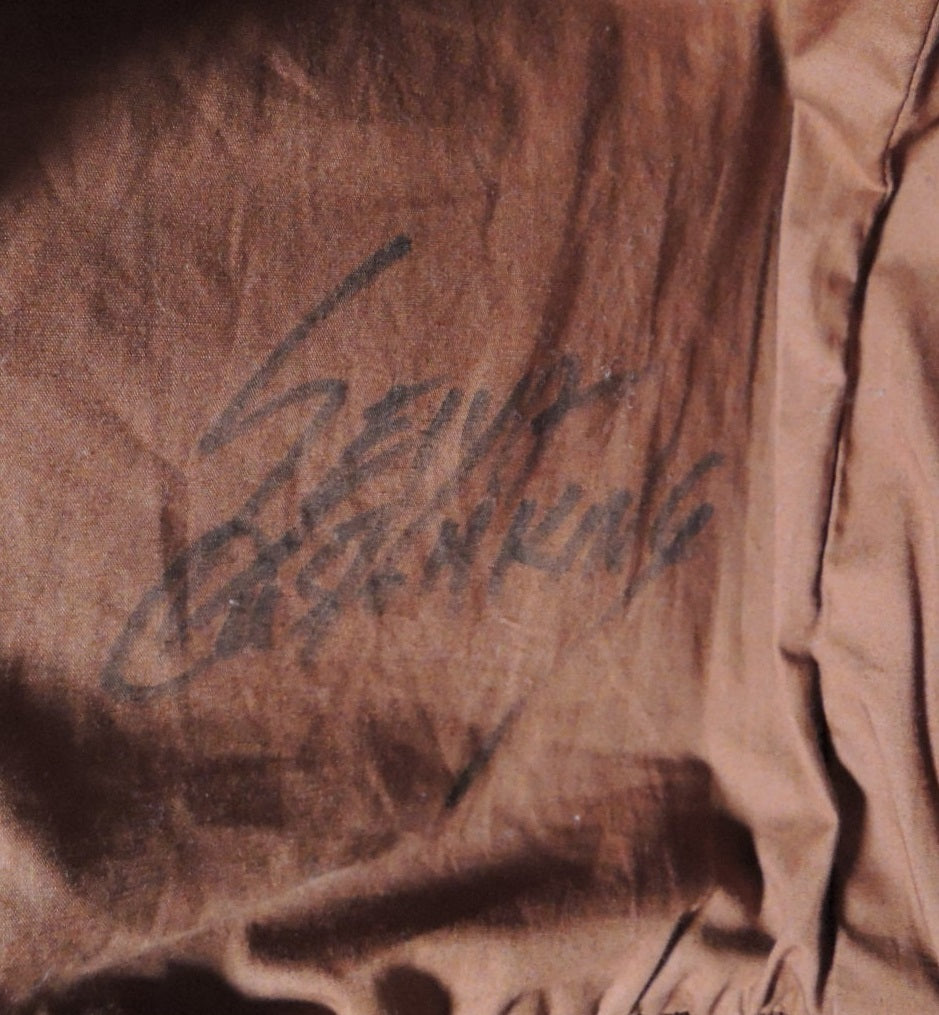
Customization Program: Custom King / one-off full custom execution attributed in provided materials to Kusano-san
Base Pattern: A-2 flight jacket
Theme Direction: Imperial Japanese Army aviation / Nakajima Type 2 Single-Seat Fighter / Hinomaru insignia / WWII-inspired crossover military custom narrative
Edition Status: One-off full custom model
Material: Leather shell with mixed knit components
Color: Deep seal-to-russet brown leather body with red-brown waistband knit and mixed-tone sleeves
Special Construction Notes: Red waistband rib, mixed sleeve knits, leather internal rising-sun motif noted in provided description
Back Artwork: Hand-rendered aircraft cloud-panel composition reading “NAKAJIMA TYPE II FIGHTER” with interceptor slogan and kanji detail
Front Presentation: Clean A-2 pocket layout with minimal frontal interruption, custom insignia at sleeve and internal custom details
Size Marked: 34
Measurements Provided: Shoulder 41 cm / Body width 48 cm / Sleeve 60 cm / Length 58 cm
Condition Notes from provided material: Verdigris / color variation / rubbing / small knit hole at right rib exterior / general use and handling signs / additional small holes or minor wear possible
Collector Positioning: One-off Japanese-made military reinterpretation piece crossing reproduction accuracy, art-jacket culture, and boutique custom archive appeal
Lot-Style Micro Qualifiers
Collector’s one-off custom with strong display impact
Boutique Japanese reproduction base elevated by bespoke aviation artwork
Cross-category piece spanning military repro, art jacket, and archive fashion
Unrepeatable custom execution with unusual Japanese fighter subject matter
Overview
This is the kind of jacket that does not belong to the ordinary hierarchy of reproduction wear. It sits in a more unstable and more interesting territory, where elite Japanese leather craft collides with imaginative military customization and turns into something closer to portable aviation folk art than simple outerwear.
At base, this is an A-2. That matters, because the A-2 is never neutral. It is already one of the most myth-loaded garments ever made: part military artifact, part American cultural shorthand, part eternal menswear silhouette. But this particular piece refuses to remain in that well-mapped American lane. Instead, it pivots eastward and reconstructs the jacket around a different theater of imagery: Imperial Japanese fighter iconography, the Hinomaru roundel, and the lyrical visual culture of wartime aircraft illustration translated through modern Japanese collector craftsmanship.
The result is strange in the best possible way. Not gimmick. Not cosplay. Not crude provocation. It is much more sophisticated than that. It reads as a one-off collector’s interpretation of how the A-2 silhouette can become a canvas for alternate aviation mythology.
That is why this jacket matters. It is not simply “a custom.” It is a counter-narrative A-2, one that takes the most iconic American leather flight jacket and reimagines it through Japanese warbird devotion, boutique artisan intervention, and art-jacket theatrics.
Iconography
The back panel is the soul of the garment.
The composition centers on a painted Nakajima Type II Fighter, framed in a cloud-like field with text arcing above and below. The image has all the ingredients that make military custom jackets so addictive: aircraft portraiture, slogan language, soft theatrical framing, and an almost romantic sense of airborne speed. The plane does not appear as technical diagram alone. It appears as symbol, memory, and attitude.
This is crucial. Many custom jackets fail because they merely place an airplane on the back. Here, the aircraft is staged as identity. The cloud vignette isolates it like a shrine image or nose-art vignette. The script and color work around it push it further into the realm of personal mythology. That gives the jacket narrative charge rather than decorative filler.
The Hinomaru references intensify that charge. They instantly relocate the visual language away from familiar Allied nose-art territory into something rarer and more disorienting for the market. Most collectors have seen endless American squadron themes. Far fewer encounter Japanese aviation custom interpretations executed with this level of intent. That rarity of visual vocabulary gives the piece unusual memorability.
And then there is the phraseology. Even where some lettering is partially stylized or imperfectly legible through imagery and angle, that imperfection helps rather than hurts. It gives the jacket the feel of a hand-built custom, not a mass-produced graphic product. It preserves the artist’s hand. A little turbulence in the lettering makes the object feel more alive.
Material
The success of a custom leather jacket always depends on whether the base garment has enough authority to carry the artwork. This one does.
Rainbow Country has long been respected because its jackets are not hollow reproductions. They have body, seriousness, and leather presence. A cheap base would make the artwork feel pasted on. A good base lets the art feel integrated into the object’s identity. That is what is happening here.
The leather field has the rich, dark sheen that allows painted imagery to float above the surface without looking synthetic. It gives the jacket visual depth even before the artwork is considered. The surface character, including variation, rubs, and areas of tonal irregularity, does not undermine the piece. It enhances it. This kind of finish behavior helps the garment feel aged, inhabited, and dramatic. In fact, on a jacket like this, a little atmospheric irregularity is part of the visual music.
The red waistband rib is also a meaningful choice. It is not just a material note. It changes the whole mood of the garment. Against the dark leather, it injects a warm militarized undertone that echoes vintage aviator palettes while also helping the custom artwork feel more integrated. The mixed sleeve knit arrangement further distances the jacket from factory sameness. It reinforces the sense that this was assembled as an authored object, not merely a SKU.
Maker Significance
Rainbow Country already occupies serious ground in the Japanese reproduction ecosystem. That foundation matters because the collector is not being asked to trust artwork alone. They are being asked to trust artwork built on top of a maker known for substantive leatherwear.
That is one half of the equation.
The other half is the customization program. A one-off full custom attributed in the provided materials to a specialist hand under the Custom King banner changes the category entirely. We are no longer dealing with a standard catalog release. We are in the realm of bespoke interpretive leatherwear, where the value sits not only in materials and pattern, but in singular execution.
One-off pieces always behave differently in the market. Their value cannot be fully reduced to contract accuracy or maker reputation alone. They develop their own weather system. Their appeal becomes emotional, symbolic, and narrative. People do not buy them merely because they are well made. They buy them because they are impossible to replace exactly.
That irreplaceability is a major value engine here.
Historical Context
This jacket is not pretending to be an untouched wartime original. It does something arguably more interesting: it stages a dialogue between wartime iconography and postwar collector culture.
For decades, the A-2 has operated as a vessel for projection. Veterans personalized them. Reproduction makers mythologized them. Collectors froze them into idealized artifacts. Japanese makers, perhaps more than anyone else, learned how to turn that mythology back into living product. But once that happened, a further step became possible: the reproduction jacket could become not just a replica of history, but a new artifact of historical imagination.
That is precisely where this piece lives.
Its Japanese fighter theme, its artisanal intervention, and its one-off custom status make it part of a later chapter in military clothing culture: the chapter where collectors and makers no longer simply preserve military garments, but actively reinterpret them, curate them, and create new heirlooms from old symbolic grammar.
In that sense, this jacket belongs as much to the history of collecting as it does to the history of military dress.
Collector Relevance
This piece attracts several buyer types at once:
Japanese reproduction collectors will understand the Rainbow Country foundation and the seriousness of the build.
Military aviation enthusiasts will respond to the unusual Japanese warbird focus.
Art-jacket collectors will care about the one-off graphic execution and visual singularity.
Archive fashion buyers will respond to the silhouette plus the rarity of the back-panel language.
Cross-category collectors will be especially vulnerable to it, because there is very little else like it.
The strongest objects are often the ones that feel slightly dangerous to classify. This is one of those. It is too artful to be reduced to repro wear. Too grounded in quality to be treated as novelty. Too singular to be fully charted by comparables.
That ambiguity is a strength, not a weakness.
Condition Positioning
The condition profile should be framed honestly and elegantly: visible use, verdigris and tonal shifts, rubbing, a small hole to the right outer rib, and the possibility of minor additional age-related nuances. But crucially, none of this reads as catastrophic. The jacket still presents strongly, and on a one-off art-custom piece, surface character often becomes part of the aesthetic authority rather than merely a deduction.
The right language here is not “perfect.” The right language is:
collector-grade, one-off, visually commanding, structurally presentable, and richly atmospheric.
That is a better and more truthful frame. It protects the listing while preserving desire.
Summary
This is a one-off Rainbow Country A-2 transformed into a Japanese aviation art object, with enough maker pedigree to satisfy serious leather collectors and enough visual singularity to break out of ordinary repro territory.
It is powerful because it does not try to be universal.
It is powerful because it is specific.
Dark leather, red knit, Hinomaru symbolism, aircraft portraiture, hand-done presence, and a silhouette already loaded with mythology.
This is not simply a jacket to wear.
It is a jacket to interpret, display, discuss, and remember.
Authenticity & Stewardship
Evaluated under the Japonista Aviation & Military Garment Authentication Framework™
Each work is examined through a structured, multi-layered assessment:
• Model classification and military typology verification (A-2, B-3, MA-1, G-1, L-2, etc.)
• Material evaluation across leather, shearling, nylon, wool, and mixed components
• Hardware inspection including zippers, snaps, and period-correct fastenings
• Graphic and nose art analysis, including paint method, iconography, and historical alignment
• Condition and structural integrity review, including wear patterns consistent with age and use
Where applicable, contract labels, manufacturer markings, and period construction details are reviewed to confirm authenticity and era alignment.
Guaranteed 100% Authentic.
All garments are curated and backed by the Japonista Lifetime Authenticity Warranty™, with emphasis on both material truth and historical accuracy.
A Note on Flight Jackets, Service & Visual Identity
Military flight jackets were engineered as functional equipment—designed for temperature regulation, durability, and survival in demanding conditions. Over time, they evolved into carriers of identity, memory, and personal expression.
Nose art and painted jackets—originally applied to aircraft and later to garments—represent a distinct form of visual folklore. Pin-up figures, squadron insignia, mascots, and symbolic imagery transformed standard-issue equipment into individualized statements of presence and morale.
At Japonista, these jackets are approached as wearable military artifacts. Surface wear, leather creasing, paint aging, and textile fatigue are evaluated as evidence of lived history rather than imperfection.
We preserve these works with restraint—allowing their material narrative to remain visible and intact.
Our role is to connect these garments with collectors who recognize their dual nature as both functional objects and historical documents.
Inquiries, Availability, and Private Consideration
Many flight jackets are singular in character due to condition, paintwork, contract variation, or production era. Certain pieces are held firmly due to rarity, historical resonance, or preservation status.
All inquiries are handled discreetly, and we welcome thoughtful discussion regarding provenance, contract details, nose art interpretation, and long-term wear or display considerations.
Collectors building focused archives—by model type, era, or graphic style—may consult with us for deeper guidance.
Concierge Support & Collector Guidance
Japonista Concierge™ provides tailored assistance for collectors seeking deeper engagement with aviation garments:
• Model and contract identification (A-2 variants, G-1 lineage, MA-1 evolution)
• Leather and textile preservation guidance
• Paint conservation and display considerations
• Wearability versus archival preservation assessment
• Strategic acquisition planning for aviation-focused collections
For select rare or historically significant works, private reservation or structured acquisition arrangements may be available on a case-by-case basis.
Before Proceeding
We encourage collectors to review our shop policies and house guidelines, available through the links in our website footer. These outline shipping protocols, handling considerations, and condition standards specific to vintage leather, painted garments, and military-issued clothing.
Understanding these guidelines supports responsible stewardship of each piece.
A Closing Note
Flight jackets occupy a distinct place within material history. They are objects of function shaped by environment, and over time, transformed into records of identity, service, and expression.
Nose art—whether applied to aircraft or garments—extends this narrative, capturing moments of humor, defiance, and individuality within structured military life.
At Japonista, we steward these works as aviation artifacts in wearable form—ensuring they continue their journey with collectors who understand both their construction and their story.
If you have questions or wish to explore related items, please feel free to contact Japonista Concierge™ at any time.