Rare Vintage, Antiques and Art Collector / Curator / Personal Shopper From Japan
Imperial-Style Chinese Cloisonné Wine Ewer with Carved Jade Medallion — Qing Dynasty Court Tradition Decorative Bronze Vessel
Imperial-Style Chinese Cloisonné Wine Ewer with Carved Jade Medallion — Qing Dynasty Court Tradition Decorative Bronze Vessel
Couldn't load pickup availability
Have a reasonable price in mind? Submit your best offer and our concierge will review it personally.
Object Overview
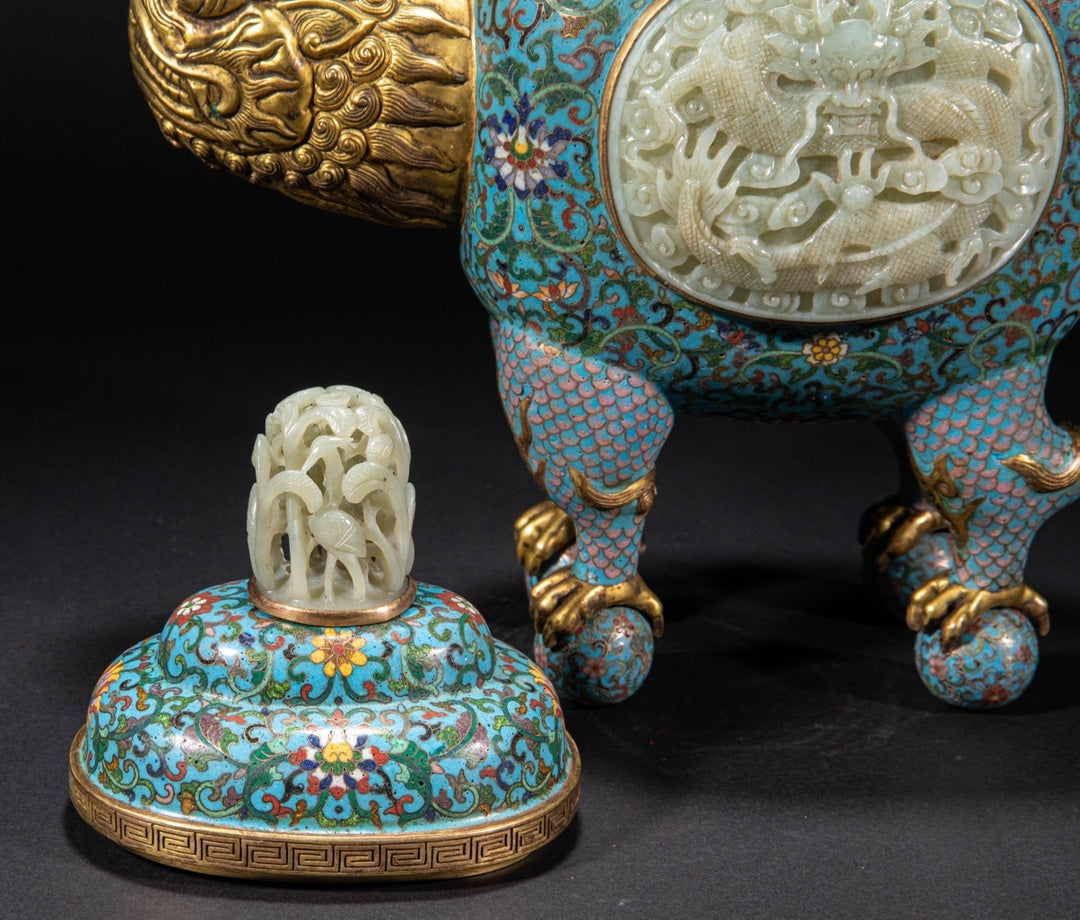
Monumental Chinese cloisonné wine ewer executed in Qing-dynasty court style, featuring dense turquoise-ground enamel, sculptural gilt-bronze mounts, a carved jade medallion centerpiece, and a zoomorphic pouring spout. A composite decorative object integrating enamel, bronze casting, and jade carving into a single high-authority display vessel.
This cloisonné wine ewer reflects the mature decorative vocabulary associated with late imperial Chinese court aesthetics, where technical virtuosity and material richness were combined to produce objects intended for both ceremonial function and elite interior display. The vessel’s commanding silhouette, elevated handle structure, and sculptural spout place it firmly within the tradition of statement objects rather than utilitarian ware.
The enamel body is executed in dense cloisonné technique, with tightly packed wire partitions forming a continuous ornamental field. The turquoise-ground surface acts as a visual anchor, allowing the surrounding motifs and metallic elements to read with clarity and depth. Cloisonné of this type required sequential firing cycles, precise temperature control, and a high level of workshop coordination, making such vessels inherently labor-intensive.
Bronze elements are integrated structurally rather than applied decoratively. The spout, handle framework, and fittings are cast to function as architectural extensions of the form, reinforcing the vessel’s weight and presence. Gilt surfaces retain strong definition, suggesting controlled handling and careful preservation.
At the center of the composition, a carved jade medallion introduces a secondary material language. Jade carving, traditionally associated with moral virtue, continuity, and status, elevates the object beyond enamelware alone. The deliberate pairing of cloisonné and jade signals a decorative hierarchy consistent with elite tastes, where mixed-material refinement functioned as a visual marker of authority.
The object aligns with Qing-style decorative production intended for high-level interiors, scholar environments, or ceremonial display. Whether commissioned for ritual wine service or created as a prestige object, the ewer reads as a fully resolved decorative form rather than a hybrid curiosity.
Material & Craft Analysis
The vessel integrates cloisonné enamel with cast bronze and jade carving. Turquoise-ground enamel fields, structural bronze fittings, and the jade medallion function together as a cohesive mixed-material composition.
Cloisonné Enamel: Dense wire partitions with evenly distributed enamel fills, consistent coloration, and controlled surface leveling.
Bronze Structure: Cast bronze spout, handle framework, and fittings integrated into the vessel’s structural logic.
Gilt Finish: Warm-toned gilding providing contrast and material hierarchy.
Jade Medallion: Carved stone insert functioning as a symbolic and material focal point.
Cultural & Symbolic Context
Cloisonné wine ewers occupy a symbolic role in Chinese decorative arts, associated with ritual hospitality, status display, and elite interior culture. The presence of jade reinforces themes of refinement and continuity.
In Chinese decorative tradition, wine ewers functioned as markers of hospitality, ritual continuity, and social hierarchy. Cloisonné enamel, introduced and refined through imperial workshops, became associated with formality and visual authority. Jade’s inclusion reinforces symbolic associations with longevity, virtue, and cultivated taste.
The object corresponds stylistically to Qing-dynasty decorative traditions, particularly the synthesis of enamel, bronze, and jade favored in late imperial interiors. While exact court attribution is not claimed, the execution reflects workshop standards aligned with elite decorative production rather than commercial export ware.
Collector Relevance
This piece will resonate with collectors seeking materially complex Chinese decorative arts that emphasize presence, craftsmanship, and historical continuity. Its scale, mixed-media execution, and architectural form make it suitable as a centerpiece object within serious Asian art collections or refined interior installations.
Condition
Overall condition is visually strong with no apparent structural damage. Surface wear is consistent with age and handling. No third-party material assay or institutional documentation is included. Buyers are advised to review all images carefully.
Dimensions & Weight
- Height: approx. 44 cm
- Width: approx. 28 cm
- Estimated weight: approx. 6.5–7.0 kg
Shipping & Logistics
Estimated packaged weight: 10–12 kg. Concierge logistics support available via Japonista Concierge Logistics™.
Authenticity & Stewardship
Evaluated under the Japonista Authentication Framework™:
- Material, carving, and surface-study comparison
- Iconographic and stylistic verification
- Condition and stability review (surface integrity)
- Construction assessment and handling-risk evaluation
Guaranteed 100% Authentic. Covered by the Japonista Lifetime Authenticity Warranty™.
A Note on Stewardship and Collecting
At Japonista, we approach Buddhist statues, sacred images, and ritual objects not merely as collectibles, but as cultural and spiritual artifacts deserving of respect, understanding, and careful presentation. Every piece we offer is thoughtfully examined, researched, and curated with sensitivity to its origin, meaning, and historical role.
Our role is not only to offer access to rare and meaningful objects, but to serve as responsible custodians—connecting the right works with collectors who value depth, intention, and authenticity.
Inquiries, Availability, and Private Consideration
Some of the cultural and heritage works may allow room for discussion, while others are held firmly due to rarity, condition, or cultural importance. All inquiries are reviewed personally and discreetly, and we welcome thoughtful questions or expressions of interest.
If you are exploring a particular theme, deity, lineage, or period—or seeking guidance in building a focused collection—our concierge team is always available to assist with quiet expertise and care.
Concierge Support & Collector Guidance
Japonista Concierge™ provides personalized assistance for collectors seeking deeper understanding, thoughtful acquisition, or long-term curation strategies. Whether your interest is devotional, scholarly, or aesthetic, we are here to help guide your journey with clarity and respect.
For select high-value or historically significant works, private reservation or structured payment arrangements may be available on a case-by-case basis. Please reach out to discuss eligibility and discreet options.
Before Proceeding
We kindly encourage collectors to review our shop policies and house guidelines, available through the links in our website footer, which outline shipping, handling, and conditions specific to vintage, sacred, and collectible works.
A Closing Note
Thank you for exploring Japonista’s collection of Oriental Cultural Heritage and arts. We are honored to share these meaningful works and to help place them where they may continue to be appreciated, studied, and respected.
If you have questions or wish to explore related works, please feel free to contact Japonista Concierge™ at any time.