Prince Shokai
Prince Shokai Yokosuka Jumper, Descending Hawk and Pine Embroidery, Navy and Silver-White Satin Sukajan
Prince Shokai Yokosuka Jumper, Descending Hawk and Pine Embroidery, Navy and Silver-White Satin Sukajan
Couldn't load pickup availability
Have a reasonable price in mind? Submit your best offer and our concierge will review it personally.
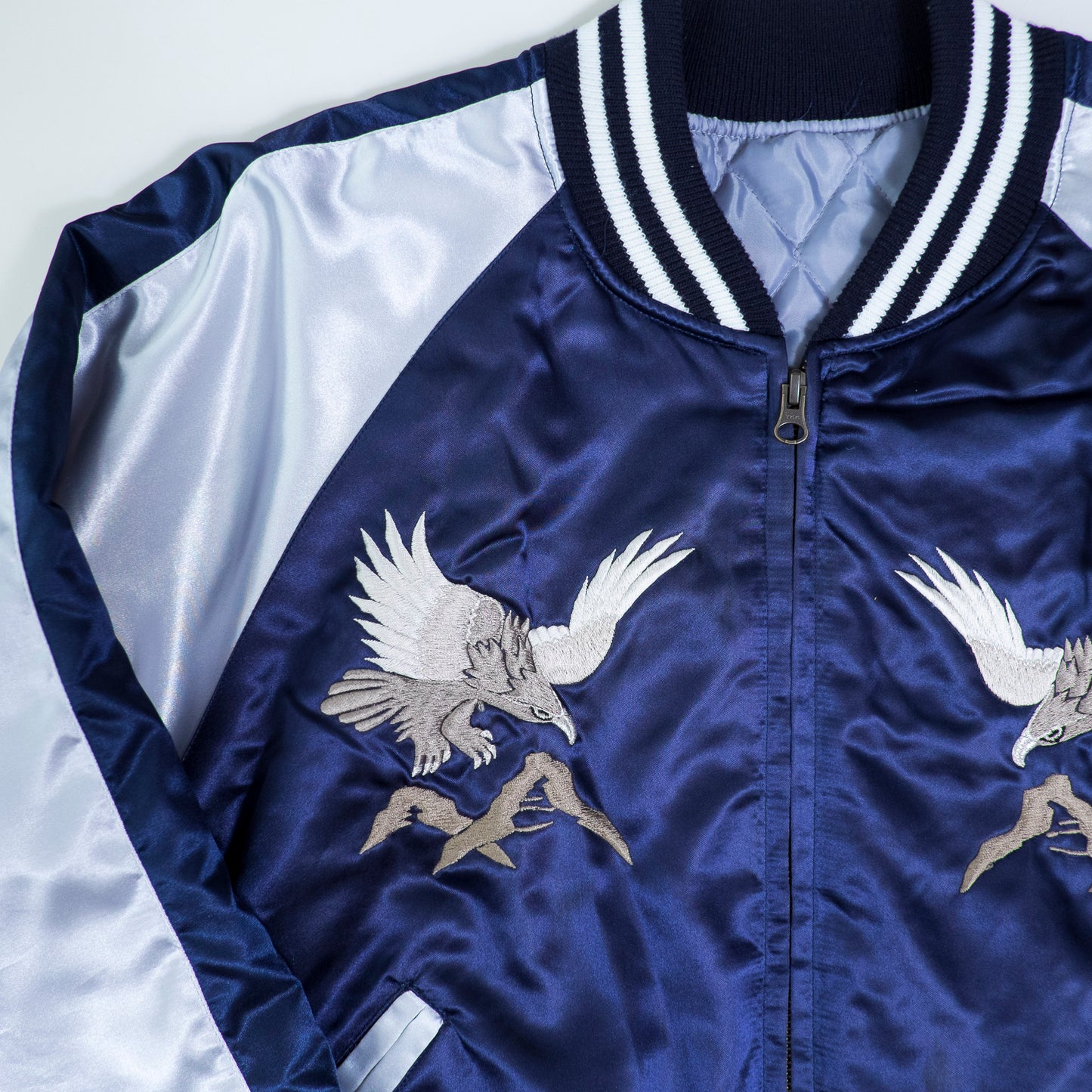
A vintage Prince Shokai sukajan of unusual restraint: midnight navy and silver-white satin, a great raptor descending onto a pine branch, a floral crest and arched Yokosuka script, all embroidered in near-monochrome thread so the design reads almost like relief carving.
The Piece
This beautifully balanced Prince Shokai Yokosuka jumper is rendered in deep midnight navy and luminous silver-white satin, with large-scale raptor and pine embroidery across the back and smaller mirrored birds on the chest. Rather than many competing colors, the design concentrates on navy, white, silver, warm gray and muted brown, a disciplined palette that lets the embroidery read almost like relief carving against the lustrous ground. The dark body, pale sleeves, striped ribbing and monochromatic threadwork give it a crisp athletic presence while keeping the ornamental character of a traditional Yokosuka jumper: wearable without being timid, richly embroidered without crowding, and less theatrical than a densely colored dragon or tiger jacket, yet no less commanding.
The back is dominated by a large bird of prey descending toward a pine branch, wings lifted and widely spread in a V-shaped silhouette, talons lowered at the instant before landing or seizing its perch. It may be read as a stylized hawk or eagle; the embroidery favors symbolic force over ornithological naturalism. The hawk, or taka, has long carried associations with courage, disciplined strength, keen vision, aspiration, status and decisive action, a fitting emblem for warriors and powerful households, and it conveys watchfulness: confidence grounded in alertness rather than noise. Read as an eagle, it brings authority, independence, endurance and command of the sky, linking the Japanese auspicious motif to the bold iconography of American souvenir, military and varsity clothing. Pine, or matsu, stays green through winter and is associated with longevity, resilience, constancy, dignity and steadfast character; beneath the bird it pairs the raptor's freedom and vision with the endurance of the evergreen, while the muted brown branch and warm gray needles soften the cool palette.
Above the bird sits a circular embroidered crest containing a stylized floral device. Its geometry follows the visual language of Japanese kamon, or family crests, appearing related to a rounded floral or mokkō-type design within a circular border, although the precise historical crest is not confirmed from the photographs. It acts as a symbolic seal between the arched lettering and the raptor. Across the upper back curves a cursive Yokosuka inscription in thick, raised embroidery with a chenille-like softness, tying the jacket to the city that gave the souvenir-jacket tradition its name. On the front, two smaller birds with raised wings above short pine branches sit symmetrically either side of the zipper, reading like guardian emblems; the metal zipper divides the composition without cutting through them, and they stay visible whether the jacket is worn open or closed.
The embroidery is worked in ivory, white, silver-gray, beige, taupe and muted brown thread, closely related tones that model the bird, pine, branch, lettering and crest like a monochrome illustration translated into thread. The central bird's wings divide into long tapered outer feathers, shorter secondary layers and compact body plumage, with fine directional stitching following each section; tail, neck, legs and talons are differentiated through line direction and tone. Pine foliage is formed from radiating clusters of narrow stitches, each suggesting a fan of needles and preserving open space around the bird. The rear embroidery occupies most of the central back panel, from the shoulders toward the waistband.
The sukajan grew from embroidered souvenir jackets associated with Yokosuka, its name commonly understood as a contraction of “Yokosuka jumper,” where American military outerwear met Japanese embroidery, local souvenir culture and postwar fashion. Early examples carried maps of Japan, dragons, tigers, eagles, military insignia, Mount Fuji and place names; the form later moved into youth culture, rockabilly, biker and punk wardrobes, luxury fashion and international streetwear. This jacket keeps the genre's defining elements, and its motifs are unusually cohesive: raptor, pine, crest, lettering and chest birds form a single language of vigilance, endurance, strength and place, read as one composition from every direction. The Prince Shokai attribution adds interest for collectors who favor sukajan connected directly with Yokosuka souvenir-jacket culture.
Details
- Maker: Prince Shokai
- Era: Later 20th to early 21st century Japanese souvenir-jacket production (late Showa, Heisei and Y2K-era revival); exact year of manufacture not shown
- Origin: Japan
- Material: Satin-finish shell (synthetic or rayon satin; material tags list rayon satin); ribbed knit (material tags list cotton ribbing); embroidery thread; pale blue diamond-quilted lining; metal zipper
- Color: Midnight navy, silver-white, pale blue, ivory, soft gray, taupe and muted brown
- Size: Manufacturer's size tag not visible in the photographs
- Measurements: Flat measurements are not shown in the available images; no chest width, back length, sleeve span, shoulder width or hem width should be assumed
- Construction: Single-face embroidered sukajan with a pale icy-blue diamond-quilted lining (not reversible); navy satin body with silver-white sleeves and navy shoulder panels; raglan-inspired angled paneling; navy-and-white striped rib collar, cuffs and waistband; center-front metal zipper with navy satin facings; diagonal welt pockets with pale welts
Condition
- Vintage pre-owned condition with characteristics consistent with age, storage and careful prior use; the jacket presents strongly, its navy and silver-white contrast clear, the embroidery well defined and the main structural elements intact.
- Satin: natural creasing, light rippling and localized puckering, partly inherent to lightweight satin and partly from the tension between dense threadwork and surrounding fabric. The navy body keeps a rich sheen; the pale sleeves appear bright overall, with minor surface variation possible under changing light.
- Embroidery: the back design remains complete and strongly legible, with no major missing section visible; minor thread irregularities, small loose fibers or slight age-related lifting may be present around densely stitched edges and lettering.
- Ribbing: collar, cuffs and waistband intact with their navy-and-white pattern, showing gentle waviness and relaxation from wear and storage; no severe unraveling or missing section visible.
- Lining: the pale blue quilted lining is present and generally sound, with light creasing throughout; minor loose fibers or edge wear appear possible around the interior neckline seam.
- Zipper and pockets: the metal zipper and front welt pockets are present, with no major separation visible around the zipper tape or pocket openings; vintage hardware may feel different from modern factory-new components.
- No large holes, extensive seam failure, severe tearing, widespread staining or major embroidery loss is visible in the photographs. Navy may read as deep blue, indigo or near-black depending on screen and light.
Fit Guidance
For a reliable fit assessment, compare the jacket with a similar garment that already fits comfortably, measuring both flat: A pit to pit; B back length from the base of the collar to the hem; C sleeve length along the upper seam from the collar area to the cuff; D hem width; E cuff width or another relevant fit point.
Japanese vintage sizing does not consistently correspond to modern Western sizing; a tagged medium, large or free size may fit differently depending on production period, silhouette, shoulder construction, lining thickness and ribbing contraction. The jacket suits masculine, feminine and gender-neutral wardrobes, its impact coming from proportion, color and embroidery rather than gendered tailoring.
Styling and Display
For Japanese Americana, pair with raw denim, a white T-shirt, engineer boots and a simple leather belt; for contemporary streetwear, wide black trousers, washed denim, sneakers or minimal monochrome layers; with a rockabilly or biker lean, cuffed denim, boots and open-collar shirts. The high-contrast palette photographs particularly well under directional light, the satin reflecting while the matte thread stays dimensional, suiting editorial, stage and music photography.
Hung on a broad padded hanger, mounted in a textile display or photographed flat, the back functions almost like an embroidered panel, the white wings and pine branches legible at a distance.
Preservation Guidance
Professional dry cleaning by a specialist experienced with embroidered vintage garments is recommended; do not machine wash, soak, bleach, wring or tumble dry. Do not iron over the birds, pine, crest or lettering; if light steaming is needed, keep the steamer at a distance and avoid saturating the fabric. Protect the satin from rough surfaces, sharp accessories, hook-and-loop fasteners and abrasive straps, and avoid stretching the ribbing.
Store on a broad padded hanger in a breathable cover rather than sealed plastic, in a cool, dry place away from prolonged sunlight, humidity, smoke, perfume and moths, with no heavy garments pressing on the embroidery, and inspect the satin, lining, ribbing, zipper and threadwork periodically.
Authenticity & Care
Attributed to Prince Shokai; the garment's Yokosuka lettering, motif system and construction are consistent with the maker's heritage sukajan production. Every piece is examined and documented in Japan before dispatch and is offered with the Japonista authenticity guarantee.
Delivery from Japan
Packed by hand in Japan and shipped insured and tracked by EMS or an equivalent express service. Import duties and taxes, where applicable, are payable on arrival. Returns follow our published policy.
Considered offers are welcome through Send an Offer, and each one is reviewed personally.
Continue browsing: Sukajan Souvenir Jackets · Amekaji & Wagara Fashion
Related pieces: Prince Shokai black velvet tiger sukajan · Prince Shokai velvet eagle and hawk sukajan · Prince Shokai velvet tattoo-art sukajan
Yokosuka Archive
A particular size, motif or decade in mind? Postwar souvenir jackets and heritage amekaji surface in Japan one at a time. Name the maker, the embroidery and the chest measurement, and the Hunting Salon™ watches for it on your behalf. Request a jacket search →
Collectors also search: prince shokai sukajan · navy hawk sukajan · yokosuka jumper eagle pine · prince shokai yokosuka jacket · hawk embroidered souvenir jacket · navy satin sukajan · vintage yokosuka jumper