Rare Vintage, Antiques and Art Collector / Curator / Personal Shopper From Japan
Prince Shokai Vintage Japanese Street Wear Fashion YOKOSUKA JUMPER Black Velvet Tiger Sukajan Bomber Yakuza Gangsta Y2K Souvenir Tour Jacket
Prince Shokai Vintage Japanese Street Wear Fashion YOKOSUKA JUMPER Black Velvet Tiger Sukajan Bomber Yakuza Gangsta Y2K Souvenir Tour Jacket
Couldn't load pickup availability
Have a reasonable price in mind? Submit your best offer and our concierge will review it personally.
Prince Shokai “Yokosuka” Black Velvet Souvenir Jacket with Roaring Tiger, Bamboo, Mirrored Chest Embroidery, and Satin Lining
COLLECTOR’S OVERVIEW
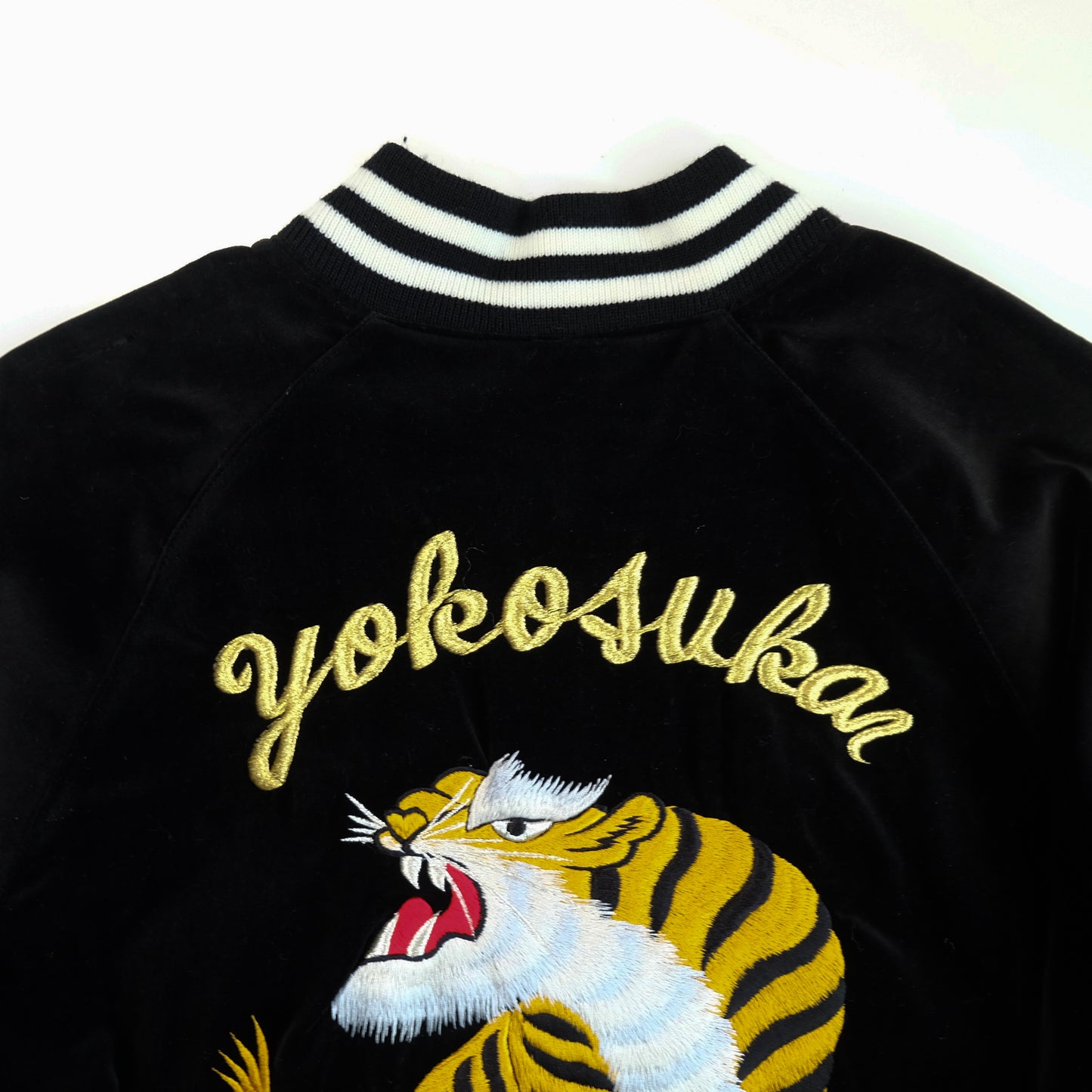
A commanding vintage Yokosuka jumper by Prince Shokai, constructed in deep black velvet or velour-finish fabric and embroidered with one of the most enduring images in Japanese sukajan culture: a roaring tiger poised upon a branch beneath sweeping gold “Yokosuka” lettering.
The back composition is direct, balanced, and immediately recognizable. A broad-shouldered tiger sits upright with its mouth open, fangs exposed, paws planted firmly on the branch, and striped tail curling upward beside its body. Fresh green bamboo leaves emerge around the branch, introducing a vivid natural accent against the otherwise disciplined palette of black, gold, white, red, brown, and green.
Across the front, two mirrored tiger heads face inward toward the zipper. Their open mouths, white whiskers, red tongues, and sharp teeth give the jacket a powerful appearance even when the larger rear embroidery is not visible.
The soft black pile fabric gives this piece a markedly different presence from the more common satin sukajan. Velvet absorbs light into a near-black field while the embroidery rises vividly from its surface, creating an almost theatrical contrast between darkness and color.
This is a lined, single-face embroidered sukajan rather than a fully reversible two-design jacket. Its interior is finished in smooth pale satin, while the exterior remains dedicated entirely to the black velvet tiger composition.
IDENTIFICATION
Object Type
Vintage Japanese sukajan, also known as a Yokosuka jumper, embroidered souvenir jacket, or Japanese souvenir bomber.
Brand and Maker
Prince Shokai.
The lower-right back embroidery includes the wording “by Prince Co.,” connecting the design to the Prince name shown in the seller attribution.
Origin
Japan.
Garment Category
Japanese embroidered souvenir jacket with black velvet or velour-finish exterior, pale satin lining, striped rib-knit trim, central metal zipper, and front welt pockets.
Primary Motif
Roaring tiger seated upon a branch with bamboo foliage.
Secondary Motifs
Mirrored tiger heads on the chest, embroidered “Yokosuka” lettering, green bamboo leaves, brown branches, and maker script.
Color Palette
Black, golden yellow, ivory white, warm orange, red, brown, pale gray, and fresh green.
Wearability
Unisex collectible outerwear with a traditional short bomber silhouette.
Construction Format
Single-face embroidered sukajan with an interior satin lining.
THE YOKOSUKA JUMPER TRADITION
Sukajan Origins
The sukajan developed from souvenir jackets associated with Yokosuka and other Japanese port communities during the postwar period.
American-style bomber and varsity jackets were adapted through Japanese embroidery, creating garments decorated with tigers, dragons, eagles, Mount Fuji, maps, flowers, military insignia, and place names.
The term “sukajan” is commonly understood as a shortened form of “Yokosuka jumper.” The embroidered Yokosuka lettering on this jacket therefore carries more than decorative value. It directly references the city whose name became inseparable from the garment tradition.
From Souvenir to Japanese Streetwear
Although early jackets were connected closely with souvenir culture, the sukajan later entered Japanese youth fashion, motorcycle culture, rockabilly, punk, visual-kei styling, vintage Americana, luxury design, and international streetwear.
The jacket became a mobile picture surface, combining the compact practicality of a bomber with the visual impact of embroidered Japanese art.
This Prince Shokai example preserves that classic formula through a large back motif, smaller paired chest emblems, striped athletic ribbing, a metal zipper, and a strongly defined color architecture.
Japanese-American Design Exchange
The garment’s bomber shape, welt pockets, striped trim, and zipper construction recall American military and collegiate outerwear.
Its tiger, bamboo, expressive linework, and place-name embroidery belong to the visual language of Japanese souvenir textiles.
The result is not purely American or purely traditional Japanese clothing. It is a hybrid object shaped by travel, cross-cultural exchange, street fashion, and embroidery craftsmanship.
THE ROARING TIGER
Central Back Composition
The rear embroidery centers on a large tiger seated upon a dark brown branch.
The animal is shown in a compact but imposing pose. Its front paws rest side by side, its back rises into a powerful curve, and its tail sweeps upward along the left side of the composition.
The head turns sharply toward the left, mouth wide open in a roar. This creates directional energy and prevents the animal from appearing static despite its seated posture.
Facial Expression
The tiger’s face is one of the jacket’s strongest details.
Its eyes are sharply focused, the brows angle downward, and the white whiskers extend outward from the muzzle. The open mouth reveals pointed white fangs, a bright red tongue, and contrasting dark interior.
A dramatic white beard or lower ruff frames the jaw and chest, increasing the apparent size of the head and giving the animal an almost guardian-like presence.
Striped Body
The coat is embroidered in golden yellow and orange with strongly defined black stripes.
The stripes curve around the torso, legs, neck, and tail rather than appearing as flat horizontal bands. This directional stitching helps describe the animal’s volume and muscular shape.
The white chest creates a bright central field between the striped shoulders, while the pale paws and claws emphasize the tiger’s grounded position upon the branch.
Exaggerated Sukajan Anatomy
The tiger is not rendered as a strictly naturalistic wildlife study.
Its compact body, enlarged paws, broad white chest, expressive face, and theatrical roar belong to the stylized vocabulary of souvenir-jacket embroidery. These visual exaggerations allow the motif to remain immediately legible from a distance and while the jacket is in motion.
TIGER SYMBOLISM
Strength and Courage
The tiger represents physical power, courage, determination, and the ability to confront danger directly.
Its muscular body and predatory confidence have made it one of the defining motifs of Japanese sukajan, tattoo art, martial imagery, and masculine decorative design.
Protection
In broader East Asian symbolism, the tiger may function as a protective force capable of driving away harmful influences.
Its intimidating appearance is not merely aggressive. It can also be understood as guardian imagery, placing a powerful animal across the wearer’s back as a visual shield.
Authority and Independence
The tiger moves alone and commands its territory without relying on a group.
For this reason, it can signify self-reliance, authority, independence, and confidence developed through experience rather than display alone.
Controlled Power
The tiger in this composition is seated rather than charging.
Its open mouth expresses force, but its body remains balanced upon the branch. This combination suggests restrained power: energy held in reserve and released only when necessary.
BAMBOO AND BRANCH IMAGERY
Green Bamboo Leaves
Fresh green leaves emerge around the tiger and branch.
Their brightness creates a sharp chromatic contrast with the black velvet and warm golden fur. The foliage also softens the geometry of the tiger’s stripes and introduces movement around the lower half of the composition.
Bamboo Symbolism
Bamboo is admired for combining strength with flexibility.
It can bend beneath wind or snow without losing its essential structure, making it an emblem of resilience, adaptability, integrity, and disciplined growth.
Paired with the tiger, bamboo adds a second form of strength. The animal represents immediate power and decisive action, while the plant represents endurance through flexibility.
The Supporting Branch
The tiger rests upon an embroidered brown branch angled across the lower back.
This branch provides a firm visual base and prevents the animal from appearing suspended against the black ground. Its diagonal movement also gives the composition a natural landscape structure without requiring an elaborate scenic background.
Tiger and Bamboo Combination
The pairing of tiger and bamboo is visually and symbolically effective.
The tiger brings intensity, motion, and authority.
The bamboo brings balance, persistence, and composure.
Together they create an image of strength that is neither reckless nor fragile.
“YOKOSUKA” LETTERING
Arched Back Inscription
The word “Yokosuka” is embroidered in large golden cursive lettering across the upper back.
Its arch follows the curve of the shoulders and frames the tiger below. The flowing script contrasts with the angular stripes, fangs, and bamboo leaves, creating a softer transition between the collar and central animal.
Place Identity
Yokosuka is not used here as a generic Japanese word.
It identifies the geographical and cultural home associated with the sukajan tradition. The inscription therefore connects the jacket directly with the history and mythology of the Yokosuka jumper.
Raised Embroidery
The lettering is worked in dense golden thread with a substantial raised surface.
Against the light-absorbing velvet, the script appears almost luminous. Its warm tone also coordinates with the tiger’s orange-gold body.
Maker Signature
The lower-right corner carries a smaller embroidered inscription reading “by Prince Co.”
Its discreet placement functions like an artist’s signature beneath the central composition and adds identifiable maker character without distracting from the tiger.
MIRRORED FRONT TIGERS
Paired Chest Motifs
Two tiger heads are embroidered symmetrically across the chest.
Each faces inward toward the central zipper, creating a heraldic arrangement that remains visually balanced whether the jacket is worn open or closed.
Open-Mouthed Expression
The chest tigers repeat the aggressive expression of the larger back figure.
White whiskers, pointed teeth, red tongues, black stripes, golden fur, and pale lower jaws are clearly articulated despite the reduced scale.
Front-to-Back Continuity
The chest motifs prepare the viewer for the monumental tiger on the reverse side of the garment.
This continuity gives the jacket a complete design program rather than treating the front and back as unrelated decorative areas.
Visual Framing
Because the tiger heads face inward, they naturally frame the wearer’s chest and zipper line.
The resulting symmetry gives the front a strong, almost crest-like quality while leaving sufficient black velvet visible around the embroidery.
BLACK VELVET OR VELOUR EXTERIOR
Surface Character
The exterior is constructed from a soft black pile textile consistent with velvet or velour.
The nap absorbs and redirects light, causing the surface to shift between deep black, blue-black, and charcoal depending on the angle of viewing.
This variation is inherent to pile fabric and gives the jacket depth without printed decoration.
Contrast with Embroidery
White, orange, yellow, red, green, and brown threads appear especially vivid against velvet.
Unlike reflective satin, which produces highlights across the entire garment, the dark pile creates a quiet background that allows the tiger to dominate.
Tactile Presence
The plush surface gives the jacket a richer and more substantial visual character than a conventional lightweight satin souvenir bomber.
It also introduces a connection with vintage leisurewear, rockabilly jackets, smoking jackets, stage clothing, and luxury sportswear.
Natural Nap Direction
Areas of the black exterior may look lighter or darker where the pile has been brushed in different directions.
Folds, pressure, handling, and storage can temporarily alter the orientation of the nap. This should be understood as a characteristic of velvet rather than uniform fading.
INTERIOR SATIN LINING
Pale Lining
The interior is finished in smooth pale silver-white satin.
This light lining creates a clean contrast with the dark exterior and makes the jacket easier to layer over clothing.
Single-Face Construction
The lining is not designed as a second pictorial outer face.
The jacket should therefore be understood as a lined, non-reversible sukajan rather than a reversible jacket with two complete exterior designs.
Functional Role
The satin lining reduces friction against shirts and knitwear while helping the velvet shell retain its bomber shape.
Its smooth surface also protects the reverse side of the embroidery from direct contact with the wearer.
GARMENT CONSTRUCTION
Bomber Silhouette
The jacket follows the classic short sukajan profile.
It has a gathered waistband, full sleeves, rounded shoulder line, low ribbed collar, and central zipper closure. The body is intended to sit near the hip while allowing volume through the arms and upper torso.
Raglan-Style Shoulders
The sleeves extend diagonally from the neckline toward the underarm.
This raglan-style construction provides freedom of movement and creates an uninterrupted shoulder line around the large back embroidery.
It also avoids placing a conventional shoulder seam directly through the upper Yokosuka lettering.
Central Metal Zipper
A metal zipper closes the jacket through the center front.
The darker zipper tape blends into the black velvet exterior, while the visible metal teeth provide a restrained utilitarian contrast.
Welt Pockets
Diagonal welt pockets are positioned near the lower front.
Their openings are worked in the same dark textile, allowing them to remain functional without interrupting the paired tiger-head composition.
Ribbed Collar
The low bomber collar is finished in black ribbed knit with two contrasting white stripes.
Its compact height leaves the upper back visually open and allows the Yokosuka embroidery to sit close to the neckline.
Cuffs and Waistband
The cuffs and waistband repeat the black-and-white stripe system.
The elastic ribbing draws the velvet inward at the wrists and lower body, creating the characteristic rounded bomber silhouette.
Athletic Influence
The striped trim introduces an American varsity and collegiate character.
This athletic detailing creates a lively contrast with the Japanese tiger motif and plush velvet surface.
EMBROIDERY EXECUTION
Thread Palette
The embroidery uses golden yellow, warm orange, white, black, red, brown, green, pale gray, and cream thread.
The palette is compact enough to remain cohesive but broad enough to separate the tiger’s fur, stripes, chest, mouth, branch, bamboo, lettering, and facial details.
Directional Stitching
The thread direction changes across the tiger’s body.
Stitches follow the curve of the torso, neck, legs, and tail, helping the animal appear rounded rather than flat.
The white chest and beard use denser radiating stitchwork, creating a textural distinction from the shorter golden fur.
Facial Detailing
Fine embroidery defines the eyes, nose, brows, whiskers, mouth, tongue, and teeth.
The sharp black outlines maintain clarity against the golden and white areas, while the red mouth introduces a concentrated point of intensity.
Claw Definition
The front paws are prominently embroidered with individual pale claws.
Their exaggerated size reinforces the tiger’s physical authority and helps anchor it securely to the branch.
Bamboo Leaves
The leaves are created through elongated green stitches arranged in pointed clusters.
Their clean shape contrasts with the denser fur embroidery and remains legible against the black background.
Lettering Density
The Yokosuka script uses thick, raised golden embroidery.
Its surface catches light differently from the velvet and gives the upper back a dimensional, almost appliquéd effect.
Localized Puckering
Light rippling may occur around dense embroidery where the threadwork places tension on the softer pile textile.
This is a natural characteristic of heavily embroidered souvenir garments and contributes to the dimensional surface of the design.
COLOR ARCHITECTURE
Dominant Black
Black controls nearly the entire jacket.
It creates a powerful stage for the embroidery while making the garment comparatively easy to style despite the bold tiger image.
Gold and Orange
Golden and orange thread form the tiger’s coat and the Yokosuka lettering.
These warm tones produce visual unity between the animal and place-name inscription.
White
White appears in the tiger’s chest, beard, brows, whiskers, teeth, and striped ribbing.
It creates the strongest contrast against the black velvet and sharpens the facial expression.
Red
Red is concentrated within the open mouths.
Because it is used sparingly, the tongues and inner mouths become immediate focal points.
Green and Brown
Green bamboo leaves and brown branches introduce natural color without competing with the tiger.
They connect the animal to a landscape context while keeping the design disciplined.
PERIOD AND STYLE ASSESSMENT
Likely Era
The jacket appears consistent with late 20th-century to early 21st-century Japanese souvenir-jacket production, including the late Showa, Heisei, and Y2K-era revival of classic Yokosuka jumper imagery.
Its velvet construction, machine embroidery, striped ribbing, satin lining, and simplified heritage motif system align with vintage Japanese streetwear produced for collectors and fashion wear rather than early postwar souvenir manufacture.
Heritage Motif Revival
The design uses one of the foundational sukajan subjects rather than a contemporary pop-culture graphic.
Tiger, bamboo, Yokosuka lettering, and mirrored chest embroidery place the garment firmly within the heritage vocabulary of the genre.
Y2K Streetwear Relevance
The plush black surface, oversized pictorial back, compact bomber profile, and high-contrast chest motifs also resonate strongly with current interest in Y2K Japanese fashion and archive streetwear.
Exact Production Date
The precise year of manufacture is not visible in the supplied photographs.
The jacket is therefore presented as a vintage or vintage-era Prince Shokai sukajan whose individual production date remains unspecified.
CONDITION
Overall Condition
Vintage pre-owned condition with gentle textile variation, velvet nap movement, light creasing, and handling character consistent with age and prior wear.
The jacket presents strongly in the supplied photographs. The black exterior remains deep in tone, the tiger embroidery is vivid, and the striped ribbing retains clear contrast.
Velvet Nap
The black pile surface shows natural directional variation.
Some areas may appear darker, lighter, brushed, or slightly flattened depending on the orientation of the velvet nap and the direction of light.
Minor pressure marks or temporary changes in pile direction may occur around folds, seams, pockets, sleeves, and embroidered areas.
Back Embroidery
The large tiger, bamboo, branch, Yokosuka lettering, and Prince signature remain clearly defined.
No major missing portion of the principal back design is visible in the supplied photographs.
Small thread irregularities, raised fibers, or light edge wear may be present within the dense embroidery.
Front Embroidery
The mirrored tiger heads remain bright and sharply legible.
Their teeth, mouths, whiskers, brows, stripes, and pale lower jaws appear substantially intact.
Ribbing
The black-and-white collar, cuffs, and waistband remain present and visually cohesive.
The knit may show gentle relaxation, waviness, or age-related softening consistent with wear and storage.
No major missing ribbed section or extensive unraveling is visible.
Interior Lining
The pale satin lining appears present and generally clean in the photographed areas.
Natural creasing and light storage folds are visible. Minor age-related surface variation may be present beyond what can be seen from the limited interior view.
Zipper
The central metal zipper, slider, and lower fastening components are present.
No major separation is visible along the photographed zipper tape. Vintage hardware should be handled patiently and should not be forced if resistance is encountered.
Pocket Openings
The diagonal front welt pockets appear structurally present.
No major tearing or extensive separation is visible around the pocket edges in the supplied photograph.
Structural Condition
No large holes, severe tearing, catastrophic seam failure, widespread embroidery loss, or major missing component is visible in the available images.
The jacket remains a genuine vintage garment rather than factory-new clothing. Subtle nap variation, creasing, minor thread movement, and gentle signs of age form part of its authentic character.
DIMENSIONS AND SIZING
Recommended Measurement Points
A: Pit-to-pit chest width
B: Back length from the base of the collar to the lower waistband
C: Sleeve length measured from the collar seam along the upper sleeve to the cuff
D: Relaxed waistband width
E: Cuff width or another relevant fit point
Raglan Sleeve Measurement
Because the jacket uses raglan-style construction, there is no conventional shoulder seam from which to measure the sleeve.
The most useful sleeve measurement is taken from the base of the collar along the upper arm to the end of the cuff.
Japanese Vintage Sizing
Japanese vintage sizing should not be treated as directly equivalent to modern Western sizing.
Fit varies according to production era, intended silhouette, ribbing tension, body length, sleeve fullness, and layering preference.
Actual flat measurements should be compared with a similar bomber jacket that already fits comfortably.
Unisex Fit
The jacket is suitable for masculine, feminine, and gender-neutral wardrobes.
The correct fit should be determined by garment measurements and preferred silhouette rather than gendered size assumptions.
COLLECTOR DESIRABILITY
Prince Shokai Attribution
The Prince Shokai attribution and embroidered “by Prince Co.” signature provide identifiable maker interest.
This distinguishes the garment from unbranded tiger jackets and gives the composition a recognizable place within Japanese souvenir-jacket production.
Classic Yokosuka Subject
The tiger is one of the foundational sukajan motifs.
Collectors seeking a garment that communicates the traditional Yokosuka-jumper identity immediately may find this design especially appealing.
Velvet Construction
Black velvet or velour creates a more unusual tactile and visual experience than standard satin.
The pile gives the jacket depth, absorbs light beautifully, and makes the embroidery appear particularly saturated.
Strong Front and Back Program
The mirrored chest tigers and monumental rear tiger form one coherent design.
The jacket remains identifiable from the front while reserving its most dramatic image for the back.
Restrained Palette
The compact palette of black, gold, white, red, green, and brown makes the garment easier to wear than many heavily multicolored sukajan.
It retains visual force without becoming difficult to coordinate.
Clear Yokosuka Identity
The large embroidered place name anchors the jacket within the history of the souvenir-jacket form.
It also gives the upper back a strong graphic presence when the tiger is partly concealed by movement or layering.
Display Potential
The back functions effectively as an embroidered textile panel.
Displayed on a broad padded hanger, the tiger remains immediately legible from across a room, making the jacket suitable for a fashion archive, studio, gallery wall, collector interior, or retail display.
STYLING
Japanese Americana
Pair with selvedge denim, a plain white T-shirt, engineer boots, and a leather belt.
The striped ribbing, black velvet, and tiger motif work naturally within Japanese interpretations of vintage American workwear.
Rockabilly Styling
Wear with cuffed jeans, creepers or boots, an open-collar shirt, and restrained accessories.
The velvet surface and roaring tiger evoke the theatrical confidence of Japanese rockabilly and hot-rod fashion.
Contemporary Streetwear
Style with wide black trousers, washed denim, sneakers, or minimal monochrome layers.
A restrained outfit allows the golden tiger embroidery to become the central visual statement.
Biker-Inspired Wardrobe
The jacket pairs effectively with leather trousers, heavy boots, silver jewelry, and faded black denim.
Its protective tiger imagery and compact bomber shape create strength without requiring the weight of a leather motorcycle jacket.
Gender-Neutral Styling
The graphic animal motif and athletic construction move easily across masculine, feminine, and gender-neutral wardrobes.
The piece can be worn fitted for a traditional compact sukajan silhouette or more loosely for contemporary styling.
Stage and Editorial Use
Black velvet responds beautifully to controlled lighting.
The pile creates deep shadows while the embroidered tiger, white chest, and golden Yokosuka lettering remain sharply illuminated.
This contrast makes the jacket particularly effective for editorial photography, live performance, music shoots, visual-kei styling, and theatrical wardrobe.
CULTURAL AND ARTISTIC VALUE
Wearable Animal Iconography
The tiger is not printed onto the garment as a flat surface image.
Its body is constructed through dense thread direction, raised contours, layered colors, and textural changes. The jacket therefore carries a tactile image rather than merely a graphic reproduction.
Power and Resilience
The combined tiger and bamboo motif expresses two complementary forms of strength.
The tiger confronts danger directly.
The bamboo survives by yielding without breaking.
Together they form an image of courage tempered by adaptability.
Place and Identity
The Yokosuka lettering ties the garment to a specific cultural history.
It transforms the jacket from a generic tiger bomber into an object that identifies itself with the birthplace and mythology of the sukajan tradition.
Subculture and Craft
Sukajan occupy a distinctive position between embroidery craft and subcultural fashion.
They may be technically detailed while remaining connected to streetwear, motorcycle culture, music, youth style, and rebellion.
This Prince Shokai jacket embodies that balance through a luxurious pile textile, traditional tiger imagery, athletic ribbing, and bold wearable construction.
WHY THIS PIECE STANDS OUT
Monumental Tiger Back
The seated tiger fills the back with a compact, forceful silhouette.
Expressive Face
The open mouth, red tongue, white beard, angled eyes, and long whiskers give the animal exceptional personality.
Mirrored Chest Tigers
The front remains visually powerful and directly connected to the back design.
Gold Yokosuka Lettering
The raised script creates a strong place identity and frames the central composition.
Black Velvet Surface
The pile textile gives the jacket richer depth and a more luxurious character than ordinary satin.
Classic Black-and-White Ribbing
The athletic trim keeps the jacket crisp, wearable, and unmistakably bomber-inspired.
Balanced Symbolism
Tiger and bamboo combine power, protection, resilience, and adaptability.
Collector-Friendly Wearability
Despite its large embroidery, the disciplined color palette makes the jacket easy to integrate into contemporary wardrobes.
CARE AND PRESERVATION
Professional Cleaning
Professional dry cleaning by a specialist experienced with vintage velvet, embroidery, satin lining, and ribbed knit is recommended.
Do not machine wash, soak, bleach, wring, or tumble dry.
Velvet Care
Do not iron the velvet directly.
Heat and pressure may crush the pile, create permanent shine, or produce flattened areas.
Gentle specialist steaming from a safe distance may be used when appropriate, but the textile should never be saturated.
Nap Maintenance
Temporary pressure marks may sometimes relax when the garment is allowed to hang naturally in a dry environment.
Do not scrub or aggressively brush the velvet. Any pile restoration should be carried out gently with tools suitable for velvet.
Embroidery Care
Do not iron directly over the tiger, bamboo, lettering, or chest motifs.
Avoid pulling loose fibers or cutting thread ends without understanding their connection to the embroidery structure.
Abrasion Protection
Keep the jacket away from hook-and-loop fasteners, rough bags, sharp jewelry, textured walls, and abrasive straps.
Both velvet pile and embroidery can snag through repeated friction.
Ribbing Care
Do not carry the garment by the collar, cuffs, or waistband.
Handle the ribbing evenly and avoid unnecessary stretching.
Zipper Care
Align the zipper components carefully before fastening.
Do not force the slider if resistance is encountered. Vintage metal hardware benefits from patient, straight handling.
Storage
Store on a broad padded hanger that supports the shoulders without creating sharp points.
Use a breathable garment cover rather than sealed plastic.
Keep the jacket in a cool, dry environment away from direct sunlight, humidity, smoke, perfume, and prolonged compression.
Long-Term Display
When displayed, avoid sustained daylight and strong heat sources.
Periodic rest in dark storage will help preserve the black pile, colored embroidery, white ribbing, and pale lining.
SHIPPING, OFFERS, AND FINAL-SALE POLICIES
Shipping
Worldwide tracked shipping is available from Japan, generally through Japan Post EMS or another suitable tracked international service.
The jacket will be carefully folded with protective material placed between the velvet surface, embroidery, ribbing, zipper, and satin lining.
Tracking information is normally provided approximately 3–5 business days after dispatch.
Delivery times depend on destination, customs processing, postal conditions, and the international service available at the time of shipment.
Packaging
Special care will be taken to avoid unnecessary pressure on the central tiger, Yokosuka lettering, chest embroidery, and velvet pile.
The jacket may retain gentle transit folds upon arrival. These should be allowed to relax naturally rather than treated with direct high heat.
Additional Photographs
Additional photographs may be available upon request.
Please contact us before purchase should you wish to examine the embroidery edges, velvet nap, ribbing, cuffs, waistband, zipper, pockets, lining, interior label, or other specific areas more closely.
Offers
Reasonable offers may be considered on selected items.
Some firmly held collector garments have limited flexibility, while others may allow greater room for negotiation. Serious and respectful proposals are welcome and considered individually.
Product Representation
Every effort has been made to represent the jacket accurately through the photographs and description.
Color may vary according to screen calibration, lighting, camera exposure, and the directional character of velvet.
The exterior may appear black, blue-black, charcoal, or deep midnight depending on the direction of the pile and surrounding light.
Vintage Condition
This is a pre-owned vintage garment and is not presented as factory-new.
Natural nap movement, creasing, ribbing relaxation, minor thread variation, lining folds, and age-related textile character may be present.
These qualities form part of the jacket’s history and should be appreciated as characteristics of authentic vintage clothing.
Final Sale
The jacket is sold in its present condition as photographed and described.
All sales are final. No returns, claims, cancellations, or exchanges are accepted for accurately disclosed vintage wear, sizing, velvet nap variation, textile color variation, creasing, embroidery tension, ribbing relaxation, patina, or age-related characteristics, subject to applicable Etsy rules and consumer law.
Please review all photographs, condition details, sizing information, and policies carefully before completing your purchase.
#PrinceShokai #PrinceCo #VintageSukajan #TigerSukajan #YokosukaJacket #YokosukaJumper #BlackVelvetJacket #VelvetSukajan #JapaneseSouvenirJacket #TigerEmbroidery #JapaneseStreetwear #JapaneseAmericana #Y2KJapaneseFashion #EmbroideredBomber #VintageBomber #SukajanCollector #JapanVintage #WearableArt #JapaneseEmbroidery #TigerJacket #BambooEmbroidery #RockabillyFashion #BikerStyle #ArchiveStreetwear #UnisexVintage #CollectorJacket #StatementOuterwear #SouvenirBomber #JapaneseFashion #Japonista
MATERIAL TAGS
velvet textile, satin lining, ribbed knit, embroidery thread, metal zipper