Rare Vintage, Antiques and Art Collector / Curator / Personal Shopper From Japan
Prince Shokai Blue YOKOSUKA JUMPER Vintage Japanese Eagle Hawk Street Wear Fashion Sukajan Bomber Yakuza Gangsta Y2K Souvenir Tour Jacket
Prince Shokai Blue YOKOSUKA JUMPER Vintage Japanese Eagle Hawk Street Wear Fashion Sukajan Bomber Yakuza Gangsta Y2K Souvenir Tour Jacket
Couldn't load pickup availability
Have a reasonable price in mind? Submit your best offer and our concierge will review it personally.
Prince Shokai Yokosuka Jumper with Raptor, Pine, Kamon-Style Crest, and Two-Tone Satin Construction
COLLECTOR’S OVERVIEW
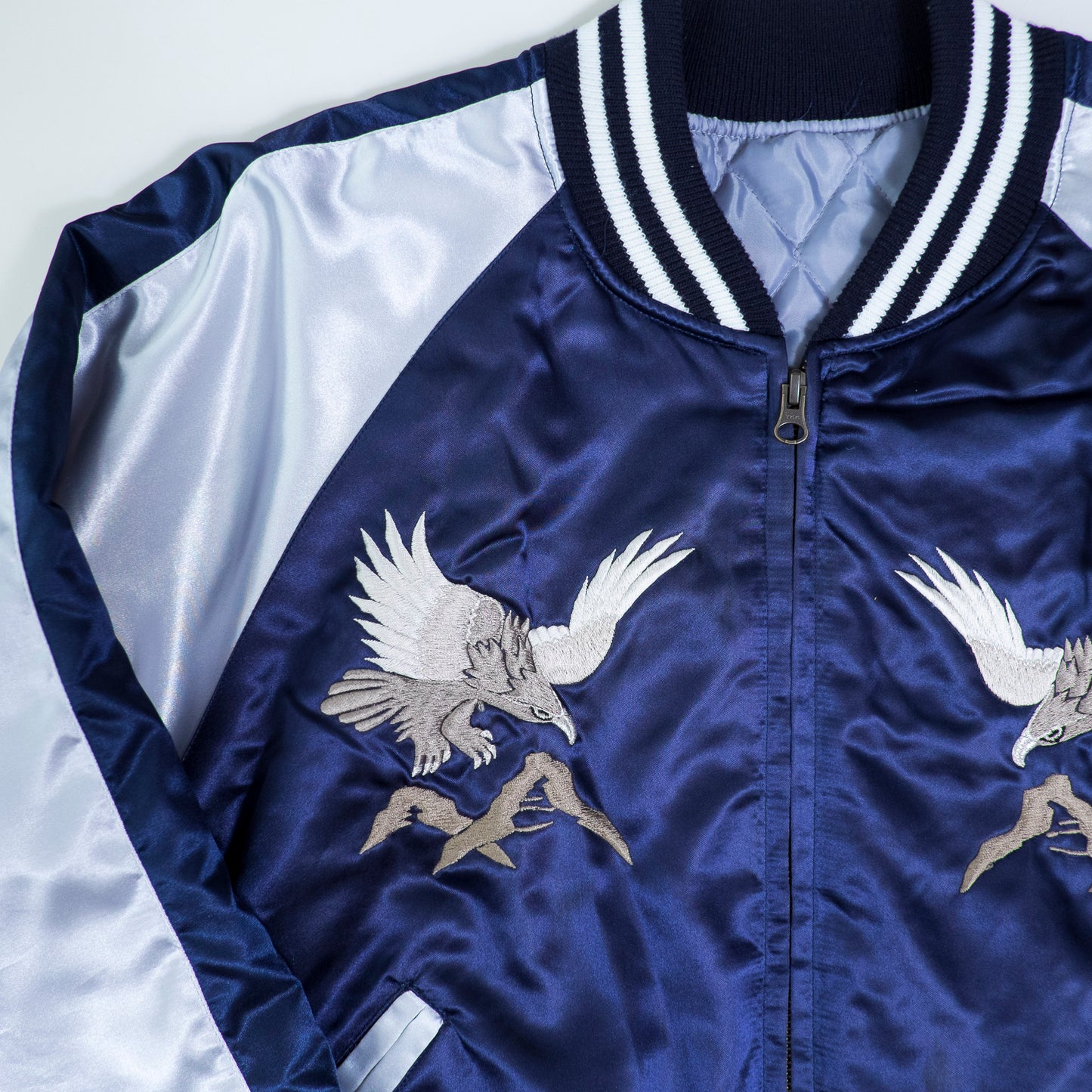
A beautifully balanced vintage Prince Shokai sukajan rendered in deep midnight navy and luminous silver-white satin, with large-scale Japanese raptor and pine embroidery across the back and smaller mirrored birds decorating the chest.
The jacket’s visual strength comes from its disciplined palette. Rather than relying on many competing colors, the design concentrates on navy, white, silver, warm gray, and muted brown. This limited architecture allows the embroidery to read almost like relief carving against the lustrous satin ground. The white bird appears suspended above the pine branch, wings extended and talons lowered, while the arched Yokosuka inscription and circular floral crest establish the garment firmly within the Japanese souvenir-jacket tradition.
The contrast between the dark navy body, pale sleeves, striped ribbing, and monochromatic embroidery gives the jacket a crisp athletic presence while preserving the ornamental character expected of a traditional Yokosuka jumper. It is wearable without being visually timid, richly embroidered without becoming crowded, and equally suited to a serious sukajan collection or contemporary Japanese streetwear wardrobe.
IDENTIFICATION
Object Type
Vintage Japanese sukajan, also known as a Yokosuka jumper or Japanese souvenir bomber jacket.
Maker
Prince Shokai.
Origin
Japan.
Garment Category
Embroidered souvenir jacket with satin-finish shell, ribbed bomber trim, metal zipper closure, welt pockets, and quilted interior lining.
Primary Imagery
Large descending hawk or eagle above a pine branch, accompanied by smaller paired raptors on the front chest.
Secondary Imagery
Circular floral kamon-style crest, embroidered Yokosuka lettering, pine needles, pine branches, and symmetrical chest motifs.
Color Palette
Midnight navy, silver-white, pale blue, ivory, soft gray, taupe, and muted brown.
Wearability
Unisex Japanese outerwear with a traditional bomber silhouette.
Construction Format
Single-face embroidered sukajan with a pale diamond-quilted lining. The photographs show a lined jacket rather than a fully reversible two-design construction.
THE YOKOSUKA JUMPER TRADITION
Sukajan and Postwar Japanese Material Culture
The sukajan developed from embroidered souvenir jackets associated with Yokosuka, the port city whose name became inseparable from this distinctive garment form. The word “sukajan” is commonly understood as a contraction of “Yokosuka jumper,” reflecting the meeting of American military outerwear, Japanese embroidery craftsmanship, local souvenir culture, and postwar fashion.
Early examples often carried maps of Japan, dragons, tigers, eagles, military insignia, Mount Fuji, and personalized place names. Over time, the sukajan moved beyond its original souvenir function and became part of Japanese youth culture, rockabilly fashion, biker styling, punk wardrobes, luxury fashion, and international streetwear.
This jacket retains several of the genre’s defining elements: a satin bomber body, contrasting sleeves, striped ribbing, elaborate back embroidery, paired chest motifs, and a direct visual connection to Yokosuka.
A More Restrained Sukajan Aesthetic
Many contemporary sukajan are built around intense multicolored embroidery. This Prince Shokai example takes a more restrained route. Its monochromatic bird and pine composition emphasizes line, feather structure, motion, and negative space.
The result is less theatrical than a densely colored dragon or tiger jacket, yet no less commanding. The cool navy and silver-white palette creates an almost nocturnal atmosphere, giving the garment a polished character that can move between vintage collecting, Japanese Americana, tailored casualwear, and modern street styling.
SUBJECT, IMAGERY, AND SYMBOLISM
The Descending Raptor
The back is dominated by a large embroidered bird of prey shown descending toward a pine branch. Its wings are lifted and widely spread, creating a powerful V-shaped silhouette that fills the central body of the jacket.
The bird may be read as a stylized hawk or eagle. The embroidery favors symbolic force over strict ornithological naturalism, combining the sharp beak, layered wing feathers, extended talons, and commanding posture traditionally associated with raptor imagery.
The downward movement gives the scene unusual energy. Rather than resting passively on a branch, the bird appears at the instant before landing or seizing its perch. This suspended action creates tension across the back panel and allows the embroidery to animate naturally as the jacket moves.
Hawk Symbolism in Japanese Visual Culture
The hawk, or taka, has long carried associations with courage, disciplined strength, keen vision, aspiration, status, and decisive action. Its sharp sight and elevated flight made it a fitting emblem for warriors and powerful households.
Hawk imagery also conveys watchfulness. The bird surveys its surroundings from above, notices what others overlook, and moves with speed when the moment arrives. On clothing, it can suggest confidence grounded in alertness rather than noise.
Eagle Associations
When interpreted as an eagle, the bird introduces overlapping ideas of authority, independence, power, endurance, and command of the sky.
Eagle imagery also appears frequently within the broader sukajan tradition because of the garment’s Japanese-American cultural lineage. The raptor can therefore function simultaneously as a Japanese auspicious motif and as part of the bold iconography associated with American souvenir, military, and varsity clothing.
Pine Branches
The raptor is surrounded by embroidered pine needles and supported by a substantial pine branch.
Pine, or matsu, is one of the most enduring auspicious motifs in Japanese decorative culture. Because the tree remains green through winter and survives difficult conditions, it is associated with longevity, resilience, constancy, dignity, and steadfast character.
The pine does more than fill the background. It provides the symbolic ground beneath the bird. The composition brings together elevation and rootedness: the freedom and vision of the raptor paired with the endurance and stability of the evergreen pine.
The Bird-and-Pine Combination
Hawk and pine imagery is especially effective because the two motifs reinforce one another.
The bird provides motion, concentration, and authority. The pine provides continuity, patience, and resilience. Together they form a visual statement about strength that is both active and enduring.
The muted brown branch and warm gray pine needles soften the cold navy-and-white palette while preserving the jacket’s restrained elegance.
Paired Chest Raptors
Two smaller birds appear on the front chest, positioned symmetrically on either side of the zipper.
Each bird is embroidered with raised wings above a short pine branch. Their mirrored placement gives the front a heraldic balance and prepares the viewer for the much larger scene across the back.
The chest motifs are not simple miniature copies. Their compact scale and symmetrical arrangement make them read like guardian emblems, framing the wearer and creating visual continuity between the front and back.
Floral Kamon-Style Roundel
Above the large back bird is a circular embroidered crest containing a stylized floral device.
Its geometry is consistent with the visual language of Japanese kamon, or family crests, although the precise historical crest represented is not confirmed from the photographs alone. It appears related to a rounded floral or mokkō-type design enclosed within a circular border.
Within the composition, the crest functions as a symbolic seal. It lends the jacket a formal, heraldic quality and creates a focal transition between the arched lettering and the raptor below.
Yokosuka Inscription
An embroidered cursive Yokosuka inscription curves across the upper back.
This lettering acts as both place reference and identity marker. It connects the jacket directly to the city from which the souvenir-jacket tradition takes its name and gives the garment the character of a true Yokosuka-themed jumper rather than a generic embroidered bomber.
The flowing script softens the rigid circular crest and angular wings below, balancing typography, emblem, and pictorial embroidery within a single back composition.
DESIGN AND COLOR ARCHITECTURE
Midnight Navy Body
The central body is constructed in a rich navy satin-finish textile.
Under changing light, the surface shifts between deep indigo, royal blue, and near-black navy. This movement is characteristic of satin weave and gives the garment visual depth without requiring printed pattern.
The darker center also creates an ideal ground for the pale embroidery. White and silver threads rise clearly from the navy field, allowing the bird’s feather divisions, pine needles, and crest outlines to remain legible from a distance.
Silver-White Sleeves
The sleeves are executed in a bright silver-white satin finish.
Their pale color broadens the shoulders visually and creates a bold two-tone contrast with the navy torso. Because the embroidery is concentrated mainly on the body, the clean sleeves provide necessary negative space and prevent the jacket from appearing overworked.
The white sleeves also echo the plumage of the central bird, making the garment itself feel integrated into the embroidered composition.
Navy Shoulder Panels
Navy satin panels run along the upper shoulder and outer sleeve line.
These darker sections create a continuous frame from the collar across the shoulders and down the body. They also give the sleeves more structure visually, preventing the white fabric from appearing disconnected from the central navy panel.
Striped Ribbing
The collar, cuffs, and waistband are finished with navy-and-white striped ribbed knit.
This striped treatment introduces a varsity and athletic character that connects the jacket to American bomber, baseball, and collegiate outerwear. At the same time, it provides a practical elastic finish at the garment’s principal openings.
The repeated bands create visual rhythm and neatly resolve the contrast between the navy body and pale sleeves.
Pale Blue Interior
The interior is lined in a pale icy blue textile with diamond quilting.
This lining provides a soft tonal bridge between the navy exterior and white sleeves. Its restrained color keeps the interior visually coherent with the jacket’s exterior palette.
The diamond quilting adds light insulation, stabilizes the lining, and supports the jacket’s bomber silhouette. The construction shown is intended as an interior lining rather than a second decorative outer face.
EMBROIDERY AND TEXTILE WORK
Back Embroidery Scale
The rear embroidery occupies most of the central back panel, extending from the shoulder area toward the waistband.
The large scale allows the raptor’s individual feather groups to be clearly articulated. The primary wing feathers are long and tapered, while shorter layered sections create volume around the body and shoulders.
This hierarchy of feather shapes gives the bird dimensionality and prevents the white embroidery from becoming a single flat mass.
Thread Palette
The embroidery uses ivory, white, silver-gray, beige, taupe, and muted brown thread.
These closely related tones create subtle modeling within the bird, pine, branch, lettering, and crest. The effect resembles monochrome illustration translated into thread, with tonal changes used in place of bright color.
The restrained thread palette is especially effective against the saturated navy satin.
Feather Articulation
The central bird’s wings are carefully divided into long outer feathers, shorter secondary layers, and compact body plumage.
Fine directional stitching follows the natural flow of each section. This gives the wings a sense of extension and helps the embroidery maintain clarity even where pale thread is layered over pale thread.
The tail, neck, legs, and talons are also differentiated through line direction and tonal variation.
Pine Needle Embroidery
The pine foliage is formed through radiating clusters of narrow stitches.
Each group suggests a fan of needles rather than a dense block of greenery. This method preserves open space around the bird while creating a recognizable Japanese landscape motif.
The pine clusters are distributed across the back to guide the eye around the central bird and anchor the composition within the jacket panel.
Text Embroidery
The Yokosuka lettering is rendered in thick, raised cursive embroidery.
Its substantial thread density gives it a chenille-like visual softness, contrasting with the finer directional stitches used for the raptor and pine. The lettering remains highly legible against the navy ground.
Chest Embroidery
The paired front birds are smaller but retain clearly defined wings, bodies, talons, and pine branches.
Their placement has been carefully balanced so the imagery remains visible when the jacket is worn open or closed. The metal zipper divides the composition cleanly without cutting through the birds themselves.
GARMENT CONSTRUCTION
Bomber Silhouette
The jacket follows the classic short sukajan and bomber-jacket profile.
It has a compact waist, gathered ribbed hem, rounded shoulder line, full sleeves, and a straight central zipper. The silhouette is designed to sit near the hip while allowing movement through the upper body.
Raglan-Inspired Paneling
The shoulder construction uses angled panels that extend from the neckline toward the underarm area.
This creates a smooth visual line across the upper body and supports the two-tone arrangement of navy and silver-white satin. The diagonal panel seams also direct attention inward toward the embroidered back.
Front Closure
A metal zipper closes the jacket through the center front.
The zipper is framed by navy satin facings that maintain the body color and keep the closure visually discreet. The photographed hardware appears functional and appropriately proportioned to the garment.
Front Pockets
The front includes diagonal welt pockets positioned near the lower torso.
Pale pocket welts echo the silver-white sleeves and create small points of contrast against the navy body. Their angled orientation follows the natural position of the hands and supports the jacket’s athletic styling.
Interior Quilting
The pale interior lining is secured with diamond-pattern stitching.
Quilted lining is characteristic of many lined sukajan and bomber jackets, providing light structure without excessive bulk. The quilting also prevents the lining from shifting freely inside the shell.
Collar Construction
The low ribbed collar sits close to the neckline and is finished with alternating navy and white stripes.
This compact collar keeps the upper back clear, allowing the Yokosuka lettering and crest to begin close to the shoulder line without visual interference.
Cuffs and Waistband
The cuffs and waistband repeat the navy-and-white stripe system.
The ribbing draws the satin fabric inward, producing the characteristic gathered shape seen at the wrists and lower body. This contrast between fluid satin and elastic knit is central to the classic sukajan silhouette.
PERIOD AND ERA ASSESSMENT
Likely Production Context
The jacket appears consistent with later 20th-century to early 21st-century Japanese souvenir-jacket production, including the late Showa, Heisei, and Y2K-era revival of traditional Yokosuka jumper designs.
The satin finish, machine embroidery, quilted lining, striped ribbing, and clean two-tone color blocking place it within the established heritage-sukajan tradition rather than an early handmade postwar example.
Vintage Character
The jacket has the visual vocabulary of vintage Japanese streetwear: bold placement embroidery, a compact bomber shape, lustrous synthetic or rayon satin, athletic ribbing, and a direct Yokosuka identity.
Its restrained blue-and-white palette also aligns with souvenir jackets that emphasize maritime, military, varsity, and Japanese heraldic associations rather than maximal multicolored decoration.
Production Date
The precise year of manufacture is not shown in the supplied photographs.
The garment should therefore be understood as a vintage or vintage-era Prince Shokai sukajan whose exact production date remains unspecified.
CONDITION
Overall Condition
Vintage pre-owned condition with visible characteristics consistent with age, storage, and careful prior use.
The jacket presents strongly in the supplied photographs. Its navy and silver-white color contrast remains clear, the embroidery retains substantial definition, and the main structural elements appear intact.
Satin Surface
The satin-finish shell shows natural creasing, light rippling, and localized puckering.
Some of this movement is inherent to lightweight satin, while additional rippling commonly develops around large embroidered areas because of the different tension between dense threadwork and the surrounding fabric.
The navy body continues to show a rich reflective sheen. The pale sleeves appear bright overall, with minor surface variation possible under changing light.
Embroidery
The large back embroidery remains visually complete and strongly legible.
The raptor, pine branches, floral crest, Yokosuka lettering, and front chest birds retain their principal outlines and tonal divisions. No major missing section of embroidery is visible in the supplied images.
Minor thread irregularities, small loose fibers, or slight age-related lifting may be present, particularly around densely stitched edges and lettering.
Ribbing
The striped collar, cuffs, and waistband appear intact and retain their graphic navy-and-white pattern.
The ribbing shows gentle waviness and relaxation consistent with wear and storage. No severe unraveling or major missing section is visible in the photographs.
Interior Lining
The pale blue quilted lining remains present and appears generally sound.
Light creasing is visible throughout the lining. Minor loose fibers or edge wear appear possible around the interior neckline seam, consistent with use and construction stress in this area.
Zipper and Pockets
The central metal zipper and front welt pockets are present.
No major separation is visible around the photographed zipper tape or pocket openings. Operational performance should always be assessed with the understanding that vintage hardware may feel different from modern factory-new components.
Structural Assessment
No large holes, extensive seam failure, severe tearing, widespread staining, or major embroidery loss is visible in the supplied photographs.
The jacket is offered as a genuine vintage garment rather than factory-new clothing. Natural creasing, subtle textile variation, minor thread movement, and gentle signs of age form part of its history and appearance.
DIMENSIONS AND SIZING
Manufacturer’s Tag Size
The manufacturer’s size tag is not visible in the supplied photographs.
Exact Measurements
Exact flat garment measurements are not shown in the available images.
No chest width, back length, sleeve span, shoulder width, or hem width should be assumed without direct measurement.
Recommended Measurement Method
For the most reliable fit assessment, compare the jacket with a similar garment that already fits comfortably.
Measure both garments flat and compare:
A: Pit to pit
B: Back length from the base of the collar to the hem
C: Sleeve length following the upper seam from the collar area to the cuff
D: Hem width
E: Cuff width or another relevant fit point
Japanese Vintage Sizing
Japanese vintage sizing does not consistently correspond to modern Western sizing.
A tagged Japanese medium, large, or free size may fit differently depending on the production period, intended silhouette, shoulder construction, lining thickness, and degree of ribbing contraction.
Please allow room for movement and layering when assessing fit. Sukajan jackets are often worn with a slightly compact bomber silhouette, but individual preferences vary from fitted to relaxed.
COLLECTING VALUE
Prince Shokai Interest
The Prince Shokai attribution adds meaningful interest for collectors who prefer sukajan connected directly with Yokosuka souvenir-jacket culture.
Rather than presenting itself as a generic fashion bomber, the jacket carries explicit Yokosuka lettering and a traditional motif system that speaks directly to the garment’s historical identity.
Strong Motif Cohesion
The jacket’s motifs are unusually cohesive.
The hawk or eagle, pine branches, circular crest, Yokosuka lettering, and chest birds all contribute to a single visual language of vigilance, endurance, strength, and place. No element feels randomly added.
Refined Monochrome Embroidery
The limited embroidery palette gives the piece broad styling potential.
Collectors who find heavily colored sukajan difficult to wear may appreciate the way this jacket preserves dramatic imagery while remaining controlled, cool-toned, and visually sophisticated.
Front-to-Back Continuity
The paired chest birds anticipate the monumental bird on the back.
This continuity distinguishes the design from jackets with unrelated front and back motifs. The garment reads as a complete composition from every direction.
Display Potential
The large central embroidery makes the jacket highly suitable for display.
Hung on a broad padded hanger, mounted within a textile display, or photographed flat, the back functions almost like an embroidered panel. The white wings and pine branches remain legible even at a distance.
STYLING
Japanese Americana
Pair with raw denim, a white T-shirt, engineer boots, and a simple leather belt for a classic Japanese Americana presentation.
The jacket’s striped ribbing and two-tone construction work naturally with workwear and vintage athletic clothing.
Contemporary Streetwear
Style with wide black trousers, washed denim, sneakers, or minimal monochrome layers.
Keeping the rest of the outfit restrained allows the navy satin and white raptor embroidery to become the focal point.
Rockabilly and Biker Influence
The short bomber silhouette also works with cuffed denim, boots, open-collar shirts, and vintage accessories.
Its hawk-and-pine imagery provides the strength associated with biker graphics while remaining distinctly Japanese in symbolism and composition.
Gender-Neutral Styling
The jacket can be worn across masculine, feminine, and gender-neutral wardrobes.
Its visual impact comes from proportion, color, and embroidery rather than gender-specific tailoring. Fit should be determined entirely by flat garment measurements and preferred silhouette.
Editorial and Stage Use
The high-contrast palette photographs particularly well under directional lighting.
The satin reflects light while the embroidered thread remains matte and dimensional, creating texture suitable for editorial styling, stagewear, music photography, fashion shoots, and visual merchandising.
CULTURAL AND ARTISTIC VALUE
Wearable Embroidery
A sukajan is not merely a bomber with decoration added to it. Its identity is built around the relationship between garment shape and embroidered storytelling.
The back panel acts as the primary pictorial field, while the chest motifs, ribbing, sleeve contrast, and lettering complete the narrative.
Japanese and American Design Exchange
The jacket embodies a long-running design exchange between Japanese embroidery and American outerwear.
Its bomber silhouette and varsity-style striped ribbing speak to American athletic and military clothing, while its pine, crest, and raptor imagery remain rooted in Japanese symbolic design.
Strength Without Excess
The visual language is forceful but not chaotic.
A single descending bird carries the composition, supported by pine and crest imagery. The navy field supplies depth, the pale sleeves amplify the wings, and the embroidery uses tonal nuance instead of visual noise.
This disciplined arrangement is one of the jacket’s most desirable qualities.
WHY THIS PIECE STANDS OUT
Distinctive Navy and Silver Palette
The midnight-blue and silver-white combination is crisp, elegant, and easy to coordinate.
It offers a cooler alternative to the more common black, red, gold, and multicolored sukajan palette.
Large Dynamic Back Composition
The descending raptor fills the back with movement.
Its open wings, lowered talons, and angled body create a sense of action rarely achieved by static perched-bird designs.
Traditional Pine Symbolism
The pine motif adds cultural depth and transforms the embroidery from a simple wildlife image into an auspicious Japanese composition.
Yokosuka Identity
The embroidered place name connects the garment directly to the birthplace and cultural mythology of the sukajan.
Balanced Front Embroidery
The mirrored chest birds ensure the jacket remains visually interesting from the front without competing with the larger back design.
Collector-Friendly Wearability
The limited palette makes the jacket easier to style than many heavily embroidered examples while retaining the authority and presence expected from a collector-grade statement garment.
CARE AND PRESERVATION
Cleaning
Professional dry cleaning by a specialist experienced with embroidered vintage garments is recommended.
Do not machine wash, soak, bleach, wring, or tumble dry. Water, agitation, and heat may affect the satin surface, embroidery tension, lining, ribbing, and metal hardware.
Embroidery Care
Do not iron directly over the embroidered birds, pine branches, crest, or lettering.
Direct pressure may flatten raised threads, distort stitching, or create shine. If light steaming is required, keep the steamer at a safe distance and avoid saturating the fabric.
Satin Care
Satin should be protected from rough surfaces, sharp accessories, hook-and-loop fasteners, and abrasive bag straps.
Friction may cause pulls, snags, or changes in surface sheen.
Ribbing Care
Avoid stretching the collar, cuffs, and waistband unnecessarily.
When putting on or removing the jacket, handle the ribbed areas gently and avoid pulling from a single point.
Storage
Store on a broad padded hanger that supports the shoulders without creating sharp points.
Use a breathable garment cover rather than sealed plastic. Keep the jacket in a cool, dry space away from prolonged sunlight, humidity, smoke, perfume, and moth activity.
Long-Term Preservation
For extended storage, allow the jacket to rest naturally without heavy garments pressing against the embroidery.
Periodically inspect the satin, lining, ribbing, zipper, and threadwork. Gentle preventive care will preserve both its wearability and value as collectible Japanese textile culture.
SHIPPING, OFFERS, AND FINAL-SALE POLICIES
Shipping
Worldwide tracked shipping is available from Japan, generally through Japan Post EMS or another suitable tracked international service.
The jacket will be carefully folded with protective material placed around the embroidery, satin surfaces, zipper, and ribbed trim. It will then be securely packaged for international transit.
Tracking information is normally provided approximately 3–5 business days after dispatch.
Delivery times depend on destination, customs processing, postal conditions, and the international service available at the time of shipment.
Additional Photographs
Additional photographs may be available upon request.
Please contact us before purchase should you wish to examine specific areas such as the embroidery edges, lining, ribbing, cuffs, waistband, zipper, pockets, interior neckline, or any visible signs of age in greater detail.
Offers
Reasonable offers may be considered on selected items.
Some collector pieces have greater flexibility than others, while firmly held garments may have limited room for negotiation. Serious and respectful proposals are welcome and will be considered individually.
Product Representation
Every effort has been made to represent the jacket accurately through the supplied photographs and description.
Color may appear slightly different depending on screen calibration, lighting, and the reflective nature of satin. Navy may shift visually between deep blue, indigo, and near-black depending on viewing conditions.
Vintage Condition
This is a pre-owned vintage garment and is not presented as factory-new.
Natural creasing, minor surface variation, thread irregularity, ribbing relaxation, lining wear, and other age-related characteristics may be present. These qualities form part of the garment’s authentic history.
Final Sale
The jacket is sold in its present condition as photographed and described.
All sales are final. No returns, claims, cancellations, or exchanges are accepted for accurately disclosed vintage wear, sizing, patina, textile variation, color variation, creasing, or age-related characteristics, subject to applicable Etsy rules and consumer law.
Please review all photographs, condition details, sizing information, and policies carefully before completing your purchase.
#PrinceShokai #VintageSukajan #YokosukaJacket #YokosukaJumper #JapaneseSouvenirJacket #HawkJacket #EagleJacket #RaptorEmbroidery #PineTreeEmbroidery #JapaneseStreetwear #JapaneseAmericana #NavySukajan #BlueBomberJacket #EmbroideredBomber #VintageJapaneseFashion #SukajanCollector #WearableArt #JapaneseEmbroidery #Y2KStreetwear #JapanVintage #SouvenirBomber #UnisexVintage #RockabillyFashion #BikerStyle #ArchiveFashion #CollectorJacket #JapaneseTextiles #StatementOuterwear #VintageBomber #Japonista
ETSY SEARCH TAGS
prince shokai, vintage sukajan, yokosuka jacket, hawk embroidery, eagle bomber, japanese souvenir, navy satin jacket, pine tree jacket, japanese streetwear, y2k bomber jacket, embroidered bomber, collector sukajan, unisex japan jacket
MATERIAL TAGS
rayon satin, cotton ribbing, embroidery thread, quilted satin lining, metal zipper