Rare Vintage, Antiques and Art Collector / Curator / Personal Shopper From Japan
Pre-War 1930s Nomura Japanese Tin Armored Military Vehicle Large Lithographed Vintage Metal Toy
Pre-War 1930s Nomura Japanese Tin Armored Military Vehicle Large Lithographed Vintage Metal Toy
Couldn't load pickup availability
Have a reasonable price in mind? Submit your best offer and our concierge will review it personally.
Cultural Thesis — The Machine Before the Myth
Before Japan exported fantasy, it exported steel imagination.
This pre-war Japanese tin armored vehicle belongs to the interwar moment when industrial aspiration, mechanical modernity, and national identity converged in domestic object culture. Produced during the 1930s Shōwa period, it reflects a nation intensely conscious of technology as power, of machinery as spectacle, and of scale as symbolic authority.
Unlike later post-war toys shaped by optimism and futurism, this vehicle carries a different emotional register. Its mass, turreted profile, and riveted lithographic panels communicate gravity rather than whimsy. It is a child’s object, yet it speaks in the language of industry, discipline, and command. In miniature, it compresses the visual vocabulary of an era when machines were not merely transport but declarations.
Today, such objects function less as playthings than as material witnesses — small yet potent artifacts from a decade when modernity was being rehearsed at every scale.
Material & Construction — Surface as Testimony
Executed in lithographed tinplate, the vehicle exemplifies the precision graphic engineering of pre-war Japanese toy manufacture. The printed rivet lines, simulated ventilation panels, insignia, and chassis detailing are not incidental ornament but deliberate illusions of structural legitimacy. Lithography here becomes architecture: it persuades the eye that folded sheet metal is armored mass.
The body retains its original painted and printed surfaces, now softened by oxidation, minor abrasion, and tonal fading consistent with early twentieth-century tin. These are not defects in the decorative sense but chronological markers. Each softened edge and dulled panel records decades of survival — through wartime material scarcity, post-war repurposing, and the attrition that erased countless comparable examples.
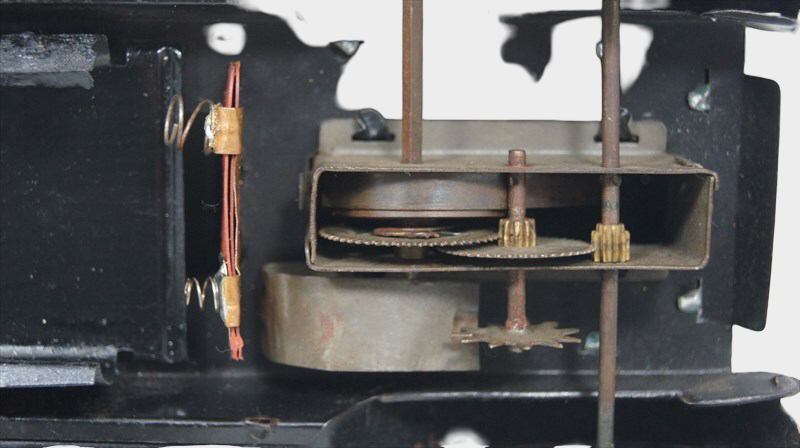
Its scale — approximately 26 cm in length — places it above the ephemeral novelty class. It reads as a substantial domestic object, intended to command presence on the floor or shelf. The presence of battery configuration elements further situates it within a transitional technological moment, when electrical novelty intersected with mechanical play.
Materially, it stands as both toy and industrial artifact: folded tin as narrative metal.
Formal Object Data
Object Type: Tinplate armored military vehicle toy
Maker: Attributed to Nomura Toy
Era: Pre-war Japan, Shōwa period (circa 1930s)
Origin: Japan
Material: Lithographed and painted tinplate with assembled components
Mechanism: Battery-operated configuration indicated; operational status unverified
Dimensions: Approx. 26 cm (L) × 11 cm (W) × 13.5 cm (H)
Condition: Original vintage condition with age wear, oxidation, surface abrasion, and structural patina consistent with pre-war tinplate; mechanism untested
Completeness: As observed; wheels, turret structure, and primary body components present
🏛 HISTORICAL NARRATIVE
Nomura’s place in Japanese toy history sits at a hinge: early industrial confidence, then wartime scarcity, then the post-war explosion of exports and pop iconography.
Within that trajectory, militarized vehicles of the 1930s occupy a crucial role. They are the “earthbound ancestors” of later Japanese mechanical mythology. Before rockets, before space robots, before television heroes, there was the armored vehicle: a symbol of modern power rendered legible to the home.
This is why pre-war military tin can feel emotionally complex. It is aesthetically compelling, mechanically fascinating, and historically charged. The collector’s task is not to romanticize it, but to understand it, and to place it with narrative honesty.
🎯 COLLECTOR RELEVANCE
This piece resonates across multiple collecting disciplines:
-
Pre-war Japanese tinplate and lithography
-
Early industrial design objects
-
Military-themed material culture (toy history, not militaria fetish)
-
Nomura lineage collecting
-
Museum-grade “mechanical imagination” archives
Collectors focused only on robots or post-war exports often miss pre-war vehicles. Yet it is precisely these larger pre-war forms that establish the visual grammar Japan later amplified: bold graphic engineering, disciplined surfaces, and machines as cultural symbols.
🧭 CURATORIAL PLACEMENT
Postwar Hope & Motion — Prewar Power & Authority
Within a collection framework, this armored vehicle functions as a grounding counterweight to later narratives of wonder and liberation. Where post-war mobility objects often express freedom, exploration, and consumer progress, pre-war armored forms express power, control, and mechanical authority.
Placed deliberately, it deepens the honesty of the archive. It reminds the viewer that “mechanical imagination” is not only joyful. It is also political, shaped by anxiety, ambition, and the realities of its decade.
This is how a single object can stabilize an entire collection story: it makes the later optimism more intelligible by showing what came before it.
Authenticity & Collectible Stewardship
Evaluated under the Japonista Collectibles Authentication Framework™:
-
Period, manufacturer, and production-era assessment
-
Material, paint, lithography, and surface-wear analysis
-
Mechanical, structural, and component integrity review (where applicable)
-
Design, iconography, and cultural-context verification
Guaranteed 100% Authentic.
Every piece is backed by the Japonista Lifetime Authenticity Warranty™ and curated with collector-grade scrutiny.
A Note on Collecting & Preservation
At Japonista, we approach vintage and modern toys not merely as nostalgic objects, but as design artifacts, cultural touchstones, and expressions of their era—from postwar ingenuity and Showa imagination to contemporary pop and designer movements.
Each work is carefully examined, researched, and presented with respect for its original intent, historical context, and collector relevance, balancing preservation with the honest character earned through time and play.
Our role is not only to offer access to meaningful collectibles, but to act as thoughtful custodians—connecting the right pieces with collectors who value history, originality, and lasting significance.
Inquiries, Availability, and Private Consideration
Some collectible works may allow room for discussion, while others are held firmly due to rarity, condition, provenance, or cultural importance. All inquiries are reviewed personally and discreetly, and we welcome thoughtful questions or expressions of interest.
If you are exploring a specific theme, franchise, maker, era, or mechanical category—or seeking guidance in building a focused collection—our team is always available to assist with informed, quiet expertise.
Concierge Support & Collector Guidance
Japonista Concierge™ offers personalized assistance for collectors seeking deeper understanding, strategic acquisitions, or long-term curation across vintage and modern collectibles.
Whether your interest lies in nostalgia, design history, mechanical fascination, or pop-culture legacy, we are here to support your collecting journey with clarity, care, and discretion.
For select high-value or historically significant pieces, private reservation or structured payment arrangements may be available on a case-by-case basis. Please contact us to discuss eligibility and options.
Before Proceeding
We kindly encourage collectors to review our shop policies and house guidelines, available through the links in our website footer, which outline shipping, handling, and condition standards specific to vintage, mechanical, and collectible works.
A Closing Note
Thank you for exploring Japonista’s collection of vintage and modern toys, robots, and cultural collectibles. We are honored to share these enduring objects of imagination and design—and to help place them where they may continue to be appreciated, studied, and enjoyed.
If you have questions or wish to explore related works, please feel free to contact Japonista Concierge™ at any time.