Rare Vintage, Antiques and Art Collector / Curator / Personal Shopper From Japan
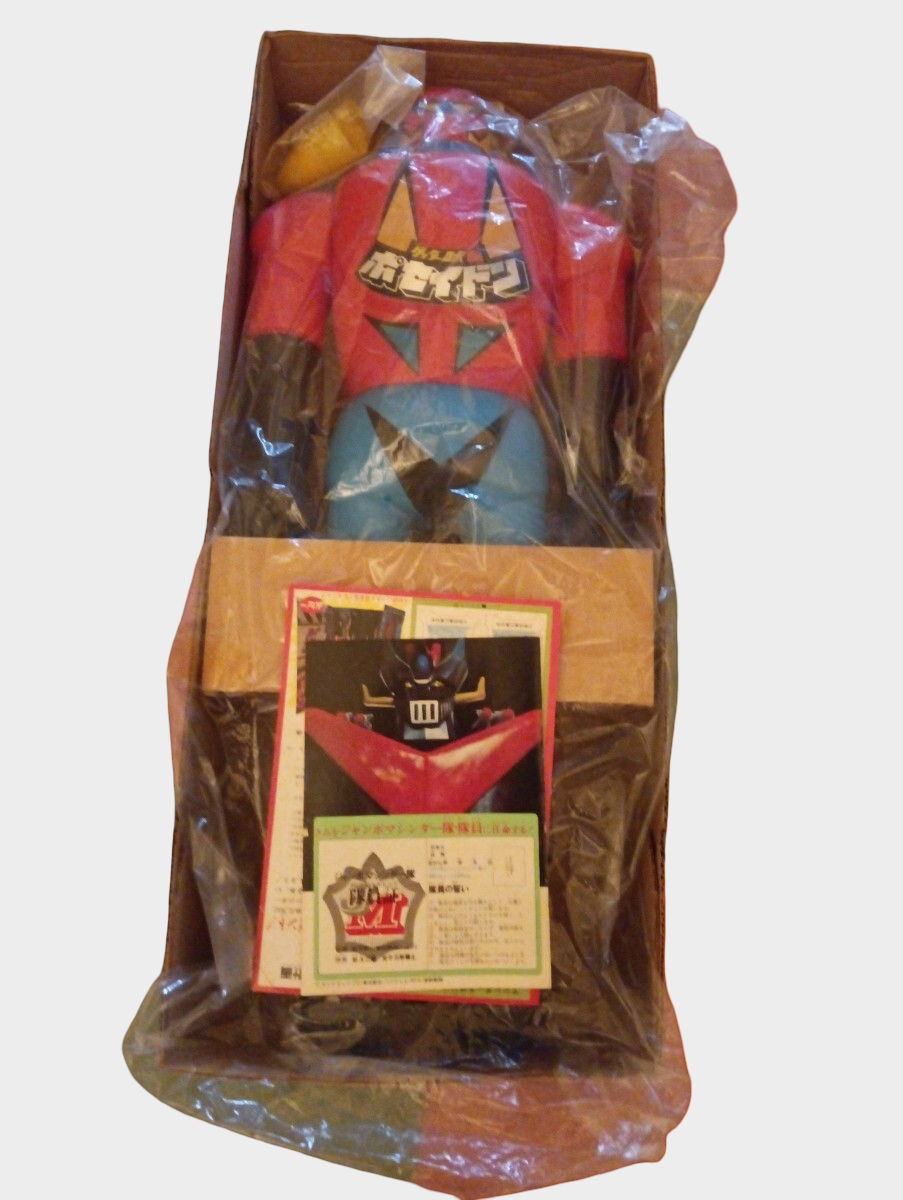
Popy Jumbo Machinder “Poseidon” Vintage Giant Robot with Box, Missiles Sealed, Paper Goods, Showa-Era Display Icon
Popy Jumbo Machinder “Poseidon” Vintage Giant Robot with Box, Missiles Sealed, Paper Goods, Showa-Era Display Icon
Couldn't load pickup availability
Have a reasonable price in mind? Submit your best offer and our concierge will review it personally.
Jumbo Machinder refers to a large-scale Japanese robot toy format, typically produced in soft vinyl at approximately 60 cm in height. Developed during the 1970s super-robot era, these figures were designed as monumental display pieces with missile-launching features and bold mechanical presence. Many of the most iconic examples were produced by Popy, a Bandai subsidiary renowned for defining the standards of Japanese robot toys.
CURATORIAL OVERVIEW — WHAT THIS OBJECT ACTUALLY IS
This is a jumbo-scale, Showa-era character robot, built for impact first and subtlety never. In the 1970s, Japanese toy makers perfected a special kind of cultural engineering: they took television heroes, condensed them into bold, readable shapes, and scaled them up until they crossed a threshold. Past that line, the object stops being a plaything and becomes an artifact, something that occupies space the way a sculpture does.
The Jumbo Machinder category sits right at that threshold. These figures were designed to be seen from across a room, designed to project “presence” even when standing still. That is why the surfaces are simple and declarative, why the silhouette is so confident, and why the emotional effect remains intact decades later. You do not need nostalgia to understand it. You only need eyes.
This example lands in the sweet spot collectors chase: jumbo body, strong color identity, and the surviving ecosystem that matters at the top end, the box, the inner supports, and the sealed accessory pack that signals completeness and restraint. Even with age wear, the object reads as authentic because it has lived a real life in time.
Object: Vintage Popy Jumbo Machinder “Poseidon” character robot figure with original box and paper goods
Category: Jumbo-scale character robot toy (display-grade vintage)
Era: Showa-era vintage (approx. 1970s)
Maker line: Popy / Jumbo Machinder family (character robot series)
Scale / size class: Jumbo class
Dimensions (figure): Height approx. 60 cm (jumbo-scale)
ICONOGRAPHY & THEMATIC ANALYSIS
“Poseidon” is not merely a name. It’s a concept signal: sea-power, weight, and authority. Showa robot design loved mythic shortcuts, turning ancient archetypes into modern armor. The head shape, chest insignia geometry, and bold color blocking communicate the same message as the character fiction: force under control.
The jumbo format amplifies that mythology. On screen, robots move; in the room, they rule. The viewer becomes the camera. This is why jumbo robots are often displayed like modern art: a single stance, a single angle, and the piece becomes a time portal to an era when imagination was engineered into consumer objects with surprising seriousness.
MATERIAL & CRAFT ASSESSMENT
Jumbo robots of this class are defined by industrial simplicity done correctly: clean molded forms, durable construction choices, and large color fields that reward distance viewing. The “craft” is in the translation: converting animated identity into a stable, manufacturable object that still reads instantly as itself.
Condition nuance matters here. Dusting, sticker-area grime, and bag disturbance do not automatically diminish value. In jumbo collecting, these details often function as authenticity cues, because the category is notorious for over-cleaned examples that lose surface truth. The sealed missile pack is particularly meaningful: it signals that at least part of the system remained protected across decades.
HISTORICAL CONTEXT — WHY THESE SURVIVE AT ALL
Most jumbo robots did not survive because they were big, and big things get damaged, thrown out, or simply cannot be stored easily through multiple moves. Packaging survival rates are even worse: jumbo boxes are light, easy to crush, and rarely kept once a child grows up.
That’s why “warehouse find” provenance stories resonate, even when the condition is imperfect. Long-closed shops and storerooms are the last natural habitats for untouched jumbo ecosystems: box, inserts, bag, and paperwork living together as one stranded time capsule. When these surface, they tend to leapfrog typical “loose figure” listings because they offer something rarer than cleanliness: completeness of context.
COLLECTOR RELEVANCE
This is for the collector who understands that the jumbo category is closer to design and cultural history than to ordinary toys:
-
Jumbo format: the most display-dominant tier
-
Box + inner supports: signals preservation and legitimacy
-
Sealed accessory pack: high emotional and market value cue
-
Paper goods included: strengthens “era authenticity” and presentation value
Placed correctly, this becomes a room’s anchor object, the kind of piece visitors remember.
SUMMARY — WHY THIS PIECE MATTERS
A jumbo robot is the physical form of a television-era myth, scaled up until it becomes sculpture. This Poseidon example carries the collector-critical ecosystem around it: box, supports, paper, and sealed parts. Age wear is present, but the soul of the category is intact: scale, identity, and time-capsule gravity.
Why Popy Matters
Founded in 1971 and later integrated into Bandai, Popy occupies a foundational position in the history of Japanese character toys. During the explosive growth of anime and tokusatsu in the 1970s, Popy established the manufacturing and design standards that would define how robots and heroes were translated from screen to physical form.
Popy’s significance lies not only in licensing major properties, but in formalizing scale, weight, and material language. Through lines such as Chogokin and Jumbo Machinder, the company set expectations for mass, durability, and visual authority—creating toys that felt monumental rather than disposable. These objects were designed to command space, functioning as both playthings and display icons within the home.
Many conventions now taken for granted in Japanese robot toys—die-cast heft, oversized proportions, bold mechanical silhouettes—were normalized through Popy’s output. Even after the brand was absorbed into Bandai in the early 1980s, the term “Popy era” continues to signal a peak period of experimentation, quality, and cultural impact.
For collectors, Popy represents origin rather than revival: the moment when Japanese toy design matured into a globally influential language. Items bearing the Popy name are recognized not merely as licensed merchandise, but as historical benchmarks in the evolution of modern toy culture.
Authenticity & Collectible Stewardship
Evaluated under the Japonista Collectibles Authentication Framework™:
-
Period, manufacturer, and production-era assessment
-
Material, paint, lithography, and surface-wear analysis
-
Mechanical, structural, and component integrity review (where applicable)
-
Design, iconography, and cultural-context verification
Guaranteed 100% Authentic.
Every piece is backed by the Japonista Lifetime Authenticity Warranty™ and curated with collector-grade scrutiny.
A Note on Collecting & Preservation
At Japonista, we approach vintage and modern toys not merely as nostalgic objects, but as design artifacts, cultural touchstones, and expressions of their era—from postwar ingenuity and Showa imagination to contemporary pop and designer movements.
Each work is carefully examined, researched, and presented with respect for its original intent, historical context, and collector relevance, balancing preservation with the honest character earned through time and play.
Our role is not only to offer access to meaningful collectibles, but to act as thoughtful custodians—connecting the right pieces with collectors who value history, originality, and lasting significance.
Inquiries, Availability, and Private Consideration
Some collectible works may allow room for discussion, while others are held firmly due to rarity, condition, provenance, or cultural importance. All inquiries are reviewed personally and discreetly, and we welcome thoughtful questions or expressions of interest.
If you are exploring a specific theme, franchise, maker, era, or mechanical category—or seeking guidance in building a focused collection—our team is always available to assist with informed, quiet expertise.
Concierge Support & Collector Guidance
Japonista Concierge™ offers personalized assistance for collectors seeking deeper understanding, strategic acquisitions, or long-term curation across vintage and modern collectibles.
Whether your interest lies in nostalgia, design history, mechanical fascination, or pop-culture legacy, we are here to support your collecting journey with clarity, care, and discretion.
For select high-value or historically significant pieces, private reservation or structured payment arrangements may be available on a case-by-case basis. Please contact us to discuss eligibility and options.
Before Proceeding
We kindly encourage collectors to review our shop policies and house guidelines, available through the links in our website footer, which outline shipping, handling, and condition standards specific to vintage, mechanical, and collectible works.
A Closing Note
Thank you for exploring Japonista’s collection of vintage and modern toys, robots, and cultural collectibles. We are honored to share these enduring objects of imagination and design—and to help place them where they may continue to be appreciated, studied, and enjoyed.
If you have questions or wish to explore related works, please feel free to contact Japonista Concierge™ at any time.