Rare Vintage, Antiques and Art Collector / Curator / Personal Shopper From Japan
Popy Jumbo Machinder Mazinger Z “XX Plan” Giant Soft Vinyl Figure w/ Rocket Punch (Boxed)
Popy Jumbo Machinder Mazinger Z “XX Plan” Giant Soft Vinyl Figure w/ Rocket Punch (Boxed)
Couldn't load pickup availability
Have a reasonable price in mind? Submit your best offer and our concierge will review it personally.
Jumbo Machinder refers to a large-scale Japanese robot toy format, typically produced in soft vinyl at approximately 60 cm in height. Developed during the 1970s super-robot era, these figures were designed as monumental display pieces with missile-launching features and bold mechanical presence. Many of the most iconic examples were produced by Popy, a Bandai subsidiary renowned for defining the standards of Japanese robot toys.
CURATORIAL OVERVIEW — WHAT THIS OBJECT ACTUALLY IS
This is a Popy Jumbo Machinder era Mazinger Z: an oversized, display-dominant robot figure designed to feel “almost life-sized” in a child’s world and “architectural” in an adult collection. The Jumbo format matters because it’s where 1970s Japanese character goods stop behaving like small playthings and start behaving like room objects—tall, visually loud, and built to command a shelf the way a sculpture commands a plinth.
Mazinger Z itself is not just a famous robot; it is one of the root engines of the Super Robot boom—the moment Japanese pop culture decided that machines could be mythic heroes, with iconic attack language (like rocket punch) and instantly readable silhouettes. Owning a Jumbo Machinder Mazinger is, in collector terms, like owning a “first-chapter artifact” from the modern robot canon: the design vocabulary (horned head, chest plate, bold primary color blocking) becomes the template that decades of robot media remix.
This specific set’s appeal is sharpened by the included rocket punch parts and the original box, even with wear. In this category, packaging is not “nice to have”—it’s provenance-adjacent: it anchors period identity, confirms intended configuration, and adds that museum-y feeling of “this survived with its paper skin.”
Object: Popy “Jumbo Machinder” Mazinger Z (XX Plan / XX-1 style) giant soft vinyl figure with accessories
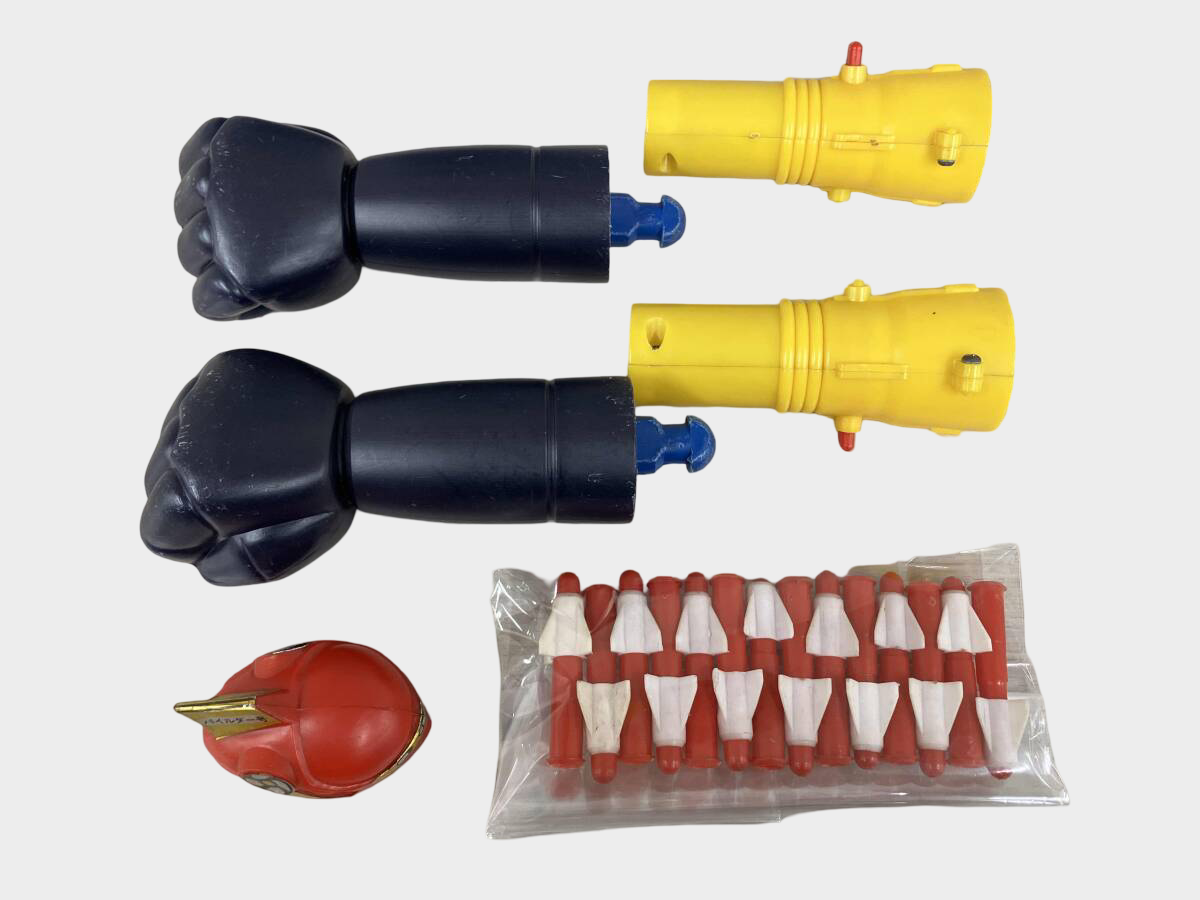
Included: main figure + 2 rocket punch fists (and small accessory parts as pictured) + original box
Condition:
-
Box shows damage (wear, creases, edge stress)
-
Figure has scratches and surface grime consistent with age/handling
ICONOGRAPHY & THEMATIC ANALYSIS
Mazinger’s visual language is basically a compact theology of postwar modernity:
-
Helmet + horns: part knight, part demon-warding talisman—technology as protective spirit.
-
Chest plate / “power core” zone: the body reads like a machine with a heart—heroism made mechanical.
-
Rocket punch: a perfect 1970s idea—violence turned into a detachable gadget, a signature move you can name, reenact, and ritualize. It’s not just an accessory; it’s the brand of action the character represents.
-
Primary colors + hard contrast: the graphic clarity is intentional. These were meant to read instantly from across a room, across a store shelf, across a TV screen—icon design, not realism.
Collectors respond to Jumbo Machinder robots because they sit right at the intersection of industrial design, children’s imagination, and broadcast-era iconography. They are to the 1970s what neon signage is to city nights: bold, simplified, and culturally loud.
MATERIAL & CRAFT ASSESSMENT
This appears to be the classic Jumbo-era build: soft vinyl body presence with hard plastic details and jointed limb geometry designed for stable standing rather than precision articulation. The finish is intentionally “graphic”—large color fields, clean separations, and a sheen that reads well under indoor light.
Condition notes matter here:
-
Scratches / grime: common on Jumbo-scale pieces because the surface area is huge; every shelf move becomes a contact event.
-
Paint wear risk: edges, protrusions (horns, chest contours), and hands are typical friction points.
-
Box damage: extremely normal for large-format packaging; surviving boxes often show corner crush, creasing, and rub.
Net-net: this is the kind of object where honest wear doesn’t automatically kill value—because the category is rare, display-forward, and nostalgia-heavy. What kills value is missing identity anchors (key parts, obvious breaks, severe deformation). This listing still reads as “complete enough to be a real collector object,” especially with the punch parts and box present.
HISTORICAL CONTEXT — WHY THESE SURVIVE AT ALL
Big character toys from the 1970s survived at lower rates than small ones for a simple reason: they were inconvenient. They take space, they get knocked, they get dragged, and when families downsize, they are the first things to disappear. Add to that the fact that the “Jumbo” concept was built for play—not for archival storage—and you get a survivorship filter where boxed examples become disproportionately scarce.
The Popy-era robot ecosystem also sits in a critical moment: mass media + mass manufacturing + character licensing maturing into a full consumer universe. These weren’t random toys; they were part of an emerging system where TV, magazines, and retail formed a loop. Jumbo Machinder pieces are physical fossils of that loop—large enough to feel like “the real thing,” branded enough to be instantly legible, and culturally central enough to remain desirable half a century later.
COLLECTOR RELEVANCE
Who this is for:
-
Super Robot canon collectors who want a pillar object (not just another figure).
-
Design-driven interiors where a single pop artifact can anchor a room.
-
Serious Mazinger Z fans who value format (Jumbo scale) as much as character accuracy.
-
Buyers who understand that box presence—even worn—adds historical “objecthood.”
Why it converts in a premium listing:
Because it reads like an artifact, not inventory. The silhouette does the work from ten feet away.
SUMMARY — WHY THIS PIECE MATTERS
A Popy Jumbo Machinder Mazinger Z is a large-format icon from the era that defined robot hero language. This example keeps the core value signals intact—strong display presence, character-defining accessories (rocket punch), and the original box—with honest wear that is typical for the category. It’s the kind of piece that turns “collector shelf” into “collector room.”
Why Popy Matters
Founded in 1971 and later integrated into Bandai, Popy occupies a foundational position in the history of Japanese character toys. During the explosive growth of anime and tokusatsu in the 1970s, Popy established the manufacturing and design standards that would define how robots and heroes were translated from screen to physical form.
Popy’s significance lies not only in licensing major properties, but in formalizing scale, weight, and material language. Through lines such as Chogokin and Jumbo Machinder, the company set expectations for mass, durability, and visual authority—creating toys that felt monumental rather than disposable. These objects were designed to command space, functioning as both playthings and display icons within the home.
Many conventions now taken for granted in Japanese robot toys—die-cast heft, oversized proportions, bold mechanical silhouettes—were normalized through Popy’s output. Even after the brand was absorbed into Bandai in the early 1980s, the term “Popy era” continues to signal a peak period of experimentation, quality, and cultural impact.
For collectors, Popy represents origin rather than revival: the moment when Japanese toy design matured into a globally influential language. Items bearing the Popy name are recognized not merely as licensed merchandise, but as historical benchmarks in the evolution of modern toy culture.
Authenticity & Collectible Stewardship
Evaluated under the Japonista Collectibles Authentication Framework™:
-
Period, manufacturer, and production-era assessment
-
Material, paint, lithography, and surface-wear analysis
-
Mechanical, structural, and component integrity review (where applicable)
-
Design, iconography, and cultural-context verification
Guaranteed 100% Authentic.
Every piece is backed by the Japonista Lifetime Authenticity Warranty™ and curated with collector-grade scrutiny.
A Note on Collecting & Preservation
At Japonista, we approach vintage and modern toys not merely as nostalgic objects, but as design artifacts, cultural touchstones, and expressions of their era—from postwar ingenuity and Showa imagination to contemporary pop and designer movements.
Each work is carefully examined, researched, and presented with respect for its original intent, historical context, and collector relevance, balancing preservation with the honest character earned through time and play.
Our role is not only to offer access to meaningful collectibles, but to act as thoughtful custodians—connecting the right pieces with collectors who value history, originality, and lasting significance.
Inquiries, Availability, and Private Consideration
Some collectible works may allow room for discussion, while others are held firmly due to rarity, condition, provenance, or cultural importance. All inquiries are reviewed personally and discreetly, and we welcome thoughtful questions or expressions of interest.
If you are exploring a specific theme, franchise, maker, era, or mechanical category—or seeking guidance in building a focused collection—our team is always available to assist with informed, quiet expertise.
Concierge Support & Collector Guidance
Japonista Concierge™ offers personalized assistance for collectors seeking deeper understanding, strategic acquisitions, or long-term curation across vintage and modern collectibles.
Whether your interest lies in nostalgia, design history, mechanical fascination, or pop-culture legacy, we are here to support your collecting journey with clarity, care, and discretion.
For select high-value or historically significant pieces, private reservation or structured payment arrangements may be available on a case-by-case basis. Please contact us to discuss eligibility and options.
Before Proceeding
We kindly encourage collectors to review our shop policies and house guidelines, available through the links in our website footer, which outline shipping, handling, and condition standards specific to vintage, mechanical, and collectible works.
A Closing Note
Thank you for exploring Japonista’s collection of vintage and modern toys, robots, and cultural collectibles. We are honored to share these enduring objects of imagination and design—and to help place them where they may continue to be appreciated, studied, and enjoyed.
If you have questions or wish to explore related works, please feel free to contact Japonista Concierge™ at any time.