Rare Vintage, Antiques and Art Collector / Curator / Personal Shopper From Japan
Popy Daikengo Jumbo Machinder Vintage 1970s Giant Robot Figure w/ Box — Display-Grade, Rare Japanese Showa Classic (Incomplete Tail Part)
Popy Daikengo Jumbo Machinder Vintage 1970s Giant Robot Figure w/ Box — Display-Grade, Rare Japanese Showa Classic (Incomplete Tail Part)
Couldn't load pickup availability
Have a reasonable price in mind? Submit your best offer and our concierge will review it personally.
Jumbo Machinder refers to a large-scale Japanese robot toy format, typically produced in soft vinyl at approximately 60 cm in height. Developed during the 1970s super-robot era, these figures were designed as monumental display pieces with missile-launching features and bold mechanical presence. Many of the most iconic examples were produced by Popy, a Bandai subsidiary renowned for defining the standards of Japanese robot toys.
CURATORIAL OVERVIEW — WHAT THIS OBJECT ACTUALLY IS
This is a Jumbo Machinder-class character robot: the oversized, room-commanding format that sits somewhere between toy, statue, and pop-cultural artifact. In the 1970s, Japan’s robot boom wasn’t just a TV trend—it was a design language that rewired how kids imagined heroism: machines with faces, armor with symbolism, and weapons that read like mythology rebuilt in industrial steel. Jumbo figures were the “flagship scale” of that moment. They were meant to dominate the space—a child’s bedroom turned into a control room, a small apartment turned into a hangar.
Daikengo’s silhouette carries that era’s most specific visual grammar: primary colors that pop under indoor light, sharp emblem geometry, and a “knight-meets-robot” posture that makes the figure feel like a guardian idol more than a mere character. The boxed presentation matters here: for these giants, the packaging is often the first casualty of decades, so a surviving box upgrades the object from “big vintage figure” into archival display material—the kind of thing collectors use to anchor an entire shelf section.
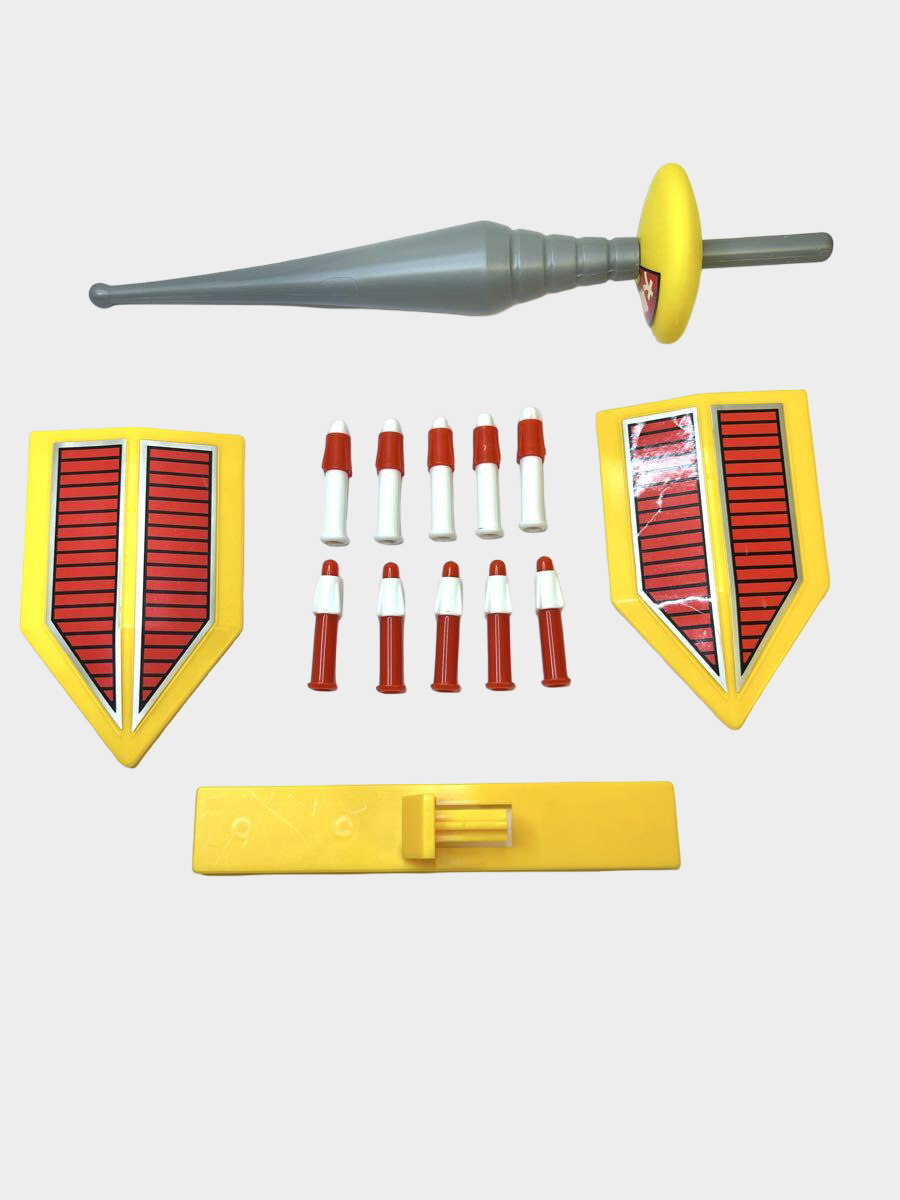
Important realism: the seller clearly states an incomplete accessory detail—a missing part that attaches at the tail end—which means this is best positioned as display-grade, boxed, rare, rather than “complete set museum-perfect.” That said, for jumbo robots, visual presence and body integrity often matter more than one small attachment, especially when the figure reads powerfully at distance and photographs like a centerpiece.
Object: Popy “Jumbo Machinder” Daikengo / Jumbo Machinder DAIKENGO — vintage large-format Japanese robot figure set (boxed)
Primary Category: Showa-era character robot / jumbo display-grade figure
Era: 1970s (period-accurate styling)
Materials: painted molded plastic body + internal hardware; accessories appear mixed molded plastic components (confirm via close-ups)
Scale: “Jumbo Machinder” class (large, display-dominant; typically ~55–65cm range—
Inclusions (per seller): box + figure + pictured accessories only
Known Missing / Damage: One accessory part that attaches to the tail is missing (“the part worn/attached at the tail end is missing”).
Condition: “Very rare,” boxed condition; please confirm condition via photos; used-vintage sale
ICONOGRAPHY & THEMATIC ANALYSIS
Showa robot design is never random decoration. It is a codified mythology:
-
Color-blocking as identity: Bold red/blue/yellow patterns weren’t just “kids’ colors”—they were an instant readability system for television and print, and they translate perfectly into large-scale figures. On a jumbo body, those colors become almost architectural: like signage on a futuristic fortress.
-
Knight logic in machine form: Many robots of this lineage borrow from medieval silhouettes—helmet crests, chest emblems, shield-like panels—because the narrative role is essentially the same: a protector in a world where ordinary bodies can’t win.
-
Weapons as ritual objects: The accessories (and their storage) often function like sacred regalia: items that symbolize power, not just play. That’s why “missing one attachment part” matters—collectors instinctively read accessories as part of the figure’s “complete myth.” In listing language, you acknowledge the missing tail-mounted part clearly, then pivot to what survives: the core heroic presence + boxed context + rarity.
MATERIAL & CRAFT ASSESSMENT
Jumbo figures from this era are built to be handled, but also to survive being handled badly—meaning thick walls, robust joins, and paint meant to tolerate friction. The tradeoff is that decades later, collectors commonly see:
-
micro-scuffs and surface rub, especially on raised paint edges and corners
-
joint looseness in shoulders/hips depending on storage stress
-
box wear (creases, soft corners, abrasion) from stacking and humidity cycles
-
small component loss (like the seller’s tail-attachment disclosure), because detachable parts drift across decades like socks in a dryer.
The seller promises careful packaging and quick shipment, which is good—but for jumbo class items, your own repack is still mandatory. Double-box with rigid corner protection and void-fill engineered so the figure can’t “hammer” the box walls in transit.
HISTORICAL CONTEXT — WHY THESE SURVIVE AT ALL
These giants weren’t cheap, and they weren’t niche. They were aspirational objects in a high-velocity decade where Japan’s manufacturing confidence was rising and TV was shaping childhood at national scale. But survival rates are brutal for three reasons:
-
Size is the enemy of storage. Large toys get moved, bumped, and discarded first.
-
Boxes were treated as disposable. Keeping packaging required a collector mindset that most families didn’t have.
-
Accessory entropy is real. Small parts vanish long before the main body dies.
So when a boxed jumbo robot remains presentable, it becomes more than nostalgia—it becomes evidence. Evidence of what Showa-era toy ambition looked like when it went maximal: bright, fearless, and engineered to feel larger than life.
COLLECTOR RELEVANCE
This piece speaks to three buyer types:
-
The “Showa wall” collector: building a period-accurate lineup of vintage hero robots where scale variation is the point—and jumbo scale is the crown.
-
The interior display buyer: wants one object that reads instantly as “Japanese pop-cultural design history,” without needing context. Jumbo robots do that effortlessly.
-
The archival-minded fan: values box + figure as a matched unit because the packaging is part of the cultural document.
Because the seller states a missing tail-mounted attachment, the strongest positioning is: rare, boxed, display-grade with transparent condition truth. The buyers most likely to convert are the ones who prioritize visual impact and era authenticity over microscopic completeness.
SUMMARY — WHY THIS PIECE MATTERS
A jumbo robot is not subtle. It is a monument to an era—a time when children’s fiction was bold enough to make machines into saints, and manufacturing was confident enough to build them at a scale that could own a room. This Daikengo example retains the two things that matter most: the commanding core figure and the boxed identity frame, while honestly carrying a known limitation: one missing tail attachment part. For the right collector, that’s still a high-gravity centerpiece—an object that doesn’t just sit on a shelf, it declares a whole worldview.
Why Popy Matters
Founded in 1971 and later integrated into Bandai, Popy occupies a foundational position in the history of Japanese character toys. During the explosive growth of anime and tokusatsu in the 1970s, Popy established the manufacturing and design standards that would define how robots and heroes were translated from screen to physical form.
Popy’s significance lies not only in licensing major properties, but in formalizing scale, weight, and material language. Through lines such as Chogokin and Jumbo Machinder, the company set expectations for mass, durability, and visual authority—creating toys that felt monumental rather than disposable. These objects were designed to command space, functioning as both playthings and display icons within the home.
Many conventions now taken for granted in Japanese robot toys—die-cast heft, oversized proportions, bold mechanical silhouettes—were normalized through Popy’s output. Even after the brand was absorbed into Bandai in the early 1980s, the term “Popy era” continues to signal a peak period of experimentation, quality, and cultural impact.
For collectors, Popy represents origin rather than revival: the moment when Japanese toy design matured into a globally influential language. Items bearing the Popy name are recognized not merely as licensed merchandise, but as historical benchmarks in the evolution of modern toy culture.
Authenticity & Collectible Stewardship
Evaluated under the Japonista Collectibles Authentication Framework™:
-
Period, manufacturer, and production-era assessment
-
Material, paint, lithography, and surface-wear analysis
-
Mechanical, structural, and component integrity review (where applicable)
-
Design, iconography, and cultural-context verification
Guaranteed 100% Authentic.
Every piece is backed by the Japonista Lifetime Authenticity Warranty™ and curated with collector-grade scrutiny.
A Note on Collecting & Preservation
At Japonista, we approach vintage and modern toys not merely as nostalgic objects, but as design artifacts, cultural touchstones, and expressions of their era—from postwar ingenuity and Showa imagination to contemporary pop and designer movements.
Each work is carefully examined, researched, and presented with respect for its original intent, historical context, and collector relevance, balancing preservation with the honest character earned through time and play.
Our role is not only to offer access to meaningful collectibles, but to act as thoughtful custodians—connecting the right pieces with collectors who value history, originality, and lasting significance.
Inquiries, Availability, and Private Consideration
Some collectible works may allow room for discussion, while others are held firmly due to rarity, condition, provenance, or cultural importance. All inquiries are reviewed personally and discreetly, and we welcome thoughtful questions or expressions of interest.
If you are exploring a specific theme, franchise, maker, era, or mechanical category—or seeking guidance in building a focused collection—our team is always available to assist with informed, quiet expertise.
Concierge Support & Collector Guidance
Japonista Concierge™ offers personalized assistance for collectors seeking deeper understanding, strategic acquisitions, or long-term curation across vintage and modern collectibles.
Whether your interest lies in nostalgia, design history, mechanical fascination, or pop-culture legacy, we are here to support your collecting journey with clarity, care, and discretion.
For select high-value or historically significant pieces, private reservation or structured payment arrangements may be available on a case-by-case basis. Please contact us to discuss eligibility and options.
Before Proceeding
We kindly encourage collectors to review our shop policies and house guidelines, available through the links in our website footer, which outline shipping, handling, and condition standards specific to vintage, mechanical, and collectible works.
A Closing Note
Thank you for exploring Japonista’s collection of vintage and modern toys, robots, and cultural collectibles. We are honored to share these enduring objects of imagination and design—and to help place them where they may continue to be appreciated, studied, and enjoyed.
If you have questions or wish to explore related works, please feel free to contact Japonista Concierge™ at any time.