Rare Vintage, Antiques and Art Collector / Curator / Personal Shopper From Japan
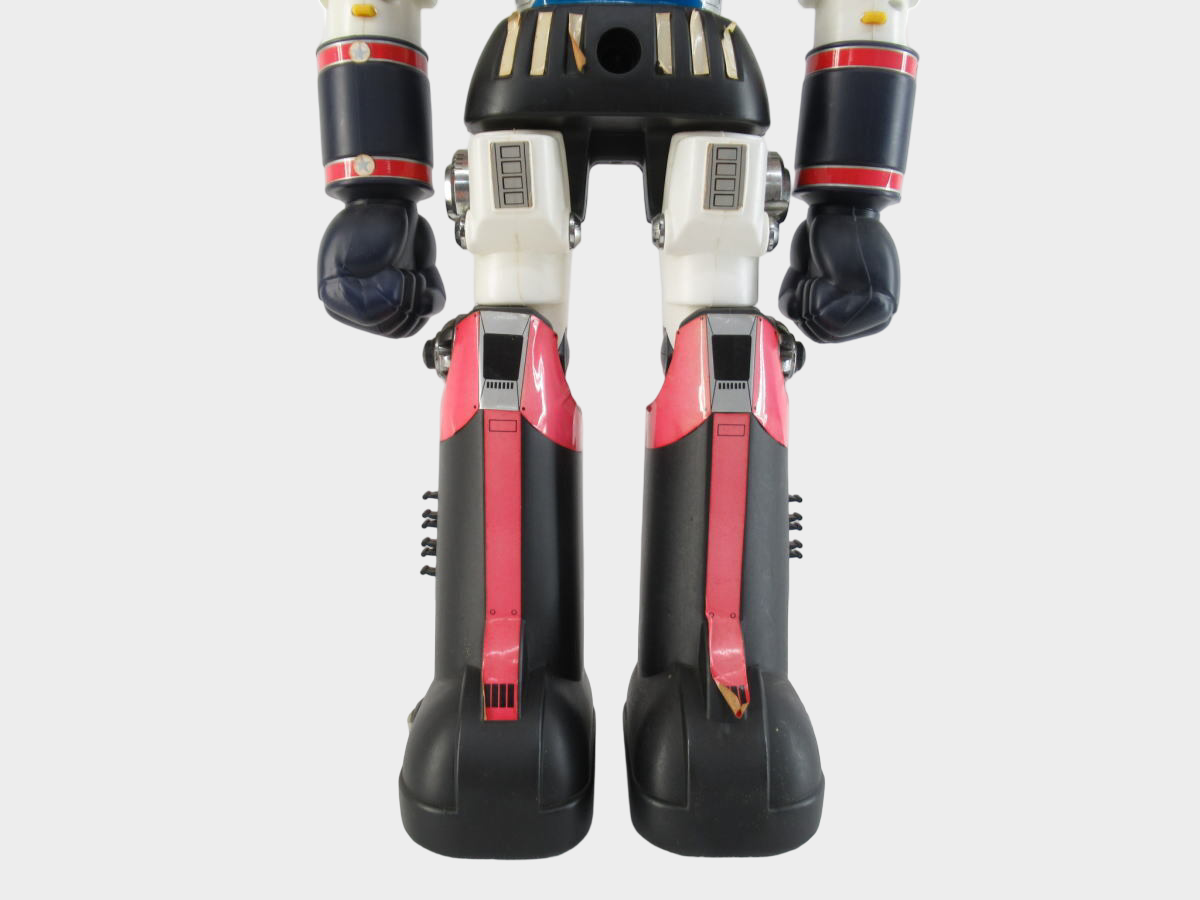
Vintage Popy MCG Battle Fever J Jumbo Machinder Giant Robot Figure 62cm Japan Retro Showpiece Display Toy
Vintage Popy MCG Battle Fever J Jumbo Machinder Giant Robot Figure 62cm Japan Retro Showpiece Display Toy
Couldn't load pickup availability
Have a reasonable price in mind? Submit your best offer and our concierge will review it personally.
Jumbo Machinder refers to a large-scale Japanese robot toy format, typically produced in soft vinyl at approximately 60 cm in height. Developed during the 1970s super-robot era, these figures were designed as monumental display pieces with missile-launching features and bold mechanical presence. Many of the most iconic examples were produced by Popy, a Bandai subsidiary renowned for defining the standards of Japanese robot toys.
CURATORIAL OVERVIEW — WHAT THIS OBJECT ACTUALLY IS
Battle Fever sits at a pivotal cultural junction: the era when Japanese hero entertainment refined its vocabulary of color, emblem, and silhouette into something instantly readable. In jumbo form, the design becomes architectural. This is not merely a character figure, it’s a period badge you can stand in a room. At 62 cm, the piece operates like a pop-cultural relic with museum logic: scale, scarcity, and immediate recognition.
Object: Popy “Battle Fever Robo” jumbo figure
Era: vintage era release (classic character line)
Height: 62 cm
Materials: molded plastic body; applied graphic elements / decals
Condition: used with small marks; presentation-ready at display distance
Included: only what appears in the images
Weight: assumed weight: 3.6 kg
Packed size estimate: 78 × 32 × 20 cm
ICONOGRAPHY & THEMATIC ANALYSIS
The power of Battle Fever-era design is its graphic confidence: bold chest language, helmet geometry, and the disciplined balance between “toy friendliness” and “hero severity.” Jumbo scale amplifies those decisions. The figure reads like a totem of televised optimism, when hero machines and teams were visual systems as much as stories.
MATERIAL & CRAFT ASSESSMENT
Jumbo plastics from this lineage were built to survive handling, but the real test is decades of storage and moves. Minor surface wear is normal and often desirable; it signals the object’s continuity through time. What matters is the figure’s stance stability, decal legibility, and the intactness of the most visually dominant zones (head, chest, boots).
HISTORICAL CONTEXT — WHY THESE SURVIVE AT ALL
Jumbo pieces are disproportionately lost because they’re hard to store, hard to ship, and easy to discard during life transitions. The surviving examples are the ones treated like keepers, not clutter. In collector terms, jumbo robots are “high-friction survivors,” and friction is a quiet form of rarity.
COLLECTOR RELEVANCE
-
Category anchor: a cornerstone object for tokusatsu/hero-era archives.
-
Interior strength: works as a conversation object even for non-collectors.
-
Photographic authority: looks like a set prop in studio lighting.
SUMMARY — WHY THIS PIECE MATTERS
This is a jumbo-scale survivor that turns a character into presence. If your collection needs one object that explains the era without a caption, this does it.
Why Battle Fever J Matters
Debuting in 1979, Battle Fever J occupies a pivotal position in the evolution of Japan’s tokusatsu tradition and the Super Sentai lineage in particular. While earlier series established the foundations of color-coded hero teams, Battle Fever J redefined what team-based heroism could look like—visually, performatively, and culturally.
One of its most significant contributions was the introduction of theatrical, dance-inspired combat. Influenced by choreography and international performance styles, Battle Fever J emphasized motion clarity and exaggerated poses. This was not merely aesthetic flair; it reshaped how heroes were staged on screen, ensuring that actions read clearly through suits, masks, and camera distance. This clarity would become essential for both live-action filming and toy translation.
Battle Fever J also marked an early experiment in international symbolism within Super Sentai. Team members were thematically associated with global motifs, suggesting a broader worldview at a time when Japanese tokusatsu was expanding beyond strictly domestic mythologies. This framing positioned the heroes as representatives rather than lone champions—an idea that would later crystallize into Sentai’s enduring emphasis on coordinated identity and teamwork.
From a material culture perspective, Battle Fever J arrived during a critical moment when tokusatsu and toy manufacturing became tightly synchronized. Its bold color blocking, readable silhouettes, and distinctive leader figure made it especially suitable for die-cast and vinyl adaptation. As a result, Battle Fever J characters became early fixtures in late-Showa licensed toy lines, helping standardize how Sentai heroes were miniaturized, weighted, and stylized for collectors and children alike.
For collectors, Battle Fever J signifies transition. It stands between the experimental early years of team heroes and the refined, systematized Super Sentai formula that followed in the 1980s. Items associated with the series are valued not only for age or rarity, but for representing the moment when performance, design, and merchandising aligned into a durable cultural structure.
Battle Fever J matters because it demonstrated that hero teams could be choreographed, symbolic, and collectible at the same time—a realization that would shape decades of tokusatsu storytelling and its physical legacy.
Why Popy Matters
Founded in 1971 and later integrated into Bandai, Popy occupies a foundational position in the history of Japanese character toys. During the explosive growth of anime and tokusatsu in the 1970s, Popy established the manufacturing and design standards that would define how robots and heroes were translated from screen to physical form.
Popy’s significance lies not only in licensing major properties, but in formalizing scale, weight, and material language. Through lines such as Chogokin and Jumbo Machinder, the company set expectations for mass, durability, and visual authority—creating toys that felt monumental rather than disposable. These objects were designed to command space, functioning as both playthings and display icons within the home.
Many conventions now taken for granted in Japanese robot toys—die-cast heft, oversized proportions, bold mechanical silhouettes—were normalized through Popy’s output. Even after the brand was absorbed into Bandai in the early 1980s, the term “Popy era” continues to signal a peak period of experimentation, quality, and cultural impact.
For collectors, Popy represents origin rather than revival: the moment when Japanese toy design matured into a globally influential language. Items bearing the Popy name are recognized not merely as licensed merchandise, but as historical benchmarks in the evolution of modern toy culture.
Authenticity & Collectible Stewardship
Evaluated under the Japonista Collectibles Authentication Framework™:
-
Period, manufacturer, and production-era assessment
-
Material, paint, lithography, and surface-wear analysis
-
Mechanical, structural, and component integrity review (where applicable)
-
Design, iconography, and cultural-context verification
Guaranteed 100% Authentic.
Every piece is backed by the Japonista Lifetime Authenticity Warranty™ and curated with collector-grade scrutiny.
A Note on Collecting & Preservation
At Japonista, we approach vintage and modern toys not merely as nostalgic objects, but as design artifacts, cultural touchstones, and expressions of their era—from postwar ingenuity and Showa imagination to contemporary pop and designer movements.
Each work is carefully examined, researched, and presented with respect for its original intent, historical context, and collector relevance, balancing preservation with the honest character earned through time and play.
Our role is not only to offer access to meaningful collectibles, but to act as thoughtful custodians—connecting the right pieces with collectors who value history, originality, and lasting significance.
Inquiries, Availability, and Private Consideration
Some collectible works may allow room for discussion, while others are held firmly due to rarity, condition, provenance, or cultural importance. All inquiries are reviewed personally and discreetly, and we welcome thoughtful questions or expressions of interest.
If you are exploring a specific theme, franchise, maker, era, or mechanical category—or seeking guidance in building a focused collection—our team is always available to assist with informed, quiet expertise.
Concierge Support & Collector Guidance
Japonista Concierge™ offers personalized assistance for collectors seeking deeper understanding, strategic acquisitions, or long-term curation across vintage and modern collectibles.
Whether your interest lies in nostalgia, design history, mechanical fascination, or pop-culture legacy, we are here to support your collecting journey with clarity, care, and discretion.
For select high-value or historically significant pieces, private reservation or structured payment arrangements may be available on a case-by-case basis. Please contact us to discuss eligibility and options.
Before Proceeding
We kindly encourage collectors to review our shop policies and house guidelines, available through the links in our website footer, which outline shipping, handling, and condition standards specific to vintage, mechanical, and collectible works.
A Closing Note
Thank you for exploring Japonista’s collection of vintage and modern toys, robots, and cultural collectibles. We are honored to share these enduring objects of imagination and design—and to help place them where they may continue to be appreciated, studied, and enjoyed.
If you have questions or wish to explore related works, please feel free to contact Japonista Concierge™ at any time.