Japonista
Kutani-Style Polychrome Ceramic Shishi Incense Burner Okimono, Guardian Lion Koro, Approx. 30 cm
Kutani-Style Polychrome Ceramic Shishi Incense Burner Okimono, Guardian Lion Koro, Approx. 30 cm
Freight piece: please confirm delivery before purchase
This piece travels in a crate or by freight rather than standard mail, and may need careful dismantling before it can be packed. The shipping shown at checkout is an estimate. Japonista reserves the right to determine the final handling, crating and freight cost when your order is received, according to the piece, the destination and carrier conditions at that time.
We advise requesting a delivery quote before checkout. If the final cost is higher than the amount paid, we send the difference for your approval before dispatch. Your piece is held for you until it is settled.
Request a delivery quoteCouldn't load pickup availability
All sales are final. Please read our refund policy before purchase.
Have a reasonable price in mind? Submit your best offer and our concierge will review it personally.
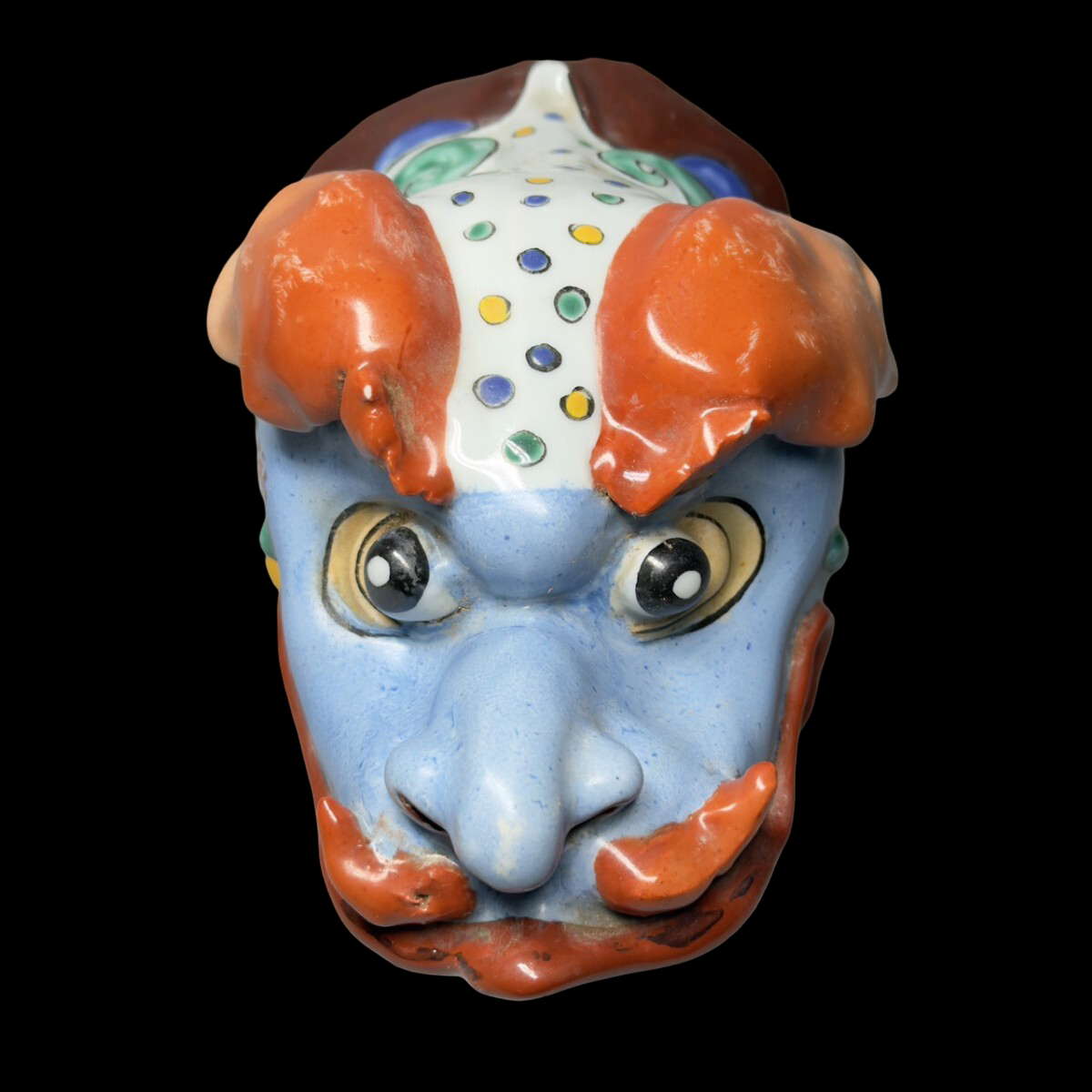
A guardian lion incense burner at statement scale: some 30 cm of hand-modeled ceramic in vivid polychrome enamels, its body and legs covered in bold color blocks, dotted accents and scrolling forms. Attributed to Kutani by style, it brings threshold protection and fragrance together in a single room-defining object.
The Piece
This Japanese ceramic shishi incense burner okimono is a sculptural guardian lion koro rendered in vivid polychrome enamels, with dense patterning across the body and legs. At approximately 30 cm tall, on a footprint of about 24 × 24 cm, it reads as a true statement object rather than a small shelf piece.
Shishi guardians are associated with threshold protection and vigilance. In incense-burner form the motif becomes functional symbolism, a protective presence that also carries fragrance and ritual atmosphere into a space. Compared with many monochrome or bronze shishi, this example emphasizes color architecture, its bold enamel blocks, dotted accents and scrolling forms staying legible at a distance.
The decoration and form are characteristic of Kutani ware: confident hand-modeling, controlled enamel application, exaggerated musculature, curling flame-like mane and dense floral ornament applied directly to the body. The dynamic pose and detailed mane call for advanced ceramic skill and point to experienced workshop production, and large ceramic shishi are uncommon, since sculpture at this scale raises firing risk, makes warping, cracking and glaze behavior harder to control, and increases transport risk.
Suited to entry halls, hospitality interiors, galleries or ceremonial spaces, it is an installation-grade guardian rather than a shelf accessory. Placed near a doorway or at the edge of a room, it reinforces its traditional role as a protective presence rather than a passive ornament.
Details
- Maker: Kutani ware (attributed by decorative style; kiln undocumented)
- Origin: Japan
- Material: Ceramic with polychrome enamels
- Measurements: Approx. 24 × 24 cm footprint (given as diameter) · Height ~30 cm
- Weight: Estimated item weight ~3.5 kg; estimated packed weight ~5.0 kg
- Form: Okimono (shishi guardian) in koro / incense burner form
Condition
- Age-related surface wear, minor abrasions and patina consistent with time and handling.
- No major structural cracks observed.
- For use as a koro, use indirect heat and careful ventilation, a small metal or ceramic insert where appropriate, and keep ash away from the painted surfaces.
Shishi Symbolism
The shishi, or guardian lion, is a protective beast of Buddhist and Daoist origin, transmitted through China and Korea before becoming fully naturalized in Japanese visual culture. In Japan it is understood less as an animal than as a protective archetype of vigilance, authority and the warding off of misfortune, guarding entrances and other liminal thresholds. Shishi imagery appears in stone, wood, bronze and ceramics; ceramic okimono bring that guardian symbolism into interiors. In Kutani ware the tama-nori shishi, with a jewel ball (tama) symbolizing wisdom, cosmic authority and the containment of spiritual power, became especially popular in the 20th century as a statement object.
Kutani Among Guardians
Kutani ware is celebrated for bold color, layered enamels and strong surface patterning, which give a guardian figure heightened visual authority. Set against other traditions:
- Kutani shishi: dense enamels, high visual impact, strong reds and gold accents, an emphasis on power and spectacle.
- Arita / Imari porcelain: whiter bodies and finer surfaces, often more refined and cabinet-scale.
- Seto / Tokoname: more subdued palettes and folk-adjacent character, quieter in presence.
- Bronze shishi: extremely durable, frequently positioned as architectural or formal display objects.
Authenticity & Care
Attribution to Kutani ware rests on decorative style, glaze characteristics and sculptural form; no kiln documentation is available, and the exact kiln, period and region are undocumented, so style labels should be read as descriptive rather than definitive. Every piece is examined and documented in Japan before dispatch and is offered with the Japonista authenticity guarantee.
Delivery from Japan
Packed by hand in Japan and shipped insured and tracked by EMS or an equivalent express service. Import duties and taxes, where applicable, are payable on arrival. Returns follow our published policy.
Considered offers are welcome through Send an Offer, and each one is reviewed personally.
Continue browsing: Butsudan & Altars · Buddhist Statues & Sacred Art
Related pieces: Jōdo Shinshū gosoku five-piece altar set · Pair of gilt yoraku hanging altar lanterns · Gohei Dorei bronze phoenix incense burner
Temple to Home
Monumental statues, zushi shrines and altars travel crated and insured through our Museum-Grade Logistics Suite™. Seeking a particular deity or school? The Hunting Salon™ searches Japan for it. Arrange crating and freight →
Collectors also search: kutani shishi incense burner · polychrome shishi okimono · japanese ceramic guardian lion · large kutani shishi · shishi koro ceramic · japanese foo dog incense burner