Rare Vintage, Antiques and Art Collector / Curator / Personal Shopper From Japan
PHERROW’S Vintage Reversible Sukajan Jacket S Tokyo Matsuri Mikoshi Crane Embroidered Japanese Souvenir Bomber
PHERROW’S Vintage Reversible Sukajan Jacket S Tokyo Matsuri Mikoshi Crane Embroidered Japanese Souvenir Bomber
Couldn't load pickup availability
Have a reasonable price in mind? Submit your best offer and our concierge will review it personally.
Black Satin Festival Jacket Reversing to Cream and Navy Heritage Bomber
COLLECTOR’S OVERVIEW
A richly embroidered vintage Pherrow’s reversible sukajan celebrating the energy, pageantry, and communal spirit of a traditional Tokyo matsuri.
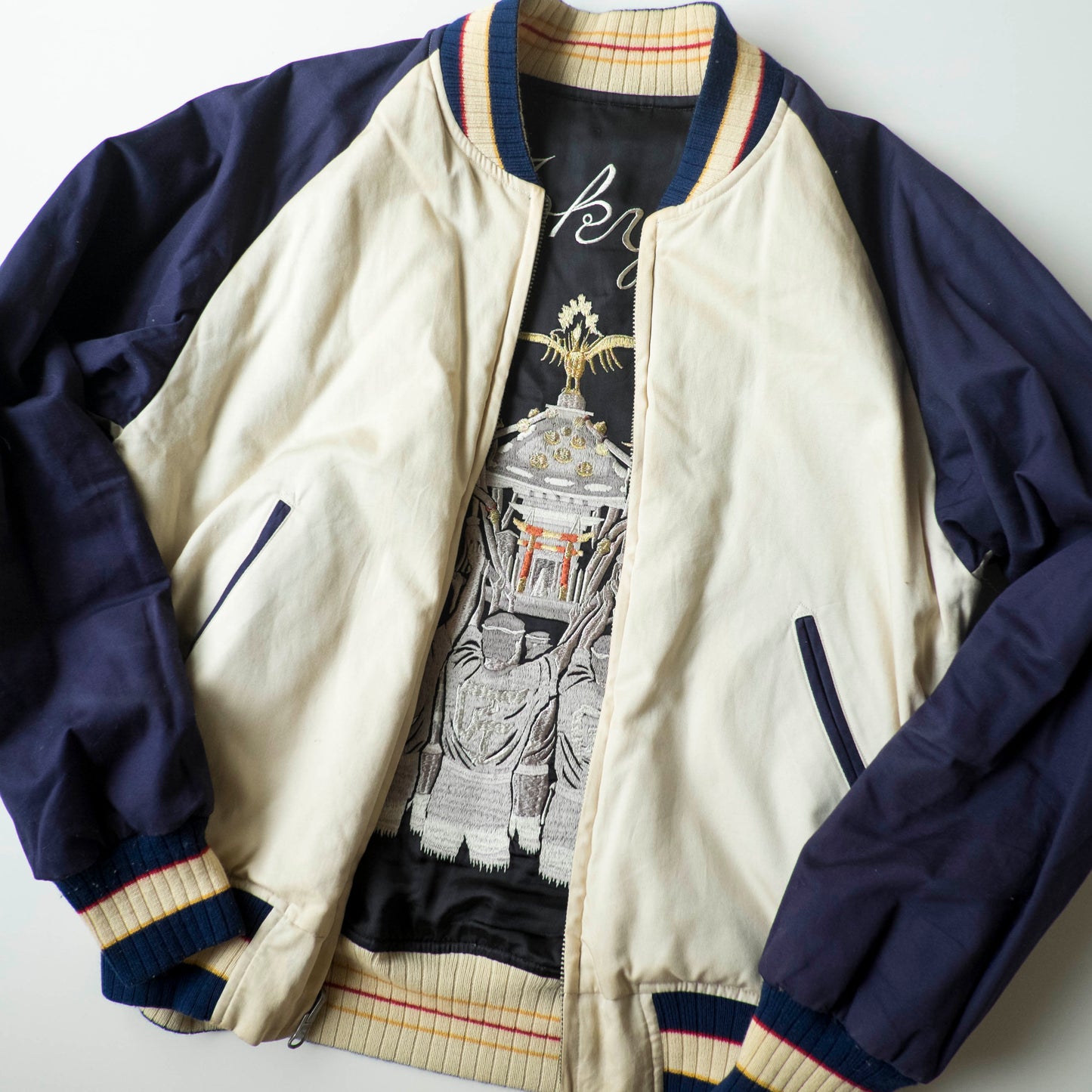
The principal black satin face presents a ceremonial mikoshi procession, with festival participants carrying a portable shrine beneath elegant embroidered “Tokyo” script. The mikoshi is crowned by a golden phoenix-like finial and surrounded by raised fans, decorative fittings, and coordinated festival dress rendered in silver, cream, charcoal, gold, and restrained orange thread.
The sleeves extend the festival narrative with animated ladder performers that appear to reference hashigo-nori, the traditional acrobatic ladder displays associated with Edo-period fire brigades and ceremonial public festivals. The front is quieter, carrying mirrored white cranes with pine-like foliage across the chest.
Reversed, the jacket becomes a minimal cream-and-navy bomber with no large pictorial embroidery. The contrast is exceptionally wearable: one face offers dense Japanese storytelling, while the other delivers a clean vintage sportswear silhouette.
IDENTIFICATION AND CONSTRUCTION
Maker
Pherrow’s / Pherrows
A Japanese heritage-fashion label associated with Amekaji, military-inspired clothing, vintage Americana, and carefully constructed reinterpretations of historic Japanese and American garments.
Object Type
Vintage reversible Japanese sukajan.
Also known as a:
Yokosuka jumper
Souvenir jacket
Embroidered tour jacket
Japanese bomber jacket
Amekaji outerwear
Reversible festival jacket
Tagged Size
Small.
Approximate Western Fit
Approximately a contemporary Western Extra Small to Small, depending on body proportions, preferred ease, and layering.
The jacket has a compact traditional sukajan fit with a relatively short bomber body, raglan sleeves, and gathered rib-knit waistband.
Construction Details
The jacket features:
Reversible two-face construction
Black satin-finish embroidered face
Cream and navy woven reverse
Raglan sleeves
Central reversible metal zipper
Angled welt pockets on both faces
Striped rib-knit collar, cuffs, and waistband
Extensive front, sleeve, and back embroidery
Lightweight souvenir-bomber structure
TOKYO MATSURI EMBROIDERY
Mikoshi Procession
The central back composition depicts a group of festival participants carrying a mikoshi, a portable shrine used during Shinto festivals to ceremonially transport the enshrined kami through the surrounding community.
The carriers wear coordinated festival garments and head coverings, their raised arms creating a strong upward rhythm beneath the shrine. Two participants hold large uchiwa-style fans displaying stylized kanji, enhancing the atmosphere of a crowded neighborhood procession.
The imagery celebrates communal strength, movement, ritual, and the spirited energy of Japanese festival culture.
Portable Shrine Details
The mikoshi is embroidered in layered silver, cream, gray, gold, and orange thread.
Visible details include:
Tiered architectural forms
Decorative roof fittings
Curving ornamental supports
Small bird-like finials
Gold circular accents
A vermilion shrine gateway detail
A golden phoenix-like ornament crowning the roof
The phoenix or hō-ō is associated with peace, renewal, virtue, and auspicious rule. Its placement at the summit gives the shrine a ceremonial focal point.
Tokyo Lettering
Large cursive “Tokyo” embroidery arcs across the upper back.
The pale silver-white script contrasts elegantly against the black ground and frames the festival scene without overwhelming it.
Festival Fans
The raised fans introduce a graphic element beside the shrine and emphasize the public, celebratory character of the scene.
Uchiwa fans are closely associated with summer festivals, dance, group identity, and neighborhood celebration. Here they also create visual balance around the vertical mikoshi structure.
SLEEVE EMBROIDERY
Ladder Performers
Each sleeve carries a mirrored embroidered figure posed beside or upon a ladder.
The figures appear inspired by hashigo-nori, traditional ladder acrobatics historically associated with Edo fire brigades and later preserved in ceremonial demonstrations.
Their exaggerated faces and animated poses give the sleeves a humorous, theatrical quality, contrasting with the more formal mikoshi procession across the back.
Crest-Like Upper Sleeve Motifs
Small gold, cream, and dark embroidered motifs appear above the ladder performers.
These read as stylized flame, bird, or festival-crest forms and reinforce the jacket’s connection with ceremonial display, movement, and Edo urban culture.
CRANE-EMBROIDERED FRONT
Mirrored Cranes
Two white cranes face inward across the chest, embroidered with extended wings and long, flowing plumage.
In Japanese visual culture, cranes represent:
Longevity
Good fortune
Loyalty
Peace
Grace
Enduring partnership
Their restrained silver-white palette creates a refined front presentation while leaving the elaborate festival narrative for the back.
Pine-Like Foliage
The cranes are framed by sweeping branches with small warm orange accents.
Pine is associated with resilience, constancy, and long life. Combined with the cranes, the imagery forms a classical auspicious pairing.
CREAM AND NAVY REVERSE
Minimal Heritage-Bomber Face
The alternate side presents a warm cream body with deep navy raglan sleeves.
Unlike the embroidered black face, this side is intentionally undecorated, allowing the jacket to function as a clean vintage bomber suitable for everyday wear.
Color Architecture
The cream center creates a soft, aged ivory appearance, while the navy sleeves and pocket trim provide crisp contrast.
Striped ribbing in navy, cream, muted red, and warm gold connects this restrained side with the richer palette of the embroidered face.
Two Distinct Personalities
The reversible design offers two genuinely different styling directions:
A pictorial black Tokyo matsuri sukajan for statement wear.
A simple cream-and-navy bomber for understated heritage styling.
PERIOD AND STYLE ASSESSMENT
Likely Era
The embroidery style, reversible construction, compact proportions, heritage-brand identity, and interpretation of traditional Japanese imagery appear consistent with late-1990s to 2000s Japanese production.
Amekaji and Sukajan Influence
This jacket brings together the American bomber silhouette and deeply Japanese imagery, a defining feature of sukajan and Amekaji design.
Rather than relying on the familiar dragon or tiger composition, it focuses on Tokyo festival culture, mikoshi ritual, ladder performance, cranes, and urban Edo heritage. That subject matter gives it a more culturally specific identity than many standard souvenir jackets.
CONDITION
Overall Condition
Vintage pre-owned condition with age-appropriate wear, textile creasing, storage folds, softened ribbing, and natural variation across both wearable faces.
The jacket remains visually expressive, and the principal embroidered designs are clearly recognizable and cohesive.
Black Satin Face
The dark satin displays visible wrinkling, light pressure lines, and directional sheen.
The color shifts between black, charcoal, and deep navy according to lighting and the angle of the fabric.
Embroidery
The Tokyo lettering, mikoshi, festival participants, fans, crane motifs, sleeve figures, shrine details, and gold accents remain substantially intact.
Minor thread fuzzing, raised fibers, isolated loose ends, flattening, or gentle edge wear may be present within the embroidered fields.
Cream and Navy Face
The cream body shows natural age-related toning, creasing, and faint surface variation appropriate to a light-colored vintage textile.
The navy sleeves display gentle folding and softened surface character from wear and storage.
Ribbing and Hardware
The cream rib-knit collar, cuffs, and waistband show visible vintage softening, mild waviness, and tonal aging. The narrow red, gold, and navy stripes remain clearly visible.
The zipper, pockets, body panels, sleeve panels, and principal seams appear present and structurally cohesive in the photographed areas.
The jacket is not presented as factory-new. Its creasing, textile variation, softened trim, and minor embroidery character form part of its authentic vintage appearance.
DIMENSIONS AND SIZING
Manufacturer’s Tagged Size
Small.
Approximate Flat Measurements
A: Body Length
54 cm (21.3 in)
Measured from the upper body to the lower waistband.
B: Body Width
47 cm (18.5 in)
Measured flat from armpit to armpit.
Approximate doubled chest circumference: 94 cm (37 in).
C: Sleeve Length from Neck
80 cm (31.5 in)
Measured from the neckline along the upper raglan sleeve to the cuff.
D: Underarm Sleeve Length
53 cm (20.9 in)
Measured from the underarm to the cuff.
E: Relaxed Waist Width
38 cm (15 in)
Measured flat across the lower waistband.
Fit Guidance
Expected to fit approximately as a contemporary Western Extra Small to Small.
The raglan sleeves provide generous reach relative to the short body, while the gathered waistband creates the compact silhouette associated with traditional sukajan construction.
For the most reliable fit, compare the listed measurements with a similar jacket that already fits comfortably.
COLLECTING AND STYLING
Collector Appeal
This jacket is especially desirable for its combination of:
Pherrow’s Japanese heritage branding
True reversible construction
Tokyo destination lettering
Mikoshi procession embroidery
Traditional matsuri subject matter
Hashigo-nori-inspired sleeve figures
Auspicious crane motifs
Minimal cream-and-navy alternate face
Compact vintage Japanese sizing
Strong Amekaji and archive-streetwear character
Styling the Embroidered Face
Pair the black side with faded denim, black trousers, military pants, work boots, loafers, or minimalist sneakers.
The pale embroidery creates strong contrast against the dark textile, allowing the jacket to work as the primary visual element in a restrained outfit.
Styling the Cream and Navy Face
The reverse pairs naturally with indigo denim, khaki chinos, neutral knitwear, canvas sneakers, or vintage athletic clothing.
Its clean color blocking gives the jacket a quieter Ivy, military-sportswear, or collegiate character.
Display Value
The embroidered back functions as a compact textile portrait of Japanese festival life.
Displayed on a broad padded hanger, the mikoshi, carriers, fans, ladder performers, and Tokyo lettering create an engaging narrative with both long-distance presence and close embroidered detail.
CARE AND PRESERVATION
Professional cleaning by a specialist experienced with vintage embroidered jackets, satin-finish textiles, reversible garments, rib-knit trim, and metal hardware is recommended.
Do not machine wash, bleach, soak, scrub, wring, or tumble dry.
Avoid ironing directly over embroidery or ribbing. Gentle steaming from a safe distance may help relax light creasing, but concentrated heat and moisture should be avoided.
Protect the satin from rough bags, hook-and-loop fasteners, jewelry, and abrasive surfaces.
When reversing the jacket, support the sleeves and body evenly rather than pulling forcefully through the cuffs.
Store on a broad padded hanger inside a breathable garment cover, away from direct sunlight, excess humidity, smoke, perfume, and prolonged compression.
SHIPPING, OFFERS, AND FINAL-SALE POLICIES
Worldwide tracked shipping is available from Japan, generally through Japan Post EMS or another suitable tracked international service.
The jacket will be carefully folded with protective material placed between the embroidered surfaces, ribbing, zipper, and hardware.
Tracking information is normally provided approximately 3–5 business days after dispatch.
Additional photographs may be available for closer examination of the embroidery, cream reverse, ribbing, zipper, pockets, condition, and measurements.
Reasonable offers may be considered. Some pieces are held more firmly according to maker, design, condition, and collector demand, but serious proposals are welcome.
The jacket is sold in its present vintage condition as photographed and described.
All sales are final. No returns, claims, cancellations, or exchanges are accepted for accurately disclosed vintage wear, sizing, textile variation, creasing, embroidery character, ribbing relaxation, patina, or age-related characteristics, subject to applicable Etsy rules and consumer law.
#Pherrows #PherrowsJapan #VintageSukajan #TokyoMatsuri #MikoshiJacket #JapaneseFestival #ReversibleSukajan #YokosukaJumper #JapaneseSouvenirJacket #JapaneseBomber #CraneEmbroidery #TokyoJacket #Amekaji #JapaneseStreetwear #VintageJapaneseFashion #MatsuriFashion #FestivalJacket #EdoCulture #HashigoNori #WearableArt #ArchiveStreetwear #Y2KJapaneseFashion #EmbroideredBomber #CollectorJacket #UnisexVintage #JapanVintage #SouvenirBomber #ShibuiStyle #HeritageFashion #StatementOuterwear
MATERIAL TAGS
satin-finish textile, woven textile, embroidery thread, rib-knit trim, metal zipper