Rare Vintage, Antiques and Art Collector / Curator / Personal Shopper From Japan
Pair Vintage Bronze Shachihoko Dragon Fish Guardians, Japanese-Inspired East Asian Mythical Sculptures, Patinated Metal Art
Pair Vintage Bronze Shachihoko Dragon Fish Guardians, Japanese-Inspired East Asian Mythical Sculptures, Patinated Metal Art
Couldn't load pickup availability
Have a reasonable price in mind? Submit your best offer and our concierge will review it personally.
Matched Cast Bronze Dragon-Fish Guardian Sculptures with Open Jaws, Spined Backs, Fan-Shaped Fins and Aged Green-Brown Patina
Introduction
A dramatic matched pair of bronze shachihoko-form dragon-fish guardians, these extraordinary sculptural creatures combine the ferocity of dragons, the armored bodies of fish, and the architectural mythology traditionally associated with the rooftops of Japanese castles and important buildings.
Both figures are modeled in vigorous motion, with their scaled bodies curving upward, jaws thrown dramatically open, rows of teeth exposed, dorsal spines rising along their backs, and large membrane-like fins spreading outward from the body. Their silhouettes are unmistakably theatrical. From a distance they appear almost prehistoric, while closer inspection reveals a highly decorative interpretation of the legendary shachihoko form.
Rather than historic architectural roof fittings, these examples are best understood as vintage revival sculptures created for decorative display, drawing upon the visual language of traditional Japanese shachihoko. Their hollow cast construction, relatively delicate fins and spines, consistent pair-work, cast-in rectangular workshop marks, and deliberately antiqued surface treatment suggest later decorative manufacture rather than Edo, Meiji, or Taisho architectural origin. The supplied assessment most plausibly places them in the later 20th century and considers Chinese manufacture for the East Asian decorative market likely.
That distinction does not diminish their impact. If anything, it allows the pair to be appreciated for what they genuinely are: highly expressive mythological sculptures with an unusually animated design, a strong Japanese visual reference, and enough sculptural eccentricity to command attention in a serious interior.
Displayed together, the pair possess a wonderfully confrontational presence. They seem ready to leap from the sea, jaws open and fins spread, somewhere between guardian beasts, armored fish and fantastical dragons.
The Shachihoko Form
Shachihoko occupy one of the more fascinating corners of Japanese architectural mythology.
Traditionally imagined as hybrid creatures combining a dragon-like or tiger-like head with the body and scales of a great fish, shachihoko became closely associated with important rooftops, particularly the ridge ends of Japanese castles.
Their bodies are generally shown curved dramatically upward, with the tail rising toward the sky. The posture creates an immediately recognizable silhouette, giving the creature the appearance of swimming vertically through air rather than water.
This pair takes that traditional vocabulary and pushes it toward fantasy sculpture.
The heads are broad and almost reptilian.
The mouths are enormously open.
Rows of teeth run around the jaws.
Multiple horn-like projections emerge behind the head.
The backs carry pronounced spines.
The sides are equipped with large webbed fins.
The tails explode into oversized fan-shaped forms.
Rather than attempting naturalism, the maker embraced exaggeration.
That exaggeration is what makes the pair memorable.
Guardians Associated with Water and Fire Protection
One of the most important traditional associations surrounding shachihoko is their relationship with water and protection against fire.
Japanese castles were historically vulnerable to fire, and the aquatic nature of the shachihoko gave the creature an auspicious protective role. The mythical fish was imagined as possessing power over water, making it an appropriate guardian for vulnerable wooden architecture.
Placed high on rooftops, historical shachihoko were therefore far more than decorative flourishes.
They were symbols.
Guardians.
Architectural talismans.
Visual declarations of protection.
That history explains why the creature continues to possess such a powerful presence even when translated into freestanding decorative sculpture.
The pair offered here were not made for roof installation, but their design unmistakably borrows from that protective tradition.
A Matched Mythological Pair
The fact that these survive as a pair is especially appealing.
Many decorative guardian figures are encountered singly. A matched pair immediately creates a more architectural and ceremonial presentation.
Placed opposite one another on a console, cabinet, mantel or low platform, the creatures create visual tension across the space.
Placed side by side, they become a sculptural study in repetition.
Seen from slightly different angles, one appears to respond to the other.
Their open mouths intensify this effect.
The creatures do not feel passive.
They seem to be calling.
Roaring.
Emerging.
The result is particularly effective in interiors where a single oversized decorative object might feel too static.
This pair creates movement.
Sculptural Anatomy
The figures are modeled with remarkable visual complexity.
Beginning at the head, each creature displays an elongated open jaw fitted with numerous individually modeled teeth. The upper and lower jaws extend forward aggressively, creating an almost crocodilian profile.
Behind the head rise projecting horn-like elements.
Additional fins and spikes continue along the neck and spine.
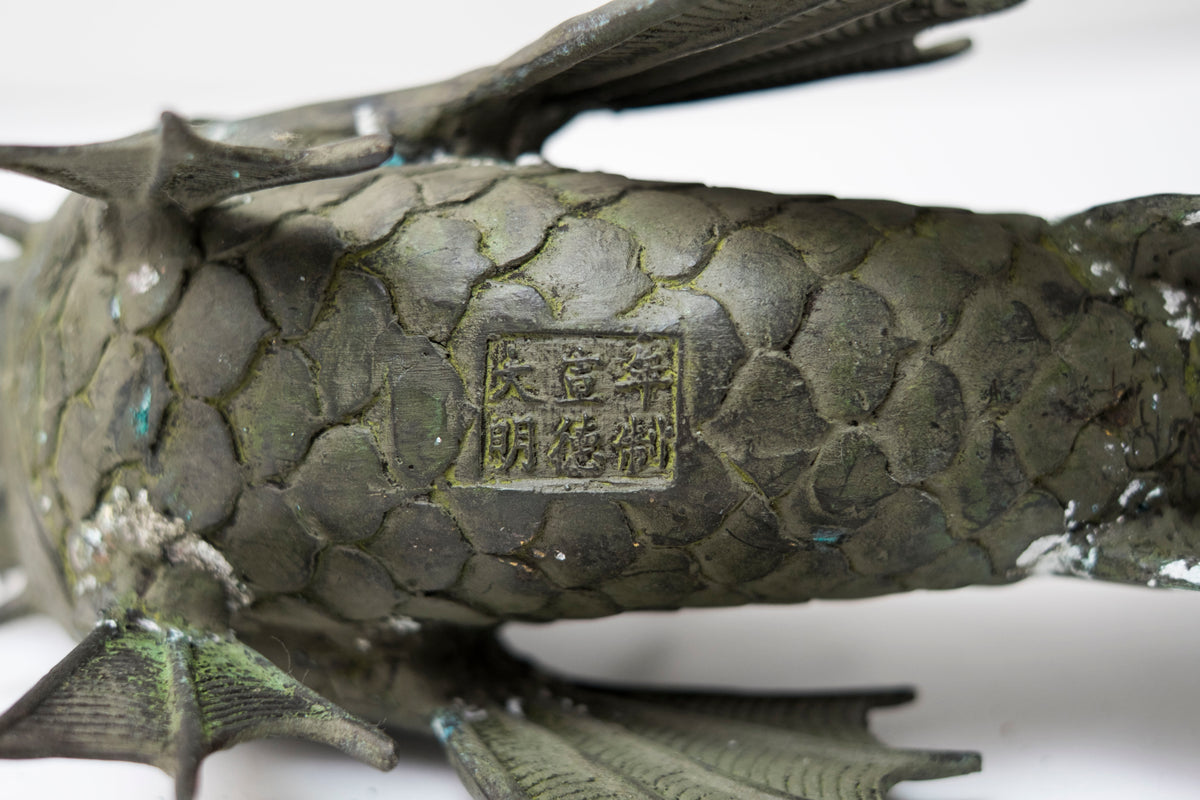
The body broadens toward the central torso and is covered in overlapping scales, each modeled individually to create a heavily armored texture.
From the sides emerge broad fins built around pronounced ribs.
These fins are especially striking.
They do not resemble the soft, flowing fins of ordinary fish.
Instead, they resemble stretched membranes or wings.
Each section is supported by raised structural lines running from the body toward sharply pointed outer edges.
The visual result lies somewhere between:
fish fins,
bat wings,
dragon membranes,
and Japanese architectural ornament.
The tails continue this same language on an enlarged scale.
Their broad fan forms create a dramatic counterweight to the heavy jaws at the opposite end of the sculpture.
The Open Jaws
The mouths are perhaps the strongest visual element.
Both creatures are captured with their jaws raised and open, revealing serrated rows of teeth.
This transforms the pair from decorative fish into unmistakably mythological guardians.
A closed-mouth version would appear far more peaceful.
Here, however, the mouths introduce drama and aggression.
The upward tilt of the head makes each animal look almost as if it were roaring toward the sky.
That vertical energy is consistent with the traditional shachihoko silhouette, where the body rises dramatically rather than resting horizontally like an ordinary fish.
Viewed from below or at tabletop level, the open jaws become particularly imposing.
Scales, Spines and Texture
The body surfaces are densely worked.
Individual scales cover large sections of the torso and tail.
Raised dorsal projections punctuate the back.
Parallel ribbing fills the fins.
Small knobs and projections appear around the head and jaw.
These contrasting textures prevent the relatively monochromatic bronze surface from becoming visually flat.
Light collects differently across every element.
The raised edges of scales catch highlights.
The recessed areas darken.
Spines cast narrow shadows.
The webbed fins create repeating bands of light and shade.
Oxidized areas introduce green and turquoise accents against the darker bronze.
As a result, the pair becomes more visually complex the closer one approaches.
Bronze and Copper-Alloy Construction
The figures appear to be cast from a bronze or related copper alloy, with hollow construction appropriate to decorative sculpture.
This is important because their relatively extensive fins, tails and dorsal elements would become extremely heavy if executed as completely solid bronze.
The casting provides sufficient body and visual weight while allowing the sculptural forms to remain manageable.
The surfaces show the characteristic warm brown, olive and green coloration associated with patinated copper-based metal.
Localized blue-green areas are also visible.
These variations give the figures considerably more depth than a uniformly polished bronze surface would provide.
The Aged Surface
One of the most visually distinctive qualities of this pair is the surface treatment.
The bronzes carry a muted green-brown patina with darker recesses and localized turquoise-blue oxidation-like coloration.
The effect creates the impression of weathered metal.
Based on the uniform character of the surface and the broader assessment of the objects, however, the patina appears at least partly deliberately antiqued rather than evidence of centuries of architectural exposure.
That distinction is worth preserving because these pieces are more compelling when described accurately.
They are not being presented as excavated architectural fragments.
They are decorative revival works whose makers intentionally borrowed the visual atmosphere of aged East Asian bronze.
The antiqued finish works particularly well on this subject.
A bright polished bronze dragon-fish would appear almost theatrical.
The muted surface makes these creatures feel darker, older and more mysterious.
Verdigris and Surface Variation
Localized green and blue-green coloration can be seen around recessed areas, joins and textured surfaces.
These color variations are characteristic of copper-bearing alloys and contribute strongly to the visual character.
There are also lighter deposits and areas of surface residue visible around several fin junctions and portions of the body.
These should be regarded as part of the present vintage condition rather than concealed.
The bronzes have not been represented as pristine modern decorative objects.
Their surface possesses age, handling, oxidation, deposits and visible irregularities.
For collectors who prefer metalwork with character rather than showroom uniformity, these variations are part of the appeal.
Cast-In Workshop Seal
A rectangular recessed seal appears on the body.
The mark is an important visual clue.
Its regularity, framing, depth and integration into the surrounding casting suggest that it was created as part of the original mold rather than individually carved into the finished bronze.
The supplied analysis finds that the mark does not correspond convincingly with documented Japanese castle-era or traditional architectural foundry marks and considers its format more consistent with later standardized East Asian decorative production.
For that reason, we do not attribute these sculptures to a historic Japanese maker, castle, shrine, foundry or named workshop.
Nor do we represent the seal as proof of Edo, Meiji or Taisho manufacture.
The mark remains an interesting component of the object's production history, but attribution should remain conservative unless further documentation emerges.
Japanese Inspiration, East Asian Revival Production
The most accurate way to understand this pair is through two separate ideas.
Their iconography is unmistakably Japanese-inspired.
Their manufacture is most likely later East Asian decorative production.
Those statements can coexist.
The shachihoko form was sufficiently recognizable and dramatic to inspire later decorative workshops throughout East Asia. Mythological forms regularly crossed cultural and commercial boundaries, particularly during the enormous growth of Asian decorative exports in the second half of the 20th century.
These sculptures therefore occupy an interesting position.
They are not architectural antiques.
They are not reproductions pretending to function as actual roof fittings.
They are freestanding interpretations of an architectural myth.
In that sense, they belong naturally within the broader history of revival decorative arts.
Why They Are Not Historic Roof Fittings
Traditional architectural shachihoko were required to survive extremely demanding conditions.
They had to withstand:
wind,
rain,
temperature change,
structural movement,
their own weight,
and long-term exposure at substantial height.
Historic roof-mounted examples therefore required construction methods very different from these decorative sculptures.
This pair features comparatively delicate lateral fins, narrow projecting elements and a freestanding sculptural format that would be impractical for permanent historic roof installation.
The scale and construction are instead suited to interior display.
That is precisely how they should be enjoyed.
Relationship to Historical Shachihoko
Although these should not be confused with early Japanese architectural examples, their design remains part of a much older visual lineage.
Traditional shachihoko can be found crowning some of Japan's most recognizable castles.
Their familiar curved fish bodies, upward-reaching tails and fierce heads became symbols not only of protection but also of power, prestige and architectural identity.
Golden shachihoko in particular became famous as emblems of castle authority.
Later craftspeople naturally adapted such imagery into:
miniature ornaments,
bronze sculptures,
ceramic figures,
souvenirs,
garden decorations,
architectural replicas,
festival objects,
and collector pieces.
This pair belongs within that continuing afterlife of the shachihoko image.
Dragon, Fish and Architectural Fantasy
What makes the shachihoko so compelling is that it never fully belongs to one animal category.
It is fish.
It is dragon.
It can feel tiger-like.
Its fins can resemble wings.
Its body belongs to water.
Its posture belongs to architecture.
Its function belongs to protection mythology.
That ambiguity gives artists enormous freedom.
These examples exploit that freedom fully.
The large fin structures make them almost airborne.
The scales keep them aquatic.
The horns make them dragon-like.
The teeth make them predatory.
The upward posture recalls traditional roof guardians.
The result is not zoology.
It is visual mythology.
A Pair Built for Dramatic Display
These sculptures deserve space around them.
Their silhouettes are too complex to disappear among small decorative objects.
A low console against a pale wall allows every spine and fin to remain visible.
A black lacquer surface would intensify the green patination.
Dark timber would bring out the warmer bronze tones.
Stone would emphasize their archaic character.
Placed at opposite ends of a long cabinet, the pair creates an architectural rhythm reminiscent of opposing roof finials.
Placed closer together, they become almost cinematic, two creatures caught in movement.
They would work particularly well in:
Japanese-inspired interiors,
eclectic collector spaces,
libraries,
studies,
gallery walls with sculptural objects,
hospitality interiors,
creative offices,
Asian art collections,
mythological collections,
and interiors combining antique and contemporary design.
A Different Kind of Japanese-Inspired Decor
Much Japanese-inspired interior decoration relies on understatement.
These creatures do the opposite.
They are extravagant.
Spiked.
Toothed.
Winged.
Scaled.
Unapologetically strange.
That makes them particularly interesting in a refined interior.
Placed among quiet ceramics, dark wood, linen, stone or minimalist furniture, their complexity becomes a deliberate focal point rather than visual clutter.
They inject mythology into otherwise restrained surroundings.
The Power of the Pair
The strength of these sculptures lies not merely in the individual objects but in their relationship.
Pairs have always carried architectural importance.
They create entrances.
Boundaries.
Symmetry.
Guardianship.
One object may decorate a space.
Two can define it.
That principle applies beautifully here.
Positioned at either side of another artwork, doorway, chest, altar-like display or architectural feature, these dragon-fish become guardians once again, even though their original manufacture was decorative rather than architectural.
That allows their symbolism to remain alive without inventing a history they did not possess.
Period and Attribution
Based on the casting, patination, seal format, fin construction and overall decorative character, these are best presented as late 20th-century revival bronzes, probably dating from the post-1960 period.
The available assessment favors Chinese manufacture in a Japanese-inspired shachihoko form rather than Japanese domestic manufacture.
We therefore intentionally avoid claims such as:
Edo period,
Meiji period,
Taisho period,
castle architectural salvage,
temple provenance,
historic roof fitting,
or documented Japanese foundry production.
Collectors deserve the distinction.
The pair remains visually compelling without borrowing an unsupported pedigree.
Collector Appeal
These sculptures offer an intriguing intersection of several collecting areas:
Japanese-inspired mythology.
East Asian bronze sculpture.
Dragon imagery.
Fish imagery.
Architectural guardian traditions.
Revival decorative arts.
Patinated metalwork.
Fantasy sculpture.
Vintage Asian interiors.
Pairs of guardian figures.
Collectors who enjoy highly recognizable masterworks may gravitate toward documented Meiji or Taisho bronzes.
Collectors who instead value unusual form, dramatic silhouette and decorative presence may find this pair considerably more accessible and more entertaining to display.
Condition
The pair is offered in vintage condition as photographed.
The bronze or copper-alloy surfaces show substantial patination, discoloration, oxidation-like coloration, deposits, rubbing, scratches and other evidence of age, handling and storage.
Localized blue-green surface coloration is visible.
Paler deposits or residue can be seen around several fin junctions and areas of the bodies.
The relatively thin fins, dorsal projections, teeth and other protruding elements are naturally vulnerable and should be handled carefully.
Please review the photographs closely for the exact condition of:
fins,
tails,
teeth,
spines,
horns,
joins,
patina,
surface deposits,
and casting irregularities.
Because these are older decorative metal sculptures with elaborate projecting forms, minor irregularities should be expected.
No claim is made that the patina is entirely naturally developed. The overall appearance is consistent with intentionally antiqued decorative bronze that has subsequently acquired additional age and surface variation.
The photographs form an important part of the condition description.
Material and Construction
The pair appears to be produced from cast bronze or a related copper alloy.
Construction appears hollow rather than solid.
The bodies incorporate individually modeled scales.
Large ribbed fins project from the sides.
Raised dorsal spines run along the back.
Multiple horn-like projections surround the head.
Each figure incorporates a cast-in rectangular workshop seal.
The surfaces carry green, olive, brown and blue-green patination.
Some areas display lighter residue or deposits.
The figures are freestanding decorative sculptures rather than architectural fittings.
Why Collect This Pair
Their appeal comes from several qualities working together.
The mythology is immediately recognizable.
The silhouettes are exceptionally dramatic.
The open jaws create personality.
The fins give the creatures unusual sculptural width.
The matched pair provides much greater decorative presence than a single example.
The aged bronze coloring works beautifully with contemporary interiors.
And perhaps most importantly, they are simply unusual.
Many Japanese-inspired bronzes depict predictable subjects such as dragons, cranes, samurai, Buddha figures or lions.
Shachihoko occupy a stranger and more architectural branch of the mythological family tree.
That makes these pieces particularly memorable.
Purchase, Shipping and Vintage Policy
These sculptures are vintage decorative objects and are offered in their existing condition as photographed.
Please review all photographs carefully before purchase. Older cast metal can naturally exhibit scratches, rubbing, oxidation, discoloration, patina variation, deposits, casting irregularities, minor surface losses and evidence of previous handling or storage.
The projecting fins, teeth, tails, spines and horn-like details are delicate in comparison with the main cast bodies and should always be handled with appropriate care.
We make every reasonable effort to photograph and describe each piece accurately. If a particular condition detail is important to your decision, please contact us before purchasing.
Some items in our collection have a little room for negotiation while others are more firmly priced. Respectful offers are welcome and considered individually.
Preparation, shipping and handling normally takes 5–10 business days or earlier whenever possible.
International orders are packed carefully and shipped with tracking whenever available. Any import duties, taxes, customs fees or brokerage costs assessed by the destination country remain the recipient's responsibility unless otherwise stated.
Vintage and collectible objects are sold in their existing condition as shown.
If you are looking for this design or model in another size, please feel free to message us. Although availability cannot be guaranteed, we may be able to locate the same or a closely matching piece in a different size through our sourcing network.
Closing
Shachihoko were born from an extraordinary idea:
place a creature of water upon the roof and ask it to guard a building from fire.
That paradox gave Japanese architecture one of its most memorable mythical forms.
These later bronze sculptures transform that architectural creature into something entirely freestanding.
The roof disappears.
The guardian remains.
What is left is a pair of fantastical animals filled with fins, scales, teeth, spines and movement.
They are not historical castle fittings, and they do not need to be.
Their power comes from the image itself.
Two mythical dragon-fish, permanently caught at the moment of rising.
#Shachihoko #DragonFish #ShachihokoPair #BronzeShachihoko #DragonFishGuardian #JapaneseInspired #JapaneseMythology #JapaneseFolklore #CastleGuardian #RoofGuardian #MythicalGuardian #MythicalCreature #DragonSculpture #FishSculpture #BronzeSculpture #BronzeArt #AsianBronze #EastAsianArt #AsianDecor #JapaneseDecor #JapaneseInterior #JapaneseDesign #JapaneseAesthetic #JapaneseCollectible #VintageAsianArt #VintageBronze #PatinatedBronze #BronzePatina #Verdigris #CopperAlloy #CastBronze #CastMetal #MetalSculpture #GuardianSculpture #DragonGuardian #MythologicalArt #FantasySculpture #ArchitecturalArt #ArchitecturalGuardian #CastleArt #SamuraiCulture #JapaneseCastle #AsianMythology #OrientalDecor #CollectorDecor #StatementSculpture #SculpturalDecor #VintageDecor #MatchedPair #GuardianPair
shachihoko pair, bronze dragon fish, dragon fish statue, japanese guardian, mythical fish art, bronze sculpture, asian bronze decor, castle roof guardian, vintage asian art, patinated bronze, dragon guardian, east asian decor, mythical sculpture
Material Tags
bronze, bronze alloy, copper alloy, cast bronze, cast metal, hollow cast metal, patinated bronze, aged metal patina, verdigris-toned patina, oxidized copper alloy, sculptural metalwork, molded metal, textured casting, incised scales, ribbed metal fins, applied antiqued finish