Rare Vintage, Antiques and Art Collector / Curator / Personal Shopper From Japan
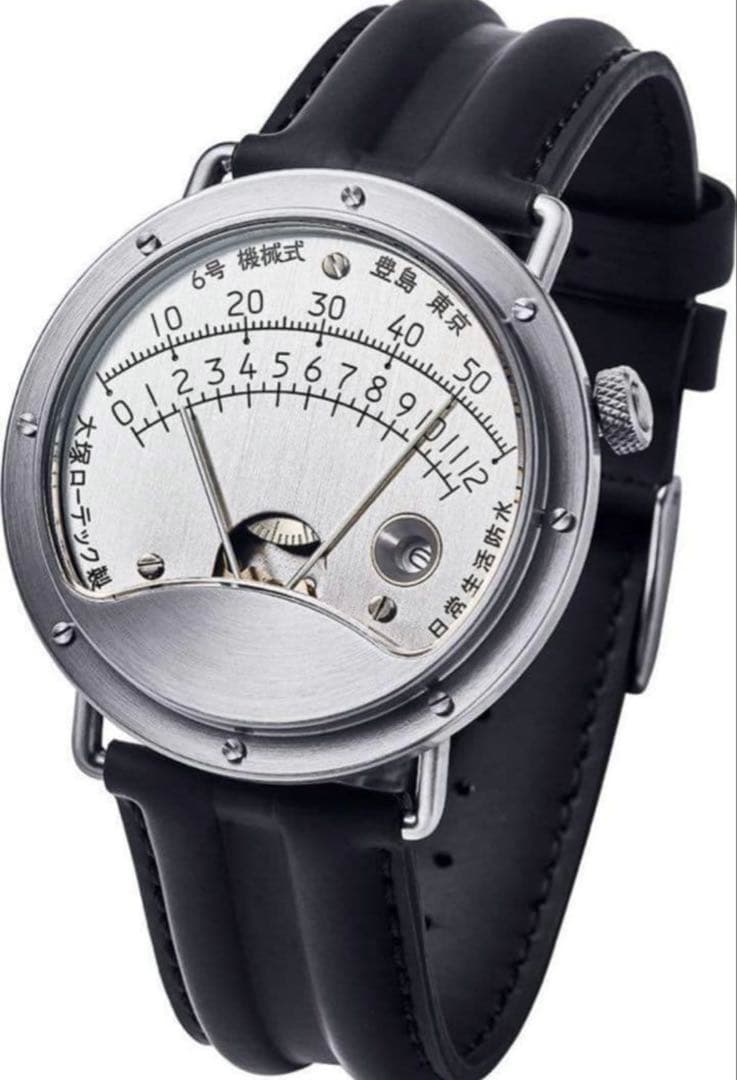
OTSUKA LOTEC No 6 Retrograde Watch Japanese Independent Horology Jiro Katayama Instrument Dial
OTSUKA LOTEC No 6 Retrograde Watch Japanese Independent Horology Jiro Katayama Instrument Dial
Couldn't load pickup availability
Have a reasonable price in mind? Submit your best offer and our concierge will review it personally.
OVERVIEW
The Otsuka Lotec No.6 represents one of the most recognizable designs within modern Japanese independent watchmaking. Created by Tokyo watchmaker Jiro Katayama, the watch transforms traditional time display into a dynamic mechanical instrument.
Rather than using standard hands over a dial, the No.6 employs a fan-shaped retrograde scale, allowing the hour and minute indicators to sweep across an arc before snapping back to their starting position.
This mechanical motion mimics the behavior of analog gauges used in laboratory equipment, aviation instruments, and industrial measurement tools.
The result is a watch that feels closer to precision instrumentation worn on the wrist than to classical Swiss watch design.
Because of its distinctive architecture and limited production volumes, the No.6 has become one of the most discussed models among collectors of modern independent horology.
Reference Family
OTSUKA LOTEC numbered model series
(No.5 / No.6 / No.7.5 / No.8 / No.9)
Condition (Observed)
New / unused
Official lottery purchase January 2026
Includes full set:
• Watch
• Original box
• Warranty card
• Manual
• Accessories
Movement
Base caliber
MIYOTA automatic mechanical movement
Jewels
Approx. 24 jewels
Beat rate
21,600 vph
Power reserve
Approx. 40 hours
Functions
Retrograde hour indicator
Retrograde minute indicator
Central seconds disc
Date display
Case
Diameter
Approx. 40 mm
Material
316L stainless steel
Finish
Industrial brushed metal
Caseback
Exhibition display back
Water resistance
Daily use resistant
Crystal
Sapphire crystal
Anti-reflective coating
Strap
Leather strap
Manufacturing Origin
Japan
Design Architecture
The No.6 dial is constructed around a fan-shaped retrograde instrument display, evoking mechanical gauges found in precision equipment and industrial measurement devices.
ICONOGRAPHY / DESIGN LANGUAGE
The No.6 dial layout is immediately recognizable due to its fan-shaped mechanical scale.
Instead of dividing time across a circular dial, the watch presents time through a semi-circular measurement arc, creating the impression of a gauge rather than a clock.
Key visual elements include:
Retrograde Hour Indicator
A pointer moves across the arc indicating the hour before snapping back to the start when reaching the end of the scale.
Retrograde Minute Display
A secondary retrograde track displays minutes with the same sweeping-then-reset motion.
Seconds Disc
A rotating seconds disc adds continuous motion to the dial, emphasizing the mechanical nature of the display.
Industrial Case Design
The brushed stainless steel case reinforces the watch’s instrument-inspired identity, favoring precision finishing over decorative polish.
The entire dial architecture resembles a mechanical measurement device, making it one of the most visually unconventional wristwatches produced in modern Japanese horology.
MATERIAL / MECHANICAL INTELLIGENCE
The No.6 utilizes a modular mechanical design philosophy.
A reliable Miyota automatic movement serves as the base engine while a proprietary Otsuka Lotec module converts standard timekeeping into the retrograde gauge display.
This architecture provides several advantages:
• Proven mechanical reliability
• Custom mechanical display innovation
• serviceable movement platform
Independent watchmakers often employ this approach when developing new mechanical display concepts, allowing them to focus engineering resources on the visual and functional originality of the display system.
The result is a watch that delivers strong mechanical character without sacrificing serviceability.
HISTORICAL CONTEXT
Otsuka Lotec was founded by Jiro Katayama, a Japanese designer who entered watchmaking through industrial design rather than traditional Swiss watchmaking apprenticeships.
Beginning in the late 2000s, Katayama developed prototype watches in his Tokyo workshop, experimenting with unconventional dial mechanisms and instrument-inspired designs.
The brand gradually evolved into the numbered model series seen today.
International recognition accelerated dramatically when the Otsuka Lotec No.6 won the Challenge Watch Prize at the Grand Prix d’Horlogerie de Genève (GPHG).
This award placed the small Tokyo workshop on the global horology map and introduced the brand to collectors outside Japan.
The No.6 therefore holds a particularly important place within the brand’s history.
COLLECTOR RELEVANCE
The Otsuka Lotec No.6 appeals strongly to several collector segments.
Independent Watch Collectors
Collectors seeking watches created by individual watchmakers rather than large luxury conglomerates.
Mechanical Display Enthusiasts
Those fascinated by retrograde mechanisms and unconventional time displays.
Industrial Design Collectors
The instrument-panel aesthetic resonates with enthusiasts of mechanical engineering and product design.
Japanese Horology Specialists
The watch forms part of the expanding story of modern Japanese independent watchmaking.
Scarcity-Driven Collectors
Limited production and distribution contribute to the watch’s desirability in enthusiast circles.
SUMMARY
The Otsuka Lotec No.6 stands as one of the most distinctive watches produced by the modern Japanese independent horology movement.
Its retrograde instrument display, mechanical gauge aesthetics, and industrial design language separate it from conventional luxury watches.
Rather than focusing on traditional prestige cues, the watch emphasizes mechanical curiosity, engineering creativity, and design originality.
For collectors seeking watches that push beyond conventional dial layouts, the No.6 represents a compelling example of contemporary independent watchmaking.
Otsuka Lotec — Brand Heritage
Japanese Independent Horology · Engineered Design · Mechanical Instrument Aesthetics
Among modern independent watchmakers, Otsuka Lotec occupies a distinctive and intellectually compelling niche. The brand was founded by Japanese designer and engineer Jiro Katayama, whose unconventional path into horology began not through traditional watchmaking apprenticeship but through a deep fascination with industrial design, mechanical instruments, and precision engineering.
Katayama originally trained in product design and worked in fields related to industrial design and metalworking before turning his attention to mechanical watches. His early experiments were driven by a simple yet powerful idea: a wristwatch could be treated not merely as jewelry or luxury fashion, but as a miniature mechanical instrument—a device whose architecture, materials, and motion communicate the passage of time with the clarity and logic of a scientific tool.
This philosophy became the foundation of Otsuka Lotec, a brand whose watches are instantly recognizable for their industrial instrument aesthetic. Rather than emphasizing ornate decoration, the watches celebrate the beauty of engineering itself. Brushed metal plates, exposed screws, engraved measurement scales, retrograde arcs, and layered mechanical structures transform the dial into something resembling a laboratory gauge, aviation instrument, or mechanical dashboard.
Many of the brand’s most celebrated models use unconventional time displays that depart from traditional watch layouts. Retrograde indications, rotating discs, and segmented arcs translate the motion of time into visible mechanical choreography. Instead of simple sweeping hands, the wearer witnesses the mechanical logic of the movement through carefully engineered display systems.
Otsuka Lotec’s models are typically identified by numbered references rather than traditional model names. Watches such as the No.5 KAI, No.6, No.7.5, No.8, and No.9 illustrate the evolution of Katayama’s design language. Each reference represents a new exploration of mechanical display architecture while maintaining the brand’s unmistakable industrial DNA.
A defining characteristic of the brand is its small-scale independent production. Unlike large Swiss luxury houses that produce tens of thousands of watches annually, Otsuka Lotec operates closer to the philosophy of a design atelier. Production volumes remain limited, and the watches are often distributed in restricted quantities through lotteries or tightly controlled releases within Japan. This scarcity has made the brand particularly appealing to collectors seeking distinctive independent watchmaking outside the mainstream luxury market.
At the technical level, Otsuka Lotec frequently combines reliable Japanese mechanical base movements with proprietary display modules and architectural dial systems designed by Katayama. The result is a watch that balances engineering practicality with conceptual originality, delivering mechanical reliability alongside a highly individual visual identity.
Today, Otsuka Lotec is widely regarded as one of the most interesting voices in modern Japanese independent horology. The watches resonate with collectors who value thoughtful engineering, distinctive design language, and the presence of a clear author behind the object.
Within the Japonista watch archive, Otsuka Lotec represents the intersection of Japanese craftsmanship, industrial design philosophy, and contemporary independent watchmaking. These watches are not merely instruments for telling time—they are mechanical expressions of engineering logic, design curiosity, and the enduring fascination of precision machinery.
Authentication & Horological Verification
Each timepiece is evaluated under the Japonista Horology Authentication Protocol™, incorporating:
• Brand verification and model reference confirmation
• Serial number alignment and production-era assessment
• Movement type identification and mechanical integrity review
• Dial originality, hand configuration, and case geometry analysis
• Bracelet or strap authenticity and component consistency evaluation
Where available, archival documentation, manufacturer markings, and reference literature are consulted to support classification.
Guaranteed 100% Authentic.
All timepieces are curated and backed by the Japonista Lifetime Authenticity Warranty™, reflecting disciplined attention to horological integrity and provenance clarity.
On Mechanical Craft, Timekeeping & Horological Heritage
Mechanical watches represent the convergence of engineering precision, artisanal finishing, and generational innovation. From manually wound calibers to high-frequency automatic movements, each watch reflects a lineage of technical refinement.
At Japonista, timepieces are evaluated not only as luxury accessories but as mechanical instruments. Movement architecture, escapement behavior, dial aging, case geometry, and component integrity are assessed with collector-level scrutiny.
Natural patina—dial toning, lume aging, light case wear, and bracelet stretch—may be preserved when consistent with age and structural stability, as these elements often contribute to historical authenticity and collector value.
Our role is to steward timepieces as horological records of craft, innovation, and mechanical artistry.
Attribution, Rarity & Condition Integrity
Vintage and rare modern watches may correspond to specific production runs, discontinued references, limited editions, or historically significant design eras.
Servicing, restoration, or replacement components—when known—are disclosed transparently. Originality of dial, hands, bezel, and movement components is evaluated to the extent possible based on inspection and available documentation.
“Investment-grade” classification reflects recognized collector demand, model lineage, and historical desirability rather than speculative guarantees.
Collectors are encouraged to request clarification regarding reference numbers, servicing history, or production context prior to acquisition.
Concierge Advisory & Collector Support
Japonista Concierge™ offers personalized assistance for collectors seeking deeper insight into:
• reference lineage and model variations
• movement architecture and servicing considerations
• long-term storage and humidity management
• strap or bracelet preservation
• acquisition strategy within curated watch collections
For rare or high-value timepieces, private consultation and structured acquisition arrangements may be available on a case-by-case basis.
Looking to secure this piece today?
At Japonista, we take pride in offering only carefully curated, original, and authentic pieces. Every item we list is examined, researched, and backed by our full authenticity guarantee—so you may buy with complete confidence.
Some of our pieces may allow a little room for negotiation, while others hold firm due to rarity, condition, or collector value. On a case-by-case basis, we do entertain best offers, and we welcome you to submit one if you have a particular figure in mind. We review all offers seriously and personally.
Should you have any questions, require tailored recommendations, or need assistance with budgeting or shipping arrangements, our concierge team is always here to help. Simply message us anytime—we are warm, responsive, and ready to assist.
Before checking out, we kindly encourage you to review our shop policies and house rules, available through the links in our website footer, as they offer clarity regarding shipping, handling, returns, and conditions for vintage and collectible goods.
For clients who wish to reserve a high-value item, Japonista provides layaway plans on a case-by-case basis. This allows you to lock in rare pieces while spacing out payments flexibly and discreetly. Simply reach out to us here request eligibility and tailored arrangements.
International Shipping & Regulatory Considerations
Timepieces are presented as collectible horological objects independent of brand affiliation. Japonista is not associated with or endorsed by the originating manufacturers.
Buyers are responsible for reviewing applicable customs duties, import taxes, and regulations in their jurisdiction prior to purchase. Watches containing exotic materials or precious metals may require additional documentation depending on destination.
Secure packaging and insured shipment are coordinated with care to ensure safe transit.
Closing Statement
Collectible watches represent the enduring dialogue between engineering, design, and time itself. Each piece reflects the precision of its movement, the discipline of its manufacture, and the cultural moment in which it was created.
At Japonista, we steward these timepieces as instruments of craft and heritage—ensuring they continue their journey from one serious collector to the next with clarity, respect, and horological integrity.