Rare Vintage, Antiques and Art Collector / Curator / Personal Shopper From Japan
Original WWII US Army M-1942 Mountain Jacket Talon Zip Mountain Troops Field Jacket
Original WWII US Army M-1942 Mountain Jacket Talon Zip Mountain Troops Field Jacket
Couldn't load pickup availability
Have a reasonable price in mind? Submit your best offer and our concierge will review it personally.
A U.S. ARMY M-1942 MOUNTAIN JACKET, SECOND WORLD WAR PERIOD
Specialized mountain-troop field garment with integrated belt, multi-pocket front, and Talon zipper; a strongly recognizable example of wartime American combat design
A U.S. Army mountain jacket of M-1942 type, constructed in lightweight khaki field fabric and designed with a long body, four large front cargo pockets, integrated waist belt, and Talon zip-front closure. Produced for specialized mountain-troop use during the Second World War, the pattern is distinguished by its combination of mobility, load-carrying practicality, and disciplined silhouette. The present example shows age, fading, stains, and repair history consistent with wartime survival, while retaining the essential structural language that defines the model. Its significance lies in the clear preservation of the mountain-jacket form, one of the most recognizable specialist garments in the American WWII field-clothing canon.
Object
U.S. Army M-1942 Mountain Jacket
Origin
United States Army
Production Era
WWII period
Category
Specialized mountain-troop field jacket / combat smock type outer layer
Material
Cotton poplin / tightly woven lightweight field fabric
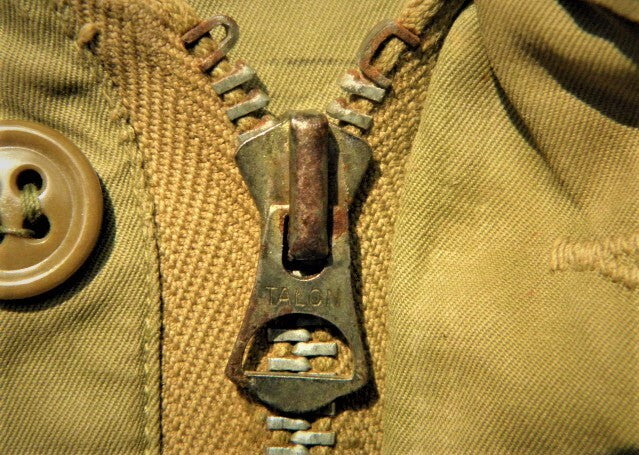
Talon zipper front closure
Buttoned storm and pocket systems
Integrated waist belt
Style Basis
M-1942 mountain-troop pattern with:
- four large cargo-style front pockets
- built-in waist belt
- long field body
- light shell construction for layered wear
- high-function pocket layout intended for active movement and equipment carriage
Color
Khaki / light olive-khaki field tone
Measurements
Shoulder: approx. 50 cm
Chest: approx. 52 cm
Sleeve: approx. 67 cm
Length: approx. 84 cm
Condition Summary
Shows age, fading, wear, stains, abrasions, and repair history
Still reads clearly as an original wartime mountain-jacket platform
Silhouette and design identity remain intact
Object Classification
Not generic military outerwear
A WWII specialized U.S. Army mountain-troop garment with strong collector recognition
COLLECTOR RELEVANCE
Tier: Specialist WWII U.S. Field Garment / Strong Pattern Collector Category
This piece is for:
- WWII U.S. Army collectors
- mountain troop collectors
- specialist field-gear buyers
- design-minded militaria collectors
- buyers who appreciate structurally distinctive combat garments
This piece is not for:
- buyers seeking pristine museum-condition examples
- casual vintage shoppers unfamiliar with military pattern importance
- anyone expecting leather-jacket drama from a utility shell
This is for the collector who understands that some garments become important because their design solved a very specific wartime problem.
CONFIDENCE & VERIFICATION NOTES
Strong positives
- correct M-42 mountain-jacket silhouette
- Talon zipper supports period reading
- pocket and belt architecture remain intact
- desirable specialist-garment recognition
- measurements remain commercially usable
CURATORIAL ANALYSIS
A Specialist Garment, Not Just Another Field Jacket
The M-42 matters because it was built for a narrower problem than ordinary field wear. It belongs to the category of garments shaped by mountain warfare logic, where mobility, layering, storage, and environmental adaptability had to coexist in one comparatively lightweight shell.
That is why the jacket feels instantly different from standard U.S. Army outerwear.
It is not merely a longer field coat.
It is a purpose-built combat garment.
Why the Pocket Architecture Matters
The front pocket layout is the first major value driver. These large cargo compartments are not decorative and not secondary. They define the garment’s identity. The M-42 is one of those jackets whose meaning is carried in its storage geometry.
The pockets tell you immediately what kind of object this is:
- active-use
- equipment-minded
- terrain-conscious
- built for movement under burden
That kind of structural clarity is what makes the model so recognizable.
Built-In Belt = Functional Compression
The integrated belt is another crucial feature. It is one of the strongest visual and functional distinctions in the pattern. It allows the garment to be tightened to the body, stabilizing load and silhouette while keeping the shell from becoming overly loose during movement.
This is not fashion waist shaping.
It is field logic.
That difference gives the M-42 a surprisingly sharp body line compared with many looser wartime utility garments.
Lightweight Fabric, Heavy Role
The shell fabric is not supposed to feel luxurious. It is supposed to work. Lightweight mountain outerwear had to remain usable in layered systems, and that means the cloth’s intelligence is more important than surface drama.
This is the opposite of the leather flight-jacket equation.
The value here is in:
- survival of shape
- retention of pocket structure
- integrity of the mountaineering / combat silhouette
- correct hardware and closure language
Not in tactile richness alone.
The Model’s Collector Magnetism
The M-42 has a strong collector pull because it sits at the intersection of several active markets:
- WWII U.S. Army collectors
- mountain troop specialists
- garment-design collectors
- wear-focused vintage buyers
- militaria buyers who like visibly distinctive field patterns
That overlap keeps the model healthy. It is not obscure in the unhelpful sense. It is specialist, but recognized.
That is the ideal combination.
Condition and How It Should Be Read
This is clearly not a mint piece. There is wear, fading, staining, and repair history. That should not be hidden or dramatized. But in this category, what matters more is whether the jacket still reads cleanly as an M-42.
It does.
The pocket planes are still present.
The belt logic is still visible.
The body length still carries the correct profile.
The object still communicates its pattern instantly.
That is what protects the value.
MATERIAL FORENSICS
Shell Fabric
The shell shows expected wartime age:
- fading
- abrasion
- surface wear
- use-consistent fatigue
But it remains materially readable. It has not collapsed into anonymous rag status. The jacket still holds its specialist identity through the cloth.
That is the key.
Front Closure
The Talon zipper is important because it keeps the centerline historically and structurally persuasive. On field garments like this, the zipper zone is one of the first places where confidence either strengthens or weakens. Here, it supports the reading correctly.
Pockets
The front pockets remain the strongest external proof of category. Their survival matters more than cosmetic neatness. Once these distort too badly, the garment loses much of its recognizability. Here, they still do their job.
Repairs and Wear
The repairs move the jacket away from purity but not out of relevance. In this category, survival maintenance is normal. The object remains collectible because its pattern is still intact and visually legible.
Authenticity & Stewardship
Evaluated under the Japonista Aviation & Military Garment Authentication Framework™
Each work is examined through a structured, multi-layered assessment:
• Model classification and military typology verification (A-2, B-3, MA-1, G-1, L-2, etc.)
• Material evaluation across leather, shearling, nylon, wool, and mixed components
• Hardware inspection including zippers, snaps, and period-correct fastenings
• Graphic and nose art analysis, including paint method, iconography, and historical alignment
• Condition and structural integrity review, including wear patterns consistent with age and use
Where applicable, contract labels, manufacturer markings, and period construction details are reviewed to confirm authenticity and era alignment.
Guaranteed 100% Authentic.
All garments are curated and backed by the Japonista Lifetime Authenticity Warranty™, with emphasis on both material truth and historical accuracy.
A Note on Flight Jackets, Service & Visual Identity
Military flight jackets were engineered as functional equipment—designed for temperature regulation, durability, and survival in demanding conditions. Over time, they evolved into carriers of identity, memory, and personal expression.
Nose art and painted jackets—originally applied to aircraft and later to garments—represent a distinct form of visual folklore. Pin-up figures, squadron insignia, mascots, and symbolic imagery transformed standard-issue equipment into individualized statements of presence and morale.
At Japonista, these jackets are approached as wearable military artifacts. Surface wear, leather creasing, paint aging, and textile fatigue are evaluated as evidence of lived history rather than imperfection.
We preserve these works with restraint—allowing their material narrative to remain visible and intact.
Our role is to connect these garments with collectors who recognize their dual nature as both functional objects and historical documents.
Inquiries, Availability, and Private Consideration
Many flight jackets are singular in character due to condition, paintwork, contract variation, or production era. Certain pieces are held firmly due to rarity, historical resonance, or preservation status.
All inquiries are handled discreetly, and we welcome thoughtful discussion regarding provenance, contract details, nose art interpretation, and long-term wear or display considerations.
Collectors building focused archives—by model type, era, or graphic style—may consult with us for deeper guidance.
Concierge Support & Collector Guidance
Japonista Concierge™ provides tailored assistance for collectors seeking deeper engagement with aviation garments:
• Model and contract identification (A-2 variants, G-1 lineage, MA-1 evolution)
• Leather and textile preservation guidance
• Paint conservation and display considerations
• Wearability versus archival preservation assessment
• Strategic acquisition planning for aviation-focused collections
For select rare or historically significant works, private reservation or structured acquisition arrangements may be available on a case-by-case basis.
Before Proceeding
We encourage collectors to review our shop policies and house guidelines, available through the links in our website footer. These outline shipping protocols, handling considerations, and condition standards specific to vintage leather, painted garments, and military-issued clothing.
Understanding these guidelines supports responsible stewardship of each piece.
A Closing Note
Flight jackets occupy a distinct place within material history. They are objects of function shaped by environment, and over time, transformed into records of identity, service, and expression.
Nose art—whether applied to aircraft or garments—extends this narrative, capturing moments of humor, defiance, and individuality within structured military life.
At Japonista, we steward these works as aviation artifacts in wearable form—ensuring they continue their journey with collectors who understand both their construction and their story.
If you have questions or wish to explore related items, please feel free to contact Japonista Concierge™ at any time.