Rare Vintage, Antiques and Art Collector / Curator / Personal Shopper From Japan
Original USAF L-2B Flight Jacket 1st Model Caleb S Turner Named Patch Early Black Label
Original USAF L-2B Flight Jacket 1st Model Caleb S Turner Named Patch Early Black Label
Couldn't load pickup availability
Have a reasonable price in mind? Submit your best offer and our concierge will review it personally.
AN ORIGINAL U.S. AIR FORCE TYPE L-2B FLIGHT JACKET, EARLY 1ST MODEL, WITH NAMED PATCH
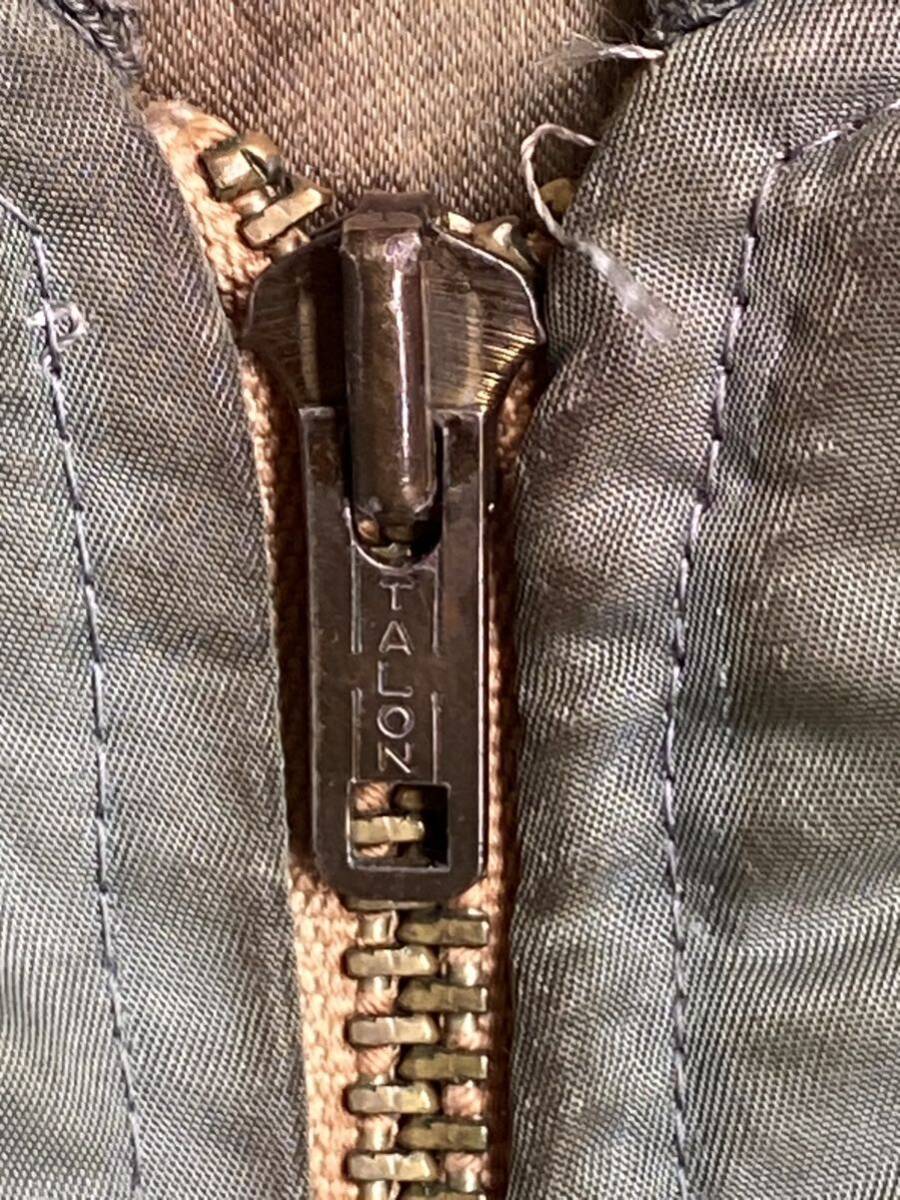
Black-label example retaining shoulder Air Force insignia and service name panel, later fitted with replacement zipper and knit trim
An original early Type L-2B flight jacket of U.S. Air Force issue, produced in the lighter postwar nylon idiom that followed the heavier B-15 family and anticipated the streamlined flight-jacket forms of the jet age. The present example retains a visible shoulder Air Force insignia together with an applied name patch reading “Caleb S. Turner / TSGT / USAF,” giving the garment an unusually direct service identity. The shell shows wear, staining, and age consistent with use, while the main zipper and all rib knit trim have been replaced, shifting the jacket away from strict collector purity but preserving structure and readability. As an object, it is best understood as a named early L-2B survivor: a historically persuasive and visually articulate example of postwar USAF flight wear in the moment of its modern transition.
COLLECTOR RELEVANCE
Tier: Named Early USAF Nylon / Wearer-Collector Specialist Category
This piece is for:
- early L-2B collectors
- black-label USAF jacket specialists
- buyers who appreciate named military garments
- wearer-collectors comfortable with replacement parts
- postwar flight-jacket historians who value design evolution
This piece is not for:
- strict originality purists
- buyers who need untouched cuffs, zipper, and trim
- fashion-only shoppers who do not understand why the insignia and name patch matter
This is for the collector who knows that a jacket can lose purity and still gain presence if enough of its historical face remains intact.
CONFIDENCE & VERIFICATION NOTES
Strong positives
- early black-label L-2B identity
- named chest patch
- strong shoulder USAF insignia
- shell remains visually persuasive
- first-model significance supports collector interest
CURATORIAL ANALYSIS
A Jacket From the Moment Flight Wear Became Cleaner, Lighter, and More Technical
The early L-2B matters because it belongs to the next decisive turn after the B-15 family. If the B-15B and related models still carry the emotional weight of fur collar and heavier transitional structure, the L-2B sharpens the silhouette and strips away some of that older bulk. What remains is a lighter, more cockpit-efficient garment designed for a different speed of air-age logic.
That is the first threshold.
This is not simply another nylon flight jacket.
It is part of the moment when USAF clothing starts to look unmistakably modern.
The knit collar, the cleaner body line, the utility sleeve pocket, and the more stripped-down face all contribute to that impression. This is the language that will ultimately feed the long life of postwar flight-jacket design.
Why Early L-2B Has Its Own Identity
There is a temptation to read the L-2B only as an early MA-1 cousin. That is too weak. The L-2B has its own role and its own elegance. It is a light-zone jacket, which means its logic is different from heavier cold-weather flight garments. It is about mobility, reduced weight, and functional cockpit wear without the density of more insulated models.
That produces a very specific kind of appeal:
- less theatrical than fur-collar jackets
- more precise than earlier transitional cloth
- more historically nuanced than later common examples
For many collectors, this is the sweet spot.
The Shoulder Insignia Does Real Work Here
One of the strongest features on this jacket is the shoulder insignia. The painted or printed U.S. Air Force roundel remains legible and emotionally active. That matters because many surviving nylon jackets lose exactly this kind of surface identity first. Once the insignia fades into abstraction, the jacket still has category, but loses some of its human immediacy.
This one keeps it.
That small circular mark does several jobs at once:
- it anchors branch identity
- it confirms service-world context
- it gives the jacket a stronger visual face
- it helps offset the loss of originality elsewhere
It is a load-bearing detail.
The Name Patch Changes the Jacket from Type to Person
Without the chest patch, this would still be a good early L-2B. With it, the object acquires a more specific emotional register. The name patch does not automatically create glamorous provenance, but it does something more useful: it gives the jacket a human point of contact.
CALEB S. TURNER / TSGT / USAF
That inscription is enough to move the jacket out of abstract model-collector space and into service-individual space. The buyer is no longer handling only “an L-2B.” They are handling a jacket that once belonged to a particular person within a particular branch structure.
That humanization matters more than many buyers realize.
Replacement Zipper and Knits: A Real Deduction, Not a Death Sentence
The main zipper and all ribbing have been replaced. This is not a small issue in pure collector terms. It permanently removes the jacket from top-tier originality. But it is important to read the result correctly. These replacements also keep the jacket legible, structurally stable, and wearable.
That trade matters.
For the strict purist:
this is a deduction.
For the wearer-collector:
this can be an advantage.
The shell, label, patch, and insignia are still doing the historical heavy lifting. The replaced components do not erase that. They merely shift the jacket’s market lane.
The Fabric Tone and Why Early Nylon Ages So Well
The slightly greyed sage shell is one of the reasons early USAF nylon jackets keep attracting collectors. This tone has a particular softness and technical calm that later flight jackets sometimes lose through overfamiliarity. It is military, but not aggressive. Functional, but also visually subtle. That balance gives the L-2B a kind of understated authority.
This jacket still retains that.
Even with staining and wear, the shell tone remains one of its best visual assets.
Why the Ask Is Not Crazy
At ¥200,000, the jacket is being priced neither as a bargain-bin beater nor as a fantasy museum piece. That is the correct lane. The number is supported by:
- early first-model identity
- black label
- surviving shoulder insignia
- named patch
- healthy overall silhouette
- growing collector interest in postwar USAF nylon
The replacements keep it from climbing much higher automatically, but the service character keeps it from falling into ordinary vintage-flight-jacket pricing. That is exactly where it should sit.
MATERIAL FORENSICS
Shell
The shell remains the jacket’s main stabilizer. It has visible wear, but still reads clearly as an early L-2B rather than a softened generic bomber. The overall body line remains intact, and the fabric still carries the right postwar technical tone.
Points that matter:
- shell still has category clarity
- fading and staining are present but not identity-erasing
- front and back silhouette remain strong
- shoulder insignia remains a major visual anchor
Knits
All knits have been replaced, which matters. Purity is gone. But the replacements preserve the silhouette well enough that the jacket still holds its proper short-bodied shape. In this category, once the waistband fails completely, the object often loses force. This one still stands.
Main Zipper
The replacement main zipper must be acknowledged plainly. It is a collector deduction. At the same time, functionality and front-line readability remain intact because of it. This again positions the jacket more firmly in wearer-collector territory.
Name Patch
The name patch is one of the most valuable surviving surface details. It personalizes the garment and adds a degree of service-specific identity that many plain L-2B survivors lack.
Shoulder Mark
The Air Force insignia is another major premium point. It gives the jacket more emotional and historical texture than an anonymous example with equivalent wear.
Authenticity & Stewardship
Evaluated under the Japonista Aviation & Military Garment Authentication Framework™
Each work is examined through a structured, multi-layered assessment:
• Model classification and military typology verification (A-2, B-3, MA-1, G-1, L-2, etc.)
• Material evaluation across leather, shearling, nylon, wool, and mixed components
• Hardware inspection including zippers, snaps, and period-correct fastenings
• Graphic and nose art analysis, including paint method, iconography, and historical alignment
• Condition and structural integrity review, including wear patterns consistent with age and use
Where applicable, contract labels, manufacturer markings, and period construction details are reviewed to confirm authenticity and era alignment.
Guaranteed 100% Authentic.
All garments are curated and backed by the Japonista Lifetime Authenticity Warranty™, with emphasis on both material truth and historical accuracy.
A Note on Flight Jackets, Service & Visual Identity
Military flight jackets were engineered as functional equipment—designed for temperature regulation, durability, and survival in demanding conditions. Over time, they evolved into carriers of identity, memory, and personal expression.
Nose art and painted jackets—originally applied to aircraft and later to garments—represent a distinct form of visual folklore. Pin-up figures, squadron insignia, mascots, and symbolic imagery transformed standard-issue equipment into individualized statements of presence and morale.
At Japonista, these jackets are approached as wearable military artifacts. Surface wear, leather creasing, paint aging, and textile fatigue are evaluated as evidence of lived history rather than imperfection.
We preserve these works with restraint—allowing their material narrative to remain visible and intact.
Our role is to connect these garments with collectors who recognize their dual nature as both functional objects and historical documents.
Inquiries, Availability, and Private Consideration
Many flight jackets are singular in character due to condition, paintwork, contract variation, or production era. Certain pieces are held firmly due to rarity, historical resonance, or preservation status.
All inquiries are handled discreetly, and we welcome thoughtful discussion regarding provenance, contract details, nose art interpretation, and long-term wear or display considerations.
Collectors building focused archives—by model type, era, or graphic style—may consult with us for deeper guidance.
Concierge Support & Collector Guidance
Japonista Concierge™ provides tailored assistance for collectors seeking deeper engagement with aviation garments:
• Model and contract identification (A-2 variants, G-1 lineage, MA-1 evolution)
• Leather and textile preservation guidance
• Paint conservation and display considerations
• Wearability versus archival preservation assessment
• Strategic acquisition planning for aviation-focused collections
For select rare or historically significant works, private reservation or structured acquisition arrangements may be available on a case-by-case basis.
Before Proceeding
We encourage collectors to review our shop policies and house guidelines, available through the links in our website footer. These outline shipping protocols, handling considerations, and condition standards specific to vintage leather, painted garments, and military-issued clothing.
Understanding these guidelines supports responsible stewardship of each piece.
A Closing Note
Flight jackets occupy a distinct place within material history. They are objects of function shaped by environment, and over time, transformed into records of identity, service, and expression.
Nose art—whether applied to aircraft or garments—extends this narrative, capturing moments of humor, defiance, and individuality within structured military life.
At Japonista, we steward these works as aviation artifacts in wearable form—ensuring they continue their journey with collectors who understand both their construction and their story.
If you have questions or wish to explore related items, please feel free to contact Japonista Concierge™ at any time.