Rare Vintage, Antiques and Art Collector / Curator / Personal Shopper From Japan
One-of-One Rodrigo Duterte “Pilipinas Naming Mahal” Yokoburi Sukajan Philippine Political Wearable Art Jacket Size L
One-of-One Rodrigo Duterte “Pilipinas Naming Mahal” Yokoburi Sukajan Philippine Political Wearable Art Jacket Size L
Couldn't load pickup availability
Monumental Hand-Guided Embroidered Tribute to Nationhood, Sacrifice, Public Duty and the Contested Legacy of the Philippines’ 16th President
Description
A singular work of Philippine political memorabilia transformed into monumental Japanese-style wearable art.
This one-of-one custom sukajan presents Rodrigo Roa Duterte, the 16th President of the Philippines, through an exceptionally ambitious embroidery program extending across the entire front and back of the garment. Rather than functioning as a conventional souvenir jacket with a small emblem or isolated portrait, the piece has been conceived as a complete textile mural: a visual statement about nationhood, sacrifice, political resolve, public memory and the turbulent struggle to define the future of the Philippines.
The back is dominated by a large monochrome portrait of Duterte, rendered through dense black, grey, silver and white thread. Behind him, radiant bands inspired by the colors and symbolism of the Philippine flag expand outward in yellow, red, blue and white. Two white doves rise above the portrait, while the inscriptions “ONE COUNTRY ♥ ONE NATION” and “PILIPINAS NAMING MAHAL” frame the composition in metallic gold embroidery.
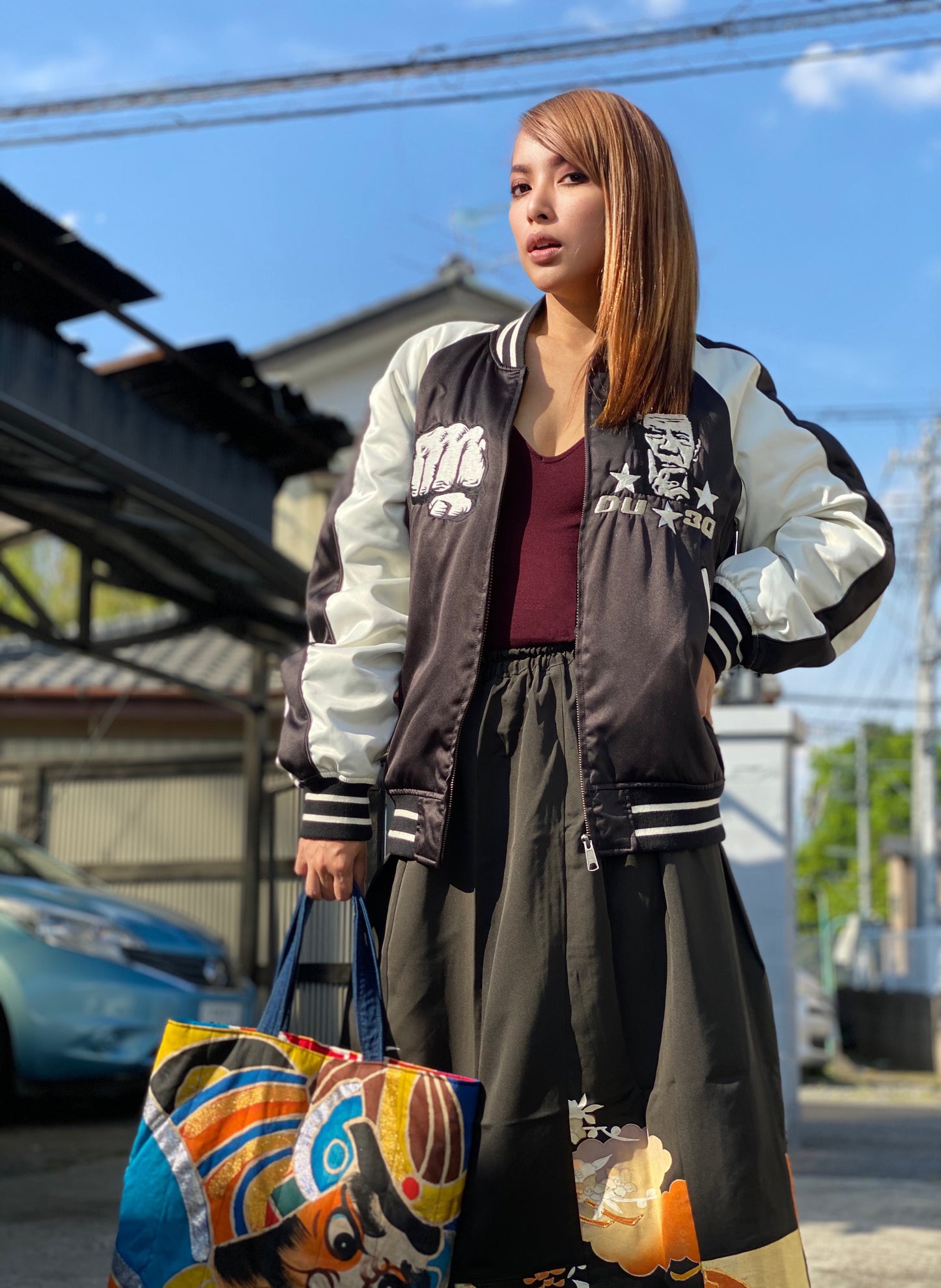
The front continues the narrative with an embroidered fist, a second portrait, the designation “DU30,” five-pointed stars and a map of the Philippine archipelago. Together, these elements turn the jacket into a three-dimensional political mural that can be worn, displayed, archived or exhibited as a document of a deeply consequential period in modern Philippine history.
Created as a one-and-only custom artwork, this jacket is not presented as ordinary apparel. It is positioned as a museum-scale collectible, political artifact and unique embroidered portrait whose valuation reflects its singularity, labor, cultural specificity and long-term historical relevance.
Visual Presence
Some garments are decorated.
This jacket makes a declaration.
The imagery does not sit quietly on the satin. It occupies it completely, using the bomber silhouette as a moving canvas. The black body creates a nocturnal background against which the silver portrait, white sleeves, metallic lettering and Philippine national colors emerge with force.
When viewed from the back, the composition resembles a political mural painted across an urban wall. The portrait is monumental, tightly cropped and centrally positioned. The face is not idealized into youthful perfection. Lines, shadows and concentrated expression remain visible, giving the figure gravity and human weight.
The gold word “PILIPINAS” cuts across the lower portrait like the title of a national monument. Above it, the phrase “ONE COUNTRY ♥ ONE NATION” forms an arch, visually uniting the opposing fields of light and color behind the figure.
When the wearer turns, the front reveals a second narrative: the clenched fist, the DU30 portrait, the stars and the Philippine map. The jacket therefore does not have a secondary or inactive side. Every visible surface contributes to the message.
Its impact is immediate, but its meaning continues to unfold through the interaction of portraiture, national symbolism and commemorative text.
Identification
Object Type: One-of-one custom embroidered sukajan / souvenir jacket
Subject: Rodrigo Roa Duterte
Historical Role: 16th President of the Philippines
Primary Inscription: Pilipinas Naming Mahal
Upper Inscription: One Country ♥ One Nation
Front Designation: DU30
Additional Motifs: Clenched fist, Philippine archipelago, stars, doves, national colors and radiating sun imagery
Artistic Format: Political portrait mural translated into wearable textile art
Embroidery Style: Hand-guided yokoburi-style custom embroidery
Colorway: Black, white, silver, gold, red, blue and yellow
Garment Style: Japanese-inspired satin sukajan / bomber jacket
Tagged or Stated Size: L
Closure: Full front zipper
Sleeves: Raglan construction
Pockets: Two angled front welt pockets
Trim: Black-and-white striped rib-knit collar, cuffs and waistband
Gender Presentation: Unisex
Production Status: Unique custom design, one example only
Collector Category: Political memorabilia, Philippine history, contemporary textile art and embroidered portraiture
“Pilipinas Naming Mahal”
The central phrase is correctly presented as:
PILIPINAS NAMING MAHAL
Within this artwork, the words carry far more than a decorative patriotic sentiment.
They express the belief that love of country demands responsibility, courage and sacrifice. The phrase is intended to communicate that devotion to the motherland is not passive. It requires a willingness to confront the conditions that weaken the nation, protect future generations and leave behind a safer, stronger and more dignified inheritance.
The jacket presents that belief through the commemorative viewpoint associated with Duterte’s supporters: that his political mission represented an unwavering commitment to confront corruption, illegal drugs and criminality regarded as destructive to the identity, security and development of the Philippines.
In this visual narrative, Pilipinas Naming Mahal becomes both an expression of affection and a demand for duty.
It carries the idea that the nation must be loved not only through ceremony, nostalgia or verbal patriotism, but through difficult choices intended to strengthen public order and protect the country’s future.
The jacket therefore frames sacrifice as an act of national stewardship. Its message is that a leader’s duty is not merely to occupy office, but to accept personal and political consequences in the pursuit of a legacy believed to benefit the country beyond the leader’s own term.
Whether admired, criticized or debated, that concept gives the inscription its emotional and historical force.
Monumental Duterte Portrait
The dominant back portrait is embroidered in a largely monochromatic palette of black, charcoal, silver, grey and white.
This restricted color scheme gives the image the character of a documentary photograph, newspaper portrait or public mural. It also separates the human figure from the brilliant national colors behind him.
The face is rendered through numerous changes in thread direction and density. Darker stitching defines the hair, eyes, brows, cheek hollows and facial contours. Pale thread catches the forehead, nose, cheekbones and folds of the jacket.
The portrait avoids a polished, idealized treatment. Instead, it preserves the sternness, fatigue and concentrated expression associated with a leader carrying political conflict and public expectation.
The military-style jacket visible in the portrait contributes to the composition’s language of authority, command and readiness. Its folds, lapels and shoulder details are defined in contrasting greys, creating depth without introducing color that might compete with the Philippine flag elements.
The head and shoulders occupy much of the back panel, allowing the portrait to remain fully legible even at considerable distance.
This scale is essential. Duterte is not represented as a small badge or commemorative seal. He is presented as the central historical figure around whom the jacket’s entire symbolic architecture has been built.
Philippine Flag and Radiant National Field
Behind the portrait, the embroidered ground divides into dynamic fields inspired by the Philippine flag and its national imagery.
On one side, broad yellow-and-white rays emerge outward, recalling the sun and its radiating energy. On the other, saturated red, blue, white and yellow forms create an unmistakably Philippine chromatic identity.
The imagery is not rendered as a flat rectangular flag. It has been expanded into an expressive background that surrounds the portrait with movement and light.
The rays introduce ideas of:
- National awakening
- Courage
- Vitality
- Direction
- Renewal
- Public hope
- The illumination of a shared national purpose
The flag colors on the opposite side provide balance while reinforcing the jacket’s identity as a work concerned specifically with Philippine history rather than generic political iconography.
Because the portrait is monochrome, the color fields appear especially luminous. The contrast creates a cinematic effect, with Duterte emerging from the center of a national panorama.
White Doves
Two white doves appear above the portrait, flying toward the upper inscription.
Their inclusion softens the otherwise forceful political imagery and introduces themes of peace, reconciliation, aspiration and national renewal.
The doves also create an important tension within the artwork.
The portrait, fist and DU30 designation communicate firmness and political struggle. The doves suggest that strength is not presented as an end in itself. Within the jacket’s symbolic message, forceful national leadership is ultimately directed toward the possibility of a safer and more peaceful society.
Their upward movement guides the eye toward the words “ONE COUNTRY ♥ ONE NATION,” visually connecting peace with unity.
“One Country, One Nation”
The upper inscription forms a wide gold arch across the shoulders:
ONE COUNTRY ♥ ONE NATION
The heart between the two phrases is embroidered in vivid pink-red, making it the emotional hinge of the text.
The wording presents national unity as something deeper than political agreement. It suggests that even amid conflict, regional difference, class division and opposing viewpoints, the Philippines remains one national community.
The jacket’s design gives the phrase a ceremonial presence. The metallic letters curve over the portrait like an inscription above a monument, memorial arch or public mural.
The wording also reinforces the meaning of Pilipinas Naming Mahal. Love of country is presented as a unifying force, while sacrifice and political action are positioned as obligations undertaken for the nation as a whole.
Pilipinas in Monumental Gold
The word PILIPINAS occupies the lower center of the back in large, dimensional gold embroidery edged with black.
Its stylized lettering has the visual weight of a title, banner or national crest.
Rather than placing Duterte’s name in the largest type, the design gives greatest prominence to the country itself. This is a significant compositional decision.
The portrait may be the central figure, but PILIPINAS is the central subject.
The leader is visually positioned as one participant within a much larger national narrative. The nation remains the ultimate focus, responsibility and intended beneficiary of public service.
The metallic gold gives the word a ceremonial and monumental quality, while the black shadow embroidery allows it to remain sharply legible against the portrait and satin ground.
“Naming Mahal”
Beneath PILIPINAS appears the phrase:
NAMING MAHAL
It is framed by embroidered stars, creating the complete message Pilipinas Naming Mahal.
The smaller placement gives the phrase an intimate emotional register beneath the monumental country name. The effect is almost dedicatory, as though the entire garment were being offered to the nation.
Gold thread connects the words visually to the upper unity inscription, establishing a continuous hierarchy of national devotion:
- One country
- One nation
- Pilipinas
- Naming mahal
Together, the texts create a complete ideological structure rather than a collection of unrelated slogans.
Front Portrait and DU30 Emblem
The front right chest carries a second embroidered portrait of Duterte, this time reduced to a strong black-and-white graphic emblem.
Beneath it appears:
DU ★ 30
The portrait is framed with stars, giving it the visual character of campaign iconography, commemorative merchandise and modern pop-political design.
“DU30” functions as a compact visual identifier associated with Duterte’s name and political persona. Its inclusion makes the front immediately recognizable even when the large back mural is not visible.
The frontal portrait is simplified compared with the detailed rear portrait. Strong black and white shapes allow it to read clearly against the satin body.
The contrast between the two portraits is deliberate:
- The back presents the historical, monumental and reflective figure.
- The front presents the concise public emblem.
- One resembles a mural.
- The other resembles a political insignia.
Together, they show how a political figure can exist simultaneously as an individual, a national symbol and a public image.
The Embroidered Fist
Opposite the DU30 portrait is a large clenched fist rendered in white, silver and black thread.
The fist projects outward toward the viewer, giving it unusual visual immediacy.
Within the context of the jacket, it represents:
- Resolve
- Resistance
- Determination
- Public strength
- Defiance
- Commitment under pressure
- Readiness to confront entrenched problems
Its placement opposite the portrait creates a balanced front composition. The face identifies the political subject, while the fist expresses the energy and determination associated with the subject’s public image.
The fist is not hidden within ornament. It occupies a large isolated field, allowing its shape to remain direct and uncompromised.
Philippine Archipelago
Near the lower front is an embroidered map of the Philippine islands.
Rendered in pale silver-white thread, the archipelago appears almost like a constellation against the black satin.
The map grounds the jacket’s political symbolism in geography. It reminds the viewer that the work concerns not an abstract ideology, but an actual nation composed of thousands of islands, regions, communities and distinct histories.
Its placement beside the pocket also makes it a quieter discovery. Unlike the monumental portrait, the map reveals itself on closer inspection.
This creates an effective visual hierarchy:
- The portrait represents leadership.
- The fist represents resolve.
- The flag represents sovereignty.
- The doves represent peace.
- The map represents the people and territory for whom leadership is exercised.
Embroidery Craftsmanship
The jacket is described as a custom work employing hand-guided yokoburi-style embroidery, a method in which the artisan actively directs the movement, contour and rhythm of the stitching rather than relying solely on a fully automated flat embroidery process.
The artistry is visible in the extensive variation of line, fill, shading and thread direction.
The rear portrait alone requires numerous tonal transitions to distinguish:
- Hair
- Forehead
- Eyes and brows
- Nose
- Cheeks
- Mouth
- Chin
- Neck
- Clothing folds
- Lapels
- Shoulder seams
- Highlights and shadows
The surrounding imagery introduces additional technical demands:
- Broad satin-stitched flag fields
- Metallic lettering
- Curved inscription placement
- Fine dove forms
- Large radiating rays
- Layered gold title embroidery
- Dense outlined stars
- Small facial details on the front
- Crisp geographical contours in the Philippine map
The portrait is not created from printed fabric or a sewn photographic transfer. Its image is built through thread.
From a distance, the stitching resolves into a recognizable figure. At close range, the individual directions and densities of the thread become visible, revealing the labor behind the illusion of light and shadow.
The jacket’s value lies partly in this tension between image and material. It behaves as portraiture from afar and textile sculpture up close.
Mural-Scale Composition
The word “mural” is especially appropriate for this jacket.
The design does not merely repeat symbols across empty fabric. It builds a complete visual environment.
The back has foreground, middle ground and background:
Foreground: The gold word PILIPINAS and commemorative text
Middle ground: The Duterte portrait
Background: The Philippine flag colors, sun rays, doves and national unity inscription
This layered structure gives the garment depth despite the flatness of the satin.
The black body behaves like a wall or night sky. Bright national colors radiate behind the figure, while metallic lettering appears to project forward.
The curvature of the bomber jacket adds further dimensionality. When worn, the mural wraps around the body, allowing the national rays and flag fields to move with the wearer.
Unlike a framed artwork, the piece does not remain fixed to one viewpoint. It changes according to posture, light, distance and movement.
Political and Historical Character
This jacket records an explicitly commemorative and admiring perspective on Rodrigo Duterte’s leadership.
It should be understood as political memorabilia created within a specific national and historical viewpoint, not as a neutral summary of every interpretation of his administration.
Duterte remains one of the most consequential and polarizing figures in recent Philippine history. His supporters frequently associate his leadership with forceful action against illegal drugs, criminality and corruption, as well as a willingness to confront institutions and conditions they believed had weakened national safety and confidence.
His critics have interpreted many elements of his leadership very differently.
The existence of those opposing views does not reduce the jacket’s importance as an artifact. It increases its historical relevance.
Political memorabilia often becomes most significant when it records intense public feeling, contested memory and the symbolism through which a society interprets its leaders.
This jacket preserves one such interpretation in unusually ambitious form.
It communicates the conviction that Duterte’s political mission was rooted in a willingness to make difficult sacrifices for the future of the Philippines and to leave behind a safer, stronger national legacy.
Whether encountered through admiration, disagreement, scholarship or historical curiosity, the garment documents a powerful political narrative that shaped public discourse across the Philippines and beyond.
One-of-One Status
This is presented as a one-of-one custom design.
Only one jacket is known with this exact combination of:
- Monumental Duterte back portrait
- Philippine flag field
- Radiating sun imagery
- White doves
- One Country One Nation inscription
- Pilipinas Naming Mahal inscription
- DU30 chest portrait
- Embroidered fist
- Philippine archipelago
- Black-and-white sukajan colorway
- Full mural-style front-and-back program
Its uniqueness is not based merely on a different thread color or a small personalization.
The complete visual narrative is specific to this garment.
That distinction places it outside normal edition-based political merchandise. It is closer to a commissioned textile portrait, artist-made commemorative object or singular exhibition piece.
No identical replacement can be ordered from regular production, and no second example is included.
Color Architecture
The palette is intentionally restrained around the garment and explosive within the symbolism.
Black satin forms the main ground, giving the jacket seriousness and allowing the portrait and national colors to emerge clearly.
Ivory-white sleeves create a strong contrast and lend the silhouette a ceremonial varsity character.
Silver and grey threads construct the portraits and map.
Metallic gold defines the inscriptions, stars and the monumental word PILIPINAS.
Red and blue carry the immediate identity of the Philippine flag.
Yellow and white form the radiant national field and sun-inspired imagery.
Pink-red appears in the heart between One Country and One Nation, introducing an explicitly emotional element into an otherwise firm political composition.
The striped black-and-white ribbing reinforces the monochrome foundation while keeping the focus on the embroidery.
Garment Construction
The jacket follows the recognizable architecture of a Japanese souvenir bomber:
- Rib-knit standing collar
- Raglan sleeves
- Smooth satin body
- Contrasting sleeve panels
- Full front zipper
- Two angled hand pockets
- Rib-knit cuffs
- Gathered rib-knit waistband
- Lightweight bomber silhouette
- Large-scale embroidery
- Unisex presentation
The raglan sleeves create a broad shoulder line and allow the white panels to flow smoothly from the collar toward the cuffs.
The body is compact compared with a long Western jacket, consistent with classic sukajan proportions. The chest remains generously cut, while the ribbed waistband draws the garment inward at the hem.
The jacket can function as apparel, but its exceptional visual and monetary positioning also makes it suitable for careful archival display rather than frequent everyday wear.
Period Assessment
The garment is a contemporary custom commemorative sukajan associated with the political and cultural period surrounding Rodrigo Duterte’s national leadership and continuing public legacy.
It is not an occupation-era military souvenir jacket and should not be interpreted as a mid-century historical sukajan.
Instead, it belongs to a later tradition in which the Japanese souvenir-jacket format has been adopted as a canvas for modern political portraiture, national identity and cross-cultural textile art.
Its historical value is therefore connected to:
- Contemporary Philippine political memory
- Duterte-era popular imagery
- Modern campaign and supporter iconography
- Japanese-inspired embroidery culture
- The globalization of the sukajan format
- The transformation of political portraiture into wearable art
Condition
Presented in very good pre-owned collector condition with natural characteristics associated with satin, extensive embroidery and careful storage.
Visible characteristics include:
- Natural satin creasing and surface movement
- Light rippling around densely embroidered areas
- Minor compression from folded storage
- Gentle handling wear consistent with age and display
- Small variations in satin sheen depending on light direction
- Minor thread texture or occasional fine embroidery fibers
- Light softening to the rib-knit collar, cuffs and waistband
- Subtle surface marks that may become visible under close directional light
The principal embroidery remains visually strong and complete.
The large rear portrait, national flag field, gold inscriptions, doves, front fist, DU30 portrait and Philippine map remain clearly legible.
No major tears, severe structural damage or substantial losses to the principal artwork are apparent in the supplied photographs.
Because this is a heavily embroidered satin garment, natural puckering and localized waviness are expected where large thread fields interact with the lighter base textile.
Please examine all photographs carefully, as they form an essential part of the condition description.
Dimensions and Fit
Approximate laid-flat measurements based on the supplied photographs:
Stated size: L
Body length: Approximately 60 cm / 23.6 in
Chest width, armpit to armpit: Approximately 61–62 cm / 24.0–24.4 in
Approximate chest circumference: Approximately 122–124 cm / 48.0–48.8 in
Underarm sleeve length: Approximately 50 cm / 19.7 in
Shoulder construction: Raglan, without a conventional fixed shoulder seam
The jacket has a broad chest and compact bomber length.
It may correspond approximately to:
- A relaxed unisex L
- A closer XL depending on shoulder and torso dimensions
- An oversized M
- A generously oversized fit on a smaller frame
The embroidery adds structure and weight to the body. Buyers intending to wear the piece should compare the measurements with a similar raglan bomber that fits comfortably.
Display and Preservation
At its current collector positioning, this jacket may be acquired primarily as an archival or display object.
It would be suitable for:
- A Philippine political memorabilia collection
- A museum or institutional study collection
- A contemporary Asian textile collection
- An embroidered portrait exhibition
- A political art archive
- A private Duterte collection
- A gallery devoted to modern nationalism and public imagery
- A collection of singular sukajan
- A fashion and political-history exhibition
- A study of cross-cultural wearable art
For long-term display, the garment should be supported on a broad padded hanger or archival mannequin.
Direct sunlight should be avoided to preserve the black satin, national colors and metallic embroidery.
For extended storage, the jacket should be laid flat or gently folded with acid-free tissue between major embroidered areas. Excessive compression should be avoided.
The piece should not be stored in a damp environment or sealed for long periods in non-breathable plastic.
Collector and Institutional Significance
The jacket’s significance comes from the convergence of several distinct collecting fields:
- One-of-one wearable art
- Rodrigo Duterte memorabilia
- Philippine political history
- Modern embroidered portraiture
- Yokoburi-style craftsmanship
- Sukajan and souvenir-jacket culture
- Nationalist visual symbolism
- Contemporary Asian political art
- Campaign and supporter iconography
- Textile murals
- Cross-cultural fashion history
- Museum-scale political artifacts
Most political jackets rely on printing, screen transfers or small campaign patches.
This garment uses extensive embroidery to construct a complete national narrative.
Most sukajan focus on dragons, tigers, eagles, waves or flowers.
This piece uses the sukajan form to preserve the image and ideological message of a specific modern leader.
Most portraits remain on paper, canvas, posters or screens.
This portrait has been translated into thread and made to occupy a moving human silhouette.
That combination gives the jacket unusual rarity and interpretive depth.
Why the US$100,000 Valuation
The valuation is based not on ordinary secondhand clothing comparisons, but on the garment’s positioning as a singular political artwork.
The US$100,000 price reflects:
- One-of-one production
- No known identical replacement
- Monumental portrait embroidery
- Full front-and-back design
- Hand-guided custom craftsmanship
- Specific Philippine national symbolism
- Direct association with a major modern political era
- Museum and exhibition potential
- Cross-category collector appeal
- The cultural rarity of political portraiture executed as a sukajan
- The possibility of future documentation, publication or exhibition
- Its status as a complete visual artifact rather than ordinary apparel
The jacket is not being priced as a mass-produced bomber, vintage fashion basic or standard supporter souvenir.
It is offered as a singular commemorative artwork and historical collectible.
Its price may be revised upward in the future as its archive, provenance, documentation, exhibition record and broader historical context continue to develop. No claim of guaranteed financial appreciation is made.
Acquisition Position
This piece is intended for a serious collector, institution, curator or patron who understands the difference between ordinary merchandise and a unique historical artwork.
The public price is fixed at US$100,000.
Any inquiry should be made with respect for the work’s unique status, cultural meaning and intended long-term placement.
Documentation accompanying the acquisition may include a detailed written description of the iconography, condition, dimensions, one-of-one status and interpretive context.
Shipping and Store Policies
This is a singular, high-value collectible offered in its existing condition.
The photographs form an essential part of the description and document the embroidery, satin, construction, measurements and visible condition.
Returns, exchanges and discretionary cancellations are not ordinarily accepted, subject to applicable marketplace policies and mandatory consumer law.
Due to the exceptional declared value, shipping arrangements may differ from ordinary store orders.
The jacket will be prepared using layered archival tissue, moisture-resistant protective packaging and a rigid outer container. Shipment may require specialist insurance, signature confirmation, identity verification and destination-specific carrier arrangements.
Final shipping cost, insurance availability and import documentation will depend on the buyer’s country.
Customs duties, local taxes, import charges and brokerage fees remain the buyer’s responsibility where applicable.
For certain destinations, private insured courier delivery or specialist art-logistics handling may be required instead of standard postal service.
#RodrigoDuterte #DuterteMemorabilia #PilipinasNamingMahal #PhilippineHistory #PhilippinePoliticalArt #PoliticalMemorabilia #WearableArt #OneOfOneJacket #CustomSukajan #YokoburiEmbroidery #EmbroideredPortrait #PhilippinesArt #DU30 #DuterteJacket #PoliticalJacket #TextileMural #PhilippineFlagArt #NationalHeritage #ContemporaryTextileArt #AsianPoliticalArt #MuseumCollectible #HistoricMemorabilia #SukajanCollector #SouvenirJacket #PhilippineCollector #NationalIdentityArt #EmbroideredJacket #CollectorArtifact #ModernHistory #Japonista
duterte jacket, political art, philippines jacket, one of one art, custom sukajan, wearable mural, du30 memorabilia, embroidered portrait, filipino heritage, yokoburi jacket, museum collectible, historic artifact, size l bomber
Material Tags
satin-like synthetic textile, multicolor embroidery thread, metallic gold embroidery thread, silver embroidery thread, rib-knit trim, metal zipper, satin pocket trim