Rare Vintage, Antiques and Art Collector / Curator / Personal Shopper From Japan
Old Real McCoy’s Flying Tigers A-2 Back Paint Jacket 1993 Limited 50 Horsehide Leather Size 36
Old Real McCoy’s Flying Tigers A-2 Back Paint Jacket 1993 Limited 50 Horsehide Leather Size 36
Couldn't load pickup availability
Have a reasonable price in mind? Submit your best offer and our concierge will review it personally.
The Real McCoy’s
Flying Tigers A-2 Leather Flight Jacket
1993, limited edition of 50
A highly desirable early-period Real McCoy’s A-2 leather flight jacket from the label’s formative years, executed as a limited-edition Flying Tigers tribute and distinguished by an ambitious painted-back design of considerable visual and collector appeal. Produced in 1993 and limited to just 50 examples, the jacket belongs to the now-historic first mature wave of Japanese military-reproduction culture, when the finest labels pursued archival seriousness with exceptional material conviction.
Constructed in top-grade horsehide and fitted with cotton broadcloth lining and merino wool knits, the jacket reflects the brand’s characteristically obsessive attention to military-inspired detail. The reverse is the principal event: a theatrical Flying Tigers composition combining sharkmouth aircraft imagery, theater-map language, and bold unit lettering in a manner that deliberately channels the great romance of wartime painted leather.
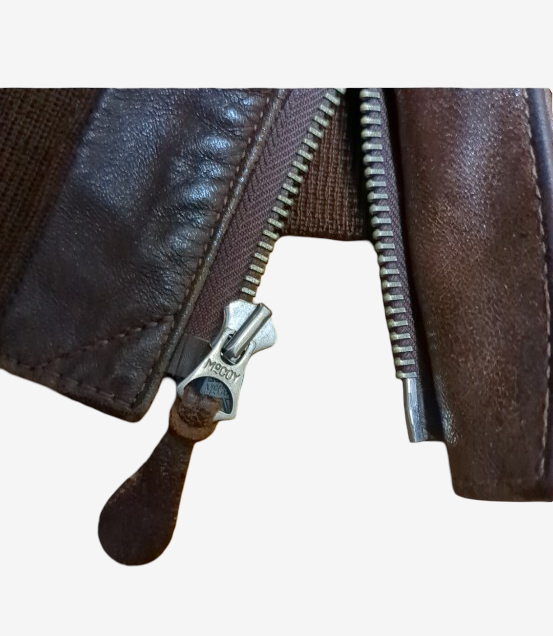
Condition is notably strong, with the horsehide reportedly supple under regular care and the zipper functioning cleanly. Minor rib repair does little to detract from the overall impact. More importantly, the jacket has now entered a second life as a collectible in its own right, no longer merely reproducing history but representing the early history of Japanese heritage reproduction itself.
An excellent example of old Real McCoy’s at its most culturally resonant.
Object
The Real McCoy’s A-2 “Flying Tigers” back-paint leather flight jacket
Brand / Era
Old Real McCoy’s
1993 production
Edition Status
Limited to 50 pieces
Theme
AVG / Flying Tigers visual tribute with large painted-back composition featuring aircraft, theater-map imagery, and wartime-inspired insignia language
Material
Top-grade North American horsehide according to seller
This is a major value driver. Early Real McCoy’s horsehide from the old era is one of the reasons these jackets moved beyond “good repros” and became collectible objects in their own right.
Tanning / Finish
Seller specifies mixed chrome and vegetable tanning approach
Aniline-based drum-dyed base
Emulsion lacquer or aniline top finish
This is unusually detailed material information and supports the impression that the jacket belongs to a serious early Japanese reproduction phase rather than generic fashion leather production
Lining
100% cotton broadcloth
Knits
100% merino wool
Seller references 1930s-style knit construction values
Sub Parts / Hardware
- RAU Fasteners snap hardware
- brass neck hook with chrome finish
- brass twin eyelets
- cotton zipper tape
- brass slider built to military-style spec language
- leather zipper pull present
Size
36
Measured Fit
Shoulder: 43 cm
Chest: 49 cm
Length: 56 cm
Sleeve: 62 cm
Condition Notes
- minor moth repair / moth disturbance at sleeve rib
- waistband rib still retains strong elasticity
- zipper runs smoothly, no tape breakage
- leather regularly oiled and described as supple
- overall condition strong for age and use
Object Classification
Not wartime original
A high-grade heritage reproduction archive piece
Early Japanese Americana / repro culture collectible with real crossover appeal to military, heritage, and Japanese-label collectors
COLLECTOR RELEVANCE
Tier: Strong Old Real McCoy’s Archive Piece
Ideal for:
- old Real McCoy’s collectors
- Japanese heritage / Americana archive buyers
- Flying Tigers visual-culture collectors
- those who want a reproduction that has become collectible on its own terms
Less ideal for:
- strict wartime-original-only collectors
- buyers who dislike painted backs
- anyone wanting oversized modern fit over period silhouette
This is a piece for someone who knows that 1990s Japanese reproduction culture is now itself part of the canon.
CONFIDENCE & VERIFICATION NOTES
Important checks:
- confirm label and serial-era consistency with 1993 old McCoy’s production
- inspect paint stability
- verify no hidden zipper tape weakness
- assess whether oiling has preserved or overly softened the horsehide
- inspect repaired rib zone for longevity
CURATORIAL ANALYSIS
When Reproduction Becomes History
The most important thing about this jacket is that it no longer lives only in the category of reproduction. It has crossed over into something more interesting: a reproduction that has itself become historical.
That is not semantic drift. It is the entire point.
In 1993, old Real McCoy’s was operating in a zone of almost obsessive material seriousness. These were not simply jackets “inspired by” military garments. They were products of a Japanese movement that treated American military clothing as industrial scripture. Stitch counts, hide selection, hardware, finish chemistry, knit behavior, label language, and silhouette proportions were all taken with extraordinary seriousness. Over time, that seriousness became collectible on its own.
This jacket belongs to that moment.
Why Old Real McCoy’s Matters
There are many reproduction brands. There are fewer brands whose earlier phases have become collecting categories in themselves. Old Real McCoy’s belongs to the second group. The early period carries weight because it captures a kind of perfectionist ambition before reproduction culture became widely mainstreamed, commercialized, or smoothed into generic “heritage.”
Old Real McCoy’s pieces from the early 1990s often matter for three reasons:
- they were materially overbuilt
- they treated source garments with almost forensic devotion
- they now document the first mature phase of Japanese military-reproduction culture
So even before the Flying Tigers theme enters the room, the jacket is already interesting.
Flying Tigers as Myth-Machine
The Flying Tigers have always occupied a special place in flight-jacket iconography. They are not merely a military unit reference. They are one of the great myth engines of aviation Americana: sharkmouth aircraft, China-Burma-India maps, volunteer-warrior romance, pre-Pearl Harbor urgency, and a whole visual language of improvised heroism.
This jacket understands that mythology perfectly. The back painting is not timid. It is narrative-heavy, cartographic, theatrical, and proud. Aircraft, theater map, insignia structure, and large upper lettering create exactly the kind of storytelling field that made vintage painted jackets legendary in the first place.
But here is the important difference: because this is a Real McCoy’s limited piece, the painting is not accidental nostalgia. It is a deliberately staged act of reverence toward the golden age of painted aviation leather.
In other words, it is myth remembering myth.
That layered self-awareness is one of the reasons it works.
The Back Paint Is the Event
The back is the axis of value. It carries the title Flying Tigers, the star-and-roundel language, the sharkmouth aircraft imagery, and the geographic theater-map composition. That is not decorative filler. It is the central cultural argument of the jacket.
A plain reproduction A-2 can be admired for its shape.
A painted one must justify its story.
This one does, because the back does not feel like a random custom paint job. It feels like a coherent limited-edition design object from a brand that understood exactly what collectors fantasized about when they dreamed of the great painted jackets of the war. The composition has hierarchy, movement, symbolism, and dramatic legibility. It reads like a tribute poster translated into leather.
That is precisely what a high-level 1990s Japanese repro label should have done, and Real McCoy’s did it.
Horsehide and the Weight of Credibility
The seller’s material notes are unusually rich and should not be ignored. Early reproduction labels often relied on vague heritage rhetoric. Here, the material description sounds like the language of a company trying to make the jacket worthy of collectors before collectors fully existed for this category.
Top-grade North American horsehide, mixed tanning logic, aniline drum dye, lacquer/aniline top treatment, merino wool, cotton broadcloth. This is not the vocabulary of ordinary commercial leather. It is the vocabulary of a brand trying to persuade through material correctness.
And now, decades later, that material seriousness is one of the main reasons these pieces have become collectible outside their original niche.
The Beauty of Small Honest Wear
The mention of minor moth repair to the sleeve rib is not a problem in any meaningful sense. In fact, the seller’s broader condition notes are encouraging:
- rib tension remains alive
- zipper tape is clean
- slider works smoothly
- leather remains supple under regular oil maintenance
That suggests the jacket has not hardened into display-only fragility. It still lives as a garment. This matters because old Real McCoy’s leather, when neglected, can become a cautionary tale. When maintained well, it becomes one of the great pleasures of heritage collecting.
A size 36 with this sort of condition and a complete visual program is exactly the kind of piece that can sit in both a serious collection and a real wardrobe.
This Is Not Military Collecting Alone
One of the strengths of this jacket is that it crosses categories beautifully. It can attract:
- military reproduction collectors
- old Real McCoy’s devotees
- Japanese Americana historians
- heritage fashion buyers
- Flying Tigers / aviation visual culture collectors
That breadth is important because it gives the object a wider and more resilient desirability than a plain repro jacket. It is not dependent on one small market. It appeals wherever craftsmanship, era-specific Japanese obsession, and painted-flight-jacket mythology overlap.
That is a valuable place to live.
MATERIAL FORENSICS
Leather
The horsehide is one of the great value anchors. Important in-hand checks:
- whether the grain break is natural and deep or over-oiled
- collar fold integrity
- sleeve flex at elbow and cuff transition
- whether oil maintenance has preserved suppleness without oversoftening structure
- finish wear consistency around pocket edges and zipper box
If the hide still has body and not just softness, the jacket is exceptionally well-positioned.
Back Paint
The paint should be checked for:
- cracking stability
- whether any flake-prone zones exist at fold lines
- whether shine / topcoat is original or later treated
- how the image reads under natural light rather than flash
A stable, vivid back paint on an old Real McCoy’s limited piece is a major positive.
Knits
Minor moth repair on a sleeve rib is tolerable and expected. More important is that the waistband still holds tension. Once waistband life disappears, silhouette collapses. Here the seller suggests the opposite, which is excellent.
Authenticity & Stewardship
Evaluated under the Japonista Aviation & Military Garment Authentication Framework™
Each work is examined through a structured, multi-layered assessment:
• Model classification and military typology verification (A-2, B-3, MA-1, G-1, L-2, etc.)
• Material evaluation across leather, shearling, nylon, wool, and mixed components
• Hardware inspection including zippers, snaps, and period-correct fastenings
• Graphic and nose art analysis, including paint method, iconography, and historical alignment
• Condition and structural integrity review, including wear patterns consistent with age and use
Where applicable, contract labels, manufacturer markings, and period construction details are reviewed to confirm authenticity and era alignment.
Guaranteed 100% Authentic.
All garments are curated and backed by the Japonista Lifetime Authenticity Warranty™, with emphasis on both material truth and historical accuracy.
A Note on Flight Jackets, Service & Visual Identity
Military flight jackets were engineered as functional equipment—designed for temperature regulation, durability, and survival in demanding conditions. Over time, they evolved into carriers of identity, memory, and personal expression.
Nose art and painted jackets—originally applied to aircraft and later to garments—represent a distinct form of visual folklore. Pin-up figures, squadron insignia, mascots, and symbolic imagery transformed standard-issue equipment into individualized statements of presence and morale.
At Japonista, these jackets are approached as wearable military artifacts. Surface wear, leather creasing, paint aging, and textile fatigue are evaluated as evidence of lived history rather than imperfection.
We preserve these works with restraint—allowing their material narrative to remain visible and intact.
Our role is to connect these garments with collectors who recognize their dual nature as both functional objects and historical documents.
Inquiries, Availability, and Private Consideration
Many flight jackets are singular in character due to condition, paintwork, contract variation, or production era. Certain pieces are held firmly due to rarity, historical resonance, or preservation status.
All inquiries are handled discreetly, and we welcome thoughtful discussion regarding provenance, contract details, nose art interpretation, and long-term wear or display considerations.
Collectors building focused archives—by model type, era, or graphic style—may consult with us for deeper guidance.
Concierge Support & Collector Guidance
Japonista Concierge™ provides tailored assistance for collectors seeking deeper engagement with aviation garments:
• Model and contract identification (A-2 variants, G-1 lineage, MA-1 evolution)
• Leather and textile preservation guidance
• Paint conservation and display considerations
• Wearability versus archival preservation assessment
• Strategic acquisition planning for aviation-focused collections
For select rare or historically significant works, private reservation or structured acquisition arrangements may be available on a case-by-case basis.
Before Proceeding
We encourage collectors to review our shop policies and house guidelines, available through the links in our website footer. These outline shipping protocols, handling considerations, and condition standards specific to vintage leather, painted garments, and military-issued clothing.
Understanding these guidelines supports responsible stewardship of each piece.
A Closing Note
Flight jackets occupy a distinct place within material history. They are objects of function shaped by environment, and over time, transformed into records of identity, service, and expression.
Nose art—whether applied to aircraft or garments—extends this narrative, capturing moments of humor, defiance, and individuality within structured military life.
At Japonista, we steward these works as aviation artifacts in wearable form—ensuring they continue their journey with collectors who understand both their construction and their story.
If you have questions or wish to explore related items, please feel free to contact Japonista Concierge™ at any time.