Rare Vintage, Antiques and Art Collector / Curator / Personal Shopper From Japan
Old Real McCoy A2 Hand Finish Horsehide Jacket Size 38 Rare Premium Reproduction Rough Wear
Old Real McCoy A2 Hand Finish Horsehide Jacket Size 38 Rare Premium Reproduction Rough Wear
Couldn't load pickup availability
Have a reasonable price in mind? Submit your best offer and our concierge will review it personally.
The Real McCoy’s — A-2 Hand Finish Horsehide Flight Jacket
Early-stage example from a cost-intensive production variant, retaining high surface sensitivity and minimal wear development
A hand-finished A-2 flight jacket by The Real McCoy’s, produced during the brand’s early experimental phase, wherein extended manual finishing processes were applied to horsehide beyond standard production parameters. The result is a surface of unusual smoothness and sensitivity, exhibiting immediate responsiveness to contact and wear.
Constructed to a Rough Wear contract silhouette, the jacket retains correct period proportions while presenting a softer visual drape due to the nature of the finishing process. The leather shows light signs of use, including minor abrasions, but remains largely uncreased, allowing for future development under continued wear.
This example reflects a moment within Japanese reproduction culture where material authenticity was pursued without regard for manufacturing efficiency, resulting in a limited and difficult-to-replicate class of garments.
COLLECTOR RELEVANCE
Tier:
Upper-tier reproduction / early McCoy’s experimental output
Best suited for:
• McCoy’s collectors
• horsehide-focused buyers
• wearer-collectors seeking control over aging
Not suited for:
• buyers requiring durability-first leather
• archival purists seeking untouched reproduction perfection
CONFIDENCE & VERIFICATION NOTES
Strong indicators:
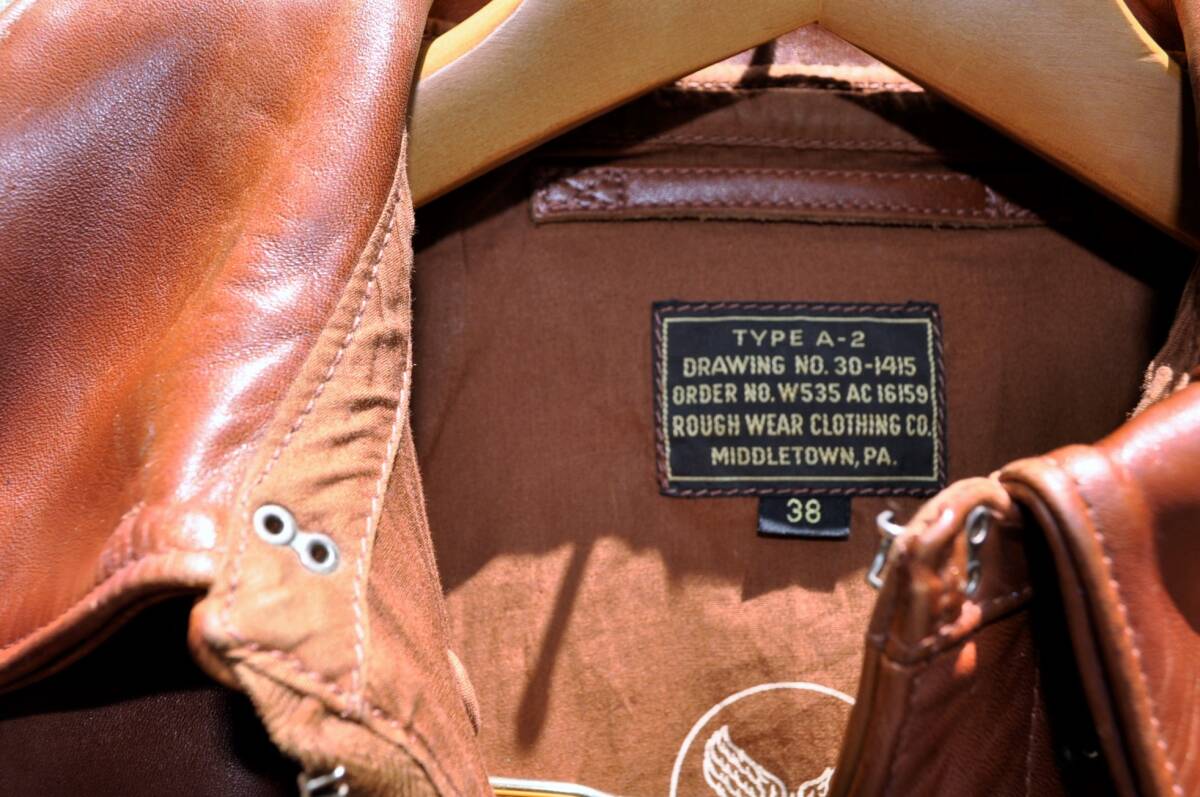
• correct label and contract reference
• consistent McCoy’s construction language
• material behavior aligns with described finish
A Production That Was Not Meant to Scale
Most reproduction A-2 jackets are engineered within constraints:
• repeatable tanning
• controlled finishing
• predictable wear behavior
This piece sits outside that system.
The “hand finish” designation is not cosmetic language.
It reflects:
a production approach that is time-intensive, inconsistent, and financially inefficient
That matters.
Because inefficiency, in this context, is precisely where rarity begins.
Horsehide in Its Most Unstable State
The defining characteristic here is not simply horsehide.
It is how the horsehide was left.
Observed qualities:
• unusually smooth surface tension
• high oil retention
• low resistance to surface marking
This creates a paradox:
The leather feels refined, almost delicate
yet structurally remains dense and capable
The result is a hide that records interaction quickly.
Not damage.
Record.
The Problem of Fragility
The seller notes that even minor contact can mark the surface.
This is not a flaw in production.
It is a byproduct of:
• reduced surface sealing
• higher oil saturation
• minimal corrective finishing
In practical terms:
This jacket will age faster visually than standard A-2s
But importantly:
it will age more honestly
Why This Matters in McCoy’s Context
Old Real McCoy’s occupies a specific position in reproduction culture.
They were not simply copying military garments.
They were attempting to:
reconstruct the process behind them
This jacket represents an extreme within that philosophy.
A moment where:
process was prioritized over scalability
The “First and Last” Problem
The seller’s claim that this type of production may never be repeated is not exaggerated.
To recreate this today would require:
• higher labor cost tolerance
• acceptance of inconsistency
• rejection of modern efficiency
Those conditions rarely align in current manufacturing.
Which leaves pieces like this:
isolated within the timeline
Silhouette Behavior
Structurally, the jacket maintains correct A-2 proportions:
• clean shoulder line
• controlled body taper
• balanced sleeve pitch
However, due to the softer surface condition:
the drape is slightly more fluid than typical horsehide A-2s
This reduces rigidity
and increases body conformity
Early Wear State Advantage
Unlike heavily worn examples, this piece remains:
• low-crease
• minimally broken-in
This creates a specific advantage:
the next owner will define the aging trajectory
For collector-wearers, this is not neutral.
It is desirable.
MATERIAL FORENSICS
Horsehide
Key indicators:
• high reflectivity under light
• minimal grain break-in
• localized micro-abrasion visible
Interpretation:
hide remains in early maturation stage
with strong potential for long-term character development
Knits
• structurally intact
• slight compression at cuff edges
• no major distortion
Supports silhouette integrity
Hardware
• period-style zipper
• functional with expected resistance
• no visible structural failure
Interior
• lining stable
• label intact (Rough Wear reference)
• no structural compromise observed
Authenticity & Stewardship
Evaluated under the Japonista Aviation & Military Garment Authentication Framework™
Each work is examined through a structured, multi-layered assessment:
• Model classification and military typology verification (A-2, B-3, MA-1, G-1, L-2, etc.)
• Material evaluation across leather, shearling, nylon, wool, and mixed components
• Hardware inspection including zippers, snaps, and period-correct fastenings
• Graphic and nose art analysis, including paint method, iconography, and historical alignment
• Condition and structural integrity review, including wear patterns consistent with age and use
Where applicable, contract labels, manufacturer markings, and period construction details are reviewed to confirm authenticity and era alignment.
Guaranteed 100% Authentic.
All garments are curated and backed by the Japonista Lifetime Authenticity Warranty™, with emphasis on both material truth and historical accuracy.
A Note on Flight Jackets, Service & Visual Identity
Military flight jackets were engineered as functional equipment—designed for temperature regulation, durability, and survival in demanding conditions. Over time, they evolved into carriers of identity, memory, and personal expression.
Nose art and painted jackets—originally applied to aircraft and later to garments—represent a distinct form of visual folklore. Pin-up figures, squadron insignia, mascots, and symbolic imagery transformed standard-issue equipment into individualized statements of presence and morale.
At Japonista, these jackets are approached as wearable military artifacts. Surface wear, leather creasing, paint aging, and textile fatigue are evaluated as evidence of lived history rather than imperfection.
We preserve these works with restraint—allowing their material narrative to remain visible and intact.
Our role is to connect these garments with collectors who recognize their dual nature as both functional objects and historical documents.
Inquiries, Availability, and Private Consideration
Many flight jackets are singular in character due to condition, paintwork, contract variation, or production era. Certain pieces are held firmly due to rarity, historical resonance, or preservation status.
All inquiries are handled discreetly, and we welcome thoughtful discussion regarding provenance, contract details, nose art interpretation, and long-term wear or display considerations.
Collectors building focused archives—by model type, era, or graphic style—may consult with us for deeper guidance.
Concierge Support & Collector Guidance
Japonista Concierge™ provides tailored assistance for collectors seeking deeper engagement with aviation garments:
• Model and contract identification (A-2 variants, G-1 lineage, MA-1 evolution)
• Leather and textile preservation guidance
• Paint conservation and display considerations
• Wearability versus archival preservation assessment
• Strategic acquisition planning for aviation-focused collections
For select rare or historically significant works, private reservation or structured acquisition arrangements may be available on a case-by-case basis.
Before Proceeding
We encourage collectors to review our shop policies and house guidelines, available through the links in our website footer. These outline shipping protocols, handling considerations, and condition standards specific to vintage leather, painted garments, and military-issued clothing.
Understanding these guidelines supports responsible stewardship of each piece.
A Closing Note
Flight jackets occupy a distinct place within material history. They are objects of function shaped by environment, and over time, transformed into records of identity, service, and expression.
Nose art—whether applied to aircraft or garments—extends this narrative, capturing moments of humor, defiance, and individuality within structured military life.
At Japonista, we steward these works as aviation artifacts in wearable form—ensuring they continue their journey with collectors who understand both their construction and their story.
If you have questions or wish to explore related items, please feel free to contact Japonista Concierge™ at any time.