Rare Vintage, Antiques and Art Collector / Curator / Personal Shopper From Japan
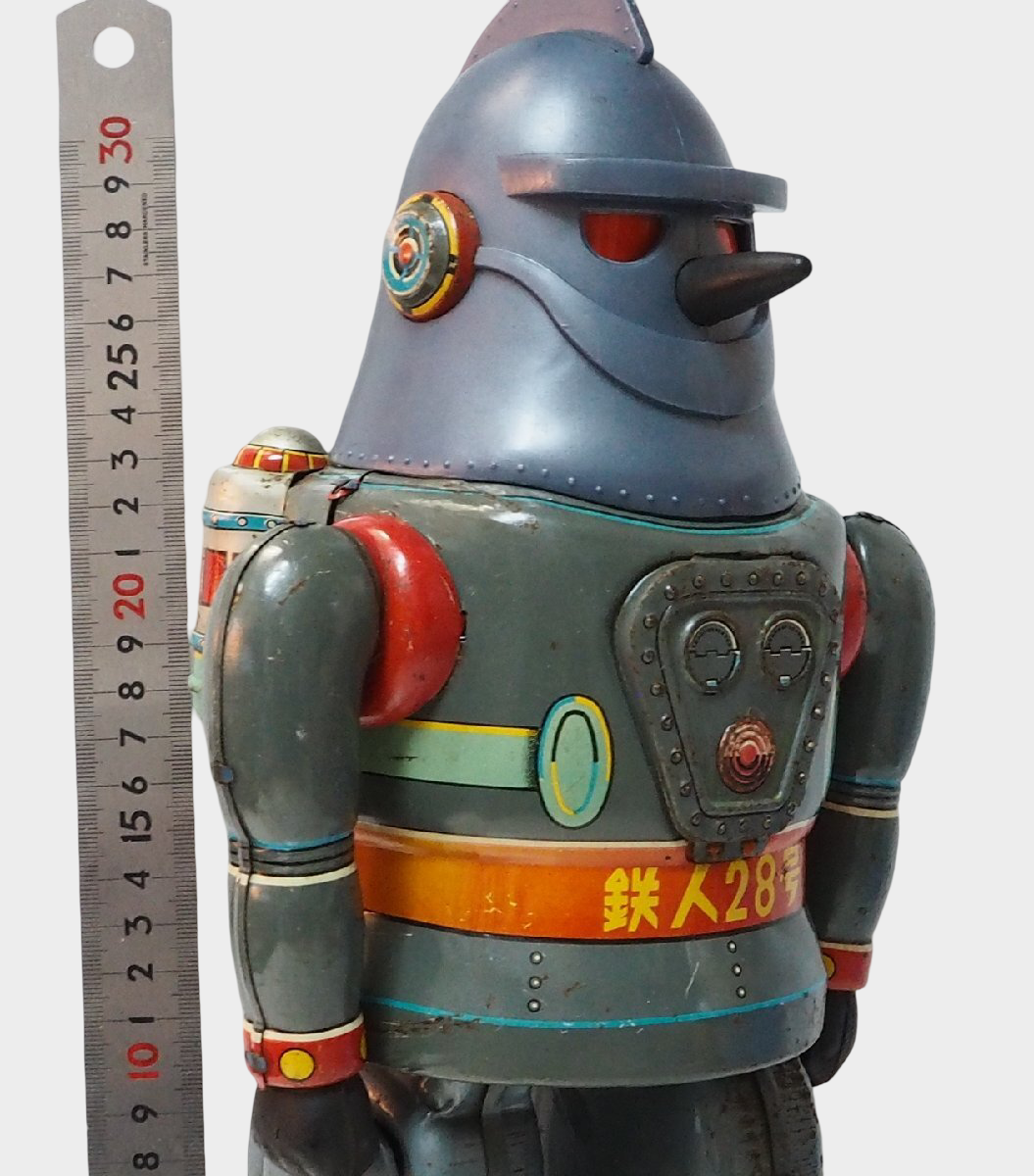
Nomura Tetsujin 28-go No.2 Silver Tin Robot Walking | Early Showa Japanese Giant Robot Toy
Couldn't load pickup availability
Have a reasonable price in mind? Submit your best offer and our concierge will review it personally.
OBJECT OVERVIEW
This is an early Nomura-produced Tetsujin 28-go No.2 tin robot in silver finish, representing one of the most foundational physical incarnations of Japan’s first giant robot hero.
The design is stark, industrial, and deliberate — silver-toned body panels, heavy rivet articulation, simplified chest controls, and weighted proportions that prioritize presence over ornament. This is the visual language of early Showa science fiction: utilitarian, mechanical, and slightly ominous.
The walking mechanism is present but currently not operating correctly, which is consistent with age, internal spring fatigue, or drivetrain resistance common in large-format Nomura robots of this period. Structurally, the figure remains complete, upright, and visually commanding.
WHO IS TETSUJIN 28-GO
Tetsujin 28-go is widely recognized as the first true giant robot in Japanese popular culture.
Created in 1956, Tetsujin predates piloted mecha entirely. The robot is not worn, entered, or merged with — it is remote-controlled, reflecting postwar anxieties around technology, power, and responsibility. This philosophical foundation directly influenced everything that followed: Mazinger, Gundam, Evangelion, and beyond.
Tetsujin robots from the 1950s–early 1960s are not just toys — they are physical artifacts of the birth of the mecha genre itself.
POSITION IN ANIME & TOY HISTORY
-
First generation giant robot icon
-
Pre-pilot, pre-super-robot era
-
Nomura examples are especially prized for:
-
Heavy-gauge tin
-
Bold mechanical silhouettes
-
Early walking mechanisms
-
Museum-grade shelf presence
-
Silver variants, in particular, read as more “industrial prototype” than character toy — a quality highly favored by advanced collectors.
CONDITION SUMMARY
-
Silver tin body with visible age wear consistent with Showa production
-
Paint loss, surface scuffs, and oxidation present
-
Walking mechanism currently not functioning correctly
-
Limbs, feet, and torso intact
-
Strong display integrity and balance
This piece is best understood as a display-grade historical robot, with optional mechanical restoration possible for advanced collectors.
COLLECTOR POSITIONING
This object belongs in:
-
Early Japanese robot collections
-
Showa-era tin archives
-
Mecha history–focused displays
-
Museum or study-room presentation
It pairs naturally with No.1 and No.3 Tetsujin variants, especially when contrasted across finishes (silver vs blue).
🤖 Tetsujin 28-go — the robot that haunts Japanese pop culture
Created by Mitsuteru Yokoyama, Tetsujin 28-go (known internationally as Gigantor) is not just Japan’s first giant robot icon—it is the moral ground zero of mecha. Where later robot anime celebrate mastery and heroism, Tetsujin 28-go is about control, guilt, and the afterlife of war.
If Astro Boy dreams forward, Big X carries inherited sin, and Anpanman embodies compassion, Tetsujin 28-go is the shadow they all step around.
🧠 What Tetsujin 28-go is really about
At the surface, a boy named Shotaro Kaneda commands a colossal robot via remote control to stop criminals. But the origin matters: Tetsujin 28-go was built as a secret wartime weapon during World War II. The war ends; the weapon remains.
This framing is unprecedented for children’s entertainment in the 1950s–60s:
-
The robot is not a hero by nature
-
It has no conscience
-
It is pure force, awaiting instruction
The question is never “Is Tetsujin good?”
The question is “Who is holding the controller?”
🧩 Comparisons with same-era giants
🌱 Astro Boy
-
Power source: benevolent science
-
Agency: internal conscience
-
Moral axis: empathy + coexistence
Astro Boy chooses to be good.
Tetsujin cannot choose at all.
This is the first major split in Japanese sci-fi ethics: autonomy vs obedience.
🕊️ Big X
-
Power source: human enhancement
-
Theme: inherited guilt
-
Burden: internalized
Big X turns guilt inward.
Tetsujin externalizes it—the guilt stands 30 meters tall and crushes buildings.
Both ask who must atone, but Tetsujin shows the damage spilling into public space.
👽 Ultraman
-
Power source: alien protector
-
Structure: organized defense
-
Violence: justified spectacle
Ultraman contains violence within ritualized battles.
Tetsujin’s violence is accidental, collateral, and frightening.
Cities are not stages; they are victims.
🎨 Why Tetsujin looks the way it does (this matters)
Tetsujin’s design is:
-
featureless
-
heavy
-
expressionless
This is intentional. He is not a character; he is an object.
Unlike later robots with faces, cockpits, or personalities, Tetsujin is closer to an industrial nightmare—a walking bomb that never learned the war was over.
This visual language influenced:
-
dystopian sci-fi
-
cautionary robot narratives
-
Japan’s deep ambivalence toward machines
🧭 Why Tetsujin predates and contradicts later mecha
Later giants like Mazinger Z and Gundam shift the paradigm:
-
robots become piloted
-
heroism becomes skill-based
-
violence becomes tactical
Tetsujin 28-go offers none of this comfort. There is no cockpit, no skill curve, no rite of passage. A child with a remote can level a city.
That terror is the point.
🧠 Cultural impact (quiet but foundational)
Tetsujin 28-go did three irreversible things to Japanese pop culture:
-
Linked robots to war memory
Even cheerful robots carry this DNA. -
Established “control” as the central mecha theme
Who commands? Who decides? Who bears responsibility? -
Normalized moral anxiety in children’s media
Japanese creators never forgot this lesson.
Every time a robot anime asks “Should we use this power?”, Tetsujin is in the room.
🏛️ Placement in Japanese retro anime history
| Axis | Representative |
|---|---|
| Hopeful future | Astro Boy |
| Weaponized past | Tetsujin 28-go |
| Inherited burden | Big X |
| Organized defense | Ultraman |
| Compassion | Anpanman |
Tetsujin 28-go is the hinge—the moment Japanese sci-fi admitted that progress does not erase history.
🕯️ Why Tetsujin 28-go still matters
Modern audiences sometimes find Tetsujin slow or bleak. That’s because it isn’t entertainment-first—it’s memory-first. It asks a question Japan was still wrestling with in the 1950s:
What do you do with the weapons you built when the war ends—but the damage doesn’t?
That question never went away.
It just learned to wear brighter colors.
TETSUJIN 28-GO: NO.1 vs NO.2 vs NO.3
Early Showa Tin Robot Lineage Explained
(Foundational context: Tetsujin 28-go)
Tetsujin 28-go is not just another robot character — it is the origin point of Japanese giant robot culture. The early Nomura tin series captures this moment before the genre split into super robot and real robot, when robots were still framed as autonomous weapons controlled remotely.
Within that lineage, No.1, No.2, and No.3 are not revisions — they are philosophical and industrial stages.
NO.1 — THE PROTOTYPE ICON
Identity
-
Earliest mass-market physical interpretation
-
Closest to manga-era conception
-
Most primitive mechanically and visually
Design Language
-
Simplest body geometry
-
Heavy, rounded torso
-
Minimal surface decoration
-
Often darker or muted finishes
-
Feels closer to a “weapon” than a character
Cultural Meaning
No.1 represents postwar anxiety made metal.
This is Tetsujin before nostalgia, before merchandising logic — a blunt embodiment of power without personality.
Collector Read
-
Rarest and most historically charged
-
Appeals to advanced, museum-grade collectors
-
Less visually playful, more austere
-
Often prized even in rough condition
Positioning Summary
Archaeological artifact of Japanese mecha history.
NO.2 — THE INDUSTRIAL STANDARD (SILVER ERA)
Identity
-
Transitional form
-
Most “machine-forward” version
-
Peak industrial aesthetic
Design Language
-
Cleaner symmetry
-
Refined proportions
-
Expanded chest panel detailing
-
Silver or muted metallic finishes dominate
-
Walking mechanism more emphasized
Why Silver Matters
Silver No.2 examples read as prototype machinery, not toys.
They visually align with early Showa visions of automation, factories, and remote warfare.
Cultural Meaning
No.2 is where Tetsujin becomes recognizable, but not yet friendly.
This is the robot as infrastructure — controlled, powerful, emotionally distant.
Collector Read
-
Strong demand from serious collectors
-
Silver variants command a premium
-
Ideal centerpiece for a focused robot display
-
Highly respected even without box
Positioning Summary
The purest expression of Tetsujin as a machine.
NO.3 — THE ICONIC HERO FORM
Identity
-
Most widely recognized version
-
Peak popularity model
-
Bridge between weapon and hero
Design Language
-
More expressive silhouette
-
Brighter accents
-
Bolder chest graphics
-
Slightly more animated posture
-
Strong shelf presence
Cultural Meaning
No.3 marks the moment when Tetsujin enters collective memory.
This is the version most people picture when they hear the name.
It represents the softening of postwar fear into adventure and nostalgia.
Collector Read
-
Broadest market appeal
-
Strong crossover between casual and advanced collectors
-
Boxed examples reach top-tier pricing
-
Ideal anchor piece for mixed collections
Positioning Summary
The canonical image of Tetsujin in popular culture.
SIDE-BY-SIDE COLLECTOR COMPARISON
| Variant | Core Identity | Visual Tone | Rarity | Market Strength |
|---|---|---|---|---|
| No.1 | Prototype weapon | Austere, raw | Very high | Institutional |
| No.2 | Industrial machine | Silver, mechanical | High | Strong, serious |
| No.3 | Cultural hero | Expressive, iconic | Moderate | Broad, liquid |
HOW THIS AFFECTS PRICING & NARRATIVE
-
No.1: priced for rarity and historical weight
-
No.2 (silver): priced for design purity and collector respect
-
No.3: priced for recognition and nostalgia liquidity
Silver No.2 pieces sit in a sweet spot:
-
Less common
-
More serious
-
More visually timeless
-
Less dependent on box condition for legitimacy
FINAL CURATOR NOTE
If No.1 is the birth, and No.3 is the memory,
then No.2 is the moment of truth — when Tetsujin fully becomes a machine worth fearing, studying, and preserving.
This is why silver No.2 examples consistently outperform expectations when presented with the correct narrative.
Authenticity & Stewardship
Evaluated under the Japonista Authentication Framework™:
- Material, carving, and surface-study comparison
- Iconographic and stylistic verification
- Condition and stability review (surface integrity)
- Construction assessment and handling-risk evaluation
Guaranteed 100% Authentic. Covered by the Japonista Lifetime Authenticity Warranty™.
A Note on Stewardship and Collecting
At Japonista, we approach Buddhist statues, sacred images, and ritual objects not merely as collectibles, but as cultural and spiritual artifacts deserving of respect, understanding, and careful presentation. Every piece we offer is thoughtfully examined, researched, and curated with sensitivity to its origin, meaning, and historical role.
Our role is not only to offer access to rare and meaningful objects, but to serve as responsible custodians—connecting the right works with collectors who value depth, intention, and authenticity.
Inquiries, Availability, and Private Consideration
Some of the cultural and heritage works may allow room for discussion, while others are held firmly due to rarity, condition, or cultural importance. All inquiries are reviewed personally and discreetly, and we welcome thoughtful questions or expressions of interest.
If you are exploring a particular theme, deity, lineage, or period—or seeking guidance in building a focused collection—our concierge team is always available to assist with quiet expertise and care.
Concierge Support & Collector Guidance
Japonista Concierge™ provides personalized assistance for collectors seeking deeper understanding, thoughtful acquisition, or long-term curation strategies. Whether your interest is devotional, scholarly, or aesthetic, we are here to help guide your journey with clarity and respect.
For select high-value or historically significant works, private reservation or structured payment arrangements may be available on a case-by-case basis. Please reach out to discuss eligibility and discreet options.
Before Proceeding
We kindly encourage collectors to review our shop policies and house guidelines, available through the links in our website footer, which outline shipping, handling, and conditions specific to vintage, sacred, and collectible works.
A Closing Note
Thank you for exploring Japonista’s collection of Oriental Cultural Heritage and arts. We are honored to share these meaningful works and to help place them where they may continue to be appreciated, studied, and respected.
If you have questions or wish to explore related works, please feel free to contact Japonista Concierge™ at any time.