Rare Vintage, Antiques and Art Collector / Curator / Personal Shopper From Japan
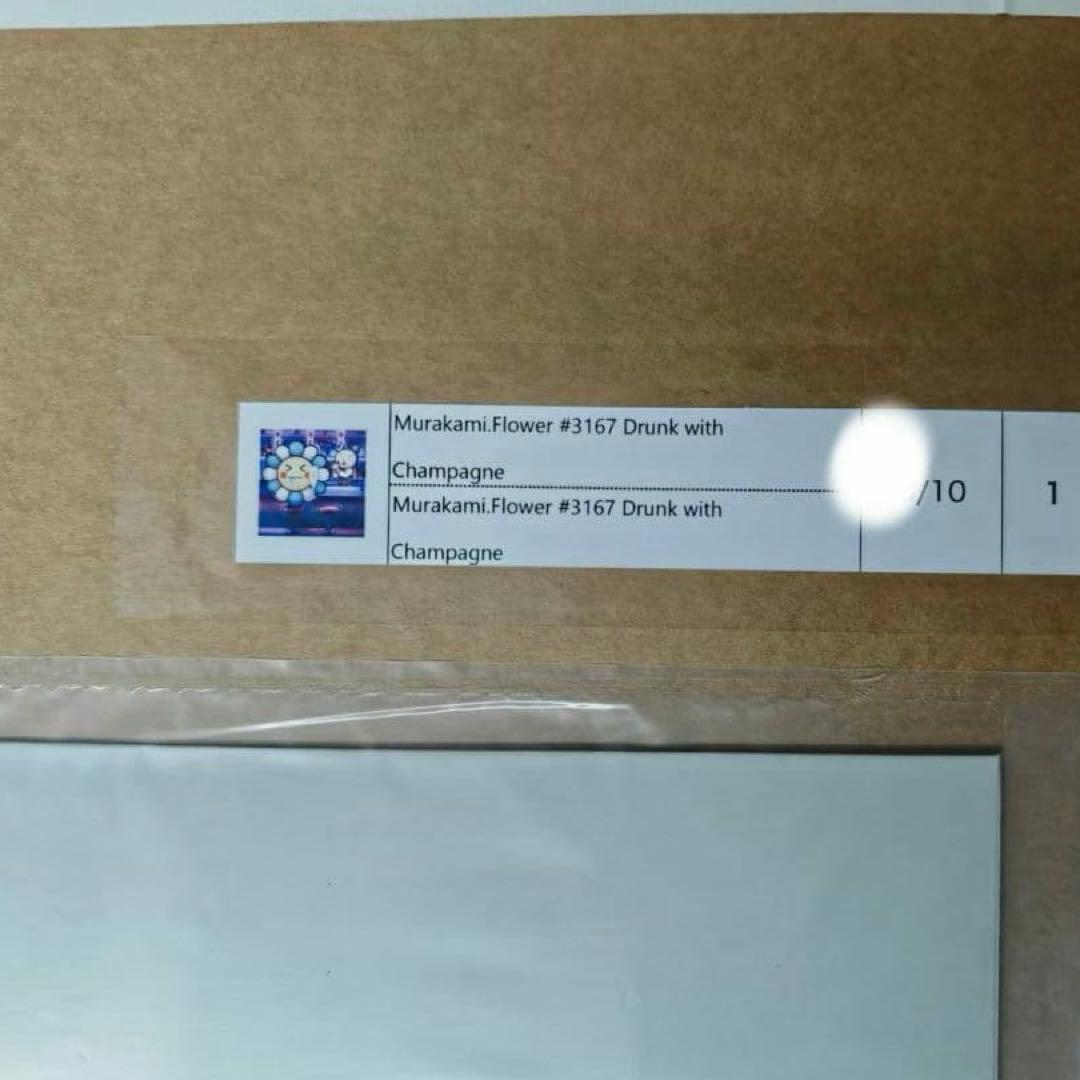
Takashi Murakami Flower #3167 Drunk with Champagne ED10 Rare UR Print Murakami Flowers Artwork
Takashi Murakami Flower #3167 Drunk with Champagne ED10 Rare UR Print Murakami Flowers Artwork
Couldn't load pickup availability
Have a reasonable price in mind? Submit your best offer and our concierge will review it personally.
Takashi Murakami
Murakami.Flowers #3167, “Drunk with Champagne”
Archival pigment print and silkscreen, edition of 10
A highly distinctive and unusually compressed work from Takashi Murakami’s Murakami.Flowers universe, “Drunk with Champagne” presents one of the artist’s most recognizable motifs not as a static icon, but as a fully staged emotional protagonist. Set within a bar interior illuminated in violet and blue tones, the central flower figure appears seated before a champagne flute, its expression shifting the familiar floral face into a comic yet psychologically charged state of intoxication.
The composition is notable for its narrative specificity. A secondary attendant figure appears in the background, reinforcing the image’s theatrical structure and transforming the work from a simple face variant into a scene of social performance and mild collapse. Murakami’s characteristic tonal precision remains intact, with the polished visual language of his flower imagery counterbalanced by an intentionally undignified emotional register.
Issued in an edition of only ten and preserved in unopened condition, the present work occupies an especially selective tier within the Murakami.Flowers corpus. It is distinguished not merely by rarity, but by its scenario-driven construction, emotional instability, and the way it extends Murakami’s floral vocabulary into a more narrative, atmospheric mode.
Object
Takashi Murakami “Murakami.Flowers #3167 – Drunk with Champagne”
Artist
Takashi Murakami
Series Context
Murakami.Flowers / character-scenario expansion within the Flower universe
Edition
ED 10
Rarity Tier
UR / ultra-low edition scenario print
Medium
Archival Pigment Print + Silkscreen
Image Size
400 × 400 mm
Sheet Size
500 × 500 mm
Condition Context
Preserved in unopened original box condition, with document inclusion noted
Visual Structure
Blue-white flower protagonist seated at a bar, champagne flute foreground, bartender-character in rear field, violet bar interior, intoxication-expression face variant
Collector Read
Not a generic Flower work, but a scene-based, emotional-state Murakami print with narrative density and extremely compressed edition size
A Flower After the Applause
Murakami’s flowers are so often encountered in daylight that people forget how strange they become at night.
This work belongs to that after-hours Murakami, the one who allows the smile to slip, the face to distort, the mood to tilt away from surface cheer into something more theatrical and unstable. The setting is not neutral. It is a bar, saturated in violet light, lined with bottles, staged like a low-lit interior where performance and emotional unraveling quietly meet. The flower sits at the counter not as an emblem, but as a character caught in a moment of private disarray.
The champagne flute does more than establish the title. It sharpens the entire emotional field of the image. Celebration becomes overindulgence. Elegance becomes absurdity. What could have been a simple joke becomes, in Murakami’s hands, something more uncomfortable and far more interesting: a flower that is no longer merely smiling for the world, but reacting to it.
Comedy with a Bruise Beneath It
Murakami has always understood that cuteness becomes more powerful when it is unstable.
The face here is not the usual flower expression of open accessibility. The eyes are squeezed shut, the mouth pulled into a grimace, the small trace of blue dribbling downward introducing a bodily awkwardness that is almost slapstick at first, then faintly pathetic, then oddly human. That sliding emotional register is central to the piece. The image keeps changing as you look at it. It begins as a joke and ends as an exposure.
This is one of Murakami’s oldest strengths: to make an image operate simultaneously as pop icon, comic tableau, and psychological leak. He understands that repetition alone is not enough. The icon has to crack. It has to reveal a state.
And here, the state is intoxication—not glamorous intoxication, but the kind that loosens the face, dissolves dignity, and leaves expression half-performed, half-accidental.
The Bar as Stage Set
The background matters tremendously. Without it, this would simply be a variant face. With it, the work becomes narrative.
The bar interior is rendered in glowing purples and neon-inflected blues, giving the whole composition a theatrical artificiality. It feels cinematic, but not in a grand sense. More like a small scene from a strange animated universe in which everything is overlit and emotionally undercontrolled. The bottles arranged behind the counter turn the space into an index of adult ritual, while the two stools in the foreground amplify the loneliness of the central figure. One is occupied. One is not. That emptiness is subtle, but it changes the mood.
Then there is the attendant figure in the background, smiling, pouring, participating. This secondary character is crucial because it prevents the scene from becoming an isolated gag. The flower is not alone in abstraction. It is situated socially. Someone is there. Someone is serving. Someone is witnessing. Suddenly the image is not just about drunkenness, but about public drunkenness, about being seen in a compromised state, about performance extending beyond comfort.
A Flower Universe That Learns to Act
Many Murakami collectors first encounter the flowers as symbols. Works like this reveal that they are also actors.
What makes this print far more important than a standard floral variant is that it shifts the flower from icon into protagonist. It is no longer functioning only as a repeated unit of visual language. It has entered a scene, acquired a circumstance, and adopted a temporary emotional identity. The flower is now living inside a world rather than merely decorating one.
That is a major distinction.
When Murakami’s figures begin to act, the entire system deepens. The flowers cease to be endlessly interchangeable and instead become capable of specific moods, scenarios, and stories. In that sense, “Drunk with Champagne” belongs to a more narratively advanced phase of the Flower universe. It expands the work from graphic repetition into emotional theater.
Color, Light, and the Liquefaction of Control
The palette is doing more than creating atmosphere. It is producing psychological slippage.
The cool blue-white petals of the central figure would normally suggest softness or clarity, but against the saturated violet room they begin to feel unstable, almost chemically altered by the environment. The orange cheeks push the face toward flushed embarrassment. The champagne glass introduces a pale gold vertical accent that momentarily steadies the composition, only to heighten the absurdity of the figure beside it.
Everything in the image appears slightly overlit yet emotionally off-balance. That is precisely the point. Intoxication here is not represented through blur, but through chromatic dissonance. The world remains sharp. The subject does not.
This is a more sophisticated solution than simple distortion. Murakami lets the environment remain controlled so that the flower’s loss of control feels sharper by contrast.
Why the Edition Size Changes the Entire Reading
An edition of ten completely alters how this work should be understood.
Without that number, the piece might still be charming, strange, and collectible. With it, it becomes sharply selective. Murakami has produced many Flower works, but not all Flower works are equal in edition compression, tonal specificity, or scene-based distinctiveness. A print like this belongs to a much thinner layer of the market. It is not just rare in the numerical sense. It is rare in the narrative sense.
Collectors who chase only the broadest Murakami signals often overlook works like this because they appear, at first glance, more playful than monumental. That is a mistake. Ultra-low editions with specific emotional scenarios tend to age very well, precisely because they reveal something less standardized in the artist’s output. They feel less like brand extensions and more like authored moments.
This is one of those works.
The Strange Elegance of a Slightly Undignified Image
The title is wonderfully important. “Drunk with Champagne” is not “drinking champagne.” It is not “with champagne glass.” It is a state-title. A condition-title. It foregrounds effect, not action. That means the work is already presenting itself as an emotional situation rather than an object depiction.
And that is what gives it strange elegance. Murakami is not simply showing luxury consumption. He is showing what comes after the luxury signifier has entered the body and begun to embarrass the self. The champagne, culturally coded as refinement and celebration, becomes the instrument of facial collapse. Prestige liquefies into comic vulnerability.
That inversion is subtle, but it is exactly the sort of tonal intelligence that separates stronger Murakami works from merely marketable ones.
Authenticity & Stewardship
Evaluated under the Japonista Contemporary Art Authentication Framework™:
• Artist attribution, studio verification, and edition confirmation
• Print process, material composition, and production context review
• Condition assessment across surface, framing, and structural integrity
• Release provenance and documentation evaluation
Guaranteed 100% Authentic.
All works are curated and backed by the Japonista Lifetime Authenticity Warranty™.
A Note on Superflat, Commercial Layering & Art Market Context
Murakami’s practice and the Kaikai Kiki studio operate within the intersection of fine art, commercial production, and mass-media aesthetics. Superflat dissolves hierarchy between gallery and marketplace, elevating pop iconography to conceptual discourse.
At Japonista, we treat Murakami and Kaikai Kiki works as contemporary canon. Surface integrity, print clarity, and edition accuracy are examined with institutional discipline, preserving artistic intent rather than speculative hype.
Our role is to steward these works within their proper art-historical and market context, connecting them with collectors who understand both conceptual lineage and edition structure.
Inquiries, Availability, and Private Consideration
Certain works are held firmly due to edition limitation, release context, or condition tier. All inquiries are handled discreetly, and we welcome thoughtful discussion regarding provenance, authentication documentation, or collection strategy.
If you are building a focused contemporary art archive—by series, era, or studio collaboration—our team is available to provide informed guidance.
Concierge Support & Collector Guidance
Japonista Concierge™ provides personalized assistance for collectors seeking deeper insight into edition hierarchies, release cycles, and long-term preservation strategies for contemporary works.
Whether your interest is exhibition display, investment alignment, or art-historical study, we guide each acquisition with clarity and market literacy.
For select high-value works, private reservation or structured arrangements may be available on a case-by-case basis.
Before Proceeding
We kindly encourage collectors to review our shop policies and documentation guidelines, which outline condition transparency, edition verification standards, and shipping precautions specific to contemporary art works.
A Closing Note
Thank you for exploring Japonista’s curated Takashi Murakami & Kaikai Kiki archive. These works exist at the intersection of art theory, commercial production, and global cultural dialogue—and we are honored to steward them with institutional seriousness.
If you have questions or wish to explore related items, please feel free to contact Japonista Concierge™ at any time.