Rare Vintage, Antiques and Art Collector / Curator / Personal Shopper From Japan
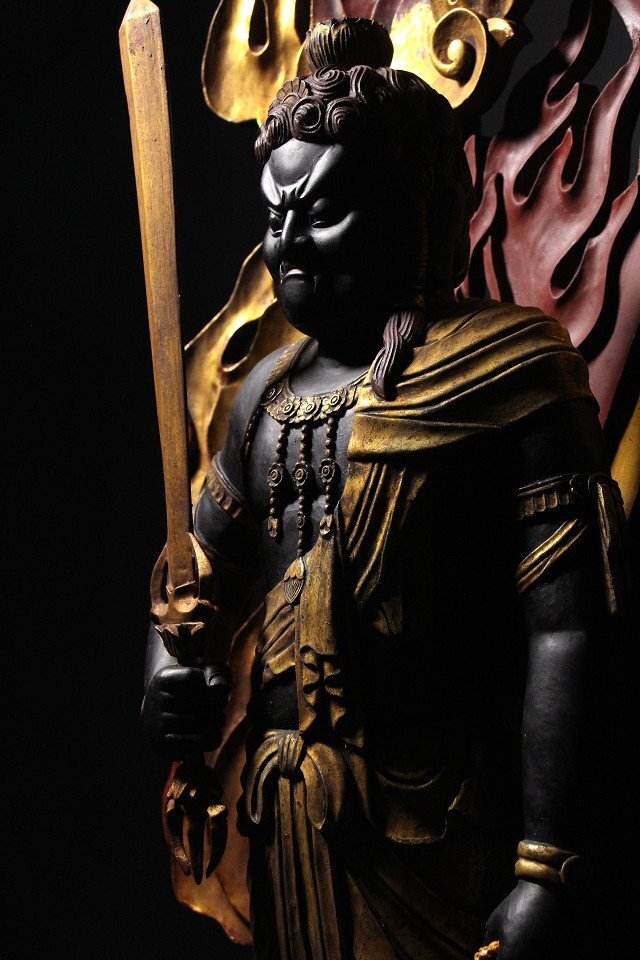
Monumental Polychrome Fudo Myoo (Acala) Standing Guardian — Carved Wood Statue (~127 cm)
Monumental Polychrome Fudo Myoo (Acala) Standing Guardian — Carved Wood Statue (~127 cm)
Couldn't load pickup availability
Have a reasonable price in mind? Submit your best offer and our concierge will review it personally.
There are Buddhist sculptures that decorate a room, and then there are sculptures that change the room’s gravity. A standing Fudo Myoo at roughly 127 cm belongs to the second category: a hall-scale presence designed to anchor attention, discipline, and protection. Even in private collection, this is not “display art” first — it is an icon of practice, an object whose visual language was engineered to confront hesitation and cut through inward noise.
Fudo Myoo (Sanskrit: Acala, “the Immovable One”) is a Wisdom King — a protector manifestation in Esoteric Buddhism. That category matters. A Wisdom King is not presented as gentle because the compassion here is expressed as force: the force required to stop what harms beings, the force required to break addiction to delusion, the force required to keep vows intact when the mind wants to drift. In temple settings, these images often stand where people pass, bow, petition, or recommit — because the figure does not negotiate. It stabilizes.
In Japanese Esoteric lineages (especially Shingon and also Tendai esoteric streams), Fudo is the archetype of unwavering clarity. The face appears wrathful, but the doctrine is precise: the “wrath” is not personal anger. It is the intensity of awakened compassion that refuses to permit self-destruction — the kind of compassion that intervenes. When collectors say a Fudo is “powerful,” the deeper meaning is that the iconography is doing its job: it makes complacency uncomfortable.
Museum-Grade Scale
At ~127 cm, the sculpture moves from shelf-object to architectural participant. This height creates a torso-level encounter for most viewers, which is the threshold where a figure begins to feel like a presence rather than a figurine. Larger Fudo images were historically more likely to be commissioned for temple halls, sub-altars, or prominent devotional placements, because they needed to read at distance, hold ritual space, and remain visually authoritative under changing light.
Museum-grade here is not “perfect condition.” Museum-grade is a combination of scale, iconographic completeness, credible age-character, and sculptural command. A standing Fudo with a full flame aura (the “flame mandorla”) is structurally complex — it is not the easiest format to produce or preserve. When a piece survives at this size with its principal elements intact, it becomes a centerpiece candidate by default.
Triads, Ensembles, and Meaning
A “triad” in Buddhist art is a three-figure arrangement where the central figure expresses the primary principle, and the flanking figures complete the doctrinal “sentence.” In many traditions, triads encode cosmology: salvation or awakening is not a solo claim — it is a relationship of vows, assistance, and proof. Triads also communicate hierarchy: who stands at the center, who attends, who protects, who guides.
Fudo is frequently understood within a wider protective “family” of icons. Some arrangements place Fudo as the central stabilizer among attendants; other contexts emphasize Fudo alongside other protectors. Even when the object is a single sculpture, esoteric presentation is ensemble-minded: the sword, rope, flame aura, stance, and base together function like a “triad in components” — three-dimensional theology where each element completes the meaning of the whole.
Who Is This Deity
Fudo Myoo (Acala) is the “Immovable One,” a Wisdom King in Esoteric Buddhism. The fierce appearance is not anger — it is compassionate intervention expressed with intensity, meant to protect vows, restrain harm, and burn away delusion.
Iconography Decode
- The Sword: symbolizes cutting ignorance, obsession, and destructive mental loops.
- The Rope: symbolizes saving by force — pulling beings back from danger and restraining what must be restrained.
- The Flame Aura: symbolizes transformation through burning away delusion; it is not decorative.
- Standing Stance: reads as active guardianship; at this scale it becomes a statement of presence.
- Polychrome Surface: historically used for legibility in temple interiors; age wear is part of life-history when the structure remains coherent.
Why Collectors and Institutions Pursue This Category
Because it is not interchangeable. A 127 cm esoteric guardian is an event-piece. It can define an entire room, collection, or exhibition narrative: “Esoteric Japan,” “Temple Protectors,” “Wrathful Compassion,” “Ritual Presence,” “Showa Devotional Sculpture.” If your collecting is centered on presence, not ornament, this is the category that earns the word “centerpiece.”
This size also bridges private and institutional sensibilities. Museums and serious collections often prefer works that communicate at distance, photograph with authority, and provide interpretive density — exactly what a large Fudo does, even before labels are written.
Condition
This work presents age-related wear consistent with an older polychrome wooden sculpture. Reported/observed issues include: surface fading, abrasions, dirt/soiling, losses/peeling, small dents, and signs of prior stabilization/repair. These do not automatically reduce the sculpture’s cultural value, but they must be approached as part of responsible stewardship. The sculpture should be assessed in person for structural stability, join integrity, and the condition of the flame aura elements.
Dimensions
- Approx. Width: 51 cm
- Approx. Depth: 35 cm
- Approx. Overall Height: 127 cm
Materials
Carved wood with layered ground and polychrome pigments, possibly with lacquered or sealed surface elements. Some minor fixes and restoration.
Collector Relevance
This is for the collector who wants an anchor-piece — not a small accent. It suits a high-ceiling interior, a dedicated alcove, a gallery wall with controlled lighting, or a private “study hall” arrangement where the piece is allowed to command space.
Collector’s Resonance
For people drawn to discipline, practice, and clarity — for collectors who respond to sacred objects as lived artifacts rather than décor. If you curate a room the way a temple curates a hall — with intention, distance, and silence — this sculpture will make sense immediately.
Confidence & Verification Notes
- Period attribution is treated as a plausible estimate, not a guaranteed fact.
- Polychrome wooden sculpture condition varies widely; restoration and stabilization may exist.
- Please verify: wood joins, internal cracking, flame aura stability, base stability, and any active flaking.
- If institutional acquisition is intended, a conservator condition review is recommended.
Authenticity & Stewardship
Evaluated under the Japonista Authentication Framework™:
- Material, carving, and surface-study comparison
- Iconographic and stylistic verification
- Condition and stability review (surface integrity)
- Construction assessment and handling-risk evaluation
Guaranteed 100% Authentic. Covered by the Japonista Lifetime Authenticity Warranty™.
A Note on Stewardship and Collecting
At Japonista, we approach Buddhist statues, sacred images, and ritual objects not merely as collectibles, but as cultural and spiritual artifacts deserving of respect, understanding, and careful presentation. Every piece we offer is thoughtfully examined, researched, and curated with sensitivity to its origin, meaning, and historical role.
Our role is not only to offer access to rare and meaningful objects, but to serve as responsible custodians—connecting the right works with collectors who value depth, intention, and authenticity.
Inquiries, Availability, and Private Consideration
Some of the cultural and heritage works may allow room for discussion, while others are held firmly due to rarity, condition, or cultural importance. All inquiries are reviewed personally and discreetly, and we welcome thoughtful questions or expressions of interest.
If you are exploring a particular theme, deity, lineage, or period—or seeking guidance in building a focused collection—our concierge team is always available to assist with quiet expertise and care.
Concierge Support & Collector Guidance
Japonista Concierge™ provides personalized assistance for collectors seeking deeper understanding, thoughtful acquisition, or long-term curation strategies. Whether your interest is devotional, scholarly, or aesthetic, we are here to help guide your journey with clarity and respect.
For select high-value or historically significant works, private reservation or structured payment arrangements may be available on a case-by-case basis. Please reach out to discuss eligibility and discreet options.
Before Proceeding
We kindly encourage collectors to review our shop policies and house guidelines, available through the links in our website footer, which outline shipping, handling, and conditions specific to vintage, sacred, and collectible works.
A Closing Note
Thank you for exploring Japonista’s collection of Oriental Cultural Heritage and arts. We are honored to share these meaningful works and to help place them where they may continue to be appreciated, studied, and respected.
If you have questions or wish to explore related works, please feel free to contact Japonista Concierge™ at any time.