Rare Vintage, Antiques and Art Collector / Curator / Personal Shopper From Japan
Monumental Kutani Ware Maneki-neko — Left-Paw Beckoning Fortune Cat — Large Hand-Painted Ceramic Sculpture (43 cm)
Monumental Kutani Ware Maneki-neko — Left-Paw Beckoning Fortune Cat — Large Hand-Painted Ceramic Sculpture (43 cm)
Couldn't load pickup availability
Have a reasonable price in mind? Submit your best offer and our concierge will review it personally.
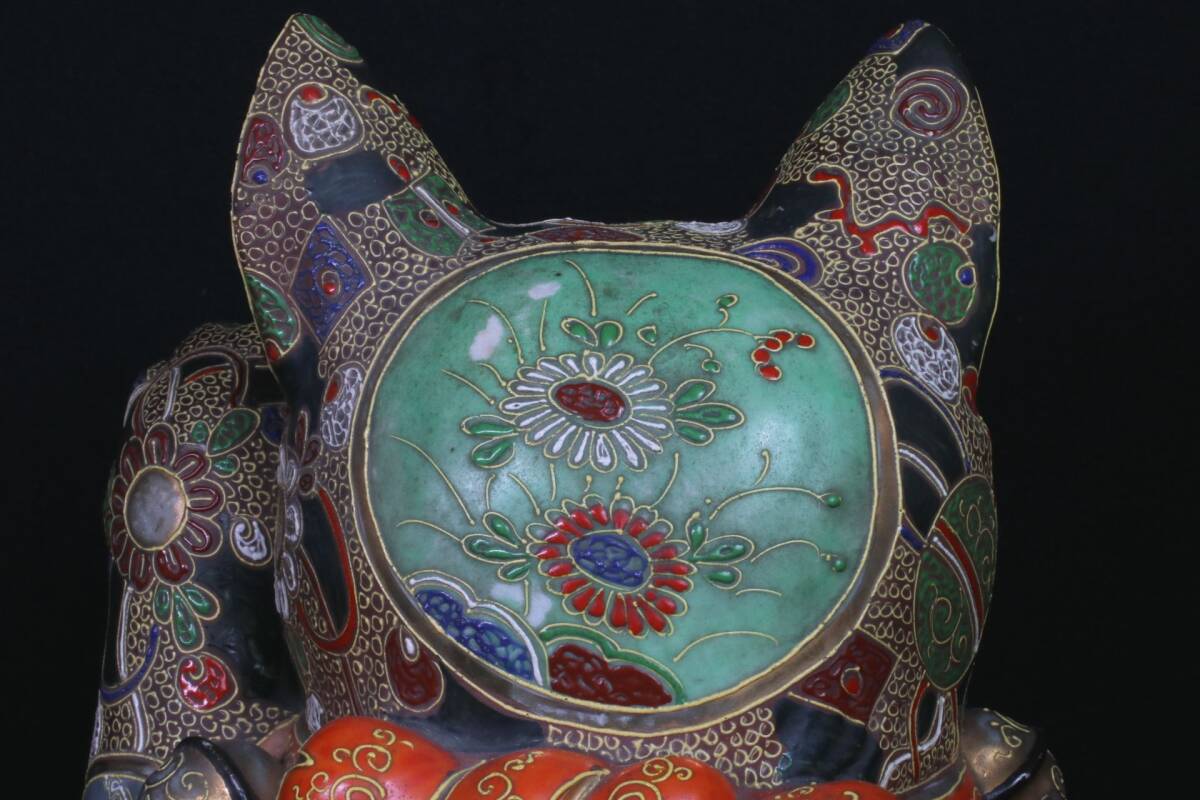
A monumental Kutani ware maneki-neko (beckoning cat) executed as a large-format ceramic sculpture with the left paw raised in the classic gesture of invitation and welcome. Rich, textile-like surface decoration and substantial mass make this an interior anchor object rather than a small curio.
Overview & Cultural Context
This is a large-format Kutani ware Maneki Neko—Japan’s “beckoning cat” icon—rendered at approximately 31 cm in height, where the object stops behaving like a small curio and starts functioning as a room-defining folk sculpture. Pieces at this scale are designed to be seen from across a space: the silhouette reads instantly, while the surface rewards closer viewing through dense pattern work and a ceremonial use of gold.
Maneki Neko imagery belongs to the everyday sacred—the kind of domestic talisman that lives in shopfronts, entrances, reception rooms, and family spaces where people want the atmosphere to feel favorable. The icon does not promise “magic”; it frames a worldview. The figure quietly teaches that good fortune is something you cultivate through steady effort, social trust, and a readiness to welcome opportunity when it arrives.
Kutani ware is a particularly persuasive home for this subject because the tradition understands color as authority. Vivid enamels, deliberate segmentation of pattern fields, and selective gilding can make a single figure feel celebratory without becoming loud. When done well, the decoration reads as intentional “auspicious density”—a visual language that signals abundance, continuity, and care.
At this height, the Maneki Neko also becomes a design object. It can anchor a shelf, console, bar top, or entry vignette in the same way a statement sculpture would—except it carries a cultural narrative that collectors and guests immediately recognize. This is the kind of piece that does not disappear into a collection; it sets the tone of the room.
Material, Technique & Artistic Character
Kutani ware typically employs overglaze enamels—layers of color applied over a ceramic body and fired to achieve saturation and clarity. In polychrome works, the craft challenge is not merely “adding color,” but balancing enamel thickness and transitions so that the surface stays crisp rather than heavy. Gilt accents add a second register: not just shine, but a controlled highlight system that guides the eye across the composition.
On large Kutani figures, surface planning matters. The best examples show disciplined spacing: pattern density increases where symbolic emphasis is intended (garments, bibs, medallions), while quieter zones allow the form to breathe. This creates readability at distance and complexity up close—exactly what display-grade sculpture requires.
The overall impression is celebratory but composed. That balance is one reason Kutani figures continue to appear in high-visibility settings—public-facing interiors where the owner wants warmth and auspiciousness without sacrificing refinement.
Iconography & Meaning
Maneki Neko iconography varies (raised paw, collar details, bib styling), but the core meaning remains stable: invitation, welcome, and the social flow that creates prosperity. In Japanese visual culture, the “beckoning” gesture is less about commanding fortune and more about opening the door to it—an icon of readiness and good conditions.
As a symbolic object, the Maneki Neko also works because it is friendly. Unlike severe guardians, it communicates approachability and optimism—qualities that make it especially effective for businesses, hospitality environments, and communal spaces where mood matters.
Why Collectors Buy This
Large-format Kutani folk figures are disproportionately difficult to keep pristine: they are tall, visually complex, and require careful storage and shipping. That practical reality makes intact examples feel scarcer over time—especially those with confident color, clear facial modeling, and a strong “presence” that reads as intentional rather than novelty.
Collectors also value this subject because it is instantly legible across cultures while still being authentically Japanese in its visual logic. It functions as both a collectible and an interior anchor: one object that can carry a corner of a room and make it feel “set.”
Finally, the piece is emotionally useful. It’s the kind of object people keep near the threshold of their lives—entryways, workspaces, counters—because it embodies the idea that good outcomes are something you invite through consistency.
Why the Beckoning Cat Matters
The maneki-neko is among Japan’s most enduring symbols of good fortune. The raised paw functions as a visual invitation—welcoming people, opportunity, and auspicious flow into a space. At monumental scale, the iconography becomes architectural: a statement of intention as much as décor.
Craft, Surface & Visual Density
Kutani ware is prized for high-saturation color, intricate linework, and confident overglaze patterning. This piece treats the body as a continuous canvas—dense motif fields, medallion-like emblems, and layered floral/arabesque ornament arranged to follow the figure’s form and keep the composition coherent from every angle.
Condition
Pre-owned with age-related storage wear. The listing notes areas of scuffing, surface grime, and possible localized paint loss. Please review all photographs carefully for exact condition, texture, and any surface irregularities.
Dimensions & Weight
- Height: approx. 43 cm
- Weight: approx. 8.7 kg
Collector’s Resonance
Best suited for collectors and interior curators who prefer symbolic objects with genuine material presence—large-format ceramics that function as both decorative sculpture and cultural iconography. Ideal as a reception statement, boutique anchor piece, or a deliberate focal object within an Asian decorative arts cabinet.
Shipping & Logistics
Due to size and mass, this item ships as a carefully protected heavy parcel. Estimated packed weight: 13-16 kilos.
Confidence & Verification Notes
Attribution to Kutani ware is based on the listing language and visual style cues consistent with Kutani overglaze decoration. Exact kiln, artist, and production decade are not confirmed unless explicitly stated in the listing imagery. Please rely on photographs for stamps/marks and surface condition, and consider third-party appraisal if investment-grade precision is required.
Key Facts
- Object type: Kutani ware Maneki Neko (Lucky Cat) — polychrome & gilt ceramic figure
- Cultural role: Domestic/merchant auspicious icon (welcome, prosperity, good conditions)
- Material: Ceramic with overglaze enamels; gilt accents
- Country of origin: Japan
- Condition: Age-appropriate wear expected; please rely on photos for exact surface state
Condition Notes
The listing indicates no major visible damage; with older polychrome ceramics, minor surface rubs, micro-scratches, and small spots of wear can appear in high points and edges. This is normal for display objects that have lived in real interiors. What matters most is structural stability, facial integrity, and the overall legibility of the painted and gilt surface—this example presents as display-grade at a glance.
Collector’s Resonance
This is for the buyer who wants an object that changes the feeling of a space: a shop owner shaping an entrance, a collector building an altar-like display shelf of Japanese folk icons, or a design-forward home where one statement piece can carry warmth, humor, and cultural intelligence at once.
Explore Our Services
If you would like white-glove packing, multi-item consolidation, or destination-specific shipping strategy, explore our Concierge Logistics options.