Rare Vintage, Antiques and Art Collector / Curator / Personal Shopper From Japan
Miyabi Musubi × ZENBU Reversible Sukajan Maeda Keiji Matsukaze Samurai Horse Skull Sakura Embroidered Jacket
Miyabi Musubi × ZENBU Reversible Sukajan Maeda Keiji Matsukaze Samurai Horse Skull Sakura Embroidered Jacket
Couldn't load pickup availability
Have a reasonable price in mind? Submit your best offer and our concierge will review it personally.
Rare Black, Ivory and Gold Japanese Souvenir Bomber with Kabukimono Warrior, Legendary Horse, Cherry Blossoms, Sakura Skull and Monochrome Tattoo-Art Reverse
Description
A spectacular reversible sukajan by Miyabi Musubi × ZENBU, built around the flamboyant warrior mythology associated with Maeda Keiji, his legendary black horse Matsukaze, and the fearless spirit of the kabukimono.
The principal face combines a deep black satin body with luminous ivory sleeves, gold piping and black ribbed trims. Across the back, a mounted samurai appears on a powerful black horse, surrounded by cascading cherry blossoms, ornamental gold arabesques, a prominent plum-blossom crest and embroidered phrases including “DAIFUHENMONO” and “TENKA MUSOU.” Pink sakura flows onto one sleeve, while the opposite sleeve is decorated with the long red shafts and metallic spearheads of traditional polearms.
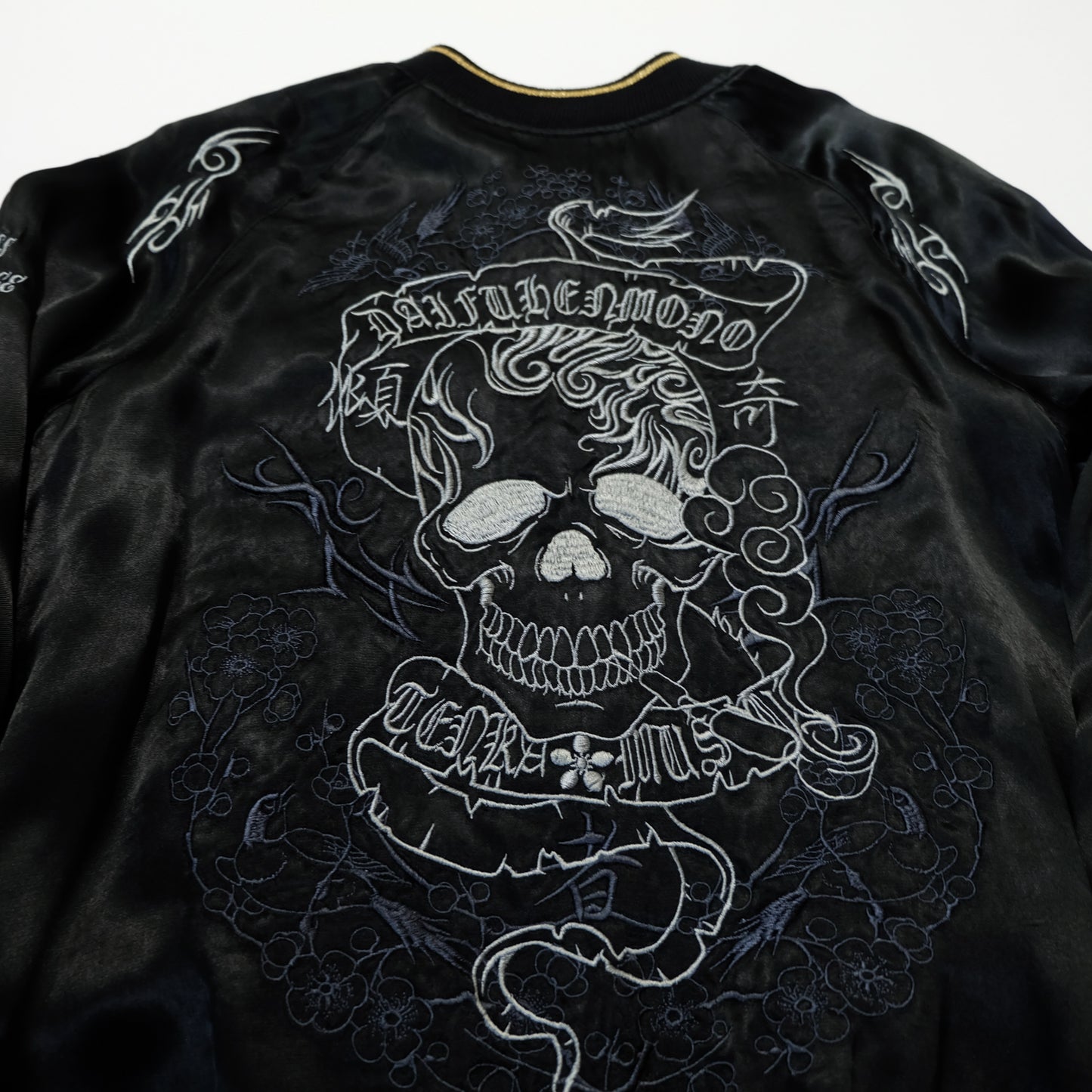
Turn the jacket inside out and the visual language becomes darker, quieter and more graphic. The second face is almost entirely black, using silver-gray embroidery to depict a large skull, banners, flowers, stylized smoke, birds and tattoo-like ornamental lines. Small chest crests, Japanese calligraphy and embroidered lettering complete the monochrome reverse.
One face is theatrical, richly colored and historical. The other is shadowed, skeletal and almost rock-and-roll in character. Together they create a rare piece of Japanese embroidered streetwear with two genuinely complete identities.
Opening Impression
The first face feels like an embroidered battle legend exploding into bloom.
A black warhorse advances from the center of the composition, its muscles and bridle defined in silver, charcoal, green and red thread. The rider rises above it in elaborate armor, framed by gold ornament and pale-pink blossoms. The surrounding floral embroidery is so dense that the warrior and horse appear to emerge through a living curtain of sakura.
The second face strips away most of the color. A large silver skull occupies the back beneath Gothic banners and faintly outlined flowers, birds and smoke. What was opulent and ceremonial on the first side becomes stark, rebellious and nocturnal on the reverse.
This is not a simple souvenir jacket with a decorative lining. It is two fully conceived works of wearable art sharing one garment.
Identification and Subject
Brand: Miyabi Musubi × ZENBU
Garment type: Fully reversible sukajan
Also known as: Japanese souvenir jacket, Yokosuka jacket, embroidered satin bomber
Primary subject: Maeda Keiji-inspired warrior riding Matsukaze
Secondary subject: Sakura skull and monochrome kabukimono tattoo imagery
Primary colors: Black, ivory, gold, pink, silver, red and green
Reverse colors: Black, silver-gray and muted metallic gold
Primary motifs: Samurai warrior, black horse, cherry blossoms, plum crest, spears, skull, birds, smoke, flowers, banners and Japanese calligraphy
Style categories: Wagara fashion, amekaji, Japanese streetwear, tattoo art, archive fashion and collectible embroidered outerwear
The embroidery prominently incorporates the expressions:
- DAIFUHENMONO / 大ふへん者
- TENKA MUSOU / 天下無双
- 傾奇御免
- “LARGENESS INCONVENIENCE PERSON”
These deliberately eccentric phrases reinforce the jacket’s kabukimono theme: fearless individuality, flamboyant dress, defiance of convention and an unapologetically outsized personality.
Maeda Keiji and Matsukaze Face
The Mounted Warrior
The central rider is presented in dark armor with vivid blue, red, gold and orange accents.
His helmet and armor rise above the horse’s mane, while the surrounding gold embroidery forms an ornate frame around his upper body. The use of black thread against the black satin prevents the figure from becoming a flat block of color. Instead, the rider emerges gradually through outlines, metallic highlights and flashes of saturated thread.
The composition draws from the legendary image of Maeda Keiji as an unconventional warrior, celebrated not only for martial strength but for theatrical dress, independence and indifference toward ordinary social expectations.
The rider is not shown in a conventional battlefield charge. He appears almost ceremonially enthroned upon the horse, surrounded by blossoms and ornament like a figure from a richly decorated folding screen.
Matsukaze, the Legendary Black Horse
The horse dominates the center of the back.
Its head is held high, mouth open and ears alert, creating a strong sense of motion and personality. White and silver highlights define the mane, face and muscular structure, while red, green and orange details describe the saddle cloth, reins and decorative tack.
The horse’s dark coloring allows it to merge into the black satin from a distance. At closer range, the dense line embroidery reveals a remarkably complex figure.
Matsukaze is central to the Maeda Keiji visual tradition. The horse represents speed, loyalty, untamed strength and freedom from restraint. Paired with Keiji, it becomes an extension of the warrior’s own rebellious character.
Cherry Blossom Cascade
A dense mass of pink, lavender, white and pale-blue cherry blossoms travels diagonally across the horse, rider and lower back.
Some blossoms remain attached to brown branches. Others scatter freely across the black surface, creating the impression of wind carrying petals through the composition.
The cherry blossom introduces beauty and impermanence into an image otherwise dominated by war, armor and physical strength. The petals soften the horse’s dark body while making its silhouette more visible against the black ground.
The same sakura embroidery continues along one sleeve inside a black vertical stripe, visually extending the back design around the wearer’s arm.
Gold Arabesque Ornament
Metallic-gold floral scrolls frame the entire central scene.
These elaborate curves recall lacquer decoration, brocade textiles, temple ornament and the curling botanical motifs found in traditional Japanese decorative arts. Their near-symmetrical placement gives the composition an almost heraldic structure.
The gold embroidery is especially dense around the shoulders, lower back and sides of the horse. Against black satin, it produces a dramatic illuminated effect, resembling metalwork laid over dark lacquer.
Plum-Blossom Crest
A large five-petaled floral crest appears above the rider.
Rendered in dense gold thread, it resembles the plum-blossom heraldry traditionally connected with the Maeda visual tradition. Its placement at the top of the composition functions almost like a seal, family emblem or ceremonial crown.
The crest is repeated in silver on the monochrome reverse, creating continuity between both faces.
“DAIFUHENMONO”
The Gothic embroidered lettering across the upper back reads “DAIFUHENMONO.”
The phrase references the celebrated 大ふへん者 expression associated with Maeda Keiji. Its intentionally ambiguous and eccentric character suits the kabukimono ideal perfectly: a person of exceptional boldness who refuses to fit neatly within ordinary expectations.
The jacket reinforces this wordplay through the unusual English phrase embroidered on the front:
LARGENESS
INCONVENIENCE
PERSON
Rather than presenting polished modern English, the phrase appears intentionally literal and strange, giving the jacket an unmistakable piece of Japanese subcultural design language.
“TENKA MUSOU”
A pale banner beneath the gold crest carries the wording “TENKA MUSOU.”
天下無双 may be understood as “peerless beneath heaven” or “without equal in the realm.” Within the composition, it functions as a declaration of unrivaled courage and individuality.
Placed above the mounted warrior, the phrase completes the heroic, larger-than-life atmosphere of the embroidered scene.
Black, Ivory and Sakura Front
Sakura Skull
One chest features a skull formed almost entirely from pink cherry blossoms.
Tiny blossoms and petals build the forehead, eye sockets, cheekbones and jaw, allowing a symbol of mortality to emerge from flowers associated with fleeting beauty.
The skull is not isolated. A stream of petals continues downward toward the pocket, making it appear to dissolve back into sakura.
This pairing creates one of the jacket’s strongest visual ideas: life and death rendered through the same flower.
Kabukimono Lettering
The opposite chest carries large gold Japanese characters layered behind the embroidered English phrase:
LARGENESS
INCONVENIENCE
PERSON
The arrangement feels closer to a tattoo design, band graphic or underground streetwear emblem than conventional souvenir-jacket decoration.
The white lettering stands prominently against the metallic gold characters and black satin, giving the front a confrontational graphic quality even when the jacket is worn open.
Sakura Sleeve
One ivory sleeve is divided by a black vertical panel filled with cherry blossoms.
The flowers shift between deep magenta, pale pink and white, with petals scattering beyond the main branch pattern. This sleeve connects directly to the sakura storm covering the back.
Fine gold piping separates the ivory satin from the black body and adds a narrow metallic highlight along the raglan seam.
Spear Sleeve
The opposite sleeve carries two long red shafts ending in embroidered metallic spearheads.
The weapons are positioned vertically along the arm, their blades rendered in gray and silver thread. Wrapped grip sections add small black-and-white striped details near the lower sleeve.
This asymmetrical sleeve program is particularly distinctive. One arm represents blossoms and transience. The other represents the battlefield and martial force.
Pocket and Trim Details
The front includes:
- Full metal zipper closure
- Angled zippered hand pockets
- Ivory pocket trim
- Black ribbed collar, cuffs and waistband
- Fine gold edging along the collar and seam lines
- Raglan sleeve construction
- Lightweight, fluid souvenir-jacket silhouette
The black, ivory, gold and pink palette makes this face dramatic without relying on a single oversized color block.
Monochrome Skull Reverse
Large Skull Back Design
The reverse back presents a large silver-gray skull arranged within banners, smoke, flowers and ornamental linework.
Unlike the brilliant full-color horse side, much of the reverse embroidery is deliberately tonal. Dark charcoal outlines sit close to the black satin, revealing themselves gradually as light moves across the garment.
The skull is the brightest element. Its forehead, eye sockets, nose and teeth are traced in pale gray, while stylized flames or hair-like scrolls rise around the head.
The restrained contrast gives the design the appearance of a charcoal drawing, tattoo stencil or engraved illustration floating over black silk.
Gothic Banners and Lettering
A large banner above the skull repeats DAIFUHENMONO in Gothic-style lettering.
Additional ribbon forms curl beneath the skull, while Japanese characters appear around the central composition. The pale embroidery creates a vintage tattoo-flash atmosphere, combining Japanese calligraphy with Western Gothic typography.
Birds and Floral Outlines
Subtle birds or swallow-like silhouettes appear above the main banner.
Flowers and branches surround the lower skull, but many are embroidered in extremely dark thread. They remain almost hidden until the satin catches direct light.
This near-black-on-black embroidery is one of the reverse side’s most sophisticated qualities. The design is dense, yet it does not overwhelm the wearer from a distance.
Tribal Shoulder Details
Silver tribal-like curves decorate the upper sleeves and shoulder areas.
These motifs strengthen the tattoo-art character of the reverse and lead the eye toward the central skull composition.
Additional sleeve embroidery repeats the phrase:
LARGENESS
INCONVENIENCE
PERSON
Reverse Front
The monochrome front is comparatively restrained.
One chest carries Japanese script, while the other displays the silver plum crest and banner. Black welt pockets sit quietly against the body, and the ribbing is finished with a narrow metallic-gold stripe.
This makes the reverse especially wearable. It maintains the jacket’s identity while offering a subtler alternative to the spectacular full-color face.
Iconography and Meaning
Kabukimono Spirit
The kabukimono ideal celebrates the person who deliberately stands apart.
Such a figure refuses safe conformity, choosing extravagant clothing, bold behavior and personal freedom. On this jacket, that attitude appears through clashing alphabets, unconventional English, martial imagery, gold ornament, sakura and skulls.
The result is not polite heritage fashion. It is Japanese streetwear with the volume knob snapped off.
Samurai Warrior
The mounted warrior represents courage, self-command and the refusal to retreat from danger.
His placement amid blossoms gives the scene both grandeur and fragility, suggesting that strength and beauty are not opposing forces.
Horse
The horse represents movement, freedom, vitality and loyalty.
Its black coloring also gives it an almost supernatural presence within the design, appearing from the satin like a figure emerging from night.
Cherry Blossoms
Sakura symbolize beauty at its most temporary.
Their brief flowering season makes them a natural emblem of impermanence, renewal and the intensity of a life fully lived despite its shortness.
Placed around a warrior and horse, they evoke dignity in the face of danger. Forming a skull, they become a direct meditation on life, death and transformation.
Skull
The skull functions as a memento mori and a symbol of fearless acceptance.
Rather than being treated only as a symbol of darkness, it is surrounded and even constructed from flowers. Mortality becomes part of beauty rather than its opposite.
Spear
The red-shafted spear imagery suggests martial readiness, determination and direct action.
Its placement along one sleeve creates a visual counterweight to the blossom-covered arm.
Gold Plum Crest
The floral crest introduces lineage, authority and heraldic identity.
Its brilliant metallic embroidery visually crowns the warrior composition while linking the full-color and monochrome faces.
Style, Materials and Construction
This piece follows the classic sukajan formula while expanding it through unusually elaborate sleeve and reverse embroidery.
Visible construction details include:
- Fully reversible construction
- Smooth satin or satin-like body
- Extensive machine embroidery
- Raglan sleeves
- Metal reversible zipper
- Zippered pockets on the black-and-ivory face
- Welt pockets on the monochrome reverse
- Rib-knit collar, cuffs and waistband
- Gold piping along selected seams
- Floral sleeve panel
- Embroidered spear details
- Large back compositions on both faces
- Black-on-black tonal embroidery
- Lightweight, fluid bomber silhouette
The fabric has the shifting luster associated with rayon-style sukajan satin. The exact care and composition label is not included in the supplied photographs, so fiber content should be confirmed from the garment label before publication if available.
Period Assessment
This is a later Japanese fashion sukajan from the modern wagara and amekaji revival rather than an original postwar military-tour jacket.
Its highly detailed computerized embroidery, collaboration branding, Gothic typography, tattoo-art reverse and stylized Maeda Keiji theme place it within the early-21st-century Japanese streetwear tradition.
The jacket uses the historic souvenir-jacket silhouette as a canvas for modern subcultural storytelling. It is best understood as an archive-era fashion piece inspired by samurai legend, kabukimono identity and Japanese tattoo aesthetics.
Condition
Pre-owned condition with visible age, wear and satin-surface variation.
Observed characteristics include:
- Pronounced cloudy or mottled tonal variation across portions of the black satin
- Visible fading, pressure marks and surface changes on the monochrome face
- Pale blue-gray marks and discoloration on areas of the ivory sleeves
- Light age toning on the cream-colored satin
- General wrinkling and storage creasing throughout
- Minor handling wear around seams, edges, cuffs and pocket areas
- Possible fine pulls or small thread irregularities consistent with satin construction
- Embroidery remaining exceptionally detailed, colorful and substantially intact
- Gold, pink, silver and multicolor thread retaining strong visual presence
- Ribbed collar, cuffs and waistband appearing complete
- Zippers appearing present
- No obvious large holes, severe tears or major areas of missing embroidery visible in the supplied photographs
The visible mottling should not be described only as photographic reflection. Although satin naturally changes under directional light, this example also appears to show genuine age-related surface fading and uneven coloration, particularly on the black reverse and ivory sleeves.
These signs of wear give the jacket an authentic archive character, but buyers seeking pristine or unworn condition should review the photographs carefully.
All photographs form an important part of the condition description.
Size and Measurements
The size label and current flat measurements are not visible in the supplied photographs.
Please compare the following measurements once added:
- Chest width, pit to pit
- Body length from back neck to hem
- Yuki sleeve length from center back neck to cuff
- Hem width
Japanese sukajan sizing can differ from contemporary Western sizing. Actual measurements should be used rather than relying solely on a letter-size designation.
Fit and Styling
The jacket has a classic sukajan silhouette with:
- Short bomber-style body
- Flexible raglan shoulders
- Ribbed hem
- Fluid satin drape
- Lightweight layering profile
The black-and-ivory side pairs naturally with black denim, wide trousers, military pants, leather boots or Japanese streetwear silhouettes.
The monochrome reverse works as a subtler black bomber, with the skull and dark embroidery emerging gradually under light.
Its reversible construction allows the wearer to move between ceremonial samurai drama and darker tattoo-art minimalism without changing garments.
Visual Presence and Collectibility
This design has especially strong collector appeal because it combines several desirable themes in a single jacket:
- Miyabi Musubi × ZENBU collaboration
- Maeda Keiji-inspired kabukimono imagery
- Matsukaze black horse
- Full-color mounted-warrior back embroidery
- Sakura storm and ornamental gold thread
- Maeda-style plum crest
- Sakura skull chest design
- Embroidered spear sleeves
- Monochrome skull reverse
- Tonal black-on-black flowers and birds
- Japanese calligraphy and Gothic banners
- True reversible construction
- Strong archive-streetwear character
- Crossover appeal for samurai, tattoo-art and sukajan collectors
The full-color face resembles an embroidered Japanese historical fantasy poster. The reverse resembles a black tattoo drawing revealed in silver thread.
Displayed on a wall or mannequin, both backs function as textile art. Worn in motion, the reflective satin shifts constantly, causing the gold scrolls, black horse, blossoms and hidden reverse embroidery to appear and disappear across the folds.
Purchase, Shipping and Vintage Policy
This is a pre-owned collectible garment and is offered in its present condition. Natural wear, fading, discoloration, storage creasing, satin-surface variation, minor marks, thread irregularities and other characteristics associated with age and previous use should be expected.
Please review all photographs, measurements and descriptive information carefully before purchasing. Colors may appear slightly different depending on lighting, screen calibration and the reflective direction of the satin fabric.
Because of the individual nature of vintage, pre-owned and collectible garments, all purchases are considered final. Returns, exchanges, cancellations and claims based on fit, disclosed condition characteristics, color interpretation or personal preference cannot be accepted.
The item will be carefully packed and shipped worldwide from Japan through EMS or another appropriate tracked international service.
Preparation, shipping and handling normally takes 5–10 business days or earlier. Tracking information will be provided following dispatch.
Import duties, taxes, customs charges and local handling fees, where applicable, remain the responsibility of the buyer and are not included in the item price or shipping charge.
Respectful offers may be considered depending on current demand, rarity and availability.
If you are looking for this design or model in another size, please feel free to message us. Although availability cannot be guaranteed, we may be able to locate the same or a closely matching piece in a different size through our sourcing network.
#MiyabiMusubi #ZENBU #ReversibleSukajan #MaedaKeiji #Matsukaze #SamuraiJacket #Kabukimono #SakuraSkull #SkullJacket #JapaneseSouvenirJacket #YokosukaJacket #JapaneseBomber #WagaraFashion #JapaneseStreetwear #Amekaji #JapaneseAmericana #EmbroideredJacket #SatinBomber #WearableArt #SakuraJacket #HorseEmbroidery #SamuraiEmbroidery #TattooArtJacket #ArchiveFashion #VintageStreetwear #UnisexBomber #JapaneseHistoryArt #CollectorFashion #Japonista
miyabi musubi, zenbu sukajan, maeda keiji, matsukaze horse, reversible jacket, samurai jacket, skull sukajan, sakura jacket, japanese bomber, souvenir jacket, wagara streetwear, embroidered jacket, kabukimono art
Material Tags
satin fabric, embroidery thread, rib knit, metal zipper, metallic gold thread, embroidered textile, woven fabric