Rare Vintage, Antiques and Art Collector / Curator / Personal Shopper From Japan
Miyabi Musubi Vintage Japanese Reversible Sukajan Jacket | Red Satin Dragon, Koi & Skull Embroidery | Punk Rock n Roll Souvenir Bomber Collectible L
Miyabi Musubi Vintage Japanese Reversible Sukajan Jacket | Red Satin Dragon, Koi & Skull Embroidery | Punk Rock n Roll Souvenir Bomber Collectible L
Couldn't load pickup availability
.Maximalist Reversible Japanese Bomber with Dokuro Skull, Coiling Dragon, Kingyo Goldfish, Sakura Blossoms and Blood-Red Satin
Two completely different worlds inhabit this extraordinary reversible sukajan by Miyabi Musubi.
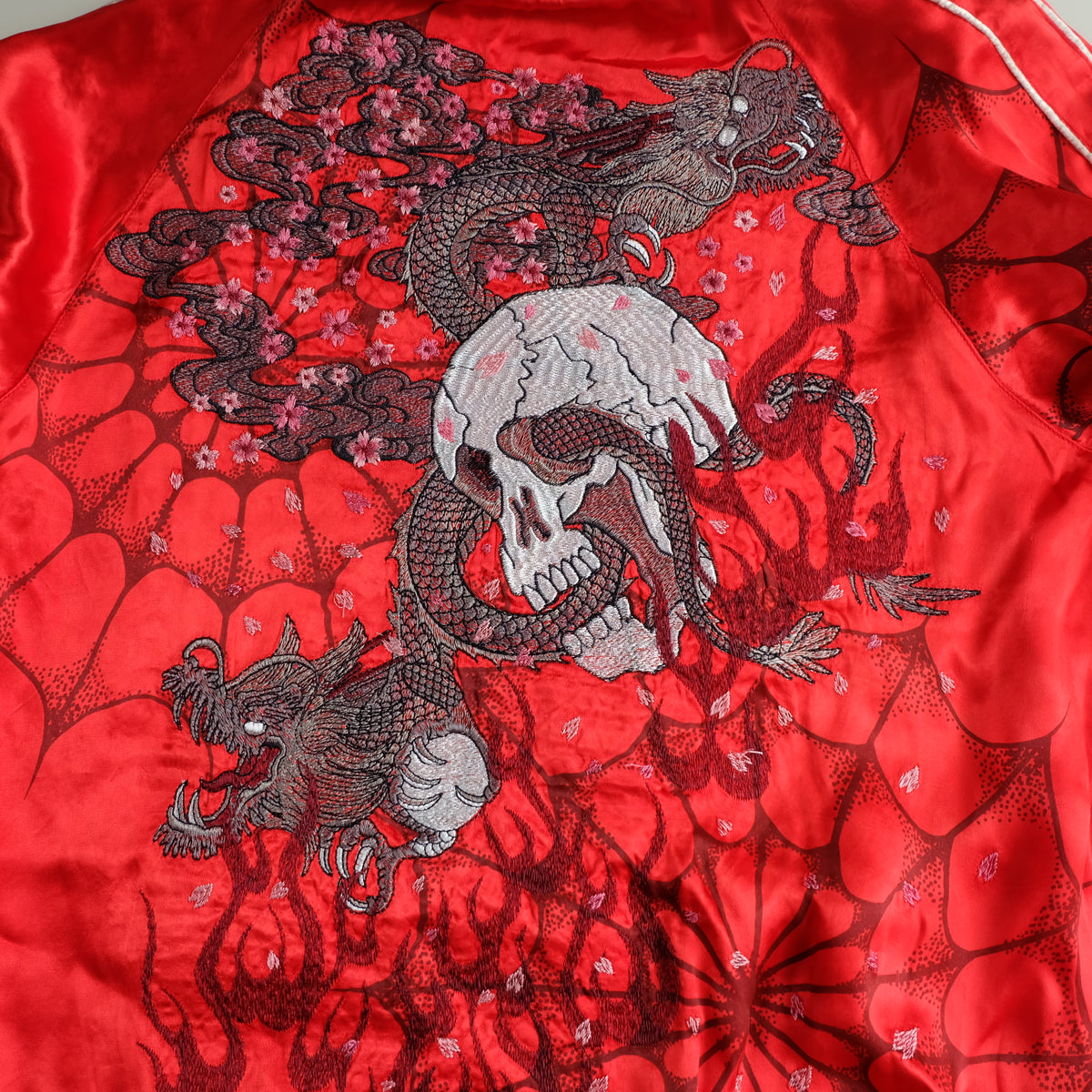
One face erupts in crimson satin with a skeletal dokuro, serpentine dragon, dark clouds, flowering cherry branches and shadowy floral forms. The opposing face shifts into a more lyrical Japanese composition of embroidered kingyo goldfish, drifting sakura petals, flowering branches and rippling water.
It is both beautiful and confrontational: part Japanese garden, part underground rock poster, part tattoo flash sheet, and part wearable textile theatre.
The saturated red colorway intensifies every detail. Silver-grey embroidery glows against the scarlet ground, burgundy shadows deepen the imagery, and pale sleeves on the kingyo face create a dramatic reversal when the jacket is turned inside out.
This is maximalist Japanese streetwear at full volume. 🌸💀🐉
Opening Impression
The first face feels almost apocalyptic.
A pale skull dominates the composition while a scaled dragon twists through and around it, appearing to penetrate the eye socket and coil through the jaw. Darker dragons, cloud formations, sakura blossoms and a fierce bird-like figure crowd the surrounding red satin.
The second face changes the emotional register completely.
Ornamental goldfish move through a red current beneath flowering cherry branches. Pink blossoms scatter across the body and sleeves, while broad dark lines suggest flowing water, woodgrain, wind or abstracted landscape contours.
The jacket therefore offers two moods:
Dokuro and Dragon Face: rebellious, gothic, tattoo-inspired, punk, nocturnal and confrontational.
Kingyo and Sakura Face: decorative, romantic, energetic, festive and unmistakably Japanese.
An exact-match specialist listing identifies this Miyabi Musubi design as a reversible goldfish-and-sakura jacket with a dragon-and-skull reverse, confirming the intended pairing of the two contrasting compositions.
Identification
Brand: Miyabi Musubi
Garment Type: Fully reversible sukajan / Japanese souvenir bomber jacket
Manufacturer’s Tagged Size: L
Primary Face: Dragon, dokuro skull, dark clouds, sakura and floral imagery
Reverse Face: Kingyo goldfish, cherry blossoms, flowering branches and flowing currents
Style: Wagara, Amekaji, Japanese streetwear, tattoo-inspired fashion
Primary Colors: Scarlet red, crimson, burgundy, silver-grey, pink and ivory
Construction: Fully reversible
Closure: Reversible front zipper
Sleeves: Raglan construction
Trim: Striped rib-knit collar, cuffs and waistband
Pockets: Angled welt pockets on both wearable faces
Fabric Character: Glossy satin-finish textile with extensive embroidery and printed detailing
Gender Presentation: Unisex
Model Reference: Approximately 164 cm tall and 52 kg
Approximate Dimensions and Sizing
Manufacturer’s tagged size: L
Overall length / height: Approximately 72 cm
Flat body width: Approximately 55 cm
Sleeve length measured from the upper shoulder area: Approximately 66.5 cm
Sleeve length measured along the lower or underarm seam: Approximately 53.5 cm
Photographed model: Approximately 164 cm tall and 52 kg
The jacket presents a relaxed bomber-style silhouette on the photographed model. Depending on the wearer’s proportions and preferred styling, it may be worn closer to the body or with a looser streetwear fit.
Vintage Japanese sizing does not always correspond directly with contemporary Western sizing. Please compare the measurements above with a similar jacket that fits you comfortably rather than relying solely on the tagged size.
Measurements are approximate and were taken with the garment laid flat. Small variations may occur depending on positioning, fabric movement and the natural volume of the reversible construction.
Fit and Wearability
The size L construction gives this piece particularly strong international wearability while preserving the compact, rounded proportions traditionally associated with sukajan jackets.
On a wearer approximately 164 cm and 52 kg, the jacket displays a comfortably relaxed silhouette with room through the body and sleeves. The raglan construction softens the shoulder line and allows the embroidered artwork to travel continuously across the chest, back and sleeves.
For a slimmer wearer, it may create a deliberately oversized Japanese streetwear profile. On a broader wearer, it may sit closer to the body. Individual results will vary according to shoulder width, chest measurement, arm length and layering preference.
For the most reliable fit assessment, compare the listed 72 cm length and 55 cm flat width with an existing bomber or jacket.
Display and Styling Presence
The supplied modeled photographs demonstrate how strongly the scarlet dragon-and-skull face reads when worn. The embroidered skull remains immediately visible from the front, while the dragon, clouds and floral imagery continue across the body and sleeves.
The red satin catches daylight differently across every fold, shifting between vivid scarlet, deep crimson and reflective ruby tones. This movement makes the jacket especially effective for editorial styling, street photography, stagewear, music performances and alternative fashion presentation.
The size L silhouette may be styled over:
Black denim, leather trousers, wide-leg pants, distressed jeans, military cargos, fitted dresses, oversized T-shirts, monochrome knitwear, engineer boots, combat boots or vintage sneakers.
Miyabi Musubi
Miyabi Musubi is an original Japanese fashion label associated with the Ryugi Assaku and METHOD retail group. The official brand description positions it as a maker of wearable Japanese-pattern clothing that balances traditional imagery with everyday styling rather than restricting wagara fashion to ceremonial or costume-like use.
This jacket represents the louder, more theatrical edge of that philosophy.
Rather than placing a small traditional motif on an otherwise conventional bomber, the design covers nearly the entire garment with imagery. Front panels, sleeves, shoulders and back are treated as connected surfaces, allowing the embroidery and printed ground patterns to flow across the body.
The result is not merely a decorated jacket. It is a reversible narrative garment with two independently developed visual identities.
Dokuro Skull and Dragon Face
The Central Skull
The most arresting feature is the large pale skull positioned across the upper torso.
Its cracked crown, hollow nasal cavity and exposed teeth are rendered in cool silver, white and muted grey thread. Burgundy outlines prevent the skull from disappearing into the scarlet satin and give it a graphic, almost illustrated quality.
A scaled serpent or dragon passes directly through the skull. Its body emerges through the eye area, curves around the cheek and continues through the open jaw.
This creates an intentionally unsettling image. The skull is not simply accompanied by the dragon. The two forms become physically intertwined, transforming the composition into a single hybrid emblem.
The Coiling Dragon
A second dragon occupies the opposite side of the torso, descending from dark embroidered clouds.
The creature is constructed from dense directional stitching that defines:
- Individual scales
- Horns and whiskers
- Curving limbs
- Clawed feet
- A serpentine body
- Open jaws
- Layered mane and facial hair
Its movement is circular rather than static. The body coils through the composition and visually connects the skull, clouds and lower embroidered imagery.
The dragon is rendered predominantly in deep plum, charcoal, grey and dark red. This subdued palette keeps it integrated with the monochromatic crimson atmosphere rather than turning it into a brightly colored fantasy creature.
Dark Clouds and Sakura
Cloud forms gather around the dragon and extend across the upper body.
Their rolling outlines evoke the stylized clouds found throughout Japanese painting, tattoo art, festival decoration and wagara textiles. Small embroidered sakura blossoms are scattered across and between these clouds.
The blossoms provide a delicate counterpoint to the skull and dragon. Their softness does not neutralize the darker imagery. Instead, they heighten it by placing beauty and mortality within the same visual field.
Lower Bird Motif
A fierce bird-like creature appears below the larger dragon.
Its spread wings, extended claws and aggressive posture contribute to the jacket’s restless energy. Rendered in dark thread against the red ground, it reads almost as a shadow or guardian emerging beneath the central composition.
Oversized Floral Linework
Large dark floral forms extend across the sleeves and lower body.
These are not isolated embroidered flowers. They operate as an all-over printed or woven graphic field, partially disappearing beneath folds and embroidered sections.
The oversized scale gives the jacket a contemporary fashion character. From a distance, the forms resemble spiderwebs, chrysanthemum petals or abstract tattoo geometry. At close range, they become part of the jacket’s layered surface.
Dokuro Symbolism and Visual Character
The dokuro, or skull, functions here less as a literal emblem of death and more as a visual declaration of impermanence, fearlessness and confrontation.
Placed beside sakura blossoms, the skull becomes part of a familiar Japanese artistic tension between beauty and transience.
The cherry blossom reaches full brilliance and then falls. The skull remains after life has passed. The dragon moves between the two, bringing energy, motion and supernatural power into the composition.
This is why the design feels more sophisticated than a simple gothic skull graphic. It combines several opposing ideas:
Beauty and decay
Power and mortality
Movement and stillness
Spring blossoms and exposed bone
Traditional ornament and punk rebellion
The result carries the visual force of tattoo culture without becoming a direct imitation of any single tattoo composition.
Punk Rock and Tattoo-Art Presence
The skull face has a distinctly underground character.
Its scarlet monochrome, anatomical imagery, dark outlines and crowded surface would sit naturally within punk, metal, rockabilly, visual-kei, tattoo, biker and alternative fashion wardrobes.
Yet the garment avoids looking like a conventional Western band jacket.
The raglan silhouette, reversible structure, satin finish, cloud forms, dragon anatomy and sakura embroidery keep it firmly anchored in Japanese sukajan and wagara design.
It is precisely this collision that gives the piece its strongest identity: Japanese decorative tradition meeting graphic rebellion in a blaze of red satin.
Kingyo Goldfish and Sakura Face
Turn the jacket inside out and the skull disappears.
The reverse reveals a red-and-ivory composition filled with ornamental goldfish, flowering branches and flowing abstract currents.
The atmosphere becomes lighter and more graceful, but it remains highly maximalist.
Kingyo Goldfish
The embroidered fish possess rounded bodies, large eyes and broad, flowing fins associated more closely with ornamental kingyo than streamlined carp.
Their bodies are worked in red, wine, silver and white thread. Individual scales create texture across the torso, while the fins are built from longer directional stitches that suggest movement through water.
Several fish appear across the front and back in different sizes and orientations. Some turn upward, others move horizontally, and smaller figures drift between branches and petals.
This variation prevents the composition from becoming rigid or overly symmetrical.
Sakura Branches
Fine embroidered branches extend diagonally across the red body.
Clusters of blossoms appear in several shades:
- Pale pink
- Dusty rose
- Burgundy
- Crimson
- Soft ivory
Loose petals float between the fish and continue onto the pale sleeves.
The blossoms are especially effective because they vary in density. Some areas form thick flowering clusters, while others contain only a few petals suspended in open satin.
Flowing Water and Marbled Currents
Dark red lines move across the body beneath the embroidery.
These lines resemble flowing water, woodgrain, wind currents or marbled ink. Their ambiguity gives the design additional depth.
Around the goldfish, they read as moving water. Near the flowering branches, they resemble the grain of an old lacquered panel. Across the lower body, they become almost psychedelic, connecting the traditional motifs to contemporary graphic design.
Ivory Sleeves
The pale ivory sleeves create a dramatic contrast against the red body.
Scattered sakura embroidery continues down the arms, preventing the sleeves from feeling empty. Crimson piping and red-striped ribbing frame the lighter fabric and reconnect it with the central color palette.
When this face is worn outward, the jacket appears brighter and more decorative than the skull side. It remains bold, but its energy is festive rather than ominous.
Kingyo as Decorative Motif
Goldfish occupy a special visual territory within Japanese decorative culture.
They are associated with ornamental beauty, cultivated form, summer atmosphere and the playful elegance of creatures observed through water. Their exaggerated tails and rounded bodies make them especially suitable for textile design because they create movement without requiring a realistic aquatic scene.
In this jacket, the kingyo act as a counterweight to the dragon.
The dragon represents mythic power and supernatural motion. The goldfish represent controlled beauty, color and fluidity.
One side roars. The other glides.
Sakura and Impermanence
Sakura blossoms appear on both faces, forming the conceptual bridge between the jacket’s opposing worlds.
On the kingyo face, the blossoms create beauty, movement and seasonal atmosphere.
On the dokuro face, the same blossoms take on a darker meaning. Their falling petals surround the skull and dragon, making the composition feel like a meditation on the temporary nature of beauty.
This repeated motif prevents the two sides from feeling unrelated. Though dramatically different, they remain chapters of the same visual story.
Color Architecture
The jacket is dominated by red, but it is far from monochromatic.
Scarlet Ground
The brilliant scarlet satin creates the first visual impact. It catches light unevenly, producing highlights and shadows across every fold.
Burgundy and Crimson
Darker reds define printed currents, cloud formations, floral outlines and embroidery shadows.
Silver and Grey
Cool metallic-looking threads shape the skull, dragon scales, fish fins and anatomical details.
Pink and Rose
Multiple pink tones soften the composition through sakura petals and flowering branches.
Ivory
The pale sleeves and selected embroidery provide breathing room within the saturated palette.
Together these colors create a jacket that feels intense without becoming visually chaotic. The restricted palette allows the many motifs to coexist within one coherent system.
Embroidery and Surface Work
The jacket uses extensive multicolored machine embroidery across both reversible faces.
Visible techniques include dense satin stitching, directional scale work, fine contour embroidery, filled floral clusters, layered fin stitching, outlined petals, textured cloud forms and broad embroidered anatomical shapes.
The dragon scales are particularly detailed. Each section is individually defined, allowing the serpentine body to remain readable even where it overlaps the skull and surrounding clouds.
The kingyo embroidery uses a different thread rhythm. Their rounded scales, soft fins and curved bodies create a more fluid texture.
The embroidery naturally introduces some gathering and puckering into the surrounding satin. This is characteristic of heavily embroidered sukajan and contributes to the dimensional quality of the garment.
Construction
Reversible Format
Both sides are designed to be worn outward.
The jacket includes finished seams, pockets, coordinated trim and complete artwork on each face. This is not a jacket with a decorative lining. It is a genuine two-look reversible garment.
Raglan Sleeves
The raglan construction produces the rounded shoulder line associated with classic souvenir jackets.
It also allows the sleeve graphics and piping to travel smoothly from the collar toward the cuffs.
Reversible Zipper
The central zipper is configured for reversible use and visually divides several embroidered motifs.
On the skull face, the zipper passes directly through the central composition, giving the artwork an asymmetrical, split-panel quality.
Rib-Knit Trim
The collar, cuffs and waistband use red ribbing with pale horizontal stripes.
This athletic trim keeps the garment connected to the bomber and stadium-jacket tradition despite the elaborate decoration.
Angled Pockets
Both faces incorporate angled welt pockets.
The pocket openings are discreetly integrated into the surrounding imagery, allowing the artwork to remain visually dominant.
Period Assessment
This appears to be an earlier or discontinued Miyabi Musubi sukajan rather than a current basic seasonal release.
An exact production year is not visible in the supplied photographs and is therefore not assigned.
The saturated color palette, all-over embroidery, reversible construction and maximalist wagara styling are consistent with Japanese streetwear associated with the late Y2K and post-Y2K revival of sukajan, tattoo graphics and decorative Amekaji.
The jacket should be presented as an older Japanese designer streetwear piece rather than represented as an original postwar souvenir jacket.
Its collector appeal comes from the design itself:
- Two fully developed reversible compositions
- Unusually dense all-over artwork
- Dragon and dokuro subject matter
- Ornamental kingyo reverse
- Sakura embroidery across both faces
- Highly distinctive blood-red palette
- Strong punk, tattoo and visual-kei crossover
- Recognizable Miyabi Musubi identity
Condition
This is a pre-owned garment offered in its present vintage condition.
Visible characteristics include general surface creasing, folding lines, light signs of wear, minor thread irregularity, natural puckering around embroidered sections and subtle tonal variation across the glossy satin.
The photographs show the embroidery retaining strong definition and vivid color. The skull, dragon, goldfish and sakura motifs remain highly legible and visually dominant.
The rib-knit trim, zipper and pocket structures appear present in the supplied photographs.
Because glossy red and ivory satin can reveal marks differently depending on lighting and viewing angle, all photographs should be reviewed carefully as part of the condition description.
No claim of mint, unworn or factory-perfect condition is made.
Vintage garments may also carry minor signs of storage, faint marks, small pulls, loose fibers, embroidery wear or other evidence of previous ownership that may not appear equally under every lighting condition.
Styling and Wearability
Dokuro Face
The skull and dragon side pairs naturally with:
Black denim, leather trousers, distressed jeans, military cargos, engineer boots, creepers, combat boots, silver jewelry and monochrome layers.
It is especially effective for punk, rock, metal, visual-kei, gothic, biker, tattoo and underground streetwear styling.
Kingyo Face
The goldfish side works beautifully with:
Dark indigo denim, cream trousers, wide-leg black pants, vintage sneakers, plain knitwear, minimal T-shirts and Japanese workwear.
The ivory sleeves make this face slightly easier to style, while the scarlet body preserves its dramatic presence.
Oversized Statement Styling
The jacket can also be worn as the dominant element of an otherwise restrained outfit.
A plain black or white base allows the embroidery to function almost like a moving mural.
Display Potential
When not worn, this jacket deserves to be displayed.
The dokuro side has the atmosphere of a Japanese tattoo study filtered through a punk-rock poster.
The kingyo face resembles an embroidered decorative screen, with ornamental fish moving beneath flowering branches and liquid red currents.
It would make a striking addition to:
Japanese streetwear collections, sukajan archives, tattoo-art interiors, music studios, alternative fashion displays, wagara textile collections, theatrical wardrobes, editorial styling rooms and Japanese pop-culture spaces.
Why This Piece Stands Apart
Many reversible sukajan repeat similar themes on both sides.
This jacket does something more ambitious.
It creates a genuine transformation between two visual identities. The wearer can move from romantic kingyo and sakura imagery to a dragon-wrapped skull without changing garments.
The contrast is theatrical, but the repeated red palette and cherry blossoms maintain continuity.
It is elegant and aggressive, traditional and rebellious, decorative and macabre.
That tension is the jacket’s entire electricity. ⚡
Purchase, Shipping and Vintage Policy
This is a vintage or older pre-owned garment offered in its present condition. Please review all photographs and written details carefully before purchasing.
Vintage garments may display minor wear, storage marks, creasing, surface variation, fading, loose fibers, thread irregularity, embroidery wear, ribbing wear or other evidence of age and previous ownership.
The item will be packed carefully and shipped worldwide from Japan by tracked EMS or another suitable tracked international service.
Shipping and handling period: approximately 5–10 business days or earlier.
Delivery time begins after dispatch and may vary depending on destination, customs processing, postal conditions and seasonal volume.
All sales are considered final. Returns, exchanges and claims based on expected vintage wear, fit preference, visible condition, minor textile irregularity or differences in color perception cannot be accepted. Please ask any important questions before purchasing.
Some prices may be flexible. Respectful offers from serious collectors are always welcome.
Searching for This Design in Another Size?
Should this Miyabi Musubi dragon, dokuro and kingyo design appeal to you but the available fit is not ideal, please feel welcome to contact us with your preferred tagged size and approximate flat garment measurements.
Availability cannot be guaranteed, particularly for discontinued and collectible Japanese sukajan. However, through our sourcing network in Japan, we may be able to locate the same model in another size, an alternate colorway or a closely related Miyabi Musubi jacket with comparable dragon, skull, goldfish or sakura embroidery.
We are always pleased to investigate suitable alternatives and assist collectors in finding a version that more closely matches their preferred fit and design.
#MiyabiMusubi #VintageSukajan #ReversibleSukajan #DragonSkull #Dokuro #Kingyo #GoldfishJacket #SakuraJacket #JapaneseSukajan #JapaneseStreetwear #WagaraFashion #Amekaji #SouvenirJacket #EmbroideredBomber #PunkRockFashion #TattooArtJacket #VisualKeiFashion #MaximalistFashion #JapaneseBomber #RedSukajan #DragonJacket #SkullJacket #WearableArt #JapaneseTextileArt #AlternativeFashion #RockabillyStyle #Y2KJapaneseFashion #CollectorStreetwear #JapanVintage
miyabi musubi, reversible sukajan, dragon skull jacket, goldfish jacket, sakura bomber, japanese streetwear, wagara jacket, punk rock jacket, embroidered bomber, souvenir jacket, dokuro jacket, red sukajan, maximalist fashion
Material Tags
satin-finish textile, embroidery thread, rib-knit trim, metal zipper, reversible construction, woven lining, decorative piping