Rare Vintage, Antiques and Art Collector / Curator / Personal Shopper From Japan
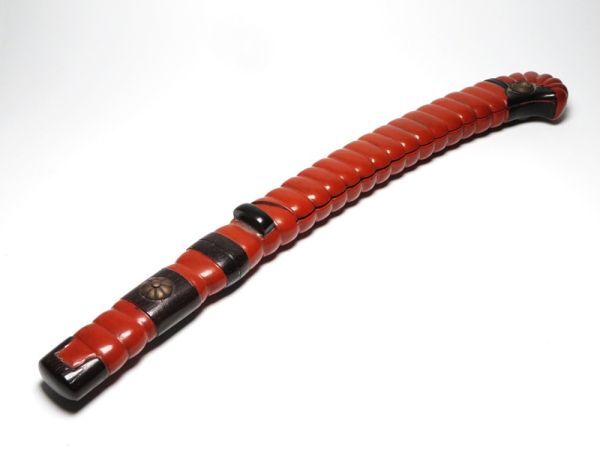
Meiji Tanto‑Shaped Yatate Portable Writing Kit — Red & Black Urushi Lacquer Travel Case, Scholar’s Object, Samurai‑Era Continuity
Meiji Tanto‑Shaped Yatate Portable Writing Kit — Red & Black Urushi Lacquer Travel Case, Scholar’s Object, Samurai‑Era Continuity
Couldn't load pickup availability
Have a reasonable price in mind? Submit your best offer and our concierge will review it personally.
Object Type
• Yatate (portable writing kit / traveling ink & brush holder), made in the aesthetic form of a tanto (short sword).
Era
• Meiji period (late 19th century), with Edo-period design language continued into early modern Japan.
Materials
• Lacquered wooden or bamboo core (primary body)
• Urushi lacquer (red lacquer dominant, with black lacquer accents in grooves)
• Small metal fittings (likely copper alloy or iron) at the cap / throat and at the end section
• Internal sleeve / channel for a brush or pen-like writing implement (a wooden writing stick is shown in photos; treat as “accessory shown” unless confirmed original)
Primary Function
• A compact, portable writing tool case used by travelers, merchants, officials, and literate classes—designed to carry writing implements and, in classic yatate systems, a small ink component (ink reservoir or ink storage). The tanto form signals “travel readiness” and status aesthetics rather than weapon function.
Canonical Category Placement
• Japanese Antiques & Cultural Objects → Scholar’s Objects (Bunbōgu) → Yatate / Portable Writing Kits
Secondary cross‑category
• Samurai / Edo‑Meiji Continuity → Travel & Utility Objects → Lacquered Accessories
What It Is NOT
• Not a sword, not a weapon, not a scabbard.
• Not an arrow quiver (yazutsu). but a “yatate” (portable writing kit).
Silhouette & tactile architecture
• The object reads immediately as “tanto-like”: long, slightly curved, and visually weighted toward a ribbed midsection that echoes the ergonomic logic of a hilt.
• The ribbing is not decorative noise—it creates a controlled grip zone, implying the maker expected repeated handling. This is consistent with travel objects that must feel secure in the hand, even when taken in and out of sleeves, boxes, or satchels.
Lacquer strategy (why the red/black works)
• The dominant red lacquer (vermilion family) creates a ceremonial warmth, while black lacquer in the recesses acts like shadow-line calligraphy—making the grooves read deeper than they physically are.
• This “dark-in-the-valleys” approach is a classic way to amplify relief carving with minimal material: the craftsmanship lies in the *finish discipline*, not only in the carving.
Joinery logic & likely internal layout
• Yatate forms vary, but the consistent requirement is: an outer shell protecting an inner writing system. Most are either:
(a) a case for brush/pen plus ink component, or
(b) a case for writing implement only, used with separate ink/inkstone.
• The visible transitions between red and black sections suggest engineered junction points: places where caps slide, lock, or stop; or where internal sleeves change diameter. Even without dismantling, the exterior “breaks” usually reflect internal segmentation.
Fittings & stress points
• Travel lacquer objects typically wear at edges and at the mouth: where the cap meets the body, where fingers pinch, where the object bumps inside storage.
• The darker mid-body band and end-cap reinforcement are consistent with a maker expecting those stress points, and “designing for survival,” which is precisely what elevates utilitarian antiques into collectible craft.
Why this form feels “Meiji”
• Meiji objects often preserve Edo refinement while adapting to a faster, more mobile society. The blend of functional portability + status-coded silhouette is the exact signature of transitional-period craft: tradition kept alive by usefulness.
CULTURAL CONTEXT & COLLECTOR MEANING
Why a writing kit shaped like a blade?
• In late Edo and Meiji Japan, the boundary between “martial identity” and “literary identity” was porous. The same social world that revered the sword also revered record-keeping, poetry, and disciplined handwriting.
• The tanto silhouette communicates readiness, self-command, and personal order—qualities admired in both warrior and scholar cultures. Collectors respond to that: it’s a “blade aura” object without weapon regulation or display risk.
Yatate as portable infrastructure
• Before mass-produced pens and notebooks, portable writing kits were the infrastructure of administration and daily life: accounts, travel notes, official messages, quick poems, reminders, receipts, and personal correspondence.
• A good yatate is not just “a holder”—it is an engineered invitation to write. That is why these objects sit beautifully beside inro, tobacco pouches, netsuke, and other Edo/Meiji pocket-world artifacts.
Lacquer, literacy, and status
• Lacquerwork (urushi) carries prestige because it is labor-intensive, repairable, and sensorial: it looks different in shifting light, and it rewards close viewing.
• When lacquer is applied to an everyday object—especially a scholar’s tool—it elevates daily practice into ritual. That is the collector-level meaning: not “decoration,” but the cultural choice to dignify ordinary acts.
Display logic for collectors
• This piece anchors a cabinet narrative: “travel + literacy + martial aesthetics.” It can be staged with:
• a small inkstone or suzuri,
• a brush rest,
• an antique paper stack,
• a small bronze okimono,
• or a single tsuba as a visual echo of the sword-form silhouette.
• It photographs exceptionally well for Shopify/IG because the red/black contrast reads cleanly and the ribbing gives macro texture.
Collector’s Resonance
• For the collector who loves Edo-to-Meiji continuity, and wants objects that feel “alive” in the hand.
• For the design buyer who values functional sculpture—objects that were made to be used, not only admired.
• For the gift buyer seeking something scholarly, Japanese, and rare, without the heaviness of overt religious iconography.
CONDITION, AGE MARKS & HONEST DISCLOSURE
Age-consistent wear (what buyers should expect)
• Micro-scratches / hairline scuffs in high-contact zones
• Edge wear at cap junctions
• Gloss variation where hands repeatedly touched the lacquer
• Minor chips or thinning at corners (typical for travel lacquer)
• Seam visibility at part junctions (structural, not necessarily damage)
Compliance-friendly disclosure line (recommended)
• “Antique lacquer objects may show age wear such as small scratches, rub marks, and finish variation. Please review photos carefully.”
MEASUREMENTS
• Approx. 38.5 cm × 6 cm
Estimated weight :
• Safe packaged weight estimate: ~1.5–1.9kg (double-box, padding, immobilized interior)
Shipping protection notes
• Wrap lacquer like glass: no internal movement, protect ribs from abrasion, separate any accessory stick/pen so it cannot rub the urushi.
Disclaimer / attribution
Attribution is presented in good faith based on the legible signature and visible construction. We describe with diligence and restraint, prioritizing authenticity and clarity over speculation.
Authenticity & Stewardship
Evaluated under the Japonista Authentication Framework™:
- Material, carving, and surface-study comparison
- Iconographic and stylistic verification
- Condition and stability review (surface integrity)
- Construction assessment and handling-risk evaluation
Guaranteed 100% Authentic. Covered by the Japonista Lifetime Authenticity Warranty™.
A Note on Stewardship and Collecting
At Japonista, we approach Buddhist statues, sacred images, and ritual objects not merely as collectibles, but as cultural and spiritual artifacts deserving of respect, understanding, and careful presentation. Every piece we offer is thoughtfully examined, researched, and curated with sensitivity to its origin, meaning, and historical role.
Our role is not only to offer access to rare and meaningful objects, but to serve as responsible custodians—connecting the right works with collectors who value depth, intention, and authenticity.
Inquiries, Availability, and Private Consideration
Some of the cultural and heritage works may allow room for discussion, while others are held firmly due to rarity, condition, or cultural importance. All inquiries are reviewed personally and discreetly, and we welcome thoughtful questions or expressions of interest.
If you are exploring a particular theme, deity, lineage, or period—or seeking guidance in building a focused collection—our concierge team is always available to assist with quiet expertise and care.
Concierge Support & Collector Guidance
Japonista Concierge™ provides personalized assistance for collectors seeking deeper understanding, thoughtful acquisition, or long-term curation strategies. Whether your interest is devotional, scholarly, or aesthetic, we are here to help guide your journey with clarity and respect.
For select high-value or historically significant works, private reservation or structured payment arrangements may be available on a case-by-case basis. Please reach out to discuss eligibility and discreet options.
Before Proceeding
We kindly encourage collectors to review our shop policies and house guidelines, available through the links in our website footer, which outline shipping, handling, and conditions specific to vintage, sacred, and collectible works.
A Closing Note
Thank you for exploring Japonista’s collection of Oriental Cultural Heritage and arts. We are honored to share these meaningful works and to help place them where they may continue to be appreciated, studied, and respected.
If you have questions or wish to explore related works, please feel free to contact Japonista Concierge™ at any time.