Rare Vintage, Antiques and Art Collector / Curator / Personal Shopper From Japan
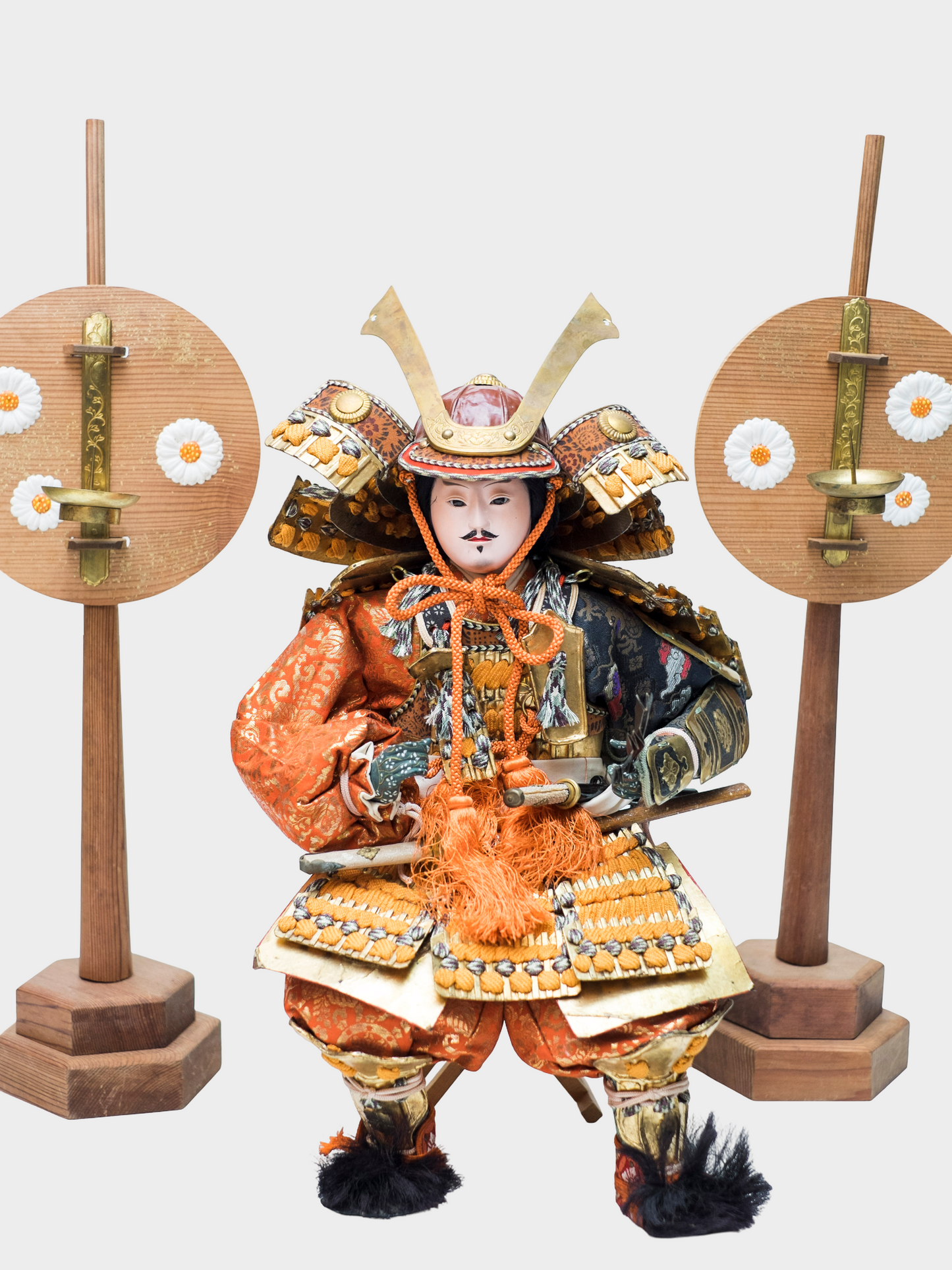
Antique Meiji Musha Ningyo Samurai Warrior Doll – Kabuto Armor, Silk Brocade, Boys’ Day Festival Display
Antique Meiji Musha Ningyo Samurai Warrior Doll – Kabuto Armor, Silk Brocade, Boys’ Day Festival Display
Couldn't load pickup availability
Have a reasonable price in mind? Submit your best offer and our concierge will review it personally.
Meiji Period Musha Ningyō
Armored Warrior Festival Figure, late 19th century
I. Overview
This Musha Ningyō stands at the intersection of ritual and sculpture.
Created during the late Meiji period, it belongs to the tradition of Tango no Sekku festival display figures, yet it carries itself with a composure that exceeds seasonal ornament. Its posture is compact and centered. The weight settles naturally into the stance. The armor does not flare theatrically. The cords do not erupt in decorative abundance. The figure inhabits its space with restraint.
Such restraint is often the most reliable indicator of period integrity.
Unlike later Showa festival dolls—whose proportions grew exaggerated and whose surfaces flattened under the logic of mass production—this example preserves dimensionality. The armor plates articulate individually. The lacing is functional rather than implied. The garments fall with textile gravity rather than printed illusion.
The effect is not spectacle. It is authority.
II. Iconography & Symbolic Vocabulary
Musha Ningyō were never mere decorations. They were embodiments of aspiration.
Displayed in domestic interiors during Boys’ Day, they represented martial virtue, filial strength, and moral discipline. In the Meiji era, when the samurai class had dissolved into memory, these figures became quiet monuments to a vanishing ethos. Armor no longer worn in battle persisted in miniature, sanctified within the household.
The kabuto crest rises in measured assertion, not flamboyance. Its metal surface bears the subdued patina that accrues through time rather than artificial intervention. The odoshi lacing binds the lamellae with structural sincerity. Each thread participates in the architecture.
The face, finished in traditional gofun, is executed with composure. The brushwork of the moustache is deliberate and spare. The eyes are not theatrical. They are forward and attentive. The expression avoids sentimentality. It suggests vigilance.
In this restraint lies its dignity.
III. Material & Craft Examination
The figure reveals its period most clearly in its surfaces.
The silk brocade beneath the armor possesses weight and density characteristic of late 19th-century textile production. The weave retains depth. The orange tones, softened through time, once signified vitality and protection. Fading appears consistent with exposure and age rather than abrupt artificial distress.
The armor plates are lacquered with care, their curvature responding to anatomical logic rather than decorative convenience. Minor oxidation at metal rivets and fittings aligns with natural aging patterns. The cords retain dimensional presence. They are not decorative appliqué but functional structural elements.
The gofun face surface remains stable. The powder layer sits evenly, without widespread cracking or flaking. This stability is significant. Gofun is unforgiving; it records instability quickly. Its quiet preservation here suggests controlled environmental history.
The twin circular shield panels create architectural framing. Their symmetry stabilizes the composition and elevates the figure beyond isolated sculpture into ceremonial arrangement. The wood bases exhibit honest grain and appropriate patination. They do not announce age; they reveal it.
IV. Historical Placement
During the Meiji period, Musha Ningyō shifted from strictly elite ritual objects toward broader merchant patronage. Industrial modernization was reshaping Japan’s economy and identity. Yet within domestic interiors, seasonal displays preserved older symbolic languages.
This figure occupies that transitional moment.
It retains hand assembly and layered construction typical of late Edo and early Meiji workshops. It does not yet exhibit the simplifications that would emerge in early 20th-century export production. The dimensional armor, textile layering, and controlled facial modeling suggest a workshop still operating within pre-industrial craft discipline.
It stands as both festival object and sculptural artifact.
V. Condition & Structural Integrity
Time has left its presence gently.
Textiles show natural softening and minor fatigue consistent with age. Armor lacquer exhibits subtle surface wear at edges. Metal fittings bear oxidation appropriate to period. These signs do not diminish the figure. They anchor it.
Structural alignment remains sound. The stance is stable. The helmet crest is intact. The sword elements retain coherence. The gofun surface shows no catastrophic instability.
The piece reads as preserved rather than restored.
VI. Collector Relevance
For the collector of Japanese festival sculpture, this Musha Ningyō represents a measured and authentic example of Meiji ceremonial craftsmanship. It does not rely on rarity theatrics. It relies on integrity.
It belongs equally in:
• A focused Musha Ningyō archive
• A broader Japanese seasonal ritual collection
• A samurai iconography study
• An institutional display examining domestic ceremonial art
Its strength lies not in excess but in composure.
VII. Summary
This is a legitimate late Meiji Musha Ningyō of disciplined construction and material sincerity.
It is not a late Showa export simplification.
It is not a modern decorative reproduction.
It is a survivor of a domestic ritual tradition that bridged Japan’s feudal memory and its modern transformation.
It stands without exaggeration.
And that, in many cases, is precisely how authentic Meiji work declares itself.
Authenticity & Stewardship
Evaluated under the Japonista Traditional Figurative Arts Authentication Framework™:
• Doll type, regional lineage, and craft-school verification
• Material assessment across gofun, silk, wood, lacquer, and mixed media
• Structural integrity of limbs, heads, joints, and mounting components
• Costume preservation, textile condition, and accessory completeness review
Guaranteed 100% Authentic.
All works are curated and backed by the Japonista Lifetime Authenticity Warranty™, with disciplined attention to craft tradition and material stability.
A Note on Ritual, Persona & Cultural Memory
Japanese dolls occupy a unique position within cultural life. They are seasonal guardians, theatrical representations, domestic symbols of growth and protection, and embodiments of aesthetic refinement. Whether Hina dolls marking spring rites, Musha figures reflecting martial valor, or Ichimatsu dolls embodying lifelike presence, each form carries defined symbolic weight.
At Japonista, we approach Japanese dolls as figurative craft traditions rather than decorative curiosities. Gofun surface aging, silk fading, minor textile fray, and patina are evaluated within historical and seasonal context, preserving authenticity while disclosing condition with transparency.
Our role is to steward these works as vessels of cultural memory, ensuring they are placed where their presence may be appreciated with contextual understanding and care.
Inquiries, Availability, and Private Consideration
Certain dolls and seasonal sets are held firmly due to completeness, rarity, or craft significance. All inquiries are handled discreetly, and we welcome thoughtful discussion regarding restoration history, display context, or lineage distinctions.
If you are building a focused archive—by festival type, regional style, theatrical representation, or historical period—our team is available to provide informed, collector-level guidance.
Concierge Support & Collector Guidance
Japonista Concierge™ provides personalized assistance regarding safe display practices, textile preservation, humidity control, and structural stabilization for delicate figurative works.
Whether your intention is seasonal installation, archival storage, or curated exhibition, we guide each acquisition with clarity and respect for the doll’s cultural and material sensitivity.
For select complete Hina or Gogatsu sets, private reservation or structured arrangements may be available on a case-by-case basis.
Before Proceeding
We kindly encourage collectors to review our shop policies and preservation guidelines, available through the links in our website footer, outlining handling precautions, environmental considerations, and condition disclosure standards specific to fragile figurative and textile works.
A Closing Note
Thank you for exploring Japonista’s curated archive of Japanese dolls. These figures embody ritual, craftsmanship, and seasonal continuity across generations. We are honored to steward them where their presence may continue with dignity and cultural understanding.
If you have questions or wish to explore related items, please feel free to contact Japonista Concierge™ at any time.