Masudaya
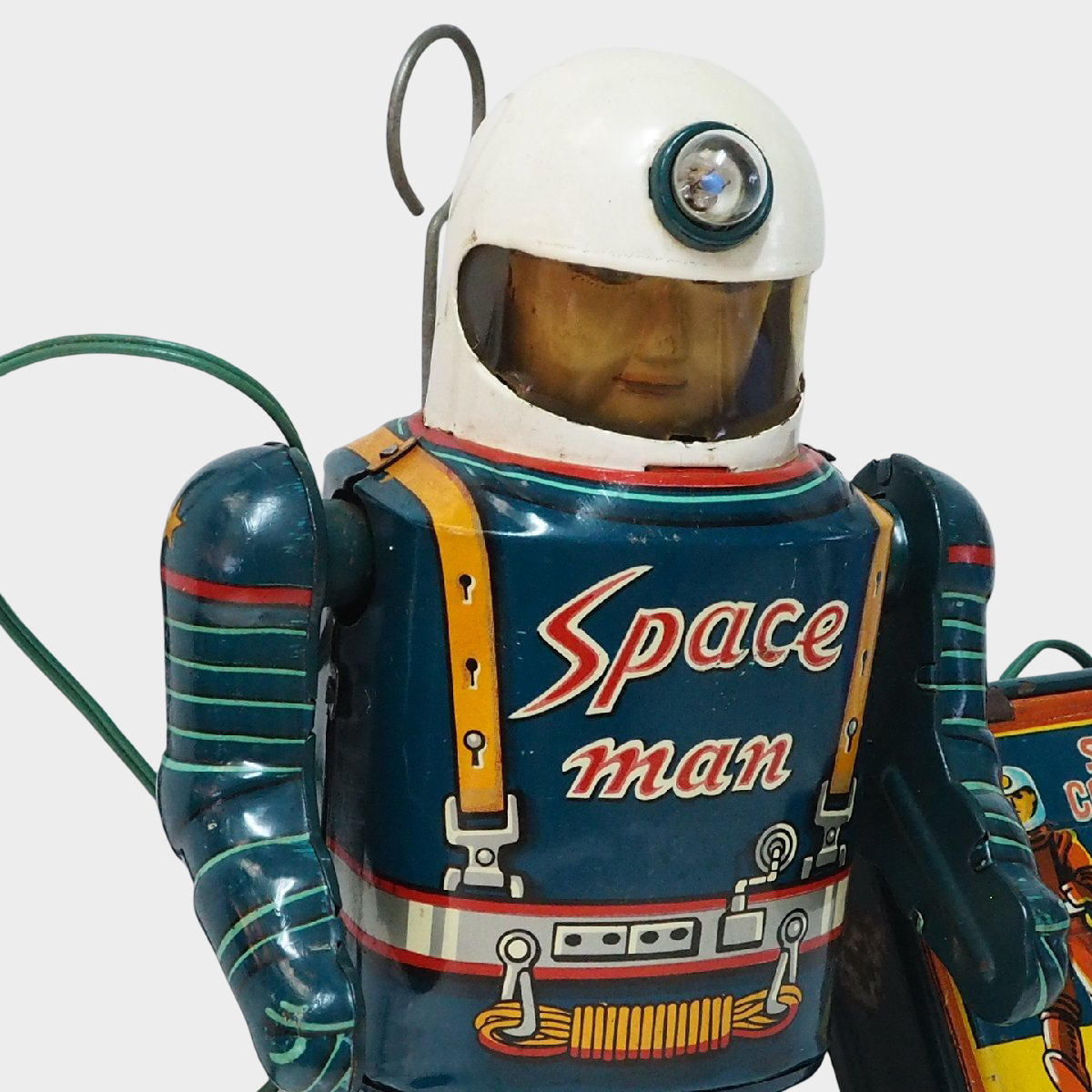
Masudaya Space Man Tin Astronaut Robot with Wired Remote Control, Late 1950s–Early 1960s Japan
Masudaya Space Man Tin Astronaut Robot with Wired Remote Control, Late 1950s–Early 1960s Japan
Couldn't load pickup availability
Have a reasonable price in mind? Submit your best offer and our concierge will review it personally.
Among the most iconic humanoid astronaut robots of the late 1950s and early 1960s, the Masudaya Space Man was Japan's answer to the space race. This example keeps its wired remote control unit, a feature reserved for higher-end toys of the era, which sets it above standard walking examples.
The Piece
Made in the early Showa space-race years, when astronaut imagery stood for technological hope and postwar rebirth, the Space Man blends Western space-race aesthetics, the Japanese tin lithography tradition and an early science-fiction optimism from before realism replaced fantasy.
The large-format tin body carries a bold astronaut chest panel, a dome helmet with clear visor window and ribbed limbs evoking pressure-suit mechanics. Its original wired remote control unit is illustrated with a space motif. Proportions favor display presence over play-scale realism: this is a statement object rather than a minimal toy.
Within the astronaut-robot lineage the remote-control version sits above the basic wind-up Space Man variants and the small-format friction astronauts, alongside Masudaya's high-end space vehicles and the premium remote-controlled robots of the same era. It is rarer than the standard Space Man walkers and stands as a collector-grade survivor, neither a reproduction nor a modern remake.
Details
- Maker: Masudaya, Japan
- Model: Space Man astronaut robot with wired remote control
- Era: Early Showa space-race period, late 1950s–early 1960s
- Origin: Japan
- Material: Lithographed tinplate; clear helmet visor
- Included: Original wired remote control unit with illustrated space motif
- Design: Large-format body; bold astronaut chest panel; dome helmet; ribbed limbs
Condition
- Structurally intact body with surface wear consistent with age.
- The original remote control unit is present.
- No restoration is assumed beyond what is visible.
Three Showa Makers
Postwar Japanese tin space robots reflected three distinct visions of the future. Daiya embodied the professional astronaut: figures of authority and realism shaped by the global space race, built in heavy-gauge tin with complex paint layering and dramatic chest emblems, so that they feel less like toys than equipment.
Masudaya captured the dream of space. Its rockets, spacemen, domes and vehicles burst with color and optimism, with clean proportions, refined helmet domes and bright lithography that translated science fiction into playful, kinetic forms and defined childhood imagination in the Showa era.
Nomura, by contrast, emphasized the machine itself. Heavy construction, simplified geometry and walking mechanisms conveyed industrial strength and engineering pride, robots built to endure rather than to entertain. Together the three makers form the foundation of Japanese space-robot history.
Authenticity & Care
An original vintage example rather than a reproduction or modern remake, retaining its period wired remote control unit. Every piece is examined and documented in Japan before dispatch and is offered with the Japonista authenticity guarantee.
Delivery from Japan
Packed by hand in Japan and shipped insured and tracked by EMS or an equivalent express service. Import duties and taxes, where applicable, are payable on arrival. Returns follow our published policy.
Considered offers are welcome through Send an Offer, and each one is reviewed personally. Pieces over $1,000 may be reserved over several payments with Layaway Privilege™.
Continue browsing: Vintage Toys · Anime Collectibles
Related pieces: Masudaya Astro Boy tin racing car · Masudaya Space Man electric tin astronaut · Masudaya Air-Flow Monster tin armored car
Toy Box Requests
Hunting a particular robot, kaiju, figure or model? The Hunting Salon™ searches Japan’s collector shops and private collections, and the Deputy Vault™ secures a piece you have already found. Begin a Hunting Salon™ request →
Collectors also search: masudaya space man remote control · vintage tin astronaut robot · remote control tin robot japan · showa space robot toy · 1960s japanese tin robot · masudaya tin robot · tin spaceman with remote